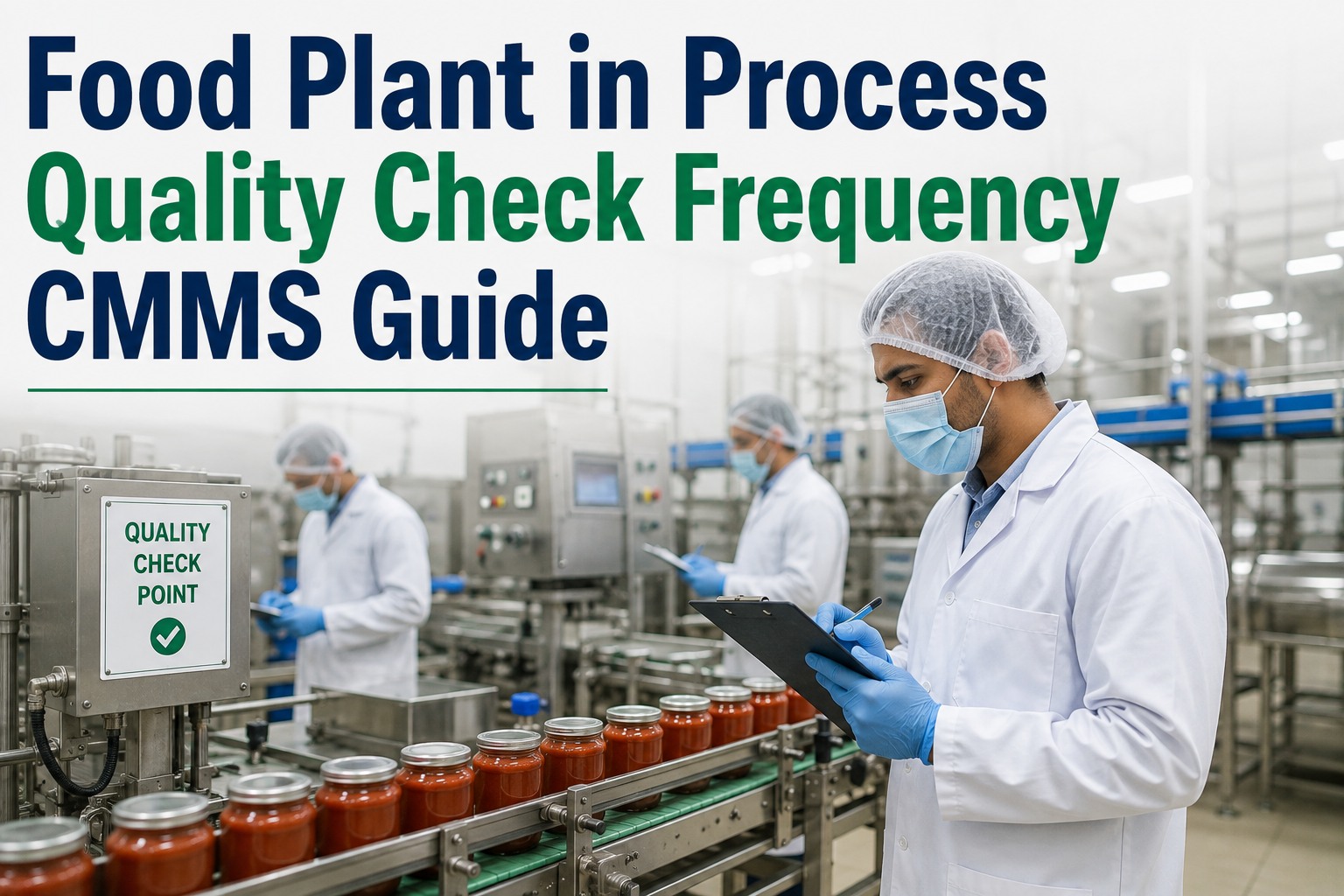
Setting in-process quality check frequency by product risk category is the single most effective lever a food plant can pull to balance safety, compliance and labor efficiency — and this in-process guide walks through exactly how to align hourly verification frequency with HACCP-linked risk profiles using a CMMS for food production lot quality tracking. High-risk products like ready-to-eat deli meats demand verification every 30–60 minutes, while low-risk shelf-stable goods may need checks only every 2–4 hours, meaning a uniform schedule either over-samples low-risk lines by up to 70% or dangerously under-samples critical control points. By integrating in-process check frequency with CMMS-driven work orders and lot genealogy, plants cut quality-related downtime by 25–40% and maintain audit-ready records automatically. The framework below covers risk-based sampling design, HACCP-linked check frequency, resource optimization and CMMS-QMS integration so your team can stop guessing and start verifying. Ready to modernize your quality checks? Start Free Trial or keep reading to build your 2026 risk-based schedule.
In-Process Guide 2026
Is your check frequency matching real product risk — or just filling a clipboard?
Most food plants apply a single hourly verification cadence across every line. The result: 60–70% over-sampling on low-risk SKUs and dangerous blind spots on high-risk critical control points. OxMaint ties every in-process quality check to a live risk profile and production lot — so the right check happens at the right interval, automatically.
Average waste reduction after risk-based scheduling
Documented across 120+ food production lines within 90 days of switching from uniform to risk-tiered in-process check frequency.
Risk-Based Sampling Design
How to set in-process quality check frequency by risk category
A risk-based in-process quality strategy sorts products and process steps into tiers so verification effort flows toward the highest probability and severity of failure — not spread evenly across every SKU on the floor.
Tier 1 — Critical Control Points
Ready-to-eat meats, infant formula, allergen-adjacent lines, thermally-processed low-acid canned foods. Any deviation can cause serious public health harm and Class I recalls averaging $10M+ in direct costs.
Tier 2 — Process Control Points
Cooked refrigerated foods, pasteurized dairy, controlled-atmosphere packaging. Failures trigger quality holds and rework but are less likely to cause immediate health harm if caught within the lot.
Tier 3 — Routine Monitoring
Shelf-stable dry goods, carbonated beverages, frozen raw commodities. Process is inherently robust or the product matrix suppresses pathogen growth, so statistical sampling suffices.
Worked Example
CMMS food in-process quality in action: a mid-scale deli plant
Consider a 180-asset ready-to-eat deli meat plant running three shifts across two high-risk lines and one medium-risk line. Before risk-based scheduling, QA techs performed uniform hourly checks on all three lines — 72 manual verifications per shift, 216 per day.
- QA labor cost: $84K/year for verification alone
- High-risk line under-sampled: CCP verified only 1x/hr
- Low-risk line over-sampled by ~67%, pulling techs from critical areas
- 3 near-misses in 12 months traced to gaps between hourly checks
- QA labor cost reduced to $55K/year — $29K saved
- High-risk line CCP verification doubled to every 30 min
- Low-risk line dropped to every 3 hrs; techs redirected to Tier 1
- 0 near-misses in 12 months; every check lot-linked and audit-ready
By moving from a uniform cadence to a CMMS-driven risk-tiered schedule, the plant cut quality verification labor by 34% while increasing sampling density on its highest-risk product. That is the core payoff of in-process check frequency aligned to risk.
Implementation Steps
Step-by-step: building your risk-based in-process check schedule
Rolling out a risk-based in-process quality system takes 4–6 weeks for a mid-sized plant. Here is the phased timeline most OxMaint food-production customers follow to move from spreadsheet chaos to automated, lot-linked verification.
Risk-classify every product and process step
Map each SKU to a risk tier using your HACCP plan, allergen matrix and historical deviation data. Tag each CCP and PRP in OxMaint so the system knows which checks are safety-critical versus quality-monitoring.
Define check parameters per tier
For each tier, specify what gets measured (pH, aw, temperature, weight, seal integrity, metal detection), the acceptable range, the sample size and the verification frequency. Load these as digital check templates in the CMMS.
Link checks to production lot tracking
Configure OxMaint so every in-process check auto-associates with the active production lot, batch code and equipment asset. This enables forward and backward traceability within seconds during a recall or audit.
Launch, monitor and optimize
Go live with mobile work orders on the floor. Review deviation trends weekly for the first month and adjust frequency up or down based on actual statistical process control data — not gut feel.
CMMS-QMS Integration
In-process check frequency comparison: uniform vs risk-based CMMS scheduling
The gap between a clipboard-driven uniform schedule and a CMMS-driven risk-based schedule is not incremental — it is the difference between reactive firefighting and predictive quality control.
| Dimension | Uniform Hourly Checks (Manual) | Risk-Based CMMS (OxMaint) |
|---|---|---|
| Check frequency logic | Same interval for every line regardless of risk | Auto-varies by product risk tier and HACCP classification |
| QA labor utilization | 30–40% wasted on over-sampling low-risk lines | Redirected to high-risk CCPs; 25–35% labor savings |
| Lot traceability | Paper check-sheets filed manually; 2–4 hr recall lookup | Every check lot-linked digitally; recall lookup in under 5 min |
| Deviation response time | Up to 1 hr gap before next check catches a drift | Real-time alerts trigger corrective work orders instantly |
| Audit readiness | Days of prep gathering and reconciling records | Always audit-ready; FDA/FSSC 22000 records export in 1 click |
| Frequency optimization | Static; reviewed annually at best | SPC-driven; frequency auto-adjusts based on deviation trends |
How OxMaint Helps
OxMaint capabilities that power risk-based in-process quality
OxMaint is not just a checklist app — it is an AI-powered CMMS and EAM platform that treats in-process quality checks as maintenance-linked, lot-tracked, deviation-responsive work orders. Here is how four core capabilities map directly to your risk-based quality goals.
Automated risk-tiered work orders
OxMaint auto-generates in-process check work orders at the correct frequency for each product risk tier — every 30 min for CCPs, every 4 hrs for low-risk monitoring. No supervisor has to remember to assign them; they appear on the tech's mobile device at the right moment, tied to the active lot.
SPC-driven frequency optimization
When a line runs in statistical control for 30 consecutive checks, OxMaint's analytics engine can recommend extending the interval. When deviation frequency rises, it flags the line for tightened sampling — automatically and with a full audit trail of the decision logic.
Lot-level traceability & recall readiness
Every in-process check — pass, fail or deviation — is linked to the production lot, batch code, equipment asset and operator who performed it. During an FDA or customer audit, you can pull the complete quality history of any lot in under 5 minutes instead of days of manual record gathering.
Real-time deviation alerts & CAPA
When an in-process check result falls outside spec, OxMaint instantly triggers a corrective action work order, quarantines the affected lot and notifies the QA supervisor. The deviation, root cause, corrective action and lot disposition are all captured in one closed-loop record.
See risk-based in-process quality on your own production lines
Book a 30-minute demo and we will map your product mix to risk tiers live, show you the exact check frequency OxMaint would generate for each line and calculate your QA labor savings.
FAQ
In-process quality check frequency — your questions answered
How often should in-process quality checks be performed in a food plant?
Frequency depends on product risk: high-risk critical control points (ready-to-eat meats, allergen lines) should be verified every 30–60 minutes; medium-risk process control points every 1–2 hours; and low-risk shelf-stable products every 2–4 hours. A risk-based schedule tied to your HACCP plan ensures verification effort matches actual food safety risk rather than applying a uniform hourly cadence that over-samples low-risk lines and under-protects CCPs.
What is the role of a CMMS in food in-process quality checks?
A CMMS like OxMaint automates the generation, assignment and documentation of in-process quality check work orders based on product risk tier. It links every check to the active production lot and equipment asset, triggers real-time alerts when results deviate from spec, and maintains audit-ready digital records that replace paper check-sheets entirely. This cuts QA labor 25–35% while improving traceability and deviation response times.
How do you link in-process checks to production lot tracking?
In OxMaint, each production run is associated with a lot or batch code in the system. When a QA tech opens an in-process check work order on their mobile device, the CMMS automatically attaches the active lot code, equipment ID, operator and timestamp to the result. This creates a closed digital thread from raw material receipt through finished goods, enabling forward and backward traceability in under 5 minutes during a recall. You can see this in action when you Book a Demo.
Can in-process check frequency be adjusted dynamically based on performance?
Yes. OxMaint's analytics engine monitors statistical process control data in real time. When a line runs in control for a sustained period — typically 30 consecutive in-spec checks — the system can recommend extending the interval to reduce over-sampling. Conversely, if deviation frequency rises above a threshold, it automatically flags the line for tightened sampling and alerts the QA supervisor, ensuring frequency always reflects current process capability.
How long does it take to implement risk-based in-process quality scheduling?
Most mid-sized food plants complete the transition in 4–6 weeks. Weeks 1–2 involve classifying products into risk tiers and tagging CCPs; week 3 defines check parameters; week 4 configures lot tracking integration; and weeks 5–6 go live with mobile work orders and begin optimizing frequency based on real deviation data. OxMaint's onboarding team handles data migration from existing spreadsheets or paper systems, and you can Start Free Trial to explore the platform immediately.
Start Your Risk-Based Quality Journey
Stop guessing. Start verifying at the right frequency.
Join the food plants that cut QA labor by 34%, eliminated near-misses and achieved 100% audit-ready in-process quality records — all by aligning check frequency with real product risk in OxMaint.
Free 14-day trial · No credit card