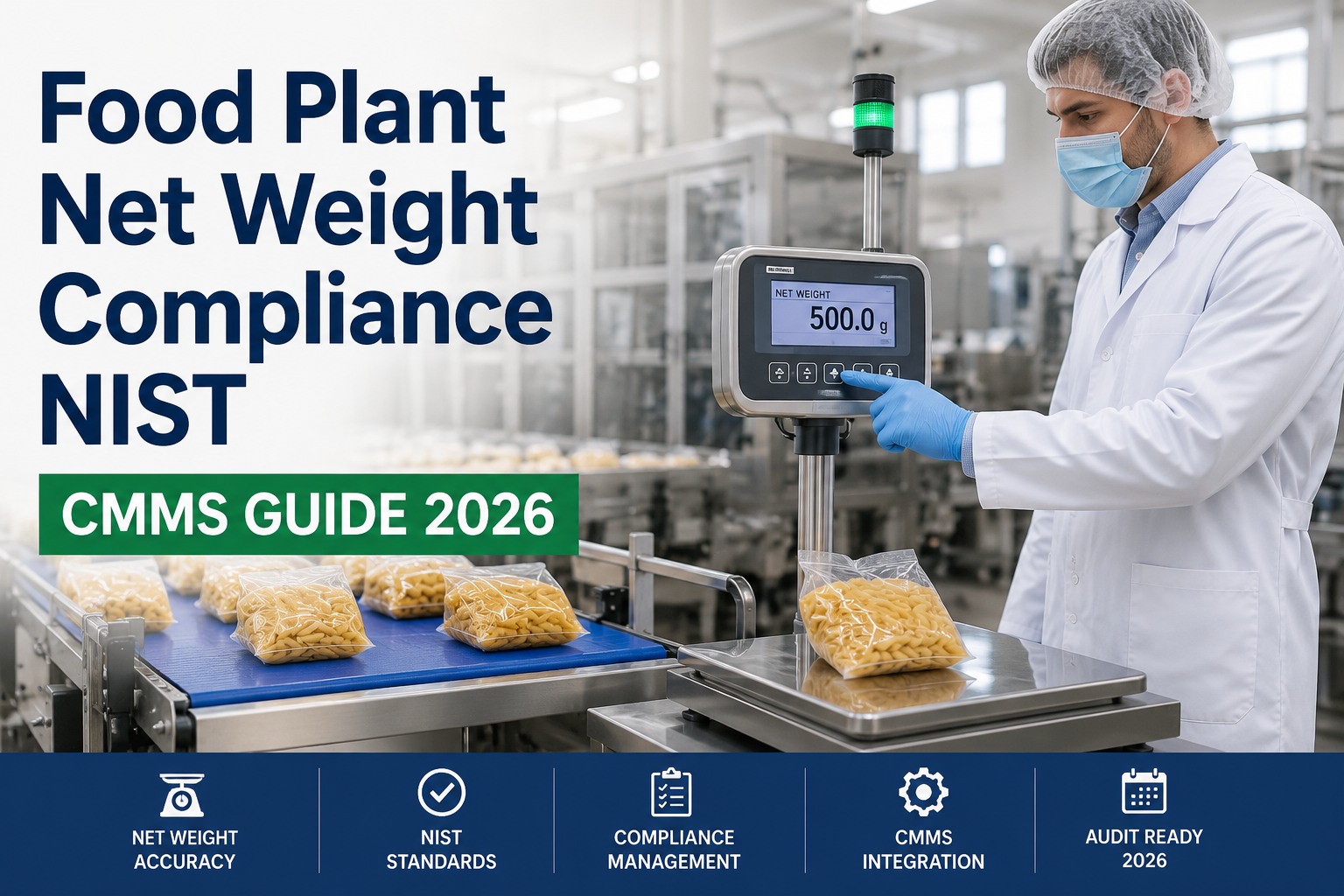
Net weight compliance under NIST Handbook 133 is the state weights-and-measures standard that governs how food packaging plants verify declared contents — and non-compliance triggers penalties, product recalls, and lost retail contracts. This guide walks maintenance and reliability teams through sampling methodology, MAV (maximum allowable variation) calculations, checkweigher integration, and the CMMS-driven net weight compliance program that keeps your facility audit-ready. If you are building a defensible fair-trade compliance program, Start Free Trial to see how OxMaint operationalizes the entire calibration and documentation workflow.
Is Your Food Plant's Net Weight Program Audit-Ready — Or One Inspection From a Recall?
State weights-and-measures officials can arrive unannounced, sample your production line, and issue stop-sale orders the same day. Without automated, time-stamped scale calibration records and checkweigher maintenance logs, proving compliance becomes nearly impossible.
What NIST Handbook 133 Requires From Food Plants
NIST Handbook 133 defines the sampling plans, MAV limits, and test procedures that state inspectors use to verify that packaged foods contain at least the declared net weight. Compliance is not optional — it is the legal definition of fair trade.
Category A Sampling
For most food products, inspectors draw a random sample (typically 10–48 units depending on lot size) and calculate the average net weight. The average must equal or exceed the declared weight on the label.
MAV Compliance
No individual package may be short by more than the Maximum Allowable Variation listed in Table 2-1. A single unit exceeding the MAV is an automatic violation — regardless of the batch average.
Defensible Calibration Records
Inspectors will request proof that your checkweighers and bench scales were calibrated to NIST-traceable standards. Missing or handwritten logs are routinely rejected during enforcement actions.
Tare Accuracy
Used packaging materials must be weighed and documented. Underestimating tare weight — even by 0.5 g — systematically inflates declared net content and triggers systematic-shortage findings across entire lot sizes.
How Net Weight Sampling and MAV Calculations Work
A food plant net weight compliance program hinges on two math checkpoints: the batch average and the individual-unit MAV. Failing either one puts your product on hold.
If the sample average falls below the label declaration, the entire lot is deemed non-compliant — even if every individual unit is within the MAV tolerance.
Any single package exceeding the MAV is an automatic violation. For a 454 g (1 lb) package, the MAV is typically 9.1 g — meaning no unit can weigh less than 444.9 g.
A mid-size sauce producer running 12 oz (340 g) jars samples 30 units from a 4,800-jar lot. The average net weight is 340.3 g — passing the average test. But one jar weighs 326 g, a shortage of 14 g. The MAV for 340 g is 10.2 g. That single jar triggers an automatic MAV violation, forcing the producer to rework or destroy the entire lot — a $28,000 loss from one checkweigher that drifted out of tolerance between calibrations.
The CMMS-Driven Net Weight Compliance Program
Manual spreadsheet tracking of checkweigher calibrations is the leading cause of net weight non-compliance. A CMMS built for food net weight compliance automates the maintenance schedule, captures digital signatures, and makes every audit defensible in minutes.
Asset & Scale Registry
Every checkweigher, bench scale, load cell, and metrology standard is registered as a tracked asset with NIST-traceable calibration intervals, serial numbers, and location data — eliminating the "which scale was due?" guesswork.
Automated PM Scheduling
Preventive maintenance work orders auto-generate 7–14 days before each calibration due date, with NIST Handbook 133 task checklists attached. Technicians receive mobile notifications — no calendar reminders needed.
Digital Calibration Logs
Calibration results — standard weight applied, measured reading, deviation, pass/fail — are entered directly into the work order on a tablet. Each entry is time-stamped, GPS-tagged, and electronically signed.
Audit-Ready Documentation
When inspectors arrive, generate a complete calibration history for any asset in under 60 seconds. Export PDF reports filtered by date range, line, or SKU — formatted to satisfy state weights-and-measures officials.
Checklist: Is Your Net Weight Program Defensible?
Run through this checklist against your current process. If you cannot answer "yes" to every item, your facility is carrying hidden compliance risk that a single state inspection can expose.
Calibration intervals tracked per asset
Every scale and checkweigher has a unique ID, documented NIST-traceable interval, and automated next-due trigger.
MAV compliance verified on each line
Documented evidence that sampling plans match NIST Handbook 133 Category A requirements for each SKU package size.
Tare weights recorded and updated
Packaging tare is verified at lot start and mid-run, with results logged against the production batch record.
Out-of-tolerance deviations escalated
Any checkweigher reading outside ±1 MAV triggers an automatic corrective work order and production hold notification.
Spare load cells and parts in stock
Critical spare parts for each checkweigher model are tracked in inventory with min/max reorder triggers.
Audit report generated in under 5 minutes
A complete calibration and maintenance history for any asset or production line is exportable on demand.
How OxMaint Powers NIST Handbook 133 Compliance
OxMaint is an AI-powered CMMS and EAM platform that turns net weight compliance from a manual paperwork burden into an automated, audit-ready workflow. Here is how specific capabilities map directly to NIST Handbook 133 requirements.
Asset & Equipment Tracking
Register every checkweigher, bench scale, and load cell as a tracked asset with NIST-traceable calibration intervals, attached manuals, and full maintenance history — so no device slips through the cracks.
Preventive Maintenance Automation
Auto-generate PM work orders with NIST Handbook 133 task checklists, standard-weight sets, and pass/fail criteria — triggered by calendar interval, usage cycles, or predictive AI signals.
Digital Work Orders with E-Signatures
Technicians complete calibration checks on mobile devices — capturing readings, deviations, and corrective actions with time stamps and 21 CFR Part 11–compatible electronic signatures.
Maintenance Analytics & Dashboards
Real-time dashboards show calibration status across every line, flag assets approaching due dates, and trend checkweigher drift over time — so you catch tolerance creep before it becomes an MAV violation.
Manual Tracking vs. CMMS for Net Weight Compliance
Most food plants still manage checkweigher calibration in spreadsheets or on paper log sheets. Here is what that approach actually costs compared to a CMMS-driven program.
| Compliance Factor | Spreadsheet / Paper | OxMaint CMMS |
|---|---|---|
| Calibration due-date tracking | Manual review; often missed by 5–15 days | Automated triggers 7–14 days ahead; escalation alerts |
| Record retrieval for inspection | 2–4 hours searching binders or shared drives | < 60 seconds via filtered asset report |
| Out-of-tolerance response time | Hours to days; depends on someone noticing | Instant corrective work order on deviation entry |
| MAV breach prevention | Reactive — caught after product ships | Predictive analytics flag drift before MAV exceeded |
| Audit documentation format | Inconsistent; handwritten; missing signatures | Standardized PDF with time stamps and e-signatures |
| Multi-site visibility | Separate spreadsheets per plant; no rollup | Unified dashboard across all facilities and lines |
The Cost of Non-Compliance vs. CMMS Payback
A single MAV violation can cost more than an entire year of CMMS licensing. Here is the math that justifies the switch.
A 180-asset food packaging plant spending $42K/yr on manual calibration management and absorbing $65K/yr in compliance-related losses (penalties, rework, expired-lot disposal) deployed OxMaint. Within 90 days, missed calibrations dropped to zero, audit prep time fell from 3 days to 45 minutes, and a predictive drift alert caught a failing checkweigher before it produced a single MAV-violating unit. Annual savings: $89K. The plant's reliability director called it "the fastest software ROI we have ever seen."
See OxMaint on Your Assets — Book a 30-Minute Demo
Walk through a live NIST Handbook 133 calibration workflow, checkweigher asset registry, and audit-report export. See exactly how OxMaint fits your lines.
Net Weight Compliance Under NIST Handbook 133 — Frequently Asked Questions
What is NIST Handbook 133 and who must comply with it?
NIST Handbook 133 is the federal standard for checking the net contents of packaged goods, adopted and enforced by state weights-and-measures officials. Any food plant that packages products by weight, volume, or count for retail sale must comply — including meat, dairy, bakery, snack, sauce, and beverage producers. Compliance is verified through unannounced state inspections.
What is MAV in net weight compliance?
MAV stands for Maximum Allowable Variation — the largest acceptable negative error for an individual package. If any single unit in a sample falls short of the declared weight by more than the MAV (defined in Handbook 133 Table 2-1), it is an automatic violation regardless of the batch average. A CMMS that tracks checkweigher calibration helps prevent the scale drift that causes MAV breaches. Start Free Trial to automate MAV-critical calibrations.
How often should checkweighers be calibrated for NIST compliance?
Calibration frequency depends on usage, environment, and manufacturer recommendations — typically daily verification with certified test weights and full NIST-traceable calibration every 3–12 months. High-speed lines in washdown environments may require weekly verification. OxMaint automates the schedule based on each asset's risk profile and interval setting.
Can a CMMS prevent net weight violations?
Yes. A CMMS like OxMaint prevents violations by ensuring calibrations are never missed, flagging checkweigher drift before it reaches the MAV threshold, and enforcing corrective-action workflows the moment a deviation is logged. Plants using automated CMMS-driven calibration programs report 40–60% fewer missed calibrations and near-zero audit findings.
What records do state inspectors ask for during a net weight audit?
Inspectors typically request: calibration certificates for all scales and checkweighers on the production line, maintenance logs showing the last service date and technician, sampling records for the lot in question, and tare-weight documentation. OxMaint generates all of these as filtered PDF reports in under a minute. Book a Demo to see the audit-export workflow.
Make Net Weight Compliance Automatic
Stop trusting spreadsheets with your fair-trade compliance. Deploy OxMaint and turn NIST Handbook 133 calibration tracking into an automated, audit-ready system your team can trust.
Free 14-day trial · No credit card