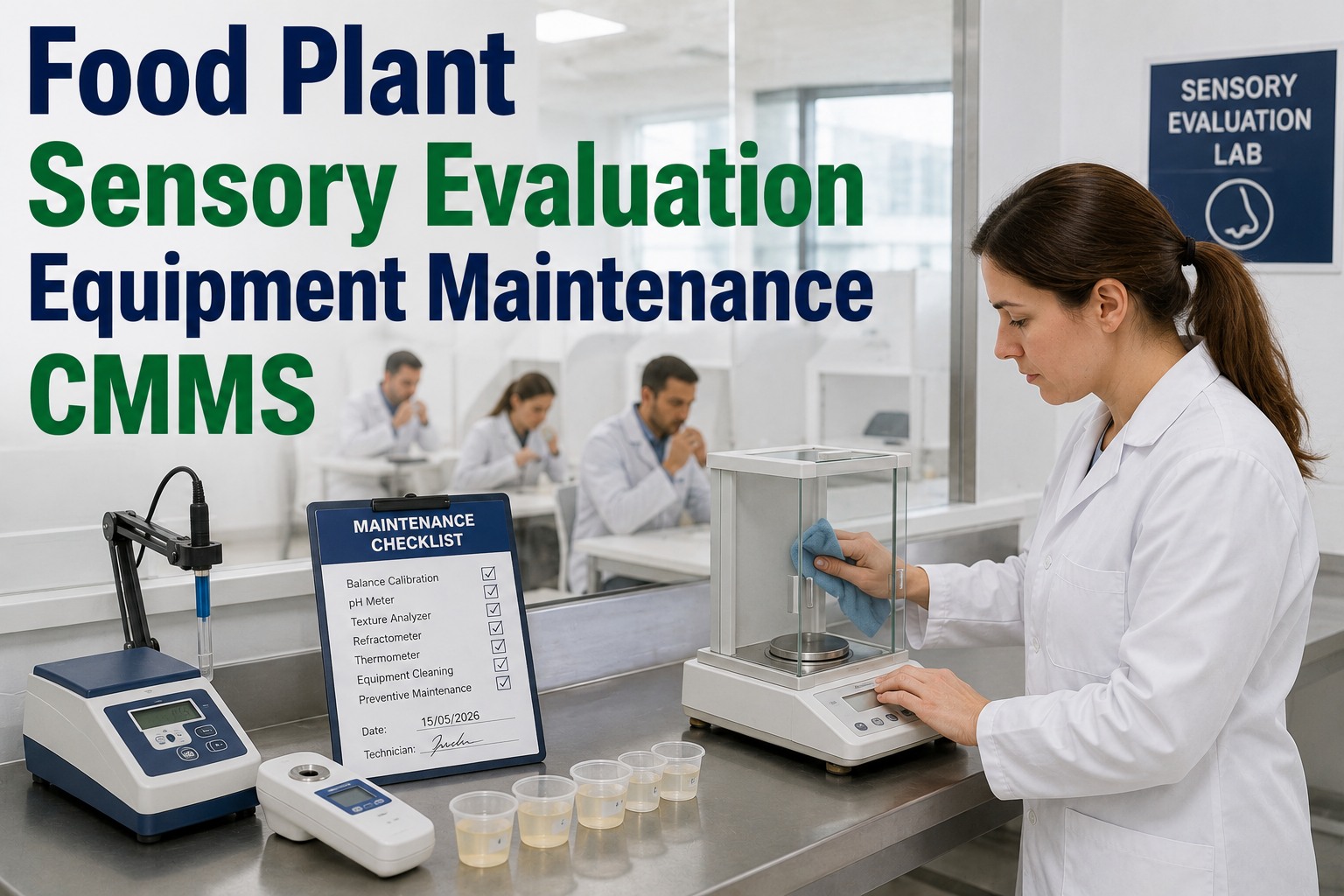
Maintaining the sensory evaluation room in a food plant requires strict environmental control, precise equipment calibration, and rigorous documentation to ensure tasting accuracy and panel consistency. A sensory evaluation equipment maintenance guide must address HVAC performance, lighting integrity, booth cleanliness, and instrument calibration—because even minor deviations in temperature, humidity, or ambient odor can skew sensory analysis results and lead to costly product quality decisions. By implementing a CMMS for food sensory evaluation programs, maintenance and reliability teams can automate preventive maintenance schedules, track calibration history, and eliminate the paper work orders that make audit readiness a nightmare. If you want to transition from reactive fixes to a predictive, audit-ready sensory CMMS strategy, you can Start Free Trial today and centralize your maintenance operations.
Sensory Guide 2026
Is your taste panel room sabotaging product quality decisions?
Even a 2°C temperature drift or a failing UV filter can invalidate an entire day of sensory panel results. OxMaint's sensory equipment CMMS automates environmental monitoring, calibration tracking, and preventive maintenance—so every tasting session is defensible, repeatable, and audit-ready.
30–50%
Reduction in unplanned sensory equipment downtime when a CMMS drives your preventive maintenance program
Environmental Control
Why sensory evaluation room maintenance drives tasting accuracy
In food plant sensory evaluation, the room itself is a piece of precision equipment. ISO 8589 standards dictate specific requirements for sensory analysis environments—neutral colors, controlled lighting (5,000–6,500 Kelvin), temperature stability between 20–22°C, and humidity held at 40–60%. When HVAC filters clog, lighting degrades, or ambient odors intrude, panelist sensitivity drops and false positives or negatives creep into your data. A single invalidated panel session can cost a mid-sized food manufacturer $5,000–$12,000 in wasted ingredients, labor, and delayed product launches.
±0.5°C
Acceptable temperature variance for valid sensory analysis testing
5,500K
Optimal color temperature for sensory booth lighting evaluation
15 min
Minimum air flush required between tasting sessions to prevent odor carryover
Without a CMMS for food sensory evaluation, these parameters are tracked on clipboards and spreadsheets—documents that get lost, miss renewal dates, and fail audits. OxMaint converts every environmental checkpoint into a tracked, automated work order with digital signatures, ensuring your sensory guide for food quality is enforced every single shift.
Preventive Maintenance Checklist
Sensory equipment maintenance guide: monthly and quarterly tasks
A defensible sensory evaluation program requires tiered preventive maintenance. Below is a structured CMMS food sensory equipment checklist, organized by frequency, that maintenance teams can deploy directly into OxMaint as recurring work orders.
Booth & Environmental
- Sanitize tasting booths with odorless, food-grade detergent and verify rinse residue levels
- Inspect HVAC return air screens for dust accumulation affecting airflow to panelist booths
- Log room temperature and humidity readings at three zones; flag any drift beyond ±0.5°C
- Verify spittoon and sink drainage to prevent lingering odor sources in the evaluation room
Lighting & Instruments
- Calibrate spectrophotometers and colorimeters using NIST-traceable reference standards
- Replace UV filters and daylight-simulation bulbs if lux output drops below 80% of original spec
- Run electronic nose (e-nose) diagnostic loops and verify sensor array baseline drift
- Test emergency backup lighting to ensure panel continuity during power fluctuations
Deep Maintenance & Audit
- Replace HEPA and activated carbon filters in the HVAC odor-scrubbing system
- Conduct full third-party calibration on all food sensory instruments with traceable certificates
- Audit spare parts inventory for critical sensors, bulbs, and filters; set min/max reorder points
- Review predictive maintenance analytics for trend lines indicating equipment degradation
Scenario Analysis
The real cost of spreadsheet-driven sensory maintenance
Consider a mid-sized food manufacturer operating a 180-asset facility with a 12-booth sensory panel room, running 3 tasting sessions per day. The maintenance team tracks HVAC filters, lighting calibration, and instrument servicing on a shared spreadsheet. Here is how the costs accumulate when a reactive, paper-based system fails:
Spectrophotometer drift undetected
The quarterly calibration reminder is buried in a spreadsheet. A colorimeter drifts 4% outside tolerance, causing a false rejection of a $28,000 production batch that actually met spec.
HVAC carbon filter exceeds service life
No automated reorder trigger exists for the activated carbon filter. Ambient odors from the production floor bleed into the sensory room, invalidating 3 days of panel results at a cost of $9,500 in wasted labor and ingredients.
Missing documentation during SQF audit
Paper work orders for booth sanitation are incomplete or missing. The facility receives a major non-conformance, requiring a $15,000 corrective action plan and risking a key retail customer relationship.
Annual Cost of Reactive Sensory Maintenance (12-booth room)
$28,000 false rejection + $9,500 invalidated panels + $15,000 audit corrective action + $8,000 lost labor = $60,500 / year
A CMMS food sensory instrument deployment in OxMaint costs a fraction of this figure—typically delivering ROI in under 90 days by preventing even one major quality event.
CMMS vs. Status Quo
CMMS vs. spreadsheet maintenance for food sensory evaluation
Maintenance and reliability teams evaluating software for their sensory program need to see the operational difference clearly. The comparison below maps the status quo against an OxMaint-driven sensory CMMS guide deployment.
| Capability | Spreadsheet / Paper | OxMaint CMMS |
|---|---|---|
| PM Scheduling | Manual calendar entries; missed reminders | Auto-generated work orders triggered by date, usage, or condition |
| Calibration Tracking | Separate logs; no link to asset history | Full calibration history per instrument with NIST certificate uploads |
| Spare Parts Reorder | Visual inspection of stockroom shelves | Min/max triggers with predictive depletion forecasting |
| Audit Readiness | Days of document reconstruction | One-click compliance reports with digital signatures |
| Downtime Prevention | Reactive; fix after failure | AI predictive analytics flag failures 7–14 days in advance |
How OxMaint Helps
How OxMaint powers your CMMS food sensory evaluation program
OxMaint is an AI-powered CMMS and EAM platform that maps directly to the demands of a food plant sensory evaluation room. By centralizing work orders, preventive maintenance, asset tracking, and analytics, OxMaint turns your sensory equipment maintenance guide into an automated, enforced system of record.
Automated PM Work Orders
Schedule recurring preventive maintenance for HVAC filters, lighting, and sensory instruments by date or usage. OxMaint auto-generates and assigns work orders, cutting manual scheduling time by 80% and ensuring no calibration date slips through the cracks.
Predictive Analytics
AI-driven anomaly detection monitors vibration, temperature, and sensor drift patterns on your sensory analysis instruments—flagging potential failures 7–14 days before they occur, reducing unplanned downtime by 30–50% and protecting panel session integrity.
Digital Audit Trails
Every work order, calibration certificate, and parts replacement is logged with timestamps and digital signatures. Generate SQF, BRC, and ISO 8589 compliance reports in one click—eliminating the 2–3 days typically spent reconstructing paper records before an audit.
Spare Parts Inventory
Track critical sensory room spares—UV bulbs, HEPA filters, O-rings, and reference standards—with automated min/max reorder triggers. OxMaint prevents stockouts that delay calibration, while reducing excess inventory carrying costs by 20–35%.
"We replaced our spreadsheet maintenance log with OxMaint for our sensory panel room. In the first six months we caught three calibration drifts before they invalidated a panel, passed our SQF audit with zero non-conformances, and cut our filter reorder lead time from 3 weeks to 4 days."
See OxMaint on your sensory assets—book a 30-min demo
Discover how an AI-powered CMMS eliminates paper work orders, automates calibration tracking, and makes every sensory panel session audit-ready.
FAQ
Common questions about sensory equipment CMMS
What is a CMMS for food sensory evaluation?
A CMMS for food sensory evaluation is a computerized maintenance management system that centralizes work orders, preventive maintenance schedules, calibration tracking, and spare parts inventory for all equipment in the sensory evaluation room—from HVAC and lighting to spectrophotometers and e-nose instruments. You can Start Free Trial to see how OxMaint maps these capabilities directly to your tasting panel environment.
How often should sensory evaluation equipment be calibrated?
Sensory analysis instruments like colorimeters and spectrophotometers should be calibrated monthly using NIST-traceable standards, while HVAC environmental sensors require weekly verification. Full third-party calibration should occur quarterly. OxMaint automates these schedules and alerts technicians when a calibration window opens, preventing the drift that invalidates panel results.
What environmental controls are required in a sensory evaluation room?
Per ISO 8589, a sensory evaluation room must maintain 20–22°C temperature, 40–60% humidity, controlled lighting at 5,000–6,500 Kelvin, and positive pressure with activated carbon filtration to prevent odor intrusion. OxMaint tracks these parameters as condition-based triggers, auto-generating work orders the moment a reading drifts outside tolerance.
How does a CMMS improve audit readiness for sensory programs?
A CMMS creates a permanent, timestamped digital record of every maintenance task, calibration certificate, and parts replacement. During an SQF, BRC, or ISO audit, you generate a complete compliance report in one click instead of reconstructing paper logs, reducing audit preparation from days to minutes. Book a Demo to see the audit reporting module in action.
Can OxMaint integrate with existing food plant maintenance systems?
Yes. OxMaint is designed to replace spreadsheets and legacy systems with minimal disruption. The platform supports asset data import, mobile work order execution, and API integration with ERP systems—allowing maintenance teams to migrate from reactive, paper-based operations to a predictive CMMS in days, not months.
Ready to make every sensory panel session defensible?
Join the maintenance teams using OxMaint to cut unplanned downtime 30–50%, eliminate paper work orders, and pass every audit with confidence.
Free 14-day trial · No credit card