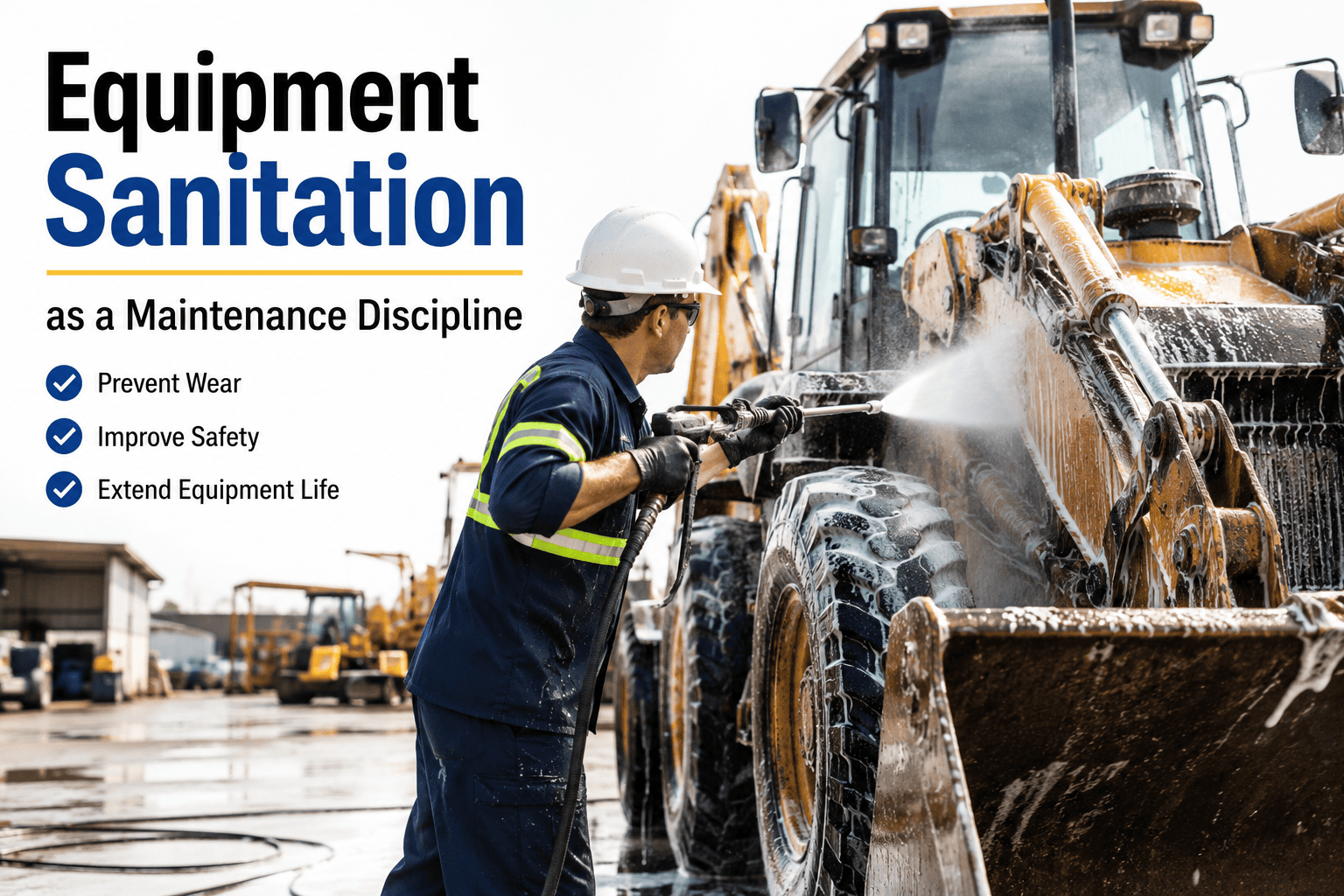
Sanitation and maintenance have always been run as two separate departments in most food plants — one keeps the CIP pumps and spray balls running, the other verifies the equipment is actually clean. That separation is exactly where audit findings and contamination events start. A cracked gasket that maintenance hasn't flagged undermines every wash cycle sanitation runs on that surface, and a spray ball with reduced coverage lets biofilm survive a cleaning cycle that looks complete on paper. Regulators reviewing food safety plans in 2026 expect facilities to treat sanitation as an engineered maintenance system, not a checklist bolted onto the production schedule. This guide breaks down what that coordination looks like in practice, and how a connected CMMS platform closes the gap between cleaning and proof of cleaning.
Equipment Sanitation Is a Maintenance Discipline, Not a Cleaning Task
Every contamination event traces back to a piece of equipment that either wasn't cleaned correctly or couldn't be cleaned correctly because it wasn't maintained correctly. The two functions succeed or fail together.
The Four Risk Zones Every Sanitation Program Has to Maintain
Not every surface carries the same contamination risk, and not every zone needs the same maintenance attention. A defensible program separates them clearly — and links each zone to the equipment condition that keeps it clean.
Fill heads, blades, conveyor belts, and mixing vats need shift-by-shift or daily cleaning with ATP verification before production resumes. Worn seals or pitted surfaces here defeat sanitation before it starts.
Spray balls, sanitary valves, pump seals, and dosing sensors are the equipment that performs the cleaning. When a component degrades, the wash cycle can complete on schedule and still leave biofilm behind.
Lines running multiple SKUs need documented teardown, dedicated-part swaps, and swab verification between allergen and non-allergen runs — every time, with no step skipped under production pressure.
Ceilings, overhead pipes, drains, and wall corners accumulate contamination slowly, but a missed quarterly cycle here is a recurring pattern auditors flag as a major non-conformity.
Building a CMMS-Integrated Sanitation Program
Coordinating sanitation and maintenance inside one system removes the manual handoffs where compliance gaps usually form. Here's the sequence that plants follow when they move off paper.
Every zone, asset, frequency, chemical, and responsible role lives in one record instead of a static document nobody updates after the first audit.
Spray ball inspections, valve rebuilds, and sensor calibration get scheduled around wash windows, so the equipment that cleans is verified before it's relied on.
Chemical concentration, contact time, and rinse confirmation are captured as required fields on the work order — not remembered after the fact on a clipboard.
Non-skippable steps require swab results and a QA sign-off before the next SKU can be scheduled to run on that line.
A complete sanitation history — by asset, zone, or standard — is retrievable in seconds instead of reconstructed from binders the week before an audit.
Manual Sanitation Tracking vs. CMMS-Integrated Sanitation
The gap between the two approaches shows up the moment an auditor asks for proof, not just a policy.
| Compliance Requirement | Paper / Spreadsheet Tracking | CMMS-Integrated Sanitation |
|---|---|---|
| Master schedule adherence | Relies on a supervisor remembering to check the calendar | Work orders generate automatically on the defined frequency |
| CIP component reliability | Tracked separately from the cleaning schedule, if at all | Spray ball and valve PM scheduled around wash windows |
| SSOP documentation | Handwritten forms filed without cross-checking | Concentration, contact time, and rinse captured as required fields |
| Allergen changeover proof | Verbal confirmation between shifts | Swab results and QA sign-off required before line restart |
| Audit record retrieval | Hours to days, often incomplete | Seconds, complete, and timestamped by asset |
What Coordinated Sanitation and Maintenance Delivers
Frequently Asked Questions: Equipment Sanitation and Maintenance
What's the difference between cleaning and sanitizing equipment?
What is a master sanitation schedule and is it required?
How often should CIP system components be inspected?
How does a CMMS support allergen changeover compliance?
How long do food plants need to keep sanitation records?
Stop Managing Sanitation and Maintenance as Two Separate Programs
The equipment that cleans your plant needs to be maintained as carefully as the equipment that makes your product. Oxmaint schedules the cleaning, verifies the chemistry, and maintains the CIP systems doing the work — all inside one auditable record.
- Master sanitation schedule generates work orders automatically by zone and frequency
- CIP component PM scheduled around wash windows, not against them
- Allergen changeover, SSOP, and audit records retrievable in seconds