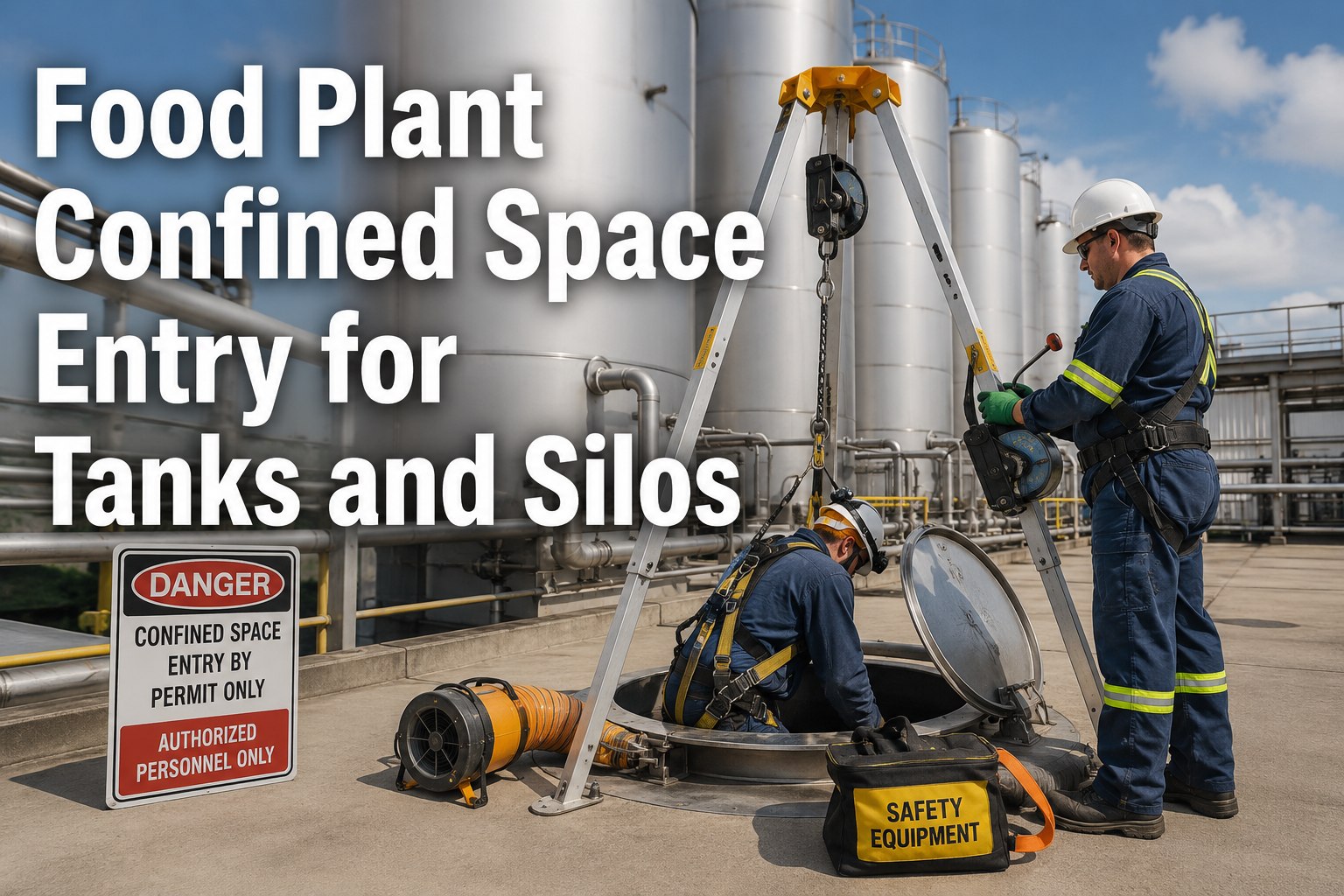
Confined space entry for tanks and silos is among the highest-consequence maintenance work in any food plant, combining atmospheric hazards, engulfment risk, and complex rescue scenarios into a single high-stakes operation. OSHA 29 CFR 1910.146 mandates strict permit-to-work protocols, continuous atmospheric monitoring, and dedicated rescue readiness for every entry, whether you are cleaning a flour silo or servicing a mixing tank. This guide covers how a modern CMMS food plant confined space entry program digitizes permits, standardizes atmospheric testing, and ensures compliance documentation is audit-ready. See how OxMaint can digitize your entire permit-to-work workflow when you Start Free Trial today.
Is your next tank or silo entry a calculated risk or an uncontrolled hazard?
Paper permits and clipboards fail when seconds matter. A single missed atmospheric reading inside a storage silo can turn a routine cleaning into a fatal incident. Digitize your confined space entry workflow with OxMaint to enforce OSHA 1910.146 compliance, validate atmospheric testing, and guarantee audit-ready rescue documentation on every single entry.
How to execute a compliant tank silo entry using a CMMS guide
A compliant confined space entry for tanks and silos requires a rigid, sequential workflow. Skipping any step compromises worker safety and violates OSHA 1910.146. Here is the 5-phase protocol every food plant maintenance team must follow, automated through a CMMS to prevent human error.
Hazard Assessment & Permit Issuance
Identify engulfment hazards, mechanical agitators, and residual chemicals. The CMMS food permit work module auto-generates a digital 1910.146 permit, forcing the entry supervisor to validate isolations, lockout/tagout (LOTO), and PPE requirements before work begins.
Atmospheric Testing & Validation
Test oxygen (19.5%–23.5%), flammable gases (under 10% LEL), and toxic chemicals (e.g., hydrogen sulfide, carbon monoxide). CMMS atmospheric testing food workflows require technicians to log calibrated gas monitor readings directly into the work order before the system allows entry.
Equipment Isolation & LOTO
Blank, blind, or disconnect pipelines to prevent product flow into the silo. OxMaint links LOTO points directly to the confined space permit, ensuring no valve or electrical source can be energized while the space is occupied.
Entry, Monitoring & Rescue Readiness
An attendant maintains constant communication, while continuous atmospheric monitoring runs. The rescue plan—detailing extraction equipment and standby personnel—must be attached to the digital permit and acknowledged by all parties inside the CMMS.
Permit Closure & Audit Archival
Upon exit, the supervisor closes the permit, verifying all tools are removed and the space is secured. The confined space tank silo CMMS permanently archives the time-stamped log, gas readings, and signatures for immediate OSHA audit retrieval.
Essential confined space entry checklist for food plant tanks and silos
Before any technician breaches a manway, verify these critical safety controls. Use this confined space guide food plants rely on to standardize pre-entry protocols across all storage vessels.
Pre-Entry Atmospheric Controls
- Oxygen content verified between 19.5% and 23.5%
- Lower Explosive Limit (LEL) confirmed below 10%
- Toxic substance levels (H2S, CO) within safe limits
- Gas monitor bump-tested and calibration current
- Continuous monitoring equipment deployed inside the space
Permit & Isolation Controls
- Digital confined space permit approved in CMMS
- Lockout/Tagout (LOTO) applied to all energy sources
- Piping blanked or blinded to prevent product flow
- Agitators and augers mechanically locked out
- Entry supervisor and attendant formally assigned
Rescue & Emergency Readiness
- On-site rescue team notified and on standby
- Self-contained breathing apparatus (SCBA) available
- Mechanical extraction device (tripod/winch) rigged
- Direct communication line to local emergency services
- Rescue plan reviewed and signed by the entry team
How OxMaint digitizes your CMMS food confined space program
Relying on paper permits leaves your facility exposed to OSHA citations and catastrophic safety failures. OxMaint transforms your confined space silo guide into a dynamic, enforced digital workflow that protects workers and eliminates administrative bottlenecks.
Digital Permit-to-Work System
Replace paper permits with mandatory digital workflows. OxMaint ensures OSHA 1910.146 requirements are met by blocking work order execution until atmospheric tests, LOTO points, and rescue plans are electronically verified.
Real-Time Atmospheric Logging
Technicians must input O2, LEL, and toxic gas readings directly into the CMMS food confined space tank module via mobile devices. Readings are time-stamped and permanently archived, eliminating falsified or lost clipboards.
Audit-Ready Compliance Archives
Survive OSHA audits without scrambling. Every confined space entry, including technician signatures, gas monitor readings, and equipment isolations, is instantly retrievable in a structured compliance dashboard.
Asset & LOTO Integration
Link confined space permits directly to equipment hierarchies. OxMaint automatically cross-references active LOTO procedures on agitators and conveyors, ensuring zero energy state before the silo entry is authorized.
The financial and operational impact of paper-based permits
A 180-asset food plant spending $42K/yr on manual permit administration and reactive safety management faces hidden costs that dwarf the price of CMMS software. Unplanned downtime from a silo entry incident can exceed $50K per hour in lost production.
| Compliance Factor | Paper / Manual Process | OxMaint CMMS Program |
|---|---|---|
| Permit Issuance Time | 45–60 minutes per entry | Under 5 minutes via mobile app |
| Atmospheric Data Integrity | Prone to human error, easily lost | Time-stamped, tamper-proof digital log |
| OSHA Audit Retrieval | Days of manual file searching | Instant retrieval via dashboard filters |
| Rescue Plan Verification | Verbal confirmation, easily bypassed | Mandatory electronic sign-off required |
| Average OSHA Citation Risk | $15,000+ per serious violation | Drastically reduced via enforced protocols |
Stop betting on paper permits for high-risk silo entries
See how OxMaint enforces OSHA 1910.146 compliance, digitizes atmospheric testing, and protects your maintenance team on every confined space entry.
Confined space entry guide for tanks and silos: FAQs
What is a confined space entry permit for food plant tanks and silos?
A confined space entry permit is a formal OSHA 1910.146 compliance document that authorizes entry into a hazardous space like a mixing tank or storage silo. It details atmospheric testing results, LOTO isolations, personnel assignments, and rescue plans. Using a CMMS food permit work system digitizes this permit, ensuring no step is bypassed and the documentation is instantly archived for audits.
How often should atmospheric testing be performed in a confined space?
Atmospheric testing must be performed before entry, and continuous monitoring must be maintained throughout the entire duration of the entry. A CMMS atmospheric testing food workflow enforces this by requiring technicians to log initial O2, LEL, and toxic gas readings on their mobile device before the digital permit will unlock, ensuring a zero-risk environment is verified and documented.
Why use a CMMS for confined space entry instead of paper permits?
A CMMS prevents the lost paperwork, incomplete signatures, and unverifiable gas readings that plague manual processes. It enforces real-time compliance, links LOTO directly to the asset, and provides instant audit trails for OSHA inspectors. You can explore these features by signing up for a Start Free Trial of OxMaint.
What are the main hazards of entering a food plant silo?
The primary hazards include oxygen deficiency or enrichment, flammable dust explosions (high LEL in flour or sugar silos), toxic gas exposure from decomposing product, and engulfment by stored bulk materials. A confined space silo guide integrated into your CMMS ensures all these specific risks are mitigated through mandatory checklists before entry is approved.
Can OxMaint integrate confined space permits with preventive maintenance schedules?
Yes, OxMaint links confined space entry permits directly to the asset's preventive maintenance (PM) triggers. When a silo cleaning PM is activated, the CMMS automatically generates the confined space permit requirements, ensuring safety protocols are tied to the maintenance schedule rather than treated as an afterthought.
Digitize your confined space entry program today
Protect your maintenance team, eliminate paper bottlenecks, and achieve 100% OSHA compliance readiness with OxMaint's AI-powered CMMS.
Free 14-day trial · No credit card