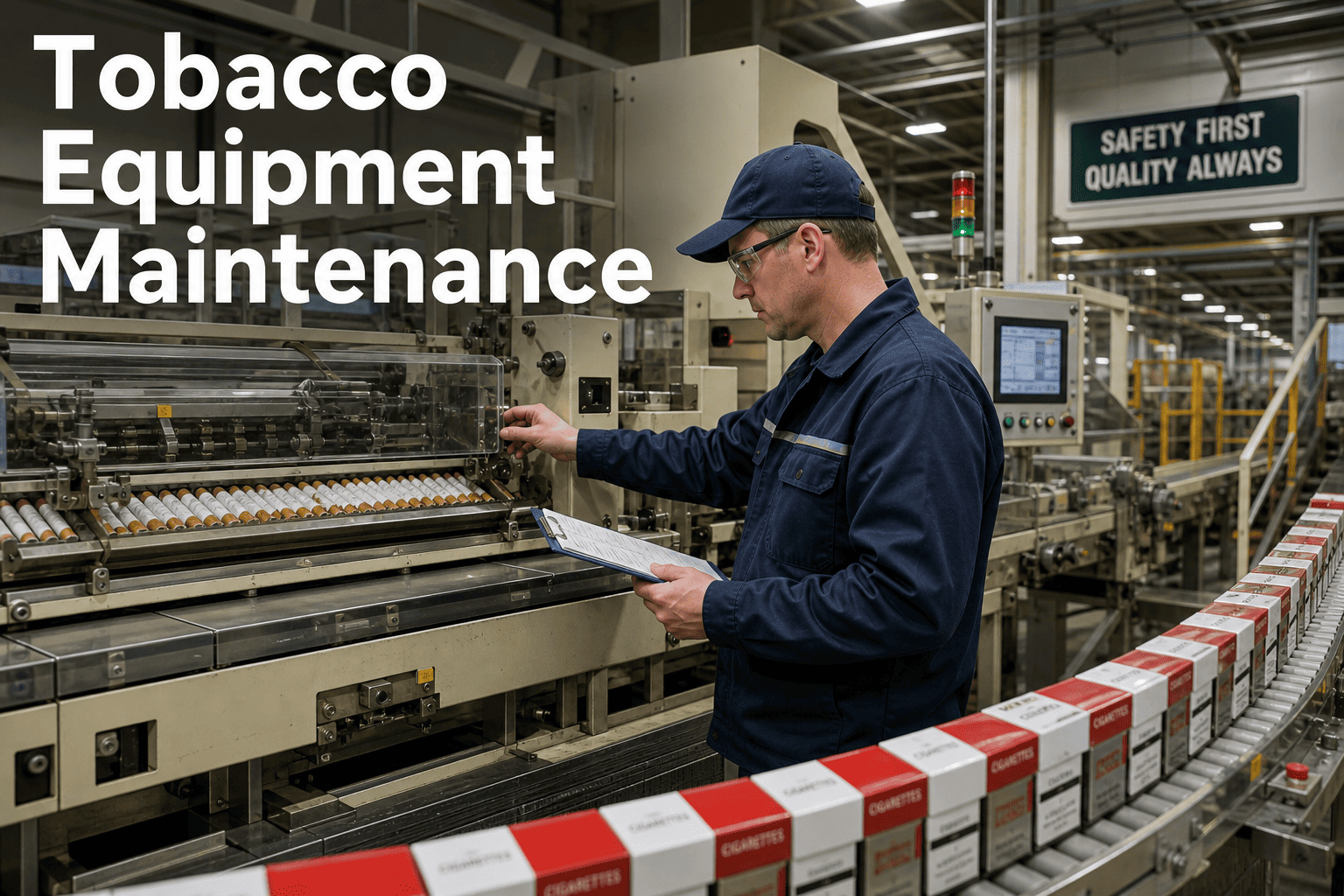
A production engineer at a tobacco manufacturing facility in North Carolina discovered the primary cigarette making machine had produced 340,000 non-compliant cigarettes over a 4-hour run when the tobacco moisture conditioner malfunctioned at 3 AM — the conditioner had drifted from 13% target moisture content to 11.2%, causing leaf brittleness that resulted in tobacco rod weight variation outside the ±0.05g specification and filter attachment failures at 1.8× normal rate. The CMMS showed the conditioner humidity sensor calibration was 6 weeks overdue, and the downstream quality inspection system had flagged the weight deviation at 3:47 AM but the alert routing had not been configured to notify the on-call maintenance supervisor, so production continued on the defective run until shift change. The non-compliant batch cost $96,000 in product destruction, machine rework, and customer order delays. OxMaint tracks moisture control equipment calibration intervals and alert routing — preventing non-compliant production runs from continuing overnight without maintenance intervention. Book a demo to see how tobacco manufacturing equipment maintenance prevents $96K moisture control failures.
North Carolina facility cost from moisture conditioner drift — 340K non-compliant cigarettes destroyed, machine rework, order delay penalties
$2.5B
Global tobacco machinery market projected for 2033 — automation and predictive maintenance driving continuous equipment modernization at 4.2% CAGR
60–65%
Required production floor relative humidity for cigarette manufacturing — outside this range causes leaf breakage, rod weight variation, and filter defects
Tobacco manufacturing equipment operates under three interdependent conditions that standard industrial maintenance programs do not address: moisture-critical processing where tobacco leaf must be maintained at precisely 12–14% moisture content throughout conditioning, rod forming, and filter attachment, or leaf brittleness causes tobacco weight variation triggering quality rejection and rework; high-speed precision production where primary cigarette making machines run at 7,000–14,000 cigarettes per minute and mechanical wear of 0.01mm in cutting drum blade clearance affects rod density uniformity across millions of cigarettes per shift; and tobacco dust fire risk where fine tobacco particle accumulation in HVAC systems, dust extraction ducts, and drive cabinets creates NFPA 654 fire and explosion hazard requiring more frequent cleaning inspection than equivalent non-dust-generating food processing equipment. Cigarette packing machines producing 1,000 packs per minute generate mechanical stress on folding mechanisms, glue dosing systems, and cellophane wrap units that causes non-compliant packages at elevated rates when PM is deferred — each defective pack triggers downstream retailer returns and brand quality audits. OxMaint provides tobacco manufacturing PM templates with moisture control calibration tracking, dust extraction inspection intervals, and high-speed machine wear monitoring integrated for continuous production schedules.
Tobacco Manufacturing Process — Maintenance-Critical Steps
01
Leaf Conditioning
Moisture conditioner adjusts leaf from 8–10% to 12–14% MC before cutting
Folding cam wear inspection monthly — worn cams cause pack damage and label misalignment
Critical PM Requirements — Humidity, Dust, Precision Wear for Tobacco Production
Tobacco manufacturing equipment failures create three distinct failure modes — moisture excursions that cause leaf quality degradation visible only in downstream weight variation data, mechanical wear on high-speed precision components that causes defect rates measurable in parts-per-million across millions of daily cigarettes, and tobacco dust accumulation in electrical and mechanical systems that creates fire hazard and regulatory exposure. Moisture conditioner sensor drift of ±1.5% moisture content causes 4–8% tobacco rod weight variation that fails specification, requiring the run to be reworked or destroyed at significant cost. Cigarette maker garniture tape wear that reduces rod circularity by 0.02mm generates ovality rejects at 3–5× normal rate across a machine producing 500 million cigarettes monthly. Tobacco dust buildup in packing machine drive cabinets and rod maker cam boxes creates NFPA 654 combustible dust fire risk requiring more frequent inspection than similar equipment in non-tobacco production environments. Start a free trial to schedule tobacco manufacturing PM with humidity control calibration, high-speed wear tracking, and dust extraction inspection integrated into cigarette production maintenance workflows.
Moisture Conditioning System
Weekly calibration
Humidity sensor calibration weekly — traceable standards, drift ±0.5% MC maximum
Production floor RH monitoring daily — 60–65% target for dimensional stability
Dust buildup in drive cabinets: NFPA 654 combustible dust fire and explosion risk
Tobacco Equipment PM
Generic FMCG Approach
OxMaint Tobacco-Specific PM
Moisture sensor calibration
Annual calibration — general instrument schedule
Weekly calibration with traceable standards — ±0.5% MC drift limit, alert routing to on-call supervisor verified monthly
Cigarette maker garniture tape
Replace on failure — standard wear item
Daily visual condition assessment with quantitative circularity check — proactive replacement at 85% wear life preventing 5× reject rate spikes
Filter glue viscosity
Checked when detachment complaints arise
4-hourly viscosity measurement with temperature compensation — drift alert before detachment rate increases, blend-specific viscosity targets stored per SKU
Dust extraction maintenance
Annual duct cleaning — standard HVAC PM
Monthly flow rate verification with NFPA 654 combustible dust inspection — drive cabinet cleaning schedule, fire risk documentation per zone
Packing machine cam wear
Reactive — replaced when pack defects exceed threshold
Monthly cam wear measurement with trend analysis — replacement at 80% wear life prevents 1,000-packs/min defect spikes on high-volume SKUs
Production floor humidity
Daily temperature log — no RH trending
Continuous RH monitoring at 60–65% target — automated HVAC PM scheduling triggered when humidity trending toward exceedance before production impact
58%
Fully automated cigarette equipment market share in 2024 — intelligent control systems and predictive maintenance driving tobacco plant modernization
14,000
Cigarettes per minute at maximum production speed — each 0.01mm garniture wear increase affecting 840,000 cigarettes per hour of operation
4.2%
Tobacco machinery market CAGR through 2033 — equipment automation and predictive maintenance investment growing steadily despite volume headwinds
Frequently Asked Questions
Why does moisture conditioner calibration require weekly intervals in tobacco manufacturing?
Tobacco leaf must be maintained at 12–14% moisture content throughout conditioning and rod forming because moisture variation of ±1.5% causes significant production quality impacts — tobacco below 11% moisture becomes brittle, causing leaf particle generation and tobacco rod weight variation outside the ±0.05g specification, while tobacco above 15% moisture causes mold risk in storage and rod forming machine jams from clumping. Humidity sensor drift accumulates over 5–10 day production periods from steam exposure and temperature cycling, making weekly three-point calibration with traceable standards necessary to catch drift before it exceeds the ±0.5% MC limit. OxMaint also verifies alert routing monthly, ensuring that sensor exceedances during overnight production notify on-call maintenance supervisors — preventing the 4-hour non-compliant run scenario that costs $96K per incident.
What NFPA 654 combustible dust requirements apply to tobacco manufacturing equipment maintenance?
NFPA 654 (Standard for the Prevention of Fire and Dust Explosions from the Manufacturing, Processing, and Handling of Combustible Particulate Solids) requires tobacco facilities to maintain dust extraction systems at design flow rates to prevent combustible particle accumulation, conduct regular inspection and cleaning of electrical enclosures and drive cabinets where tobacco dust accumulates, verify that dust extraction equipment operates within validated flow parameters preventing recirculation of tobacco particles, and document hazardous area classifications for equipment PM scheduling. OxMaint schedules monthly drive cabinet dust inspections with cleaning documentation, weekly dust extraction flow rate verification with drift trending, and quarterly duct inspection across tobacco processing zones — generating NFPA 654 compliance records per equipment location for regulatory inspection.
How does OxMaint track cigarette maker garniture tape wear to prevent reject rate spikes?
OxMaint records daily visual garniture tape condition assessments with quantitative circularity measurement data — operators document the tape surface condition rating and the rod circularity deviation measurement at each inspection. As tape approaches the validated wear limit, OxMaint automatically generates a replacement work order and escalates to maintenance planning 48 hours in advance to ensure replacement tapes are staged before the production impact threshold is reached. This proactive approach prevents the 3–5× reject rate spike that occurs when garniture tape is replaced reactively after defect rates rise — on a machine producing 500 million cigarettes per month, each day of elevated reject rates costs significantly more than scheduled tape replacement during planned maintenance windows.
What production floor humidity maintenance is required for cigarette manufacturing?
Cigarette production floors must maintain 60–65% relative humidity because tobacco leaf dimensions change with ambient humidity — low RH causes tobacco to contract and become brittle, increasing particle generation and rod weight variation, while high RH causes tobacco to expand and become sticky, causing machine jams and garniture contamination. OxMaint configures continuous RH monitoring at multiple production zone locations with automated HVAC PM scheduling triggered when trending shows humidity approaching exceedance boundaries — allowing maintenance to address HVAC filter loading or steam humidifier output before production is affected. HVAC filter PM intervals in tobacco facilities are accelerated versus standard manufacturing because tobacco dust accumulation in air handling units creates both fire risk and HEPA filter loading that reduces humidity control effectiveness at 2–3× the rate of non-tobacco production environments.
Tobacco Manufacturing PM — OxMaint
Prevent $96K Moisture Failures — Equipment Maintenance Built for High-Speed Precision Tobacco Production.