University chiller plants consume 35-45% of total campus electricity during cooling season — and most run far below optimal efficiency because tonnage allocation, sequencing strategies, and free cooling opportunities are managed by tribal knowledge rather than data. The average campus chiller plant operates at 0.85-1.1 kW per ton when properly optimized plants achieve 0.55-0.65 kW per ton — that gap represents hundreds of thousands of dollars in wasted electricity annually. Free cooling via water-side economizers can offset 15-30% of annual cooling energy at campuses in northern climates, yet 62% of universities with economizer-capable systems fail to activate them at the right switchover temperatures because there is no PM-driven protocol ensuring the valves, controls, and heat exchangers are maintained and ready. Chiller plant optimization is not a one-time commissioning event — it requires ongoing PM compliance, seasonal staging protocols, condenser maintenance, and efficiency trending that only a structured CMMS program can sustain across operator shift changes and staff turnover. Universities that deploy Oxmaint for chiller plant management report average kW/ton improvements of 18-22% within the first cooling season. Ready to optimize your chiller plant? Book a demo or start a free trial.
University Chiller Plant Optimization: Tonnage Allocation, Free Cooling, and CMMS PM
Tonnage allocation strategies, water-side economizer activation, kW/ton efficiency tracking, condenser maintenance, and how CMMS-driven PM compliance transforms chiller plant performance across cooling seasons.
Cut Chiller Energy Costs by 18-22% This Cooling Season
Oxmaint automates chiller PM schedules, tracks kW/ton efficiency per unit, and ensures free cooling systems are maintained and activated at optimal switchover points — delivering measurable energy savings from the first season.
What Is University Chiller Plant Optimization?
University chiller plant optimization is the systematic approach to maximizing cooling efficiency across a campus central plant by coordinating tonnage allocation, chiller sequencing, condenser water management, free cooling activation, and preventive maintenance execution. Unlike commercial buildings with a single chiller, university central plants typically operate 2,000-12,000 tons of installed capacity across multiple centrifugal, screw, and absorption chillers — each with different efficiency curves, part-load characteristics, and maintenance requirements. Optimization means matching the right combination of chillers to the real-time campus cooling load at the lowest possible kW/ton, while simultaneously maintaining condenser and evaporator heat transfer surfaces, ensuring cooling tower performance, and activating water-side economizer free cooling whenever ambient conditions allow. This is not a one-time commissioning exercise. Without continuous PM compliance — tube cleaning, refrigerant charge management, oil analysis, and control calibration — even a perfectly commissioned plant degrades 2-4% in efficiency per year. Oxmaint provides the PM framework that prevents this degradation, tracking every maintenance task against the specific chiller unit and trending efficiency data season over season. Ready to see your plant's efficiency potential? Book a demo or start a free trial.
Key Optimization Strategies for Campus Chiller Plants
Match chiller combinations to campus load profiles. Running a 2,000-ton chiller at 30% load wastes energy — staging a 500-ton unit first at 85% load can improve plant kW/ton by 25% during shoulder seasons.
When outdoor wet-bulb temperature drops below 45-50F, cooling towers can produce chilled water without running compressors. This offsets 15-30% of annual cooling energy in northern climates.
Lowering condenser water temperature to the chiller manufacturer's minimum reduces compressor lift and improves efficiency by 1-2% per degree. Requires clean condenser tubes and properly maintained towers.
Fouled tubes increase approach temperatures by 2-5F, degrading efficiency by 8-15%. Annual tube cleaning with CMMS-tracked scheduling maintains design heat transfer performance.
Low delta-T syndrome — where return water temperature drops below design — forces extra chillers online and wastes energy. CMMS tracks coil maintenance and valve calibration to maintain design delta-T.
Measuring kW/ton per chiller unit per season reveals degradation trends. A chiller trending from 0.60 to 0.75 kW/ton needs refrigerant charge check, oil analysis, or tube cleaning before the next season.
Why Campus Chiller Plants Underperform
Chiller staging decisions based on operator preference rather than load data. When experienced operators retire, sequencing knowledge walks out the door — 43% of campuses have no documented staging protocols.
Budget cuts push tube cleaning into the next fiscal year. Each year of deferral adds 3-5% efficiency loss. Over 3 years, a neglected condenser bundle can cost $85,000 in excess electricity.
Economizer heat exchangers, bypass valves, and controls require annual PM. Without it, free cooling hours drop by 40-60% — campuses miss thousands of compressor-free cooling hours each year.
Without kW/ton data per chiller, plant managers cannot identify which unit is degrading. The worst-performing chiller often runs the most hours because nobody is tracking individual unit efficiency.
CMMS-Driven Chiller PM Schedule
| PM Task | Frequency | Impact on Efficiency | CMMS Tracking |
|---|---|---|---|
| Condenser tube cleaning | Annually | Recovers 8-15% efficiency loss | Scheduled PM with before/after approach temp logging |
| Evaporator tube cleaning | Annually | Maintains design delta-T | Linked to chiller asset with photo documentation |
| Refrigerant charge check | Semi-annually | Low charge degrades capacity 10-20% | Charge weight logged per unit with trend history |
| Oil analysis | Semi-annually | Detects bearing wear before failure | Lab results attached to asset with alert thresholds |
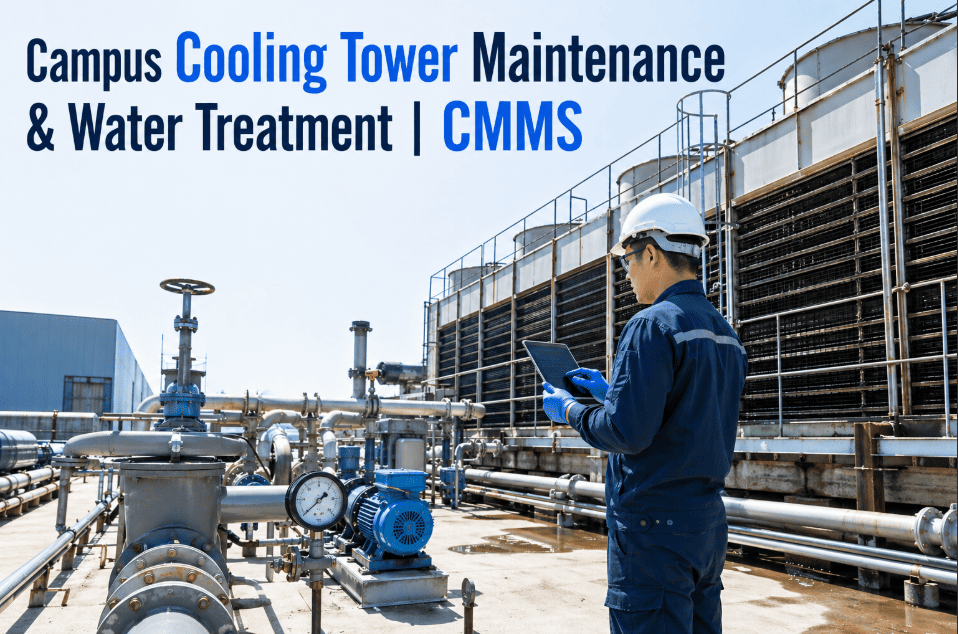
| Cooling tower fill and nozzle inspection | Semi-annually | Fouled towers raise CW temp 3-8F | Condition scoring with replacement forecasting |
| Economizer valve and control calibration | Annually (pre-season) | Enables 15-30% free cooling capture | Pre-season PM checklist with valve stroke test results |
| VFD inspection on CW and CHW pumps | Annually | VFD faults cause fixed-speed operation | Drive fault history and parameter verification |
| kW/ton baseline measurement | Seasonal startup | Establishes performance benchmark | Per-unit efficiency logged and trended year-over-year |
Oxmaint automates every task on this schedule, assigns it to the right technician, and captures completion data with timestamps and measurements. The result is a chiller plant that maintains design efficiency year after year instead of degrading silently. Explore how this works — book a demo or start a free trial.
How Oxmaint Optimizes Your Chiller Plant
Every chiller, cooling tower, pump, VFD, economizer, and control valve is registered with nameplate data, tonnage, design kW/ton, refrigerant type, and installation date. Asset hierarchy links all components to the plant they serve.
Pre-cooling-season startup PMs, mid-season tube cleaning, and post-season shutdown procedures are auto-scheduled. Operators receive mobile notifications 14 days before each task is due.
Efficiency readings per chiller unit are logged at seasonal startup and monthly during operation. Year-over-year trend charts reveal which units are degrading and need maintenance intervention.
Pre-season economizer PMs verify valve operation, heat exchanger cleanliness, and control setpoint accuracy — ensuring free cooling activates at the right conditions instead of sitting idle.
Charge weights and oil analysis results are recorded per chiller. The system flags abnormal trends — refrigerant loss rates, acid number increases — before they cause compressor damage.
Condition scoring and maintenance cost trending per chiller feed into rolling 5-10 year CapEx models. When a chiller's maintenance cost curve inflects, Oxmaint flags it for replacement evaluation.
Before Optimization vs. After CMMS-Driven Optimization
Frequently Asked Questions
What is a good kW/ton target for a university chiller plant?
When should we activate water-side economizer free cooling?
How often should chiller tubes be cleaned?
Can CMMS help with chiller replacement capital planning?
Your Chiller Plant Has Hundreds of Thousands in Savings Waiting
Every degree of fouled approach temperature, every missed free cooling hour, and every oversized chiller running at low load costs your campus money. Oxmaint gives you the PM framework, efficiency tracking, and data visibility to capture those savings starting this cooling season.
![university-sustainability-initiatives-carbon-tracking-scope-1-2-3-cmms[1]](./manage-post-2k26/uploads/university-sustainability-initiatives-carbon-tracking-scope-1-2-3-cmms[1].png)