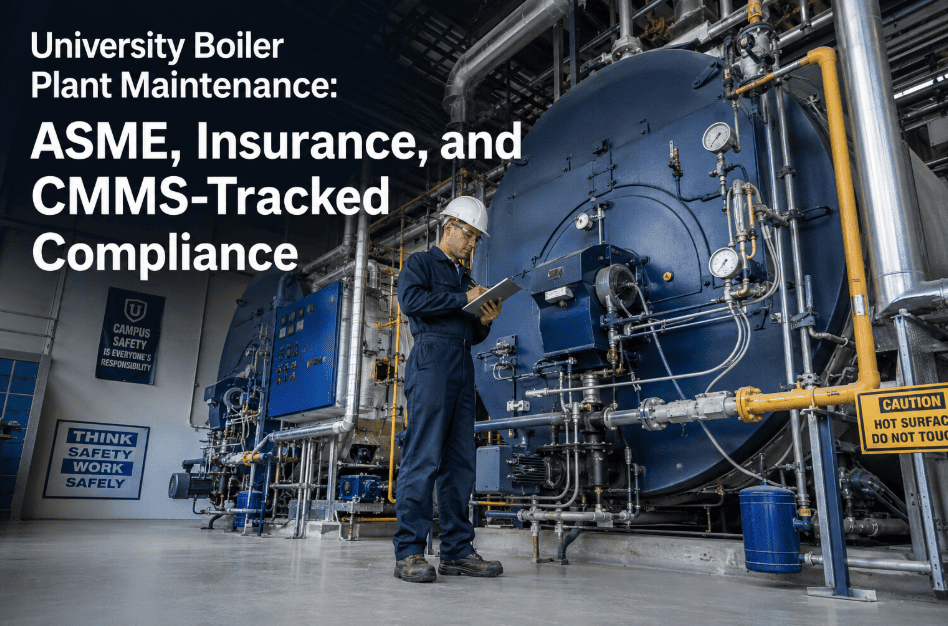
University boiler plants are among the most regulated and safety-critical assets on any campus — yet 62% of higher education facilities teams rely on paper logs and spreadsheets to track ASME compliance, insurance jurisdictional inspections, and water treatment records. A single missed inspection or undocumented operator log can trigger insurance coverage gaps, regulatory citations, and catastrophic equipment failure. Campus boiler plants operating above 15 PSI fall under ASME Section VI requirements, and insurance carriers conduct jurisdictional inspections on their own schedules — schedules that don't align with your academic calendar. The facilities directors who avoid compliance gaps are the ones running every boiler PM, inspection, and water treatment task through a CMMS platform like Oxmaint that timestamps every action and generates audit-ready documentation automatically. If your campus boiler program still depends on binder-based records, the risk exposure is real and measurable — want to see how Oxmaint closes that gap? Book a demo or start a free trial.
University Boiler Plant Maintenance: ASME, Insurance, and CMMS-Tracked Compliance
ASME Section VI protocols, insurance jurisdictional inspections, water treatment documentation, operator logs, and how CMMS transforms campus boiler plant compliance from reactive paperwork into automated, audit-ready operations.
Stop Tracking Boiler Compliance on Paper
Oxmaint auto-generates ASME-aligned PM schedules, timestamps every operator log and water treatment reading, and produces inspection-ready reports that satisfy insurance carriers and jurisdictional authorities — no binders required.
What Is University Boiler Plant Maintenance?
University boiler plant maintenance encompasses the full lifecycle management of high-pressure steam and hot water boilers that serve campus heating, domestic hot water, laboratory steam supply, and sterilization systems. Unlike commercial building boilers, university boiler plants often operate at pressures above 15 PSI, placing them under ASME Boiler and Pressure Vessel Code Section VI — the standard governing care and operation of heating boilers. Compliance involves daily operator rounds, scheduled PM tasks, annual insurance jurisdictional inspections, water treatment programs, safety valve testing, and documentation that proves every task was completed on time and by qualified personnel. A campus with 3-5 boilers generating 50,000+ lbs/hr of steam needs a system that tracks every data point — not a clipboard hanging on the boiler room wall. Facilities teams using Oxmaint centralize every boiler record into a single digital platform that insurance adjusters and state inspectors can access in seconds. Ready to digitize your boiler program? Book a demo or start a free trial.
Core Components of a Campus Boiler Plant Program
Covers operating procedures, safety controls, low-water cutoffs, flame safeguards, and relief valve testing. CMMS schedules every ASME-required task and documents completion with digital signatures.
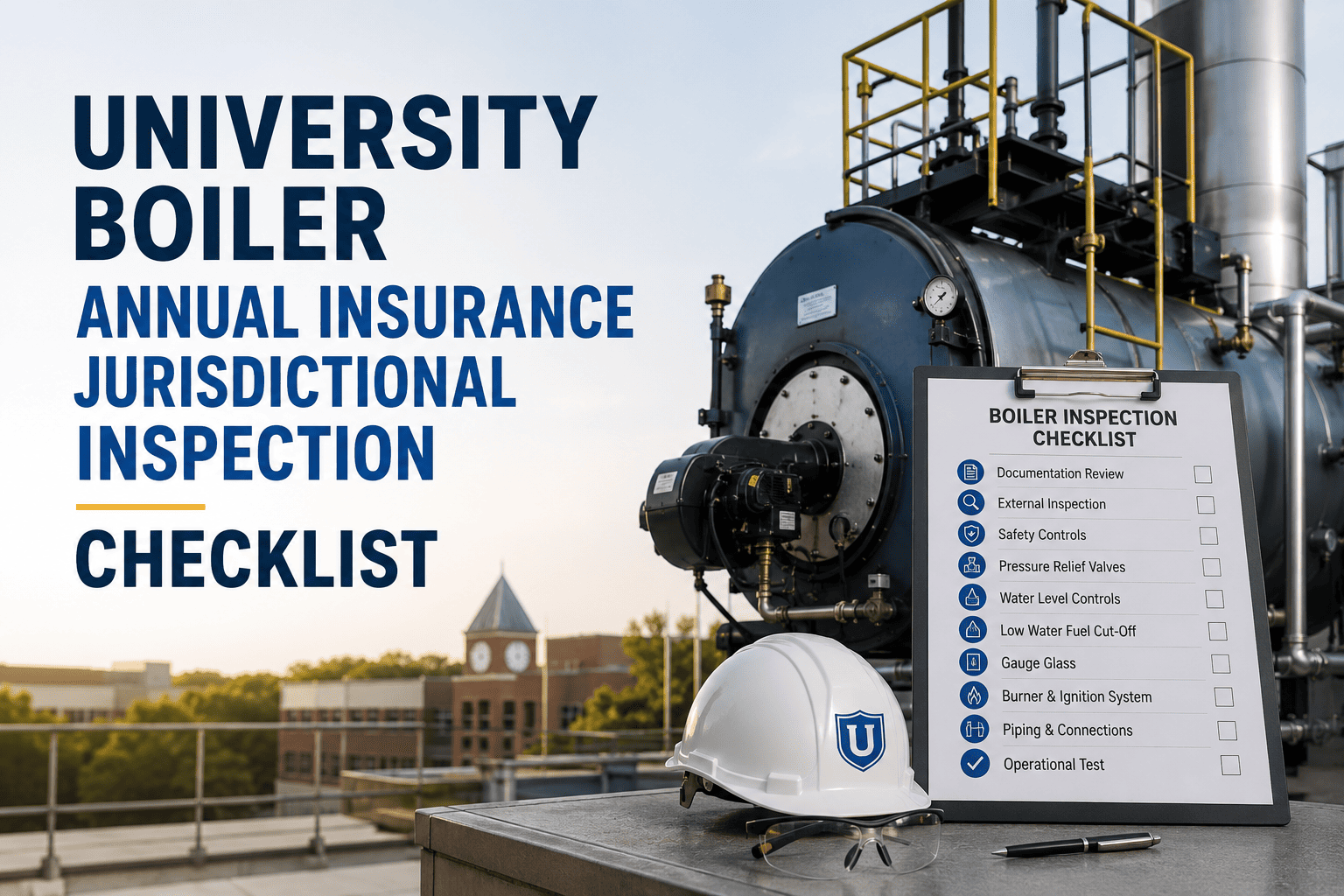
Insurance carriers mandate annual or biennial internal and external inspections. 23% of campus boilers fail first inspection — CMMS pre-inspection checklists reduce failure rates by 38%.
Boiler feedwater chemistry — pH, TDS, hardness, dissolved oxygen — must be logged daily. Poor water treatment causes 68% of boiler tube failures. CMMS timestamps every chemical test and flags out-of-range readings.
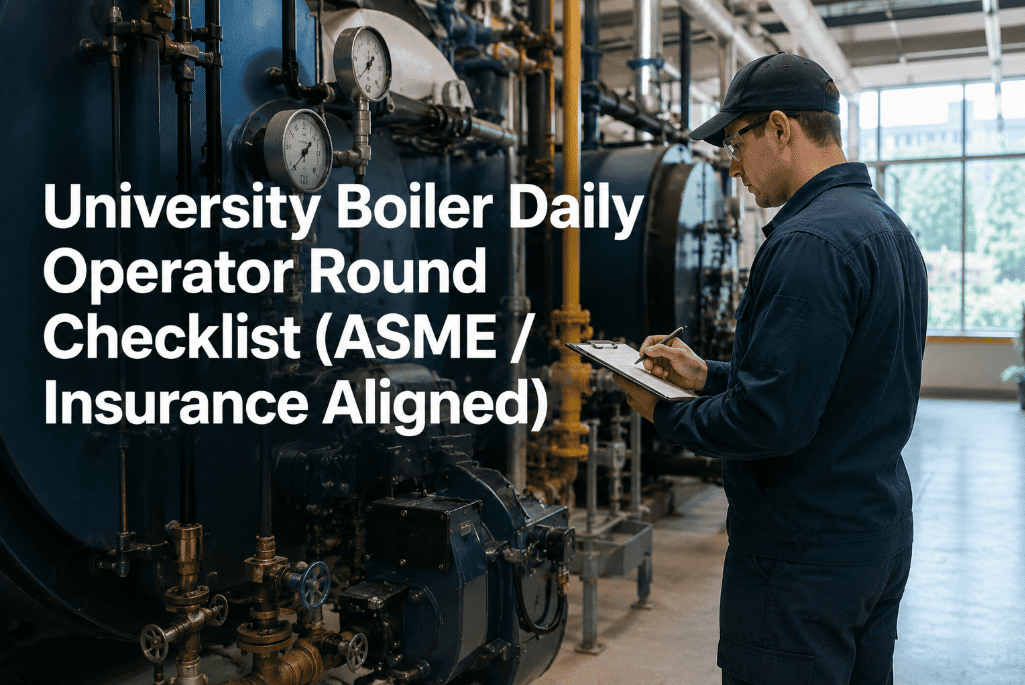
Pressure, temperature, flame condition, stack temperature, and feedwater levels require shift-by-shift documentation. Digital logs in CMMS replace paper round sheets and prevent data loss.
Relief valves, low-water cutoffs, flame safeguards, and fuel shutoff valves require periodic testing per ASME and NFPA 85. CMMS tracks test dates and auto-generates next-due alerts.
Stack gas analysis — O2, CO, CO2, and stack temperature — determines combustion efficiency. A 1% improvement in combustion efficiency saves $12,000-$18,000 annually per boiler in fuel costs.
Why Campus Boiler Plants Fail Inspections
Inspectors require 12 months of continuous operator round documentation. Paper logs with gaps, illegible entries, or missing dates are the most common citation — affecting 41% of campus boiler inspections.
ASME requires relief valve testing at defined intervals. 29% of campuses cannot prove their last safety valve test date because records are stored in disconnected filing systems.
Insurance carriers specifically look for daily feedwater chemistry logs. Without timestamped records, carriers can deny claims related to tube failures — which average $85,000 per incident.
Postponed tube replacements and refractory patching lead to unplanned mid-season shutdowns. Campuses that defer boiler maintenance spend 4.8x more on emergency repairs than those on planned schedules.
How Oxmaint Solves Campus Boiler Compliance
Every boiler, burner, feedwater system, deaerator, economizer, and safety device registered with serial numbers, install dates, manufacturer specs, and ASME nameplate data — all searchable in seconds.
Pre-built PM templates covering ASME Section VI requirements — daily rounds, weekly blowdowns, monthly safety tests, seasonal layup procedures — auto-scheduled and assigned to qualified operators.
Mobile-first digital round sheets capture pressure, temperature, flame condition, water level, and stack readings with timestamps and operator ID — eliminating illegible paper logs and data gaps.
Daily chemical test results logged against target ranges. Out-of-range readings trigger automatic corrective action work orders — reducing tube failure risk by up to 52%.
One-click reports compile 12 months of operator logs, PM completion records, safety valve test dates, and water treatment history — the exact documentation package insurance inspectors require.
Condition scoring and remaining useful life calculations flag boilers approaching end-of-life — giving facilities directors 3-5 year lead time for capital budget requests and bond planning.
Paper-Based vs. CMMS-Tracked Boiler Compliance
| Compliance Area | Paper-Based Program | Oxmaint CMMS Program |
|---|---|---|
| Operator Round Logs | Handwritten, often illegible, gaps common | Digital, timestamped, GPS-verified, no gaps |
| Safety Valve Test Records | Filed in binders, hard to locate | Attached to asset record, auto-alerts for next due |
| Water Treatment Logs | Separate spreadsheet, not linked to boiler | Integrated with boiler asset, out-of-range alerts |
| Insurance Inspection Prep | 2-3 days gathering documents | One-click report generation in under 5 minutes |
| PM Completion Rate | Average 61% on paper systems | Average 94% with CMMS scheduling |
| Inspection First-Pass Rate | 77% pass on first attempt | 96% pass on first attempt with CMMS prep |
Universities running Oxmaint report 38% fewer inspection citations and save an average of 14 hours per boiler per year on documentation alone. That time goes back to your operators for actual maintenance work — not paperwork. See the difference in your boiler plant — book a demo or start a free trial.
Frequently Asked Questions
Does Oxmaint include ASME Section VI PM templates for university boilers?
How does Oxmaint handle insurance jurisdictional inspection documentation?
Can we track water treatment chemistry in Oxmaint?
Does Oxmaint support multi-boiler plant configurations across campus?
Your Boilers Run Your Campus — Run Them With Data
ASME compliance, insurance inspections, water treatment logs, operator rounds — every boiler plant requirement flows through documentation. Oxmaint digitizes every record, automates every schedule, and produces every report your inspectors and insurance carriers demand. No more binders. No more gaps. No more failed inspections.