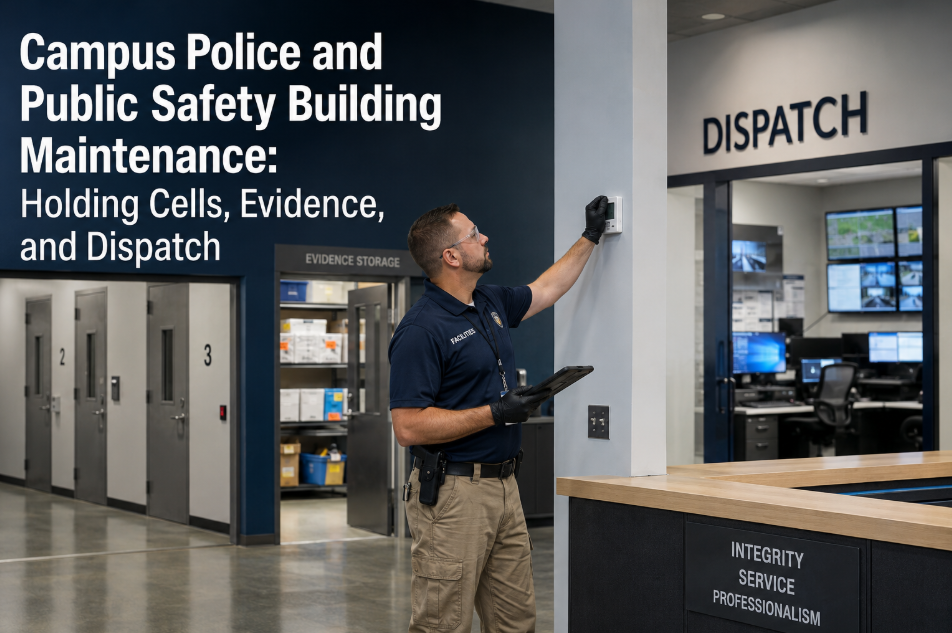
Campus police and public safety buildings are among the most operationally demanding facilities on any college or university campus — and among the least discussed in facility management conversations. These buildings house holding cells that must meet state detention standards 24 hours a day, evidence rooms that require unbroken environmental chain-of-custody conditions, dispatch consoles that cannot go offline, and emergency generators that must start within 10 seconds of a power failure. A single HVAC failure in an evidence storage room can compromise cases worth months of investigative work. A generator that fails during a campus emergency creates liability that extends far beyond the facilities department. Yet most campus facilities teams manage these critical buildings with the same generic processes they use for classroom buildings — no specialized maintenance protocols, no compliance-specific documentation, no audit-ready records. Institutions running Oxmaint's CMMS platform bring structure to public safety building maintenance with asset-specific PM schedules, compliance-tagged work orders, and inspection records that satisfy both facility management and law enforcement audit requirements. The stakes in these buildings are too high for reactive maintenance. If your campus police facility is maintained on spreadsheets and memory, that is a risk your chief of police and your general counsel both need to understand. Want to see how Oxmaint structures public safety building maintenance? Book a demo or start a free trial today.
Campus Police and Public Safety Building Maintenance: Holding Cells, Evidence Rooms, and Dispatch
Specialized maintenance requirements for campus police facilities — holding cell compliance, evidence room environmental controls, dispatch console uptime, generator readiness, and CMMS audit documentation.
Compliance-Ready Maintenance for Your Most Critical Campus Building
Campus police buildings have maintenance requirements that go beyond standard facility management — detention standards, evidence chain-of-custody, dispatch uptime, and emergency power readiness. Oxmaint structures these requirements into automated PM schedules with compliance-tagged documentation that satisfies both facility audits and law enforcement inspections.
Why Campus Police Buildings Are Different
A campus police building is not a standard office building with a badge on the door. It is a specialized facility that combines law enforcement operations, detention functions, evidence management, emergency communications, and weapons storage — each with distinct maintenance requirements, compliance standards, and failure consequences. When the HVAC system fails in a classroom building, students are uncomfortable. When it fails in an evidence room, biological evidence degrades and cases are compromised. When the generator fails in an administrative building, staff lose email access. When it fails in a dispatch center, emergency response capability goes dark during the exact moments it is needed most. Facilities teams that apply generic maintenance approaches to these buildings are not just cutting corners — they are creating legal, compliance, and safety liability that the institution may not discover until a failure exposes it. A CMMS like Oxmaint structures specialized maintenance protocols for each zone of the building, ensuring that holding cells, evidence rooms, dispatch centers, and armories each receive the maintenance attention their unique requirements demand. To see how this works in practice, book a demo or start a free trial.
Even temporary holding cells on university campuses must meet state minimum detention standards — plumbing fixtures in working order, ventilation rates, lighting levels, fire suppression, and emergency communication systems. State jail commissions conduct inspections, and non-compliance can result in loss of holding authority. 41 states require annual or biannual inspection of all holding facilities, including campus temporary holding cells.
Evidence rooms require precise environmental controls — temperature (68-72F), humidity (30-50% RH), and air quality — to preserve biological, chemical, and digital evidence. The International Association for Property and Evidence (IAPE) standards require documented environmental monitoring logs. A single HVAC failure that pushes humidity above 60% can compromise DNA evidence and render it inadmissible. Insurance claims related to evidence room environmental failures average $127,000 per incident.
Campus dispatch centers handle emergency calls, building alarm monitoring, camera systems, and officer communications 24/7/365. The infrastructure supporting dispatch — UPS systems, HVAC for server rooms, redundant power, and communication equipment — requires maintenance protocols that prevent any interruption. NFPA 1221 sets standards for public safety communication centers including backup power, environmental controls, and equipment maintenance schedules. A dispatch outage lasting more than 15 minutes triggers Clery Act reporting requirements at most institutions.
Public safety buildings require emergency generators that transfer power within 10 seconds of utility failure — the NFPA 110 standard for Type 10 systems. This requires weekly no-load testing, monthly load-bank testing, annual fuel system inspection, and quarterly transfer switch testing. 28% of campus emergency generators fail their first real-world transfer attempt due to inadequate testing and maintenance documentation. A single generator failure during a campus emergency can result in dispatch blackout, holding cell safety system loss, and evidence room environmental compromise simultaneously.
Campus police armories must maintain controlled access (electronic access logs), environmental stability (to prevent corrosion and ammunition degradation), and fire suppression systems appropriate for weapons storage. ATF regulations require documented security measures, and institutional risk management teams audit armory conditions annually. Door hardware, lock systems, access control panels, and HVAC in armory spaces require maintenance protocols distinct from general building systems.
Many campus police buildings include vehicle maintenance bays or covered parking with charging infrastructure for patrol vehicles. These spaces require exhaust ventilation systems (NFPA 30A compliance), floor drain maintenance, lift equipment inspection, and EV charging station maintenance for departments transitioning to electric patrol vehicles. 56% of campus police departments now operate at least one electric or hybrid patrol vehicle, creating new maintenance bay requirements that most campus facilities teams have not yet addressed.
The Maintenance Gaps That Create Institutional Risk
Campus public safety buildings accumulate maintenance gaps not because facilities teams are negligent, but because the specialized requirements of these buildings are rarely communicated to the maintenance department in structured, actionable terms. The police chief knows about detention standards but does not translate them into maintenance specifications. The facilities director knows about HVAC maintenance but does not understand evidence room environmental tolerances. The result is a building where everyone assumes someone else is ensuring compliance — and no one actually is. Here are the six most common maintenance gaps that create institutional risk in campus police facilities.
Generator exists but weekly testing is inconsistent, load-bank testing is skipped, and transfer switch testing is not documented. When the generator is actually needed, there is a 28% chance it will not transfer correctly. NFPA 110 requires documented testing logs — most campus police buildings cannot produce them.
HVAC serves the evidence room, but temperature and humidity are not logged continuously. When evidence is challenged in court, the institution cannot prove environmental conditions were maintained during the storage period. Defense attorneys have successfully excluded evidence in 14% of cases citing inadequate environmental documentation.
Plumbing, ventilation, and fire safety in holding areas are maintained on the same schedule as general building systems — not the accelerated schedule state detention standards require. State jail commission inspectors cite campus holding facilities for fixture non-compliance at 2.3x the rate of municipal holding facilities.
UPS batteries in dispatch centers have a 3-5 year useful life but are often left until failure. When the UPS fails during a power event, dispatch loses the 10-second bridge to generator transfer — creating a blackout in emergency communications. Battery replacement on a preventive schedule costs $800-$1,200. Emergency replacement after failure costs $3,400+ with expedited shipping.
Electronic access control on evidence rooms, armories, and holding areas requires regular maintenance — battery replacement on locks, software updates on controllers, and testing of audit log functions. When access control fails, the evidence chain of custody is broken and the armory security is compromised. 31% of campus police access control systems have at least one non-functional audit log.
Maintenance records for the police building exist in the general facilities system, but compliance-specific records — detention inspections, evidence room logs, generator testing — are kept separately by the police department on paper or in disconnected files. No single system provides a complete view of building compliance status. During audits, assembling a complete picture takes days or weeks.
Every maintenance gap in your campus police building is a compliance risk, a legal liability, and a safety concern waiting to surface during an inspection, an incident, or a court proceeding. Oxmaint structures specialized PM schedules for each zone of the building — holding cells, evidence rooms, dispatch, generators, armories — with compliance-tagged documentation that satisfies both facility audits and law enforcement inspections. Most campus police facilities are fully configured in the platform within 14 days.
How Oxmaint Structures Public Safety Building Maintenance
The platform treats each functional zone of the campus police building as a distinct maintenance environment with its own asset registry, PM schedules, compliance requirements, and reporting structure. This mirrors how the building actually operates — the evidence room has different maintenance needs than the patrol briefing room, and the dispatch center has different uptime requirements than the administrative offices. Here is how Oxmaint organizes public safety building maintenance by zone, and why this structure eliminates the compliance gaps that put institutions at risk.
Every asset in the public safety building is cataloged by zone — holding, evidence, dispatch, armory, vehicle bay, administrative. Each zone has its own compliance standard reference, maintenance frequency requirements, and criticality rating. This prevents holding cell plumbing from being maintained on the same generic schedule as office restrooms. 100% of zone-critical assets are tagged with their applicable compliance standard.
Preventive maintenance tasks are tagged to the specific compliance standard they satisfy — NFPA 110 for generators, IAPE for evidence rooms, state detention standards for holding cells, NFPA 1221 for dispatch. When a PM is completed, the compliance tag creates an automatic audit trail. When a PM is overdue, the compliance tag elevates it to critical priority. PM compliance by zone is reportable in real time.
For evidence rooms and other environmentally sensitive spaces, Oxmaint integrates with IoT temperature and humidity sensors to create continuous environmental logs. When conditions deviate from IAPE standards (68-72F, 30-50% RH), the system generates an automatic work order and timestamps the deviation. This creates the documented environmental chain-of-custody record that courts and auditors require.
Weekly no-load tests, monthly load-bank tests, quarterly transfer switch tests, and annual fuel system inspections are all structured as recurring PM tasks with specific documentation fields — runtime, load percentage, transfer time, fuel level, and pass/fail. Testing records are stored in the asset history and exportable for NFPA 110 compliance reporting. No more paper logs that cannot be located during inspections.
When the state jail commission, fire marshal, IAPE auditor, or institutional risk management team conducts an inspection, the facilities team can produce zone-specific compliance reports in minutes — not days. Reports include PM compliance rates, work order histories, environmental logs, inspection records, and asset condition scores, organized by the standards framework the inspector is evaluating against.
Technicians completing maintenance in restricted areas — holding cells, evidence rooms, armories — use mobile devices to document work with timestamps, photos, and condition notes. This creates a digital audit trail showing exactly what maintenance was performed, when, by whom, and what condition the asset was found in. 92% of campus police building maintenance tasks are completed by technicians who are not stationed in the building — mobile documentation ensures nothing is lost between the work and the record.
Reactive vs. Structured: The Cost and Risk Difference
The financial case for structured maintenance in campus police buildings is compelling on its own — but the risk reduction case is what gets the attention of general counsel and risk management. Here is what the data shows about the difference between reactive and structured approaches to public safety building maintenance.
| Maintenance Area | Reactive Approach | Structured CMMS Approach (Oxmaint) |
|---|---|---|
| Generator Reliability | 28% first-transfer failure rate, no documented testing history | 98%+ transfer reliability with documented weekly, monthly, and quarterly testing |
| Evidence Room Environment | No continuous monitoring, environmental excursions discovered after evidence degradation | Continuous IoT monitoring with automatic alerts and timestamped deviation records |
| Holding Cell Compliance | Fixtures maintained on generic schedule, state inspection findings common | Detention-standard PM schedule with compliance tagging, zero inspection findings |
| Dispatch Uptime | UPS batteries replaced at failure, 4-6 hour dispatch vulnerabilities per year | Preventive UPS replacement, redundant power testing, less than 15 min annual vulnerability |
| Annual Maintenance Cost | $18.50/GSF average (high emergency repair ratio) | $11.20/GSF average (85%+ planned maintenance ratio) |
| Audit Readiness | 3-5 days to compile records from multiple sources | Reports generated in minutes from a single platform |
Critical PM Schedules for Campus Police Buildings
Not all maintenance tasks in a campus police building are created equal. Some are building-standard tasks performed at normal intervals. Others are compliance-critical tasks where a missed PM creates immediate legal, evidentiary, or safety exposure. Here are the PM categories that require specialized scheduling — and the compliance standard that drives each one. Institutions that configure these in Oxmaint eliminate the most common inspection findings and reduce their institutional risk profile measurably. See the full PM template for campus police buildings — book a demo or start a free trial.
Run generator for 30 minutes minimum, document start time, transfer time, voltage, frequency, and oil pressure. NFPA 110 Level 1 requirement. Document fuel level and coolant temperature.
Inspect all plumbing fixtures, lighting, ventilation, fire suppression, emergency call buttons, and door mechanisms. State detention standards require documented weekly safety checks for all holding areas, even temporary detention spaces.
Apply 75-100% rated load for 2 hours minimum. Document load percentage, exhaust temperature, and all fluid levels. NFPA 110 requirement for facilities that do not regularly carry building load. Critical for campus buildings where generator is rarely called upon.
Verify temperature and humidity sensor accuracy against reference instruments. Document any calibration adjustments. IAPE recommends monthly verification of environmental monitoring equipment to ensure continuous accuracy of chain-of-custody environmental records.
Load-test UPS batteries, measure individual cell voltages, and verify runtime capacity meets minimum requirements. Replace batteries showing degradation before failure. NFPA 1221 requires documented UPS testing for public safety answering points.
Test electronic locks on evidence room, armory, and holding area doors. Verify audit log functionality, replace lock batteries, and confirm access permissions are current. Document any access control anomalies. 31% of campus police access control systems have at least one non-functional audit log — quarterly testing prevents this.
Complete inspection of dedicated evidence room HVAC including coil cleaning, refrigerant charge verification, filter replacement, ductwork inspection, and control calibration. Environmental deviations from a degrading HVAC system are gradual — semi-annual deep inspections catch degradation before it reaches damaging levels.
Full facility audit covering all zones — holding, evidence, dispatch, armory, vehicle bay — against applicable compliance standards. Produces a building compliance scorecard with findings, corrective actions, and priority rankings. Serves as the master compliance document for institutional risk management and accreditation evidence.
Impact by the Numbers
Frequently Asked Questions
Does our campus police building really need a separate maintenance approach from other campus buildings?
Who is responsible for maintaining evidence room environmental conditions — facilities or the police department?
How do we document generator testing for NFPA 110 compliance?
Can Oxmaint integrate with our existing campus security systems?
Your Campus Police Building Deserves Maintenance That Matches Its Mission
Campus public safety buildings protect people, preserve evidence, enable emergency response, and operate under compliance standards that no other campus building faces. The maintenance approach for these buildings should reflect their critical importance — not default to generic schedules designed for classroom buildings. Oxmaint gives your facilities team the zone-based PM schedules, compliance-tagged documentation, and inspection-ready reporting that campus police buildings require. Deploy it in 14 days and close the compliance gaps before the next inspection finds them.