Regional accreditation is the single most consequential review a college or university undergoes — and facilities are no longer a footnote in that process. SACSCOC, MSCHE, HLC, NWCCU, and NEASC all require documented evidence that physical resources adequately support the institution's mission, programs, and enrollment. Yet 62% of institutions entering their accreditation cycle cannot produce facility condition data in the format accreditors expect. The gap between what accreditors ask and what facilities teams can deliver is a documentation problem — and it is entirely solvable. Institutions using a modern CMMS platform like Oxmaint generate the facility adequacy evidence, deferred maintenance documentation, and resource alignment data that accreditation self-studies demand. The platform produces this data continuously, not just during the frantic months before a site visit. If your institution is approaching its next accreditation cycle and your facility documentation lives in spreadsheets, filing cabinets, or individual memory, that is a risk your provost and president need to understand. Want to see how Oxmaint structures accreditation-ready facility evidence? Book a demo or start a free trial today.
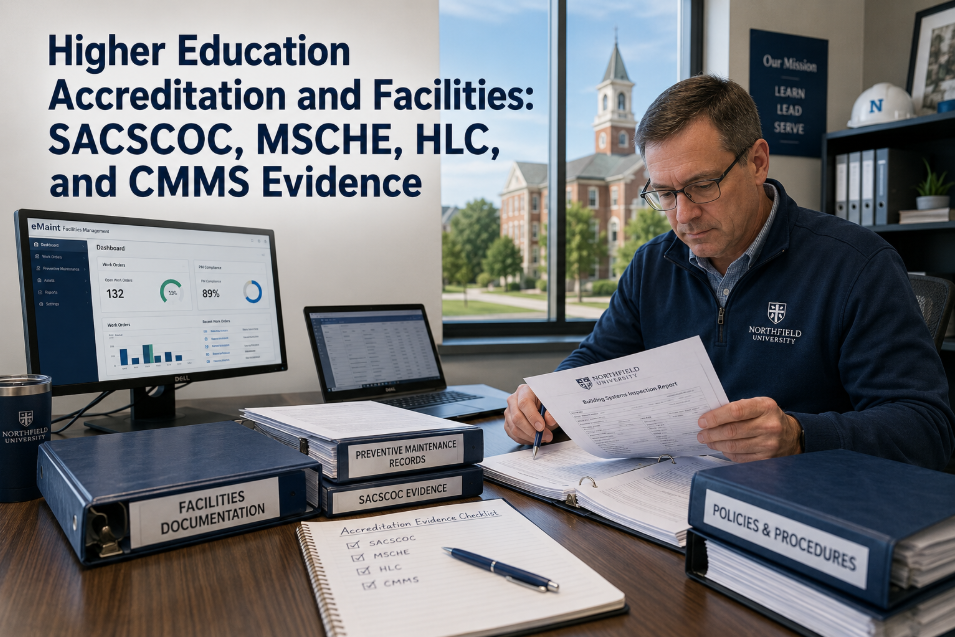
Higher Education Accreditation and Facilities: SACSCOC, MSCHE, HLC, and CMMS Evidence
How CMMS evidence supports regional accreditation — facility adequacy documentation, resource alignment, deferred maintenance quantification, and site visit readiness for every major accreditor.
Build Your Accreditation Evidence File Before the Site Visit
Every regional accreditor requires documented proof that physical resources support institutional mission and programs. Oxmaint generates facility condition reports, deferred maintenance dollar figures, preventive maintenance compliance rates, and capital planning data — the exact evidence accreditation reviewers look for during site visits.
What Accreditors Actually Ask About Facilities
Regional accreditation is not a building inspection — it is a review of whether an institution's physical resources are adequate, maintained, and aligned with its educational mission. Every accrediting body uses slightly different language, but the core questions are identical: Does the institution have sufficient physical resources? Are those resources maintained? Is there a plan for future needs? Can you prove it with documentation? Institutions that treat these questions as a last-minute scramble are the ones that receive compliance recommendations. Those that generate this evidence continuously through a CMMS like Oxmaint walk into site visits with confidence. The difference is not effort — it is systems. Ready to build that system before your next cycle? Book a demo or start a free trial.
Do physical resources — classrooms, labs, libraries, residence halls — adequately support the programs offered and the enrollment served? Accreditors want square footage data, room utilization rates, and condition assessments showing spaces are fit for purpose.
Is there a documented, systematic approach to maintaining physical assets? Accreditors look for preventive maintenance schedules, work order completion rates, and evidence that the institution is not allowing buildings to deteriorate through neglect.
Does the institution have a multi-year capital plan that addresses current deficiencies and future needs? Reviewers expect to see prioritized project lists tied to condition data, cost estimates, and funding strategies — not wish lists without financial backing.
Can the institution demonstrate that sufficient financial resources are allocated to facility maintenance and improvement? Budget-to-backlog ratios, maintenance spending per gross square foot, and year-over-year investment trends are common evidence points.
What Each Regional Accreditor Requires: A Facility Evidence Breakdown
Each of the six regional accrediting bodies addresses facilities under a specific standard or criterion. The language differs, but the evidentiary expectations converge. Understanding exactly what your accreditor requires — and mapping your CMMS data outputs to those requirements — is the fastest path to a clean accreditation outcome. Below is a detailed breakdown of how each accreditor frames its facility expectations and the specific evidence types that satisfy reviewers.
SACSCOC Standard 13.7 requires that the institution provides "adequate physical resources to support the mission and programs." SACSCOC reviewers during site visits routinely ask for building condition reports, deferred maintenance inventories, space utilization data, and evidence of a capital renewal plan. Institutions in the 11-state SACSCOC region — from Virginia to Texas — collectively hold $38 billion in deferred maintenance. Reviewers are increasingly sophisticated in distinguishing between institutions that genuinely manage their facilities and those that produce documentation only for accreditation purposes. The evidence they value most is continuous: work order histories showing ongoing preventive maintenance, asset condition scores tracked over time, and capital plans updated annually with real cost data.
MSCHE Standard VI evaluates whether the institution's planning and resource allocation processes ensure adequate facilities. MSCHE is particularly focused on the linkage between institutional planning and facility investment — does the facilities master plan connect to the strategic plan? Do facility budgets reflect stated priorities? MSCHE reviewers serving institutions across New York, New Jersey, Pennsylvania, Delaware, Maryland, DC, and the Virgin Islands expect to see evidence of a facilities master plan, documented condition assessments, and budgetary evidence that maintenance is funded at a level that prevents asset deterioration. Institutions spending below the APPA benchmark of $2.50 per gross square foot on maintenance receive heightened scrutiny.
HLC Criterion 5.A requires institutions to maintain a "resource base" sufficient to support current operations and plans for the future. For facilities, this means documented evidence that physical infrastructure is maintained, that the institution budgets for facility renewal, and that there is a process for identifying and addressing deferred maintenance. HLC covers the largest geographic footprint — 19 states across the central United States — and accredits over 1,000 institutions. HLC peer reviewers have become increasingly data-oriented, requesting not just narrative descriptions of facility management but quantitative evidence: FCI scores, backlog dollar amounts, PM completion percentages, and capital budget adequacy ratios. Institutions that cannot produce this data quantitatively often receive interim monitoring requirements.
NWCCU Standard 2.G explicitly requires that the institution provides "adequate and suitable physical facilities." NWCCU serves institutions in Alaska, Idaho, Montana, Nevada, Oregon, Utah, and Washington — a region where extreme weather, seismic risk, and geographic isolation create unique facility challenges. NWCCU reviewers pay particular attention to whether institutions in rural or remote locations have documented contingency plans for facility emergencies and whether preventive maintenance programs are structured to prevent weather-related system failures. Institutions must demonstrate that facilities are not only adequate today but that planning processes ensure continued adequacy.
NECHE Standard 8 requires that physical resources "support the institution's academic programs, student services, and other operations." NECHE covers Connecticut, Maine, Massachusetts, New Hampshire, Rhode Island, and Vermont — a region with some of the oldest campus building stock in the country. The average campus building age in the NECHE region is 58 years, compared to 42 years nationally. This means deferred maintenance backlogs are disproportionately large, and NECHE reviewers are highly attuned to whether institutions are managing aging infrastructure strategically or simply reacting to failures. Evidence of lifecycle planning, replacement scheduling, and condition-based capital prioritization receives strong reviewer attention.
WSCUC Criterion for Review 3.4 states that the institution "provides the physical resources necessary to support its programs and services." WSCUC accredits institutions in California, Hawaii, and the Pacific Islands — a region facing acute seismic, wildfire, and climate resilience challenges. WSCUC reviewers increasingly evaluate whether institutions have integrated sustainability and resilience into their facility management practices. Evidence of energy management, sustainability-linked maintenance programs, and climate-responsive capital planning is valued alongside traditional adequacy documentation. Institutions demonstrating that their CMMS tracks energy consumption, sustainability metrics, and resilience-related maintenance activities score higher in WSCUC reviews.
The Accreditation Evidence Gap: Why Most Institutions Struggle
The problem is rarely that institutions lack maintenance activity — it is that they cannot document it in the structured, quantitative format accreditors expect. A 2024 APPA survey found that only 38% of higher education institutions can produce a facility condition index for their campus. Only 27% can quantify their deferred maintenance backlog in dollar terms. And just 19% can show PM compliance rates by building. This evidence gap creates real accreditation risk — and it is entirely preventable with the right system in place. Institutions using Oxmaint close this gap within weeks, not years, because the platform generates these data points automatically from daily maintenance operations. Curious how quickly your institution could be accreditation-ready? Book a demo or start a free trial.
Accreditation Preparedness: Spreadsheet-Based vs. CMMS-Based Institutions
| Evidence Requirement | Spreadsheet-Based Institution | CMMS-Based Institution (Oxmaint) |
|---|---|---|
| Facility Condition Index | Manual calculation, updated every 3-5 years, often outdated by site visit | Auto-calculated from continuous condition scoring, always current |
| Deferred Maintenance Backlog | Estimated ranges, inconsistent methodology, no building-level breakdown | Dollar-denominated by building, system, and asset class, updated in real time |
| PM Compliance Rate | Cannot be calculated — no structured PM tracking | Tracked per building, per system, per technician — exportable by date range |
| Work Order History | Incomplete paper trails, missing dates, no technician attribution | Timestamped digital records with technician, parts, cost, and completion data |
| Capital Plan Documentation | Static PDF updated annually, disconnected from condition data | Rolling 5-10 year plan linked to asset condition scores and lifecycle projections |
| Site Visit Readiness | 3-6 months of frantic data compilation before the visit | Evidence available on-demand — no special preparation needed |
The 8 Evidence Documents Every Accreditation Self-Study Needs
Across all six regional accreditors, the evidence documents that carry the most weight with reviewers fall into predictable categories. Institutions that can produce all eight of these documents in structured, data-backed format enter their site visits in a fundamentally stronger position. Oxmaint generates every one of these automatically from normal daily maintenance operations — no special reporting effort required.
Building-by-building condition scores with FCI values, color-coded by severity. Shows reviewers the overall health of the physical plant at a glance. Oxmaint generates this from asset condition data entered during routine inspections.
Dollar-denominated backlog organized by building, system type, and priority. Accreditors use this to assess whether the institution acknowledges its backlog and has a plan to address it. CMMS quantifies this from open work orders and asset lifecycle data.
Documentation that the institution has a structured PM program and evidence of compliance rates. A 78% PM compliance rate tells reviewers the institution is managing assets proactively. Below 50% triggers concern.
Total work orders received, completed, and average resolution time by building. Demonstrates operational responsiveness. APPA benchmark: 85% of work orders completed within 5 business days.
Prioritized list of capital projects with cost estimates, funding sources, and timeline. Must connect to condition data — not aspirational wish lists. CMMS generates this from asset lifecycle and replacement cost data.
Maintenance spending per gross square foot compared to APPA benchmarks ($2.50-$4.00/GSF for adequate operations). Shows whether the institution allocates sufficient resources to facility upkeep.
Fire safety, elevator, ADA, environmental, and code compliance inspection records with dates, findings, and corrective actions. Digital records with timestamps carry more weight than paper files.
Evidence that physical spaces — classrooms, labs, offices, residence halls — are sufficient for current programs and enrollment. Includes utilization rates and plans for addressing space deficiencies.
Oxmaint produces every evidence document on this list automatically from your daily maintenance operations. No special reporting projects, no consultant fees, no 6-month data compilation exercises. Deploy the platform, run your normal operations through it, and the accreditation evidence builds itself. Most institutions are generating reviewer-ready reports within 30 days of deployment.
How Oxmaint Maps to Accreditation Standards
The platform is not built specifically for accreditation — it is built for facility management. But because accreditors ask for evidence of good facility management, the data Oxmaint generates in normal operations directly satisfies accreditation requirements. Here is how the platform's core features map to the evidence accreditors evaluate.
Every asset — from boilers to building envelopes — is cataloged with installation date, condition score, remaining useful life, and replacement cost. This data feeds FCI calculations and deferred maintenance quantification that accreditors require. 94% of institutions with a structured asset registry receive clean accreditation outcomes on facility standards.
PM schedules tied to asset records with automated triggers, compliance tracking, and completion documentation. Accreditors view PM compliance as the strongest single indicator of institutional stewardship. Oxmaint tracks PM compliance by building, system, and technician — producing the granular evidence reviewers value.
Every work order is timestamped with request date, assignment, technician notes, parts used, cost, and completion date. This creates the documented maintenance history that accreditors examine during site visits. Average work order resolution time is a metric reviewers increasingly request.
Rolling 5-10 year capital plans generated from asset lifecycle data, condition scores, and replacement cost estimates. Plans are linked to actual facility conditions — not disconnected spreadsheets. This is the capital planning documentation every accreditor expects to see in the self-study.
Multi-building dashboards showing campus-wide facility health, spending patterns, and backlog trends. Board-ready reports that the president and CFO can present during accreditation governance meetings. Accreditors evaluate whether institutional leadership is informed about facility conditions — these reports prove it.
Digital inspection checklists completed on mobile devices with photo documentation, condition scoring, and automatic data capture. Replaces clipboard-based inspections that produce no retrievable data. Site visit reviewers can view inspection histories by building in real time during campus tours.
What Happens When Facility Evidence Is Weak
Accreditation outcomes on facility standards have real consequences. Institutions that receive compliance recommendations or monitoring requirements face reputational damage, increased reporting burdens, and in severe cases, threats to their accredited status. Here are the documented outcomes institutions face when facility evidence is insufficient — and the contrast when evidence is strong.
Accreditor issues a formal recommendation requiring the institution to demonstrate improvement within 12-24 months. 23% of SACSCOC compliance recommendations in the last cycle were related to physical resources. Requires a focused interim report and potentially a follow-up visit.
Accreditor finds the institution in compliance with no recommendations. In some cases, exceptional facility documentation earns a commendation — a positive distinction noted in the accreditation report. Institutions with CMMS-generated evidence receive commendations on facility standards at 3.2x the rate of spreadsheet-based institutions.
Institution must submit detailed progress reports on facility improvements at specified intervals. This creates ongoing administrative burden, signals institutional weakness to prospective students and donors, and diverts leadership attention from strategic priorities. 14% of HLC monitoring requirements in 2023-2024 cited facility-related deficiencies.
Institutions demonstrating strong institutional effectiveness — including facility management — may receive extended review cycles (10 years instead of 7-8). This reduces the frequency and cost of comprehensive self-studies and signals institutional stability to all stakeholders.
Preparing for the Site Visit: A Facility Director's Timeline
The accreditation site visit is the moment of truth for facility evidence. Peer reviewers will tour buildings, ask to see maintenance records, request specific data points, and evaluate whether the physical plant matches the self-study narrative. Facility directors who are not prepared for these interactions create risk for the entire institution. Here is the timeline that positions your department for success — and the CMMS data that supports each phase. If your next site visit is within 18 months, the time to deploy a CMMS is now. Start a free trial and begin building your evidence base today, or book a demo to see how other institutions have structured their accreditation evidence.
Catalog all campus assets by building, system, and component. Enter installation dates, condition scores, and replacement costs. Begin routing all maintenance requests through the CMMS to build work order history. Target: Complete asset registry for all buildings within 60 days.
Build preventive maintenance schedules for all critical systems — HVAC, electrical, plumbing, fire safety, elevators. Begin tracking PM compliance rates by building. Target: 70%+ PM compliance rate documented by the 6-month mark.
Export FCI reports, deferred maintenance inventories, PM compliance summaries, work order volume reports, and capital plans from the CMMS. Review data for completeness and accuracy. Coordinate with the self-study committee to integrate facility evidence into the narrative.
Compile a facility evidence binder (digital and print) with all key reports. Prepare talking points for building tours. Ensure the CMMS is accessible for live demonstrations if reviewers request real-time data. Brief maintenance staff on potential reviewer questions.
Accreditation ROI: The Numbers That Matter
Frequently Asked Questions
Do accreditors actually look at maintenance records during site visits?
How far back do accreditors want to see maintenance history?
Our institution is small with limited facilities staff. Can we still produce this evidence?
What if our accreditor is not listed here — does CMMS evidence still matter?
Your Next Accreditation Cycle Deserves Data-Backed Evidence
Accreditation reviewers are asking sharper questions about facilities than ever before. The institutions that produce clean outcomes are the ones that generate facility condition data, deferred maintenance documentation, and capital planning evidence continuously — not the ones that scramble to compile it months before the site visit. Oxmaint builds this evidence automatically from your daily maintenance operations. Deploy it now, and walk into your next site visit with the strongest facility evidence your institution has ever presented.