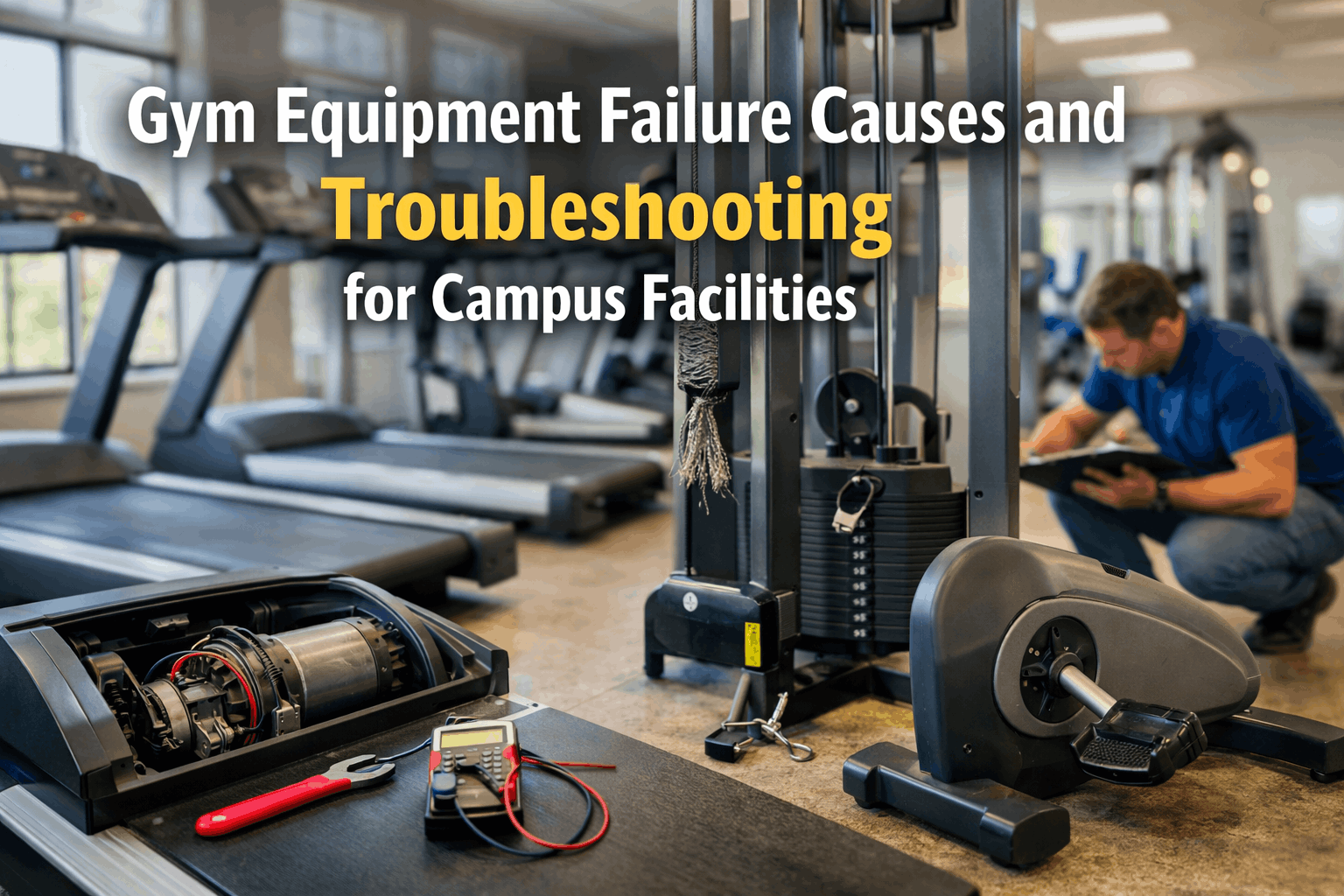
The weight stack crashes down without warning. A student stumbles as the treadmill belt suddenly stops. The cable machine that was fine yesterday now makes a grinding sound that stops everyone mid-workout. For campus recreation directors, equipment failures aren't just maintenance headaches—they're safety incidents waiting to happen.
Understanding why gym equipment fails—and recognizing the early warning signs—transforms your maintenance approach from reactive firefighting to proactive prevention. This guide breaks down the most common failure modes for campus fitness equipment, their root causes, and the troubleshooting steps that can prevent injuries and extend equipment life.
Why Campus Gym Equipment Fails Faster
Commercial gym equipment is built for heavy use, but campus recreation centers push equipment harder than most commercial facilities. The combination of high volume, variable users, and academic calendar patterns creates unique stress on every piece of equipment in your facility.
Extreme Usage Spikes
January resolution rushes and pre-finals stress workouts create 40-60% usage increases that accelerate wear on components designed for steady loads.
Inexperienced Users
First-time gym users may drop weights, use incorrect form, or force adjustment mechanisms—all accelerating component fatigue.
Deferred Summer Maintenance
Reduced summer staffing often means maintenance backlogs, and equipment returns to heavy fall use without proper servicing.
The good news? Most equipment failures follow predictable patterns. By understanding these failure modes, you can catch problems early—before they become safety incidents or expensive emergency repairs.
Treadmill Failures: Causes and Troubleshooting
Treadmills account for more campus gym injuries than any other equipment category. Their combination of moving parts, electrical components, and high-impact use creates multiple failure points that demand attention.
Belt Slipping or Stopping
High RiskWhat Happens
The belt hesitates when users step on, slows under load, or stops suddenly during use. Users may stumble or fall, particularly during sprints or incline work.
Root Causes
- Belt tension loss: Normal stretching over time causes the belt to lose grip on the drive roller
- Worn drive belt: The motor-to-roller belt degrades, reducing power transfer
- Deck friction: Insufficient lubrication increases resistance, overwhelming motor capacity
- Motor controller issues: Failing electronics can't maintain consistent speed under load
Troubleshooting Steps
- Check belt tension by lifting the belt edge at center—should lift 2-3 inches
- Inspect belt surface for glazing, cracks, or worn spots
- Verify deck lubrication (check manufacturer's lubrication schedule)
- Listen for motor strain sounds during load testing
- Check motor controller for error codes or burnt smell
Motor Overheating
Medium RiskWhat Happens
The treadmill shuts down during use, often with a burning smell. Motor housing is hot to touch. Unit may restart after cooling but fails again under load.
Root Causes
- Blocked ventilation: Dust accumulation in motor housing restricts airflow
- Excessive deck friction: Motor works harder to overcome resistance from unlubricated deck
- Failing bearings: Motor bearings create friction and heat as they wear
- Overuse cycles: Continuous heavy use without cool-down periods
Troubleshooting Steps
- Allow motor to cool completely before inspection
- Remove motor cover and vacuum dust from housing and vents
- Check motor brushes for wear (should have at least 1/4" remaining)
- Lubricate deck and verify belt tension to reduce motor load
- Check for proper ventilation clearance around unit
Emergency Stop Failure
Critical RiskWhat Happens
The emergency stop button doesn't immediately halt the belt, or the safety key lanyard doesn't trigger a stop when pulled.
Root Causes
- Worn safety switch: Repeated use degrades the magnetic or mechanical switch
- Corroded contacts: Sweat and humidity cause electrical contact degradation
- Damaged safety key: Magnet weakens or key housing cracks
- Controller malfunction: Signal not being processed correctly
Troubleshooting Steps
- Test emergency stop with belt running at low speed
- Inspect safety key magnet and console receptor
- Check wiring connections to emergency stop circuit
- Verify stop button mechanical function (should click distinctly)
- Test lanyard pull-away response time
Strength Machine Failures: Causes and Troubleshooting
Cable-based strength machines present some of the highest-consequence failure modes in campus gyms. A snapped cable or failed pulley can cause weight stacks to drop suddenly—a scenario that has caused severe injuries and significant liability claims.
Cable Fraying and Snapping
Critical RiskWhat Happens
Cable shows visible wire strand separation, feels rough when running fingers along it, or snaps completely during use—causing the weight stack to drop.
Root Causes
- Fatigue failure: Repeated bending cycles around pulleys weaken individual strands
- Corrosion: Sweat exposure accelerates oxidation of steel strands
- Pulley misalignment: Cables rubbing on pulley edges cause localized wear
- Overloading: Users exceeding weight limits stress cables beyond design parameters
- Age: Most manufacturers recommend cable replacement every 2-3 years regardless of appearance
Troubleshooting Steps
- Run a cloth along entire cable length—snags indicate fraying
- Inspect cable at pulley contact points (highest wear areas)
- Check for kinks, bird-caging (bulging), or corrosion discoloration
- Verify pulley alignment and rotation smoothness
- Review cable age against manufacturer replacement schedule
Pulley Bearing Failure
High RiskWhat Happens
Pulleys make grinding or squeaking sounds, don't rotate smoothly, or seize completely—causing jerky cable movement or sudden resistance changes.
Root Causes
- Bearing wear: High-cycle loading wears bearing races and balls
- Contamination: Dust and debris enter bearing housing
- Lack of lubrication: Sealed bearings eventually deplete lubricant
- Moisture intrusion: Humidity and sweat cause internal corrosion
Troubleshooting Steps
- Manually rotate each pulley—should spin freely and quietly
- Listen for grinding sounds during low-weight operation
- Check for lateral play (wobble) in pulley
- Inspect pulley groove for cable wear patterns
- Verify pulley guards are in place to prevent debris entry
Weight Stack Selector Pin Issues
Medium RiskWhat Happens
Selector pin doesn't fully engage, falls out during use, or won't insert into holes. Weight stack may shift unexpectedly during exercise.
Root Causes
- Pin wear: Repeated insertion/removal wears down pin diameter
- Bent pin: Dropping or forcing causes misalignment
- Hole misalignment: Weight stack plates shift, holes no longer align
- Missing magnetic tip: Magnetic pins lose holding power
Troubleshooting Steps
- Test pin engagement at multiple weight positions
- Check pin for bending or tip wear
- Verify weight stack alignment (plates should be evenly stacked)
- Inspect guide rods for straightness
- Ensure pin tether is intact (prevents pin loss)
Free Weight Equipment Failures
Free weights may seem indestructible, but they have failure modes that create serious safety hazards. Rack failures and bench malfunctions occur at the worst possible moment—when users are under heavy loads.
Bench Pad Separation
High RiskWhat Happens
Bench padding shifts or separates from frame during use, particularly during bench press or heavy movements. User loses stable position under load.
Root Causes
- Mounting hardware loosening: Vibration and repeated loading loosens bolts
- Velcro degradation: Some designs use hook-and-loop mounting that wears out
- Backboard damage: Wooden or composite backing cracks from impact
- Sweat damage: Moisture penetrates seams, weakening adhesives
Troubleshooting Steps
- Apply lateral pressure to pad—should not shift or separate
- Check all mounting bolts and hardware for tightness
- Inspect pad seams for separation or moisture damage
- Verify backboard integrity (no cracks or delamination)
- Test adjustment mechanism locks at all positions
J-Hook and Safety Bar Failure
Critical RiskWhat Happens
J-hooks slip out of position, don't lock securely, or show cracks/deformation. Safety bars fail to catch dropped weight.
Root Causes
- Impact damage: Repeated bar rack/unrack impacts deform hooks
- Liner wear: Protective liners wear through, allowing metal-on-metal contact
- Locking pin wear: Spring-loaded pins lose tension or break
- Weld fatigue: Stress cycles cause microscopic cracks at weld points
Troubleshooting Steps
- Inspect J-hook contact surfaces for deformation or cracks
- Test locking mechanism engagement at multiple heights
- Check liner condition and replace if worn through
- Examine welds with flashlight for crack indications
- Verify safety bars support rated weight capacity
Barbell Collar Failure
High RiskWhat Happens
Collars don't grip bar sleeves securely, slide during use, or release unexpectedly. Weight plates shift or slide off bar ends.
Root Causes
- Spring fatigue: Spring collars lose clamping force over time
- Mechanism wear: Quick-release collars develop play in locking mechanism
- Bar sleeve damage: Scratched or corroded sleeves reduce grip
- Wrong collar type: Standard collars on Olympic bars (or vice versa)
Troubleshooting Steps
- Test collar grip on clean bar section—should not slide
- Check spring tension on spring collars (should require firm pressure to open)
- Verify quick-release mechanism engages fully
- Inspect bar sleeves for damage that reduces grip
- Confirm collar type matches bar specification
Cardio Equipment: Ellipticals and Bikes
While generally safer than treadmills, ellipticals and stationary bikes have failure modes that cause injuries and significant downtime. Bearing failures and resistance system problems are the most common issues.
Pedal/Crank Arm Loosening
High RiskWhat Happens
Pedals develop play, click during rotation, or separate from crank arms during use. On ellipticals, foot platforms may wobble or shift.
Root Causes
- Thread stripping: Improper installation or cross-threading damages threads
- Vibration loosening: High-RPM use causes gradual thread backing
- Crank arm fatigue: Repeated stress cycles cause microscopic cracks
- Bearing failure: Worn pedal bearings create excess play
Troubleshooting Steps
- Check pedal tightness (remember: left pedal is reverse threaded)
- Inspect crank arm attachment to spindle
- Rotate pedals by hand to check bearing smoothness
- Look for cracks at crank arm stress points
- Verify pedal straps or clips are secure
Resistance System Failure
Medium RiskWhat Happens
Resistance doesn't change when adjusted, changes erratically, or becomes stuck at one level. Magnetic systems may make unusual sounds.
Root Causes
- Motor failure: Servo motors that position magnets burn out
- Belt/cable stretch: Mechanical linkage loses adjustment range
- Magnet degradation: Rare but magnets can lose strength over time
- Control board issues: Electronics fail to process resistance commands
Troubleshooting Steps
- Test resistance at all levels from console
- Listen for servo motor movement when adjusting
- Check cable/belt tension on mechanical systems
- Verify console buttons register presses
- Reset equipment to factory defaults if available
Failure Pattern Analysis: What Your Data Tells You
Individual failures are problems. Patterns of failures are opportunities. By tracking failures systematically, you can identify root causes that affect multiple pieces of equipment and make targeted improvements.
Time-Based Patterns
What to look for: Failures clustering at specific times (semester start, January, finals week)
What it means: Usage spikes exceed maintenance intervals. Equipment needs pre-peak-season service.
Action: Schedule preventive maintenance 2 weeks before predictable high-usage periods.
Equipment-Type Patterns
What to look for: One equipment type (e.g., treadmills) failing more than others
What it means: May indicate brand/model issues, improper installation, or inadequate maintenance protocol.
Action: Review manufacturer maintenance requirements and compare to current procedures.
Location-Based Patterns
What to look for: Equipment in specific areas failing more frequently
What it means: Environmental factors (humidity, temperature, dust) or higher traffic in that zone.
Action: Address environmental conditions or redistribute equipment to balance wear.
Component-Based Patterns
What to look for: Same component (belts, cables, bearings) failing across different equipment
What it means: May indicate supplier quality issues or maintenance gaps for that component type.
Action: Evaluate replacement part quality and adjust inspection frequency for that component.
Building a Failure Response Protocol
When equipment fails—especially with potential safety implications—your response needs to be immediate, documented, and consistent. A clear protocol ensures nothing falls through the cracks.
Immediate Lockout
Remove equipment from service immediately. Use lockout tags that clearly state "Out of Service" and prevent use. Never rely on verbal warnings alone.
Document the Failure
Record what happened, when, who discovered it, and any user reports. Take photos of the failure condition. This documentation protects you legally and informs repair decisions.
Assess Severity
Categorize as critical (immediate safety risk), high (potential safety risk), or standard (functional issue). Critical and high-priority items need same-day response.
Notify Stakeholders
Alert supervisors, risk management (for safety-related failures), and users (via signage). Maintain notification records.
Root Cause Analysis
Before simply repairing, understand why the failure occurred. Was it wear, misuse, environmental, or a design flaw? This prevents recurrence.
Repair and Verify
Complete repairs using OEM parts when possible. Test thoroughly before returning to service. Document the repair and any warranty claims.
Pro Tip: The 5 Whys Technique
For recurring failures, use the "5 Whys" root cause analysis method. Ask "why" five times to drill down from symptom to true root cause. Example: Cable broke → Why? It was frayed → Why? Pulley was misaligned → Why? Mounting bolt loosened → Why? Vibration + no thread lock → Root cause: Need thread-locking compound on pulley mounts.
Preventive Measures That Reduce Failures
The cheapest repair is the one you never have to make. These preventive measures significantly reduce failure rates across all equipment categories:
Scheduled Lubrication
Follow manufacturer lubrication schedules precisely. Under-lubrication causes friction failures; over-lubrication attracts dust and debris. Document every lubrication event.
Bolt Torque Checks
Monthly torque verification on all structural bolts prevents loosening failures. Use a torque wrench and follow manufacturer specifications—guessing leads to over/under-tightening.
Cable Replacement Schedule
Replace cables on manufacturer schedules (typically 2-3 years) regardless of visual condition. Internal strand fatigue isn't visible until failure is imminent.
Environmental Controls
Maintain humidity below 60% to reduce corrosion. Ensure adequate ventilation around motorized equipment. Clean dust filters on HVAC monthly during high-use periods.
User Training
Orient new students on proper equipment use. Post clear instructions. Address misuse immediately—one user forcing an adjustment can damage equipment for everyone.
Pre-Peak Maintenance
Schedule comprehensive service 2-3 weeks before predictable high-use periods (January, fall semester start). Equipment entering peak season should be in optimal condition.
Frequently Asked Questions
How do we prioritize which failures to address first?
Use a severity-based system: Critical (immediate safety risk) gets same-day response, High (potential safety risk) within 24-48 hours, Standard (functional issues) within one week. Always err on the side of caution—if there's any doubt about safety, treat it as critical.
Should we repair or replace aging equipment?
Consider replacement when repair costs exceed 50% of replacement value, when parts are no longer available, when the same unit has required 3+ major repairs in 12 months, or when the equipment is more than 10 years old. Document your decision rationale for budget justification.
How do we handle equipment failures that may have caused injury?
Preserve the equipment exactly as it failed—do not repair or adjust anything. Document with photos and written descriptions. Notify risk management and campus safety immediately. Complete an incident report. The equipment may be needed as evidence; only release it after consulting with legal counsel.
What qualifications should technicians have for gym equipment repair?
For major repairs, use manufacturer-certified technicians when possible. In-house staff can handle routine maintenance (lubrication, bolt tightening, belt adjustments) with proper training. Electrical and structural repairs should always be performed by qualified professionals. Document all technician qualifications and training.
How long should we keep failure and repair records?
Retain all maintenance and failure records for the life of the equipment plus 7 years minimum. In cases involving injuries or claims, retain records indefinitely or until legal counsel advises otherwise. Digital record-keeping makes long-term retention practical and searchable.
Ready to Get Ahead of Equipment Failures?
Oxmaint helps campus recreation teams track equipment failures, identify patterns, and build preventive maintenance programs that reduce downtime and liability exposure.