Every superintendent and CBO in America is staring at the same spreadsheet: enrollment projections falling off a cliff, deferred maintenance backlogs ballooning past budget capacity, and bond ratings under scrutiny. The convergence of the 2026 enrollment cliff with a $90 billion school infrastructure funding gap is not a future scenario—it is the operating reality right now. Moody's has explicitly flagged deferred maintenance as a "credit risk" for school districts carrying aging facility portfolios without predictive capital plans. When your facilities are hemorrhaging value, your enrollment margins erode with them. Students and families choose campuses that feel safe, modern, and well-maintained. The districts and universities that survive the cliff will be the ones that treat facility operations as a strategic enrollment lever—not a cost center. Oxmaint is the platform built to make that shift possible. Schedule a free facilities risk assessment to see exactly where your district stands.
The Fiscal Stewardship Crisis: Why Aging Infrastructure Is Your Biggest Enrollment Threat
The American Society of Civil Engineers gives US school infrastructure a D+ grade. That is not a talking point—it is a balance sheet liability. Across 130,000 K–12 schools and 5,300 post-secondary campuses, the average building age now exceeds 44 years. HVAC systems installed before modern ASHRAE 62.1 ventilation standards are failing during peak cooling months. Roofing membranes are past useful life. Electrical panels cannot support the load demands of 1:1 device programs and EV charging infrastructure. Every dollar spent on emergency reactive repairs is three dollars not spent on the strategic capital improvements that attract and retain students.
The 5-Pillar Framework: How Oxmaint Maps to Every US Education Facilities Challenge
Surviving the enrollment cliff is not about cutting budgets harder. It is about operating smarter across five interconnected pillars that determine whether your campus attracts students or loses them. Every pillar below represents a measurable enrollment and compliance lever—and Oxmaint delivers automation, visibility, and audit-readiness across all five simultaneously.
The EPA estimates that poor indoor air quality in schools affects 55 million students daily. ASHRAE 62.1 compliance is no longer optional—it is a parent expectation and, increasingly, a legal requirement. Meanwhile, 2026 decarbonization targets under state-level clean energy mandates require districts to track Scope 1 and Scope 2 emissions from aging boilers, chillers, and building envelopes.
Oxmaint delivers: Automated HVAC preventive maintenance scheduling calibrated to ASHRAE standards. Real-time IAQ sensor integration with threshold alerts. Energy consumption dashboards that track decarbonization progress against state targets. Predictive failure detection on aging mechanical systems—replacing emergency capital outlays with planned, budgetable interventions that extend asset life by 30%.
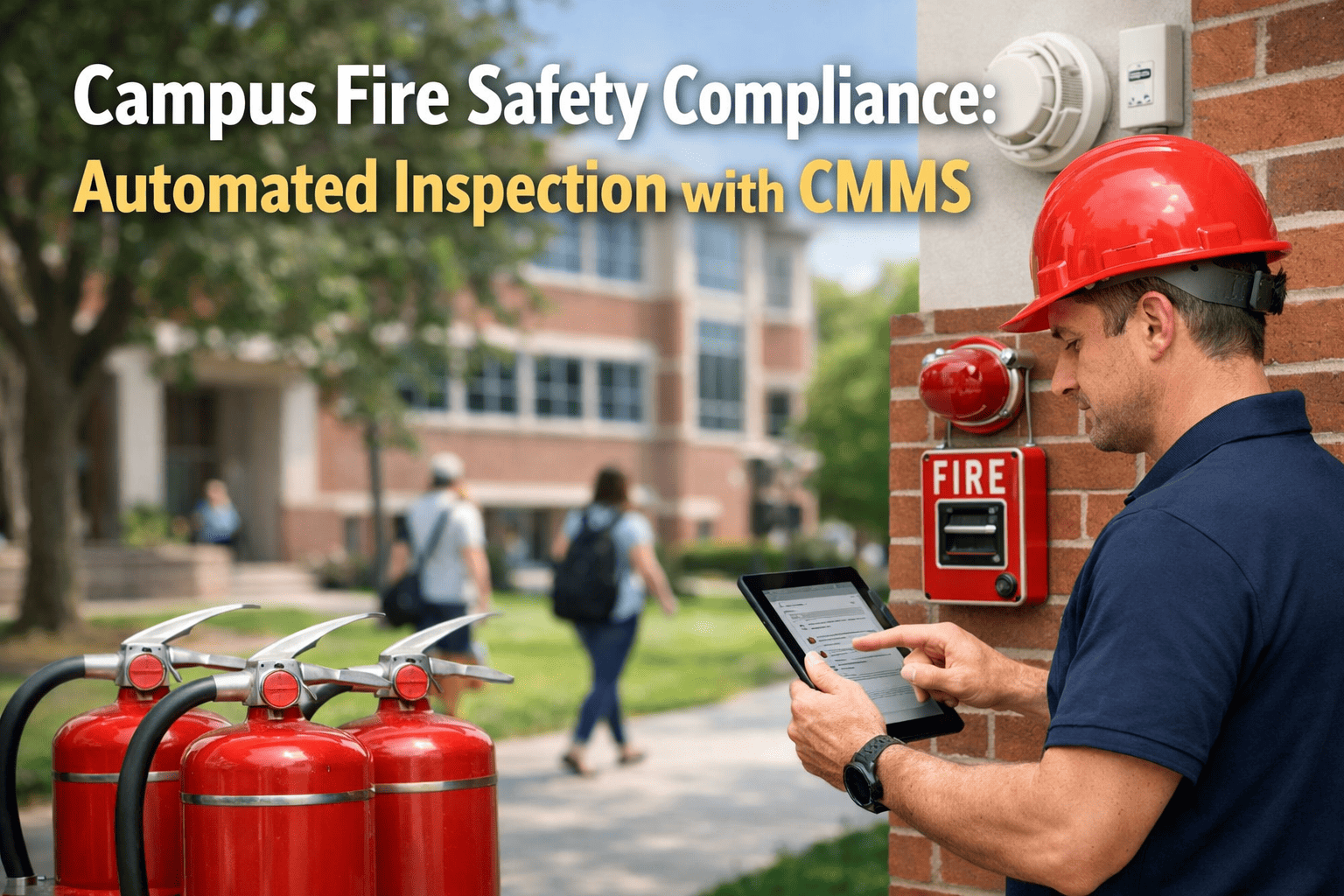
Campus safety is the number one factor driving K–12 parent enrollment decisions in 2026. NFPA fire and life safety code compliance requires documented inspection cycles for fire suppression, alarm, and egress systems—cycles that paper-based processes routinely miss. Simultaneously, the explosion of IoT-connected building systems (smart locks, IP cameras, HVAC controllers) has created a new cyber-physical attack surface that most districts have not addressed.
Oxmaint delivers: Automated NFPA inspection scheduling with digital sign-off trails. Fire suppression and alarm system preventive maintenance tied to compliance calendars. IoT asset inventory management that tracks firmware versions, patch status, and network segmentation across every connected campus device. Full audit-readiness documentation for insurance carriers and accreditation bodies.
The Western Interstate Commission for Higher Education (WICHE) projects that the number of US high school graduates will decline sharply starting in 2026, hitting regional institutions hardest. Facility quality is now a "Top 3 factor" in student college selection and K–12 open enrollment decisions. Campuses with visible deferred maintenance—stained ceiling tiles, inconsistent temperatures, broken fixtures—signal institutional decline to prospective families, directly compressing enrollment margins and per-pupil revenue.
Oxmaint delivers: Preventive maintenance programs that keep visible campus conditions at recruitment-grade quality. Work order prioritization algorithms that weight student-facing spaces (lobbies, classrooms, dining, athletics) over back-of-house areas. Facility condition index (FCI) dashboards that tie maintenance investment directly to enrollment KPIs, giving CBOs the data to defend capital requests to boards and trustees.
The US is short approximately 300,000 teachers and school staff. Facilities teams are equally understaffed, with maintenance departments running 20–40% below recommended staffing ratios. When teachers spend time managing classroom environment complaints—broken thermostats, flickering lights, pest issues—instead of teaching, both retention and instructional outcomes suffer. The educator shortage is, in part, a facilities problem.
Oxmaint delivers: AI-powered work order routing that eliminates manual dispatch and reduces response times by 60%. Mobile-first interfaces that let lean maintenance teams manage larger portfolios without adding headcount. Automated non-teaching task workflows (room setup requests, equipment reservations, environmental complaints) that keep educators focused on instruction. Predictive staffing models that align maintenance labor to seasonal demand curves.
The regulatory environment for US educational facilities is tightening on multiple fronts simultaneously. OSHA's 2026 Heat Illness Prevention standard will require documented indoor temperature monitoring and response protocols for schools—a new compliance burden most districts have not budgeted for. ADA accessibility audits are intensifying under renewed DOJ enforcement guidance. EPA lead-in-water and asbestos management programs demand continuous documentation that paper-based systems cannot reliably produce.
Oxmaint delivers: Automated compliance calendars that track OSHA, ADA, EPA, and state-specific regulatory deadlines. Digital inspection workflows with photo documentation and electronic signatures that create audit-ready records in real time. Heat illness prevention monitoring dashboards integrated with building automation systems. ADA remediation tracking with progress reporting for DOJ compliance plans. Centralized document management that produces export-ready compliance packages on demand—eliminating the multi-day scramble before federal or state audits.
The Budget Reality: Legacy Reactive Costs vs. Oxmaint Predictive Capital Planning
The financial math is unambiguous. Districts operating on legacy reactive maintenance budgets spend three times more per square foot than those running predictive capital plans—and still deliver worse facility outcomes. The challenge grid below maps the direct cost comparison across the operational categories that define your Total Cost of Ownership.
- Emergency repairs at premium contractor rates—no negotiating leverage
- Equipment run-to-failure shortens asset life by 30–50%
- Compliance gaps discovered during audits, not before them
- Energy waste from unmaintained HVAC systems—15–25% above benchmark
- No data to defend capital budget requests to school boards
- Planned maintenance at competitive rates—full budget predictability
- Predictive interventions extend asset life by 30% or more
- 100% audit-readiness with real-time compliance dashboards
- Energy optimization delivers 15% cost reduction through PM programs
- FCI data and ROI models that win board approval for capital projects
Measurable Outcomes: The KPIs That Matter to Superintendents and CBOs
Oxmaint does not deliver vague "operational improvements." It delivers specific, auditable metrics that map directly to the financial and compliance KPIs your board, trustees, and accreditation bodies require. These are not aspirational targets—they are documented outcomes from US education deployments.
Why 2026 Is the Inflection Point
The enrollment cliff is not a gradual decline—it is a step function. The National Center for Education Statistics projects the sharpest single-year enrollment drop in the 2025–2026 academic year for higher education, with K–12 districts in the Northeast and Midwest already reporting 8–12% declines in elementary enrollment. Every student lost represents $10,000–$15,000 in per-pupil funding at the K–12 level and $20,000–$45,000 in tuition revenue at the university level. Facility quality is the variable you can still control. Districts and universities that invest in predictive facilities management now will hold enrollment. Those that continue operating reactively will watch their enrollment margins compress, their bond ratings deteriorate, and their best teachers leave for better-maintained campuses.