Per-user CMMS pricing is one of the most damaging cost structures a growing school district can adopt. It starts reasonably — a handful of maintenance technicians, a facility manager, and an administrator. Then the district adds custodial supervisors who need to log work requests. Then principals who need to track building issues. Then the business office that needs cost reports. Then the new elementary school that just opened. Suddenly a platform that cost $8,000 per year at 10 users costs $38,000 per year at 48 users — for the same functionality, the same buildings, and the same maintenance team. The per-user model does not scale with operational growth. It penalizes it. School districts managing 10-50 buildings across a single administrative structure deserve CMMS access for every person who touches maintenance operations — technicians, custodians, administrators, principals, and finance staff — without watching the software bill triple every time the district grows. OxMaint's unlimited-user model keeps software costs flat regardless of how many staff access the platform, how many buildings the district adds, or how many roles need visibility into maintenance operations. Districts that have switched from per-user CMMS platforms to OxMaint report average annual savings of $24,000-$68,000 in software licensing costs alone — before counting the operational improvements that come from giving every relevant staff member actual system access. Want to see the pricing difference for your district, start a free trial or book a demo to see the full cost model.
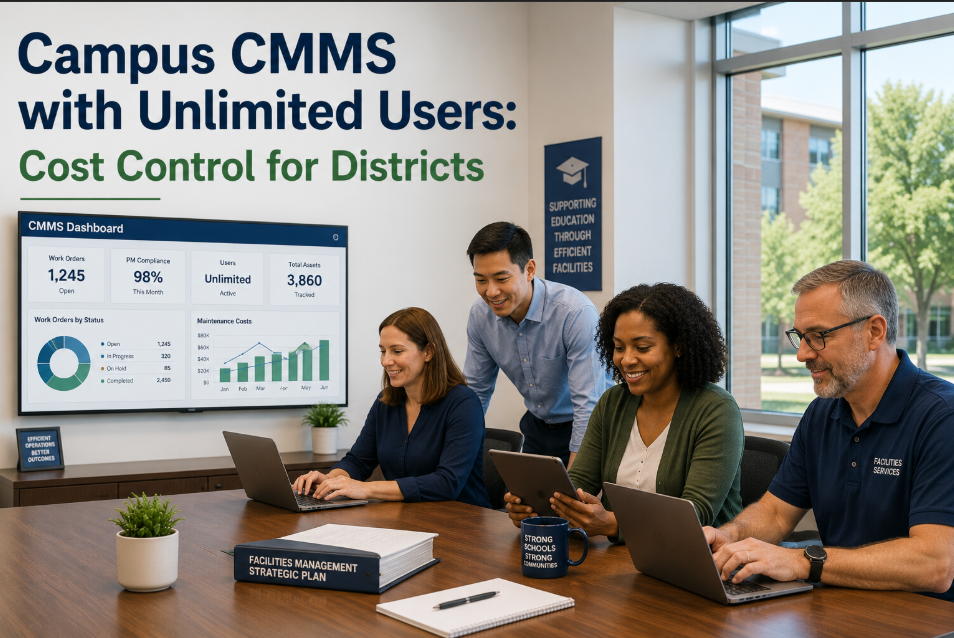
Campus CMMS with Unlimited Users: Cost Control for Districts
How unlimited-user CMMS pricing eliminates the licensing cost spiral that punishes growing school districts — and why restricting platform access to save on per-seat fees costs more in operational inefficiency than it saves in software spend.
The Hidden Cost of Per-User CMMS Pricing in Education
Per-user CMMS pricing creates a problem that most school districts do not recognize until they are already trapped in it. The initial purchase is made based on a small user count — the maintenance team. Then the district discovers that the platform only delivers its full value when every person who touches maintenance operations has access. That is a much larger number than the initial sales conversation suggested.
| User Group Added | Users | Annual Cost Added |
|---|---|---|
| Initial: Core maintenance team | 8 | $8,400 base |
| Custodial supervisors added | +12 | +$12,600 |
| Building principals added | +18 | +$18,900 |
| Finance and procurement added | +6 | +$6,300 |
| New schools opened, staff added | +14 | +$14,700 |
| Total after 3 years of growth | 58 users | $60,900 per year |
| Growth Stage | Users | Annual Cost |
|---|---|---|
| Initial: Core maintenance team | 8 | Flat annual fee |
| Custodial supervisors added | +12 | No change |
| Building principals added | +18 | No change |
| Finance and procurement added | +6 | No change |
| New schools opened, staff added | +14 | No change |
| Total after 3 years of growth | 58 users | Same flat annual fee |
Who Actually Needs CMMS Access in a School District
The real cost of per-user pricing is not the licensing overspend — it is the operational degradation that happens when districts restrict access to save money. When the people who need information cannot get it, decisions get made without data, communication breaks down, and maintenance work gets duplicated or missed entirely. Here is every role in a typical school district that benefits from CMMS access — and what they lose when access is restricted to control licensing costs.
Receive work orders, log completions, record parts used, capture photos, access asset history. Without full technician access, the CMMS cannot function as a work order system. Per-user models typically include these users — but restrict everyone else.
Log routine cleaning work orders, report equipment issues, verify building condition after events. Custodians are first on site — they identify the problems that maintenance technicians fix. Without their access, issue reporting reverts to phone calls and email, losing the documentation trail that creates work order evidence.
Monitor PM compliance across all buildings, approve high-cost work orders, review KPI dashboards, generate reports for administration and board. This is the strategic oversight role — without access, the facility director manages by phone and email rather than real-time data.
Submit maintenance requests for their buildings, track status of open work orders, receive completion notifications. Principals who cannot access the CMMS submit requests through email and phone — creating duplicate work orders, lost requests, and the perception that maintenance is unresponsive even when it is not.
Access maintenance cost reports for budget preparation, review contractor invoices against work order scopes, pull asset-level cost histories for capital planning. Without CMMS access, finance staff request reports from facility directors — adding administrative overhead and reducing budget accuracy.
Read-only dashboard access showing district-wide facility condition scores, capital planning forecasts, and maintenance performance KPIs. Board members reviewing facility conditions need objective data — not summaries filtered through administrative layers. CMMS read-only access provides the transparency that builds board confidence in facilities management.
Per-User Pricing vs Unlimited-User Model: Full Comparison
The comparison below goes beyond licensing cost to show how the pricing model affects operational behavior, access decisions, and platform adoption across the district. The goal of a CMMS is broad adoption — the more people using it correctly, the more value it generates. Per-user pricing directly works against that goal.
| Factor | Per-User CMMS Pricing | OxMaint Unlimited-User Model |
|---|---|---|
| Software Cost as District Grows | Scales linearly — more users, more cost | Fixed annual cost regardless of user count |
| Access Decision Driver | Who can we afford to give access to? | Who needs access to do their job effectively? |
| Custodial Staff Access | Often excluded to reduce licensing cost | Full access included — work requests from every building |
| Principal Visibility | Restricted — principals use phone and email instead | Full work request submission and status tracking |
| Finance Team Cost Reporting | Relies on facility director to pull and share reports | Direct access to cost attribution and budget reports |
| New School Onboarding Cost | Per-user fees for every new staff member added | Zero incremental cost — add users and buildings freely |
| 3-Year Total Cost Predictability | Unpredictable — grows with staff and district expansion | 100% predictable — flat annual fee locks in budget certainty |
| Platform Adoption Rate | Limited by access restrictions — partial adoption only | Full organizational adoption — every relevant role has access |
What Full Organizational Access Delivers for Districts
The operational value of unlimited-user access goes far beyond eliminating the licensing cost spiral. When every relevant staff member has access, the CMMS becomes a communication platform, a transparency tool, and a decision-support system — not just a work order tracker for the maintenance team. Here is what changes when access restrictions are removed. Ready to see full-access operations for your district? Book a demo or start a free trial with unlimited users from day one.
When custodial staff, teachers, and principals can submit work requests directly through OxMaint, maintenance issues get reported faster and with more detail. The facility manager receives a digital work request with location, asset, photo, and description — instead of a voicemail message that arrives three days after the problem started.
The most frequent source of friction between building administrators and facilities departments is the "what is happening with my work order" question. When principals have read-only access to their building's open work orders, that question disappears — along with the 30-45 minutes per week of phone calls and email exchanges it generates for facility managers.
When finance staff can pull maintenance cost reports directly from OxMaint — by building, by system type, by vendor, or by fiscal year — budget preparation becomes a self-service function instead of a multi-day data extraction project for the facility director. Cost variance drops from 20-30% to under 5% when attribution is real-time.
Superintendent and board member access to facility condition dashboards transforms capital planning discussions from subjective presentations into data-reviewed conversations. When board members see FCI scores by building, condition trends, and CapEx forecasts directly, facilities budget requests receive the evidence-based scrutiny — and approval — they deserve.
When a district opens a new elementary school, the facility manager adds the building and its assets to OxMaint and creates user accounts for the building's custodial staff and principal — at zero incremental cost. The platform grows with the district without triggering licensing renegotiations or surprise annual cost increases.
OxMaint's vendor portal gives external contractors access to their assigned work orders, completion documentation requirements, and invoice submission workflows without consuming user seats. Districts managing 20-40 external contractors get full vendor management functionality without any per-vendor licensing impact on their software cost.
Switching from Per-User CMMS to OxMaint: What to Expect
Most school districts switching to OxMaint from per-user CMMS platforms complete the transition within 2-4 weeks without operational disruption. The migration process is designed around the academic calendar to minimize impact on in-progress maintenance operations.
Export asset lists and open work order history from your current CMMS. OxMaint's implementation team imports this data directly into your new account — preserving asset histories and in-progress work orders so no maintenance continuity is lost during the switch.
Rebuild PM schedules in OxMaint from your existing maintenance calendar — now with unlimited users meaning every custodian, principal, and administrator gets an account simultaneously. No staged access rollout due to seat costs. Full organizational access from day one of live operations.
Run OxMaint alongside your existing system for one week. Technicians complete work orders in both systems to validate that OxMaint captures all required data correctly. Identify any custom workflows or approval processes that need configuration before full cutover.
OxMaint becomes the single system of record for all maintenance operations. Previous CMMS subscription is cancelled — generating the licensing cost savings that typically recoup the full first-year OxMaint investment within the first billing cycle after decommission.
Documented Financial and Operational Impact
These outcomes are documented across school districts that switched from per-user CMMS platforms to OxMaint's unlimited-user model. The financial impact is immediate — licensing cost reduction takes effect at the first renewal cycle after switching. The operational impact compounds over the first year as full organizational access drives broader adoption and better data quality.
Frequently Asked Questions
Does unlimited users mean everyone has the same level of access and permissions?
How does OxMaint handle data security when so many different staff roles have access?
What happens to our data from our current CMMS when we switch to OxMaint?
Can we add new buildings and campuses to OxMaint as the district grows?
Stop Paying More Every Time Your District Grows
Your district should not face a software licensing penalty every time you hire a new custodian, open a new school, or give a principal the visibility they need into their building's maintenance status. OxMaint's unlimited-user model gives every relevant staff member full platform access — from technicians in the field to board members reviewing facility conditions — at a flat annual cost that stays predictable regardless of how your district grows. Switch in two weeks. Start recovering licensing costs in the first billing cycle.