Facilities directors at universities and K-12 districts are under more budget scrutiny than at any point in the past two decades. Deferred maintenance backlogs across U.S. higher education now exceed $112 billion — and boards, CFOs, and accreditation bodies want to know exactly how maintenance investments are performing before releasing capital. The problem is that most campus facilities teams still measure performance through work order volume and reactive repair counts — metrics that tell leadership how busy the team is, not how effectively the campus is being protected. The 12 KPIs in this guide are the ones that move board conversations, win budget approvals, and demonstrate that your facilities operation is an asset protection function, not a cost center. Facilities directors using CMMS dashboards to track these KPIs report 34% fewer deferred maintenance escalations and document 28% improvement in PM compliance within the first year. To see how Oxmaint's CMMS tracks all 12 automatically across your campus, start a free trial or book a demo to see a live campus KPI dashboard.
Campus Facilities · KPI Analytics · 2026 Guide
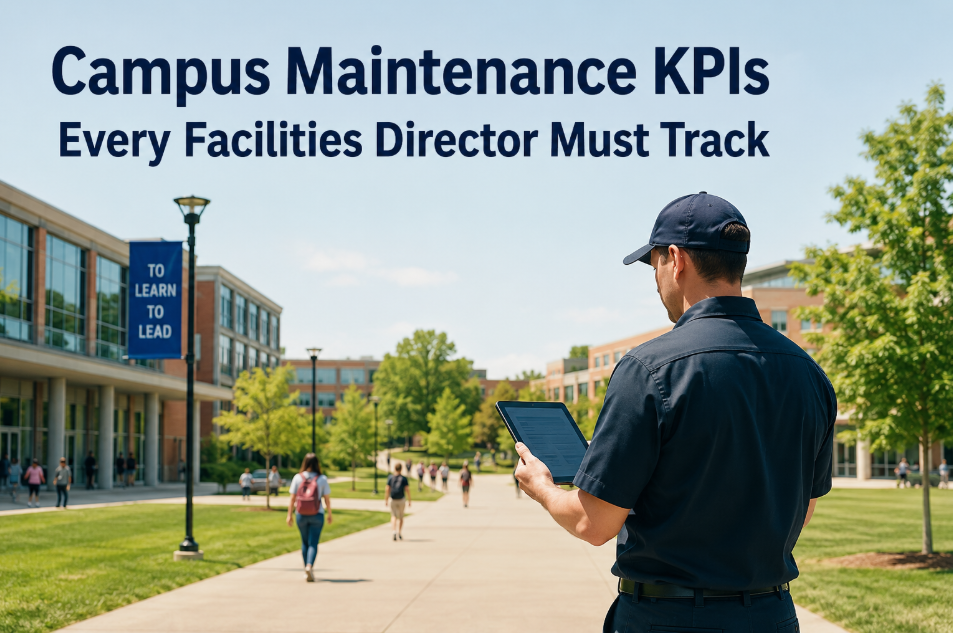
Campus Maintenance KPIs Every Facilities Director Must Track
12 performance indicators that prove maintenance value to boards and CFOs — with industry benchmarks, APPA standards, and how CMMS dashboards make them automatic.
$112B
deferred maintenance backlog across U.S. higher education — growing 8% annually without proactive tracking
34%
fewer deferred maintenance escalations for campuses using CMMS KPI dashboards vs manual tracking
4.8x
cost of reactive repair versus planned preventive maintenance — the ratio every CFO needs to see
62%
of campus facilities directors report they cannot pull real-time KPI data without manual spreadsheet work
All 12 Campus KPIs — Tracked Automatically, Not Assembled Weekly
Oxmaint calculates PM compliance rate, backlog age, cost per square foot, MTTR, and work order completion trends from every work order your team closes — updated in real time, no analyst hours required.
Start a free trial and connect your first buildings today, or
book a demo to walk through KPI dashboards configured for your campus.
Why Campus Maintenance KPIs Are Different From Industrial Metrics
Multi-Use Assets
Buildings Serve Academic, Residential, and Athletic Functions Simultaneously
A single university building may house classrooms, research labs, and administrative offices — each with different maintenance standards, compliance requirements, and occupant expectations. KPIs must track by asset type and functional category, not just by building.
Regulatory Layer
OSHA, ADA, Fire Code, and Accreditation Bodies All Audit Maintenance Records
Campus facilities operate under overlapping regulatory environments. Accreditation site visits, state fire marshal inspections, and ADA compliance audits all require maintenance documentation that paper systems cannot reliably produce. KPI tracking must include compliance-relevant metrics.
Seasonal Patterns
Academic Calendar Creates Predictable High-Demand and Low-Access Windows
Campus maintenance peaks before fall semester, during winter break shutdowns, and before commencement. KPIs must account for seasonal patterns — a PM compliance rate of 78% in October looks very different from 78% during summer maintenance season when access is unrestricted.
Stakeholder Mix
Boards, Donors, Students, Faculty, and Accreditors All Have Different Data Needs
A board wants cost-per-square-foot versus peer benchmarks. A student affairs VP wants restroom and HVAC response times. A CFO wants deferred maintenance liability and capital replacement forecasts. Campus KPI systems must generate different reports from the same data for different audiences.
The 12 Campus Maintenance KPIs — With Benchmarks and Formulas
Operational Performance KPIs
01
PM Compliance Rate
Completed PMs / Scheduled PMs × 100
APPA Target: 90%+ | Industry Avg: 67%
The foundational campus KPI. PM compliance below 80% means deferred maintenance is accumulating faster than it is being addressed. Each percentage point of PM compliance corresponds to approximately $18,000 in avoided emergency repairs per 100,000 sq ft annually. Track by building, by trade, and by asset class.
02
Mean Time to Repair (MTTR)
Total Repair Time / Number of Repairs
Campus Target: under 4 hours for critical systems
MTTR on campus directly affects student and faculty experience. An HVAC failure in a classroom building repaired in 2 hours versus 8 hours represents a fundamentally different service level. Track MTTR by priority tier — critical (life-safety, HVAC, plumbing), urgent, and routine — not as a single average.
03
Work Order Backlog Age
Average age (days) of open work orders by priority
Critical: 0 days open | Routine: under 14 days
Backlog age exposes the gap between demand and capacity. A growing backlog of 30+ day open work orders is the leading indicator of deferred maintenance acceleration. Board presentations using backlog trend data consistently unlock staffing approvals that request-volume data alone cannot justify.
04
Reactive vs Planned Maintenance Ratio
Planned Work Orders / Total Work Orders × 100
APPA World Class: 80%+ planned | Avg campus: 52%
The ratio that most directly predicts future maintenance cost trajectory. Campuses above 70% planned maintenance spend 2.3× less on emergency repairs annually. Each 10-point shift from reactive to planned saves approximately $0.42 per square foot per year in most institutional facility portfolios.
Financial and Cost KPIs
05
Maintenance Cost Per Square Foot
Total Maintenance Spend / Total Gross Square Footage
APPA Level 2: $5.20–$8.40/sq ft annually
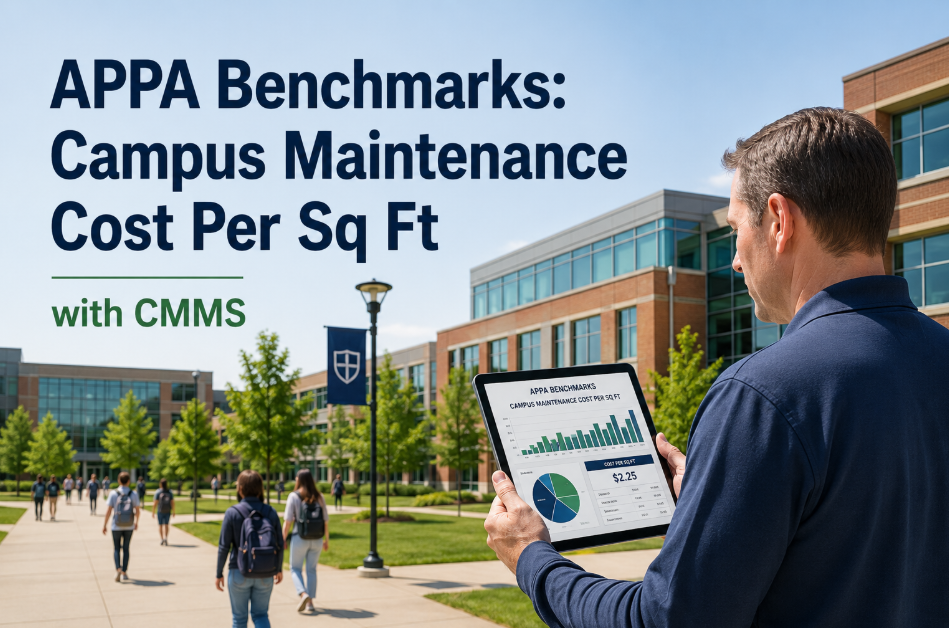
The primary benchmarking metric for campus-to-peer comparison. APPA's Facilities Performance Indicators survey allows cost-per-square-foot comparison against hundreds of peer institutions by Carnegie Classification. Track separately for custodial, maintenance, and grounds to identify which category drives peer variance.
06
Deferred Maintenance Liability (FCI)
Cost to Correct Deficiencies / Current Replacement Value
Acceptable FCI: under 0.05 | Crisis FCI: above 0.10
The Facilities Condition Index is the single metric most used by governing boards and bond rating agencies to assess campus infrastructure risk. An FCI above 0.10 signals that deferred maintenance exceeds 10% of replacement value — a level that triggers capital planning urgency and affects institutional credit ratings.
07
Maintenance Labor Utilization Rate
Direct Maintenance Hours / Total Available Hours × 100
Target: 65–75% direct utilization
Measures the proportion of technician time spent on direct maintenance versus travel, paperwork, and waiting. Industry data shows campus maintenance technicians average 28–35% direct utilization on paper-based systems. CMMS mobile work orders consistently move this to 55–68% — a 40% productivity improvement on existing headcount.
08
Energy-Related Maintenance Cost
HVAC + BAS + Lighting PM Cost / Total Maintenance Spend
Target: 18–25% of total maintenance budget
Energy systems represent 65% of campus operating cost — but their maintenance budget share rarely reflects this. Tracking energy-related maintenance spend separately enables ROI calculation: $1 invested in HVAC PM returns $4.20 in avoided energy waste and emergency repair cost on most university campuses.
Asset Lifecycle and Compliance KPIs
09
Asset Condition Score Distribution
% of Assets Rated Good / Fair / Poor / Critical
Target: 70%+ assets in Good/Fair condition
A condition score distribution across your asset registry answers the board question that FCI cannot: "Which buildings need capital investment first and why?" Tracking condition trends over 3–5 years shows whether the portfolio is improving or degrading — the most critical CapEx planning input available to facilities leadership.
10
Life-Safety Compliance Rate
Completed Life-Safety PMs / Scheduled Life-Safety PMs × 100
Required: 100% — zero tolerance for noncompliance
Fire suppression systems, emergency lighting, elevator safety inspections, and AED maintenance are not optional performance metrics — they are regulatory requirements with institutional liability attached. A single missed fire suppression inspection creates accreditation risk. Track life-safety PM completion as a separate, zero-tolerance KPI category.
11
Customer Satisfaction (CSAT) Score
Satisfied Responses / Total Survey Responses × 100
Target: 85%+ satisfaction | Industry avg: 71%
Student and faculty satisfaction with facilities directly affects enrollment decisions. Research from APPA shows that facilities quality ranks in the top 5 factors for prospective student campus visits. Track satisfaction by building and by service type — HVAC complaints cluster differently than AV and IT infrastructure complaints.
12
CapEx Forecast Accuracy
Actual Capital Spend vs 5-Year Forecast Variance
Target: forecast variance under 12% per year
The KPI that transforms facilities from a reactive cost center to a strategic planning function. Campuses with asset condition data feeding rolling 5–10 year CapEx models present capital requests with evidence — specific assets, current condition scores, replacement cost, and risk of deferral — rather than estimates. CFO approval rates for evidence-based requests average 2.4× higher than budget-based requests.
Manual KPI Tracking vs CMMS Automation — What Changes
| KPI Category |
Manual / Spreadsheet |
Oxmaint CMMS |
Time Saved |
| PM Compliance Rate |
Calculated monthly from paper logs — 6–8 hrs/month |
Real-time, auto-calculated from closed work orders |
72 hrs/year per metric |
| Backlog Age Tracking |
Manual spreadsheet audit — unknown between reviews |
Live backlog age per work order, per building, per trade |
Continuous visibility vs monthly snapshot |
| Cost Per Square Foot |
Finance team pull + manual allocation — quarterly |
Auto-calculated from work order labor + parts cost by building |
40 hrs/quarter eliminated |
| Life-Safety Compliance |
Separate tracking system or paper binder — gaps inevitable |
Flagged category with zero-tolerance alerts before expiry |
Zero compliance gaps |
| MTTR by Priority |
Estimated from work order paper dates — ±30% accuracy |
Auto-timestamped from work order open to close per priority |
Exact data vs estimates |
| Board KPI Report |
8–12 hours analyst time to compile and format |
One-click export with trend lines and peer benchmarks |
10+ hrs per board cycle |
What CMMS KPI Tracking Delivers for Campus Operations
34%
fewer deferred maintenance escalations
campuses using real-time KPI dashboards vs those relying on monthly manual reporting
$0.42
saved per sq ft per year
for every 10-point shift from reactive to planned maintenance ratio — APPA benchmark-sourced calculation
2.4x
higher CapEx approval rate
for capital requests supported by CMMS condition data versus budget-based estimates without asset evidence
40%
technician productivity gain
average improvement in direct wrench time when mobile CMMS replaces paper work orders across campus maintenance teams
How Oxmaint Tracks All 12 Campus KPIs — Automatically
Live Dashboards
PM Compliance and Backlog — Real Time, Not Monthly
Every work order closed in Oxmaint updates PM compliance rate, backlog age, and MTTR automatically. Facilities directors see current KPI status when they open the dashboard — not data that is 3 weeks old from the last manual pull. Critical KPI thresholds trigger alerts before they become board-level concerns.
Cost Tracking
Maintenance Cost Per Building, Per Square Foot, Per Trade
Labor hours, parts cost, and contractor invoices are allocated to specific buildings and assets in every work order. Oxmaint calculates cost per square foot automatically from this data — enabling APPA benchmarking comparisons without spreadsheet assembly. Track which buildings consume disproportionate maintenance budget and why.
Asset Conditions
Condition Scoring That Feeds FCI and CapEx Forecasts
Inspection results, maintenance history, and repair frequency feed Oxmaint's asset condition scoring for every building system and component. Condition scores aggregate to FCI calculations at the building and portfolio level — giving your CFO and board the infrastructure risk picture they need for capital planning discussions.
Compliance Tracking
Life-Safety PM Alerts With Zero-Tolerance Enforcement
Life-safety PMs — fire suppression, emergency lighting, elevator inspections — are flagged as a separate category in Oxmaint with automated alerts 30, 14, and 7 days before due date. Overdue life-safety work orders escalate automatically to department heads. Compliance documentation is audit-ready and exportable on demand.
Board Reporting
One-Click KPI Reports for Leadership and Governing Boards
Generate PM compliance trends, cost-per-square-foot vs peer benchmarks, FCI trajectory, and reactive vs planned ratio in a single formatted report export. What currently takes your team 8–12 hours of manual compilation is a one-click export in Oxmaint — with trend lines that tell the story of improving maintenance performance.
Mobile Execution
Technician Data Capture That Feeds Every KPI Automatically
When technicians log work orders from mobile — with timestamps, parts used, and photo documentation — every KPI updates in real time. MTTR calculates from actual open-to-close timestamps, not self-reported estimates. The quality of your KPI data is only as good as your work order data capture — mobile execution solves both simultaneously.
Frequently Asked Questions
Which campus maintenance KPI should a facilities director prioritize first?
Start with PM compliance rate and reactive vs planned maintenance ratio — these two KPIs have the highest correlation with future maintenance cost trajectory. If PM compliance is below 75%, your deferred maintenance backlog is growing faster than your team can address it, regardless of headcount. The reactive vs planned ratio tells you whether your team is spending its time preventing problems or responding to them. Both can be tracked from existing work order data in a CMMS from day one, and both generate immediately compelling data for leadership conversations. Once these two are stable, add cost-per-square-foot for benchmarking and FCI for capital planning discussions.
What does APPA Level 2 maintenance actually mean in practice?
APPA defines five levels of facilities maintenance quality, with Level 2 representing "Operational Adequacy" — the minimum standard for maintaining institutional functionality without accelerating asset deterioration. At Level 2, PM compliance runs 85–92%, response to urgent work orders occurs within 4 hours, and cost per square foot falls in the $5.20–$8.40 range for higher education institutions. Most campuses aspire to Level 2 but operate at Level 3 (Managed Deterioration) due to budget constraints and reactive maintenance patterns. CMMS data is the primary tool for quantifying the gap between current performance and APPA Level 2 benchmarks — and for making the case to close it.
How should campus KPIs differ for K-12 versus higher education facilities?
K-12 campuses typically have smaller facilities teams, more buildings per full-time technician, and stricter summer maintenance windows before academic year start. Key K-12 differences: PM compliance must be tracked against the summer maintenance window specifically (June–August is when 60–70% of annual PM volume occurs); life-safety compliance takes on additional weight because of minor occupancy regulations; and cost-per-square-foot benchmarks differ significantly — K-12 averages $3.80–$6.20/sq ft versus $5.20–$8.40 for higher education. Higher education campuses add research lab compliance, residential facilities maintenance, and athletic facility standards as distinct KPI categories that K-12 systems don't require.
How do you calculate Facilities Condition Index (FCI) and what does it mean for capital planning?
FCI = Total Cost of Identified Deficiencies / Current Replacement Value of the Facility. An FCI below 0.05 indicates a facility in good condition requiring routine maintenance. FCI between 0.05–0.10 indicates fair condition with some deferred maintenance accumulation. FCI above 0.10 is the threshold that signals crisis-level deferred maintenance — at this level, continued operation costs more than planned replacement in most asset lifecycle models. For capital planning, FCI provides the evidence-based ranking that boards need to prioritize building investments. A campus with 40 buildings can use FCI scores to rank all 40 by infrastructure risk, creating a defensible 10-year capital renewal plan from objective data rather than political negotiation.
Oxmaint CMMS · Campus Facilities Management
Stop Reporting on What Happened. Start Showing What Your Campus Is Worth.
Oxmaint tracks all 12 campus KPIs automatically — PM compliance, MTTR, cost per square foot, FCI, life-safety compliance — updated from every work order your team closes. One-click board reports. Real-time backlog visibility. Asset condition data that wins capital requests. Connect your campus and generate your first KPI dashboard in under 24 hours.