School bus fleets are among the most heavily regulated vehicle operations in the United States — and among the most under-managed when it comes to maintenance documentation, pre-trip inspection consistency, and fleet-wide visibility. A district operating 120 buses is responsible for transporting 8,000+ students daily, managing $18M+ in vehicle assets, maintaining DOT compliance across every unit in the fleet, and coordinating driver certification, vehicle inspection, and preventive maintenance schedules with a transportation department that typically runs on spreadsheets, paper inspection forms, and institutional memory held by a retiring fleet manager. The consequences of failure are not missed shipments or customer complaints — they are student safety incidents, NHTSA investigations, and the kind of public accountability that follows a school bus accident with documented maintenance failures in the vehicle's history. Districts using structured fleet management software report 52% reduction in roadside inspection violations, 44% improvement in preventive maintenance completion rates, and the elimination of the compliance documentation gaps that create liability exposure every time a bus leaves the yard without a properly documented pre-trip inspection.
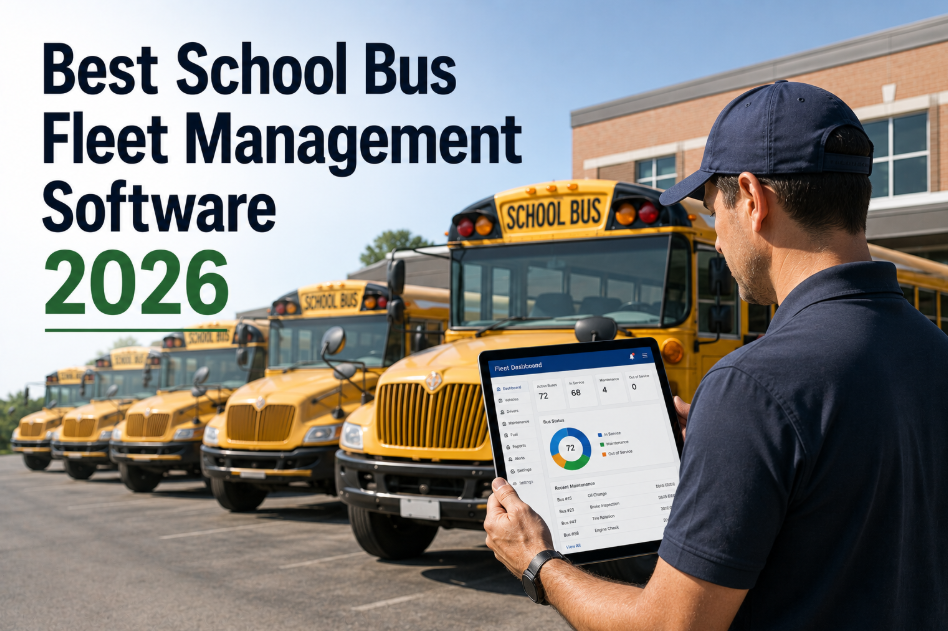
Best School Bus Fleet Management Software 2026
Top platforms for school district transportation departments ranked on GPS tracking, preventive maintenance scheduling, DOT compliance documentation, pre-trip inspection management, driver qualification tracking, and real-world adoption by fleet managers protecting student safety every day.
Why School Bus Fleet Management Is a Specialized Discipline
School bus fleet management operates under a compliance framework that combines federal DOT requirements, state-specific school transportation regulations, NHTSA standards, and district safety policies — all applied to a vehicle population that averages 12-15 years old and runs 180 school days per year on routes that include railroad crossings, narrow rural roads, and urban school zone traffic patterns that increase accident risk. Unlike commercial trucking fleets, school buses carry the same passengers in predictable patterns — but those passengers are children, which means every maintenance gap carries a level of public accountability that commercial fleet failures simply do not.
Transportation directors need platforms that manage the full fleet lifecycle: pre-trip inspection documentation that satisfies DOT auditors, PM scheduling by mileage and engine hours that prevents the brake and mechanical failures responsible for the majority of school bus out-of-service orders, driver qualification file management that ensures every operator behind the wheel has a valid CDL with the correct endorsements and a current medical certificate, and GPS visibility that confirms buses are on route and on schedule. Want to see how OxMaint manages school bus fleet compliance — start a free trial or book a demo to walk through fleet configurations.
The Critical Failure Points in School Bus Fleet Operations
Federal and state regulations require documented pre-trip inspections before every bus leaves the yard. Paper forms get signed without being completed, filed without being reviewed, and lost before DOT auditors arrive. 38% of school bus roadside violations cite deficiencies that should have been caught by a pre-trip inspection.
Buses on longer rural routes accumulate mileage 40% faster than urban routes — but calendar-based PM treats all units identically. High-mileage buses receive their oil changes, brake inspections, and transmission services weeks late while low-mileage units receive unnecessary maintenance. The result is brake failures on the buses that need attention most.
A single driver with an expired school bus endorsement, a lapsed medical certificate, or an overdue motor vehicle record pull creates a DOT violation for the district. Districts managing 80-150 drivers without automated expiration tracking face this compliance gap constantly — 23% of districts have at least one driver with expired qualification documentation at any given time.
Which buses are out of service today? Which units have overdue PM? Which drivers have expirations approaching? Without a fleet management platform, transportation directors answer these questions by walking the yard, calling the shop, and checking paper files — consuming 2-3 hours per day that should be spent on student safety oversight.
A 120-bus fleet has warranty coverage on different systems across different units at different stages of their lifecycle. Without asset-level warranty tracking, districts pay for repairs covered under warranty — a common loss of $40,000-$80,000 annually for mid-size fleets.
State transportation audits and DOT compliance reviews require complete vehicle maintenance histories, driver qualification files, and inspection records. Districts using paper-based systems spend 120-200 staff hours assembling records before each audit — time that comes directly from transportation operations.
Evaluation Criteria for School Bus Fleet Software
Digital pre-trip and post-trip inspection forms that auto-create work orders for deficiencies — with timestamped records that satisfy DOT auditors and state transportation inspectors.
Mileage-based and engine-hour PM scheduling per unit — not calendar-based averages. Brake inspections, oil services, transmission, and annual DOT inspections tracked per bus with overdue alerts.
CDL tracking, school bus endorsement status, medical certificate expiration, MVR pull dates, and annual review documentation — automated alerts before any credential lapses.
Real-time bus location, route adherence monitoring, student boarding/alighting verification, and speed monitoring integrated with maintenance data for a complete fleet operations picture.
Transportation director visibility into unit availability, PM compliance by bus, driver qualification status, and open maintenance work orders across the entire fleet in real time.
Complete vehicle maintenance histories, driver qualification packages, and inspection records exportable on demand — audit preparation measured in minutes, not weeks.
Top School Bus Fleet Management Platforms — 2026 Rankings
OxMaint leads the 2026 school bus fleet management ranking by combining DOT-grade compliance documentation with the fleet operations visibility that transportation directors need to manage student safety obligations across large bus fleets. Digital pre-trip and post-trip inspections replace paper forms entirely — drivers complete the inspection checklist from their phone before departure, any deficiency auto-creates a prioritized maintenance work order with the bus unit number, deficiency description, and driver identification attached. Pre-departure clearance is only granted digitally when the inspection is complete and any flagged issues are resolved or assessed. PM scheduling runs on actual mileage per unit — uploaded from GPS integration or manually logged by drivers — so the bus accumulating 200 miles per day gets its brake inspection on schedule while the low-mileage spare unit doesn't receive unnecessary service. Driver qualification management tracks CDL validity, school bus endorsement (S endorsement) status, medical certificate expiration dates, and annual MVR pull requirements for every driver in the fleet with automated alerts at 90, 60, 30, and 14 days before any lapse. The fleet dashboard shows transportation directors a real-time view of unit availability, PM overdue status, open maintenance work orders, and driver qualification compliance across the full fleet. Audit documentation exports the complete maintenance history and driver qualification packages in minutes — eliminating the 120-200 hour manual assembly that state audits typically require from paper-based districts. Unlimited user pricing ensures every driver, mechanic, shop supervisor, transportation director, and district administrator has access without per-seat licensing negotiation. Explore OxMaint for your fleet — start a free trial or book a demo.
Zonar built its reputation on school bus GPS tracking and electronic inspection systems — and the platform delivers industry-leading GPS route monitoring, student boarding and alighting confirmation, and electronic DVIR (eDVIR) compliance for school bus pre-trip inspections. The EVIR ground-level inspection system using RFID zone verification adds a layer of inspection accountability that pure mobile-form approaches cannot replicate. Maintenance management depth is lighter than fleet-management-heritage platforms — PM scheduling, work order management, and parts tracking are functional but less sophisticated than dedicated maintenance platforms.
Transfinder is the dominant student transportation routing and planning platform — used by 1,500+ school districts for route optimization, bell time management, and special education transportation coordination. The vehicle maintenance module covers core PM scheduling and inspection logging. Fleet maintenance depth is not the platform's primary focus — Transfinder is strongest when vehicle management is paired with its routing engine, and weaker as a standalone fleet compliance tool.
Samsara delivers strong telematics — GPS tracking, real-time speed monitoring, harsh braking and cornering alerts, driver safety scores, and dashcam integration. For districts prioritizing driver behavior monitoring and real-time vehicle location, Samsara's sensor depth is difficult to match. Fleet maintenance features cover digital inspections and basic PM scheduling. Not purpose-built for school transportation — student routing, school bus endorsement tracking, and K-12-specific compliance reporting require third-party integration or manual processes.
Tyler's student transportation module integrates tightly with Tyler's broader K-12 administrative ERP — student information, HR, finance, and facilities — making it a practical choice for districts already committed to the Tyler ecosystem. Transportation management covers routing, vehicle maintenance, and driver management. Standalone fleet management depth and DOT compliance documentation are less developed than transportation-specialist platforms. The primary value is unified district administration rather than fleet management excellence.
Limble provides solid PM scheduling and work order management that small district transportation shops — 20-40 buses — can implement rapidly without extensive setup. QR code bus identification, mobile inspection checklists, and parts tracking work well for shop operations. School-specific features — school bus endorsement tracking, DOT school bus compliance documentation, student routing integration — require manual configuration or are simply absent. Better as a shop maintenance tool than a comprehensive school bus fleet management platform.
Feature Comparison: Top 6 School Bus Fleet Platforms
| Capability | OxMaint | Zonar | Transfinder | Samsara | Tyler | Limble |
|---|---|---|---|---|---|---|
| Digital Pre-Trip Inspections | Auto-WO creation | RFID-verified EVIR | Basic logging | Digital forms | Basic | Checklist-based |
| Mileage-Based PM Scheduling | Per-unit mileage | Available | Basic PM | Telematics-driven | Basic PM | Good PM tools |
| Driver Qualification Tracking | Full DQ management | Basic driver mgmt | Driver records | Driver scoring | HR-integrated | Not included |
| GPS and Route Monitoring | API integration | Industry-leading | Route planning | Best-in-class | Basic GPS | Not included |
| Fleet Availability Dashboard | Real-time fleet view | GPS-driven | Fleet overview | Telematics dashboard | Basic | Basic |
| Audit Documentation Export | On-demand packages | Compliance reports | Basic reporting | Telematics reports | ERP reporting | Basic reports |
| Pricing Model | Unlimited users | Per vehicle + hardware | Per district/module | Per vehicle + hardware | Per module | Per user |
Paper-Based vs. Digital School Bus Fleet Operations
Frequently Asked Questions
What DOT compliance documents does OxMaint generate for school bus fleets?
How does mileage-based PM scheduling work for buses on different routes?
What school bus driver credentials does OxMaint track?
Can OxMaint integrate with student routing software like Transfinder or Edulog?
Every Bus That Leaves the Yard Is a Safety Statement
A documented pre-trip inspection, a current brake service record, and a verified driver credential are not administrative checkboxes — they are the documented evidence that your district did everything required to put students safely on that bus. OxMaint gives transportation departments digital pre-trip inspections, mileage-based PM scheduling, complete driver qualification tracking, and audit-ready documentation that protects students and the district simultaneously. Most districts are fully live within 7 days of signup.