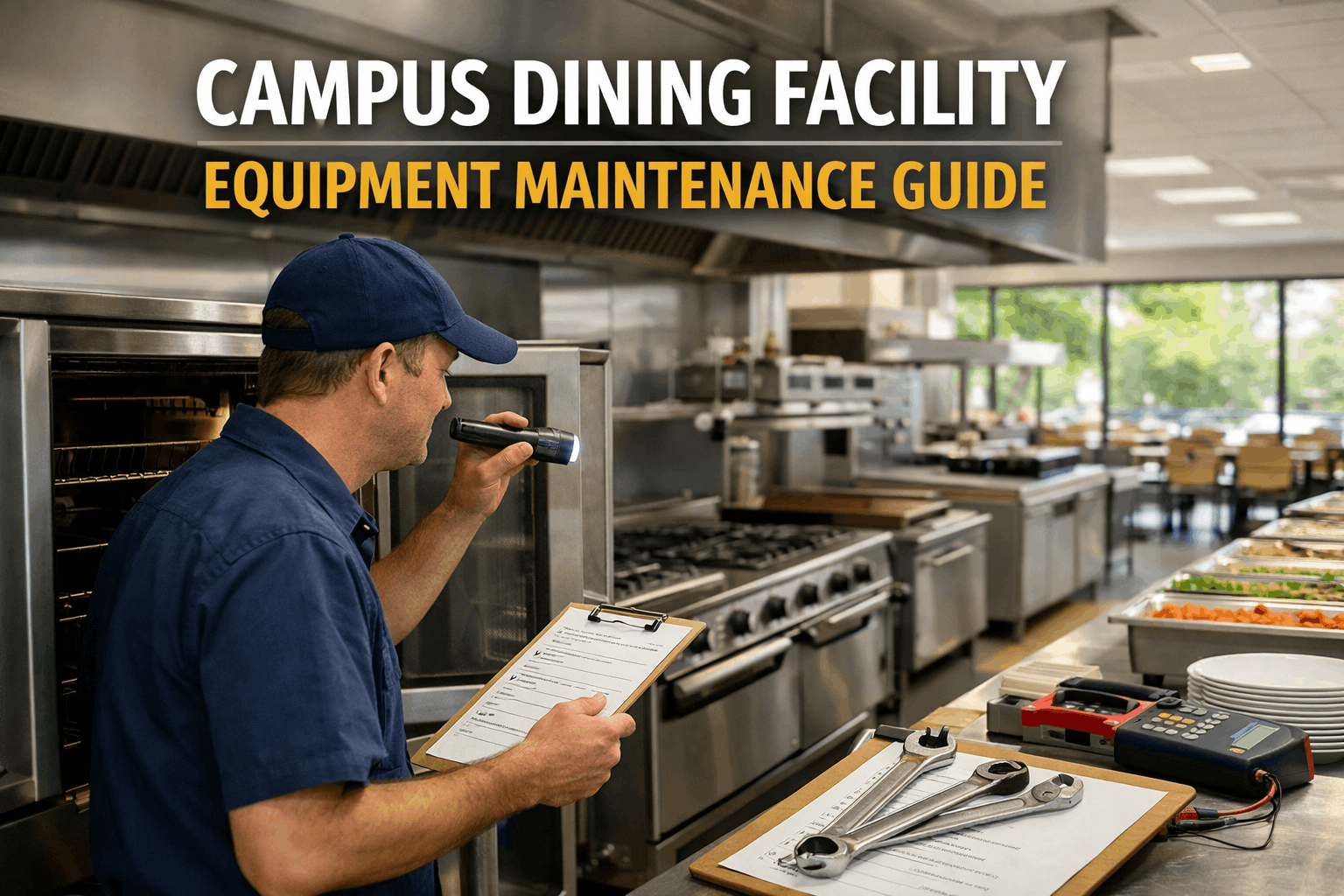
It was 5:47 AM on a Monday when the walk-in freezer at Lakewood University's main dining hall failed silently overnight. By the time kitchen staff arrived at 6:15 AM, $23,000 worth of perishable inventory had crossed the temperature danger zone. The health department shut down breakfast service for 2,800 students, and the university scrambled to arrange emergency catering from off-campus vendors at triple the cost. The post-incident review revealed the compressor had been logging elevated discharge temperatures for six weeks—data that existed but was never acted upon because campus dining equipment maintenance requests were tracked on a shared whiteboard in the back office. This wasn't a refrigeration problem. It was a preventive maintenance scheduling problem. Universities that implement systematic food service facility maintenance campus programs catch these failures weeks before they spoil inventory, shut down dining operations, or trigger health code violations. Schedule a consultation to explore how preventive maintenance scheduling can protect your campus dining operations.
78%
Reduction in Unplanned Kitchen Downtime
Universities implementing preventive maintenance scheduling for campus dining equipment report dramatic reductions in service disruptions within the first semester of deployment
Why Campus Dining Equipment Maintenance Demands a Different Approach
Campus dining facilities operate under pressures that no commercial restaurant faces: feeding thousands of students on fixed meal plan schedules with zero tolerance for service interruption. When a conveyor dishwasher fails during lunch rush or a combi oven goes down before a catered alumni event, there's no "closing early" option. University kitchen equipment servicing must account for rigid academic calendars, peak-volume meal periods, and the regulatory scrutiny that comes with institutional food service. Manual tracking methods—clipboards, spreadsheets, and memory—simply cannot keep pace with the complexity of modern campus dining operations.
The Case for Preventive Maintenance in Campus Dining
$38K
Average annual cost of emergency kitchen equipment repairs per campus dining hall—preventive scheduling cuts this by up to 60%
4.2 hrs
Average downtime per unplanned kitchen equipment failure—versus 45 minutes for a scheduled preventive service visit
82%
Of campus health code violations trace back to equipment maintenance gaps—improper temps, faulty sanitization, or failed ventilation
$5 : $1
Return on every dollar spent on preventive maintenance—through avoided repairs, extended equipment life, and reduced food waste
Ready to eliminate kitchen equipment surprises? Join leading universities using OxMaint to automate cafeteria equipment inspection schedules and protect dining operations.
How Preventive Maintenance Scheduling Works for Campus Dining
Modern preventive maintenance scheduling replaces reactive firefighting with systematic, calendar-driven care for every piece of kitchen equipment. From walk-in coolers to steam kettles, a CMMS automates inspection cycles, assigns the right technician, and builds the maintenance history that keeps your dining hall asset management program audit-ready year-round.
Preventive Maintenance Scheduling LifecycleFrom asset inventory to continuous improvement
01
Asset Inventory & Criticality Ranking
Catalog every piece of dining equipment across all campus locations—refrigeration, cooking, ventilation, dishwashing, and serving. Assign criticality scores based on food safety impact, replacement cost, and operational dependency. A failed walk-in freezer outranks a broken toaster oven.
02
PM Schedule Configuration
Define maintenance intervals for each asset class based on manufacturer recommendations, health code requirements, and historical failure data. Align schedules with the academic calendar—heavy PM during breaks, light-touch inspections during peak service periods.
03
Automated Work Order Generation
The CMMS automatically creates and assigns work orders based on your PM calendar. Technicians receive mobile notifications with detailed task checklists, asset history, and parts requirements—no more forgotten inspections or missed service windows.
04
Execution & Compliance Documentation
Technicians complete inspections using mobile checklists, capture temperature logs and photos, and record parts used—all timestamped. This documentation satisfies health department audits and commercial kitchen compliance higher education requirements instantly.
05
Analytics & Continuous Optimization
OxMaint analyzes maintenance data to identify equipment trending toward failure, optimize PM intervals based on actual wear patterns, and forecast budget needs for replacement planning. Sign up for OxMaint to transform your dining facility maintenance from guesswork to data-driven precision.
Not all kitchen equipment fails equally. A malfunctioning hood ventilation system is a fire hazard and an immediate shutdown trigger; a dented sheet pan is an inconvenience. Effective cafeteria equipment inspection programs prioritize assets by safety impact, regulatory exposure, and operational criticality. Here's how to categorize and schedule inspections for every major equipment class in your campus dining operation.
See automated PM scheduling in action. Book a demo and we'll show you how OxMaint manages cafeteria equipment inspection cycles for your specific dining operations.
Reactive vs. Preventive: The Campus Dining Maintenance Comparison
Understanding the operational difference between reactive and preventive approaches reveals why housing facility upkeep higher education leaders—and the dining operations they support—are transitioning to scheduled maintenance systems. The data is unambiguous.
Dining Facility Maintenance Approach Comparison
Reactive Maintenance
❌
Equipment runs until failure
Emergency vendor calls at premium rates
No compliance documentation trail
Unpredictable budget overruns
Meal service disruptions for students
3-5×higher repair costs than preventive approach
Preventive Maintenance Scheduling
✔️
Scheduled service before failure occurs
Planned vendor visits at contract rates
Audit-ready compliance records always
Predictable, forecastable budget cycles
Zero unplanned dining service interruptions
40-60%lower total maintenance spend annually
Commercial Kitchen Compliance for Higher Education
Commercial kitchen compliance higher education requirements span federal, state, and local jurisdictions—from FDA Food Code to state health department inspections to fire marshal reviews. Preventive maintenance scheduling isn't just an operational best practice; it's the mechanism that ensures your dining facilities pass every inspection with documented proof of ongoing care.
Monthly leak check, quarterly connector inspection, annual shutoff test
OxMaint auto-generates PM work orders aligned with each compliance requirement, attaches inspection records to asset profiles, and produces audit-ready reports on demand—eliminating the documentation scramble before health inspections.
Automate Compliance. Eliminate Guesswork.
OxMaint connects every piece of campus dining equipment to automated PM schedules, compliance checklists, and audit-ready documentation—so your team focuses on food quality, not paperwork.
Preventive maintenance investments in campus dining facilities deliver returns across multiple value streams: avoided emergency repairs, extended equipment lifespan, reduced food waste from temperature failures, lower energy consumption from well-maintained systems, and eliminated health code fines. The financial impact compounds semester over semester.
Documented Campus Dining Maintenance BenefitsBased on deployment data across university dining operations
78%
Reduction in unplanned kitchen equipment downtime
60%
Lower emergency repair costs vs. reactive approach
40%
Longer equipment lifespan with scheduled servicing
50%
Fewer health code violations at annual inspections
Calculate your potential savings. Create a free OxMaint account and our team will help model the ROI for your specific campus dining operations.
Implementation: Building Your Campus Dining PM Program
Successful preventive maintenance scheduling deployment for campus dining requires coordination between facilities management, dining services leadership, and compliance officers. A phased approach delivers immediate wins on critical equipment while building toward comprehensive coverage across all dining locations.
Typical Campus Dining PM Deployment Roadmap
Week 1-2
Equipment Audit & Inventory
Catalog all dining equipment across campusAssign criticality scores by food safety impactCollect manufacturer PM recommendations
Week 3
Schedule Design & Compliance Mapping
Build PM intervals aligned with health codesMap schedules to academic calendar breaksConfigure inspection checklists per asset class
Week 4
CMMS Configuration & Integration
Load assets and schedules into OxMaintConfigure automated work order generationSet up alert routing to dining & facilities staff
Week 5
Go Live & Train
Activate automated PM schedulingTrain kitchen staff on mobile reportingBegin first PM cycle on critical equipment
Campus dining equipment doesn't announce when it's about to fail—it just stops working during the busiest meal service of the week. Preventive maintenance scheduling changes the equation entirely. Instead of reacting to crises, our team now prevents them. We haven't had an unplanned dining hall closure in three semesters since deploying automated PM through our CMMS.
— Director of Facilities, Midwestern State University
See How Campus Dining Teams Save 20% on Equipment Maintenance with a 15-Minute Tour
Your kitchen staff shouldn't be diagnosing compressor failures during breakfast rush. OxMaint automates preventive maintenance scheduling across every piece of campus dining equipment—so your team focuses on feeding students, not fighting fires. Join universities across North America already using OxMaint to protect their dining operations, pass every health inspection, and extend equipment life by 40%.
How often should campus dining equipment be inspected?
Inspection frequency varies by equipment criticality and regulatory requirements. Refrigeration systems need daily temperature logs, weekly condenser checks, and quarterly professional service. Cooking equipment requires weekly calibration verification and monthly burner inspections. Fire suppression systems mandate monthly filter changes, quarterly hood cleaning by certified technicians, and semi-annual Ansul system inspections. A CMMS like OxMaint automates these intervals so nothing is missed during busy academic periods. Schedule a consultation to build a customized PM calendar for your dining operations.
What are the biggest compliance risks in campus dining maintenance?
The highest-risk compliance areas are food temperature control (FDA Food Code violations for improper holding temperatures), fire suppression system lapses (NFPA 96 requires documented hood cleaning and Ansul inspections), sanitation equipment failures (dishwashers not reaching required sanitizing temperatures), and grease management violations (EPA and local sewer authority fines for improper trap maintenance). Each of these requires documented, recurring PM with audit-ready records. OxMaint generates compliance reports on demand, eliminating the documentation scramble before health department visits.
How does preventive maintenance scheduling reduce food waste?
Refrigeration failures are the leading cause of food waste in campus dining—a single walk-in freezer failure can destroy $10,000-$30,000 in inventory overnight. Preventive maintenance catches compressor issues, refrigerant leaks, and thermostat drift weeks before they cause temperature excursions. Universities with automated PM programs report 35-50% reductions in temperature-related food spoilage. Beyond refrigeration, properly maintained cooking equipment ensures consistent food quality, reducing waste from over/undercooked product.
Can OxMaint integrate with our existing university maintenance systems?
Yes. OxMaint is designed to work alongside existing campus facilities infrastructure. The platform integrates with building management systems (BMS), can import asset data from spreadsheets or legacy CMMS platforms, and provides API connections for custom integrations. Most universities are fully operational within 4-5 weeks, including equipment inventory, schedule configuration, and staff training. Sign up for a free account to explore the platform's integration capabilities.
What's the ROI timeline for implementing PM scheduling in campus dining?
Most universities see measurable returns within the first semester. The immediate savings come from avoided emergency service calls (which cost 3-5× more than scheduled visits) and reduced food spoilage from temperature equipment failures. Within the first year, institutions typically report 40-60% lower total maintenance spend, 78% fewer unplanned equipment outages, and significantly improved health inspection scores. The compounding benefit is extended equipment lifespan—properly maintained commercial kitchen equipment lasts 30-40% longer, deferring $50,000-$200,000 in capital replacement costs per dining facility.