Warehouse automation delivers its promised ROI on exactly one condition: the equipment runs. A sorter that processes 12,000 parcels per hour is worth every dollar of its capital cost when it is operational — and costs more than it saves the moment it goes down during a peak dispatch window. The uncomfortable reality in most automated fulfillment centres is that the automation itself is maintained reactively, with the same break-fix approach used for manual equipment, while the stakes are an order of magnitude higher. A single unplanned conveyor stoppage in a high-throughput hub can cascade into missed SLA windows for thousands of shipments within 40 minutes. OxMaint's AI-driven maintenance platform is built to prevent exactly this — connecting sorter telemetry, robotics health data, and conveyor sensor outputs into a single maintenance workflow that flags degradation before the shift supervisor sees a red light on the floor. If your automation uptime is carrying risk your current maintenance programme cannot see, book a 30-minute session to see how AI maintenance works across your specific equipment mix.
AI Maintenance Playbook · Warehouse Automation
Warehouse Automation Equipment Reliability: The AI Maintenance Playbook
Sorters, conveyors, and robotics only deliver ROI when they run. AI-driven maintenance keeps automated warehouse equipment at peak reliability — before failures reach the floor.
23×
Cost difference between planned vs. unplanned conveyor repair
40 min
Avg. time for sorter fault to cascade into SLA breach
67%
Of automation failures are detectable 48–72 hrs in advance with AI monitoring
91%
Equipment uptime achieved by facilities using AI-driven PM programmes
Why Automated Equipment Fails Differently Than Manual Equipment
Manual warehouse equipment fails at the point of use — a forklift breaks down on the floor and the driver reports it immediately. Automated equipment degrades invisibly across thousands of operating cycles, often showing normal system status right up until the moment it stops. This distinction is not cosmetic — it fundamentally changes how maintenance must be structured.
Manual Equipment Failure Pattern
Visible and reported immediately by operator
Single asset impact — localised downtime
Cause is usually obvious at point of failure
Recovery time: 45 min–2 hours average
No cascade — other assets continue operating
VS
Automated Equipment Failure Pattern
Silent degradation across hundreds of cycles
Single failure cascades to dependent systems
Root cause buried in sensor and telemetry data
Recovery time: 2–8 hours with diagnosis
Cascade impact: sortation, packing, dispatch all affected
The 4 Automation Asset Classes and Their Critical Failure Signals
AI maintenance in warehouse automation works by monitoring the leading indicators of failure — the signals that precede breakdown by hours or days. Each automation asset class has its own signature of degradation that a trained model can detect from operational data.
Key Degradation Signals AI Monitors
Divert timing variance
Millisecond delays in divert activation indicate slat wear or servo motor degradation — invisible to visual inspection, clear in telemetry data over 500+ cycles
Motor current draw pattern
Rising current draw on drive motors, especially under load, signals bearing wear 24–48 hours before acoustic symptoms appear at the equipment
Sort accuracy rate drift
A sorter declining from 99.7% to 99.1% accuracy over two weeks is communicating mechanical misalignment — AI flags the trend before it becomes a misdirection spike
Key Degradation Signals AI Monitors
Belt tension deviation
Tension sensors reporting drift beyond ±3% of baseline indicate belt elongation or take-up mechanism wear — predictable failure mode catchable 5–7 days before belt slip
Roller vibration frequency
Vibration sensors on high-speed conveyor sections detect individual roller bearing failure before the roller seizes, preventing the belt damage that accompanies a locked roller
Drive motor thermal trend
Gradual temperature rise in drive motors during constant-load operation signals lubrication depletion or bearing pre-failure — the most common preventable cause of conveyor stoppage
Key Degradation Signals AI Monitors
Navigation error rate
AMRs logging increasing path deviation or docking retry events signal sensor calibration drift or wheel encoder wear — maintenance before the unit begins failing routes
Joint torque anomalies
Articulated robot arms reporting torque values outside learned baselines indicate mechanical wear in joints or end-of-arm tooling — catchable in real-time telemetry, invisible to walk-arounds
Battery discharge curve
AI models trained on AMR battery discharge profiles detect capacity degradation weeks before range reduction becomes operationally disruptive — preventing mid-route charging events
Key Degradation Signals AI Monitors
Crane positioning accuracy
ASRS cranes logging sub-millimetre positioning errors that trend upward over weeks indicate rack wear or encoder drift — preventable before a positioning error causes a pallet drop
Shuttle speed variance
Speed inconsistency in shuttle systems beyond ±2% of baseline signals rail contamination, drive chain wear, or motor performance degradation across the storage module
Cycle time drift
Average retrieval cycle times increasing by 3–5% over two weeks indicate systemic mechanical slowing — typically bearing wear or lubrication depletion in the lift mechanism
See AI Maintenance in Action
OxMaint Connects Your Automation Telemetry to Maintenance Work Orders — Automatically
When a sorter's divert timing variance crosses threshold, OxMaint creates a work order, assigns it to the right technician, and links the exact sensor data that triggered it — before the shift supervisor knows there is a problem. No manual monitoring. No missed signals.
The AI Maintenance Maturity Model — Where Is Your Operation?
Most warehouse automation programmes sit at Level 1 or 2. The gap between Level 2 and Level 4 is not a technology gap — it is a data and workflow integration gap that a CMMS with AI capability closes systematically.
Level 1
Reactive
Fix equipment after it breaks. Maintenance is driven entirely by failure events. No PM schedule. No data. High unplanned downtime and high repair costs.
Uptime: 72–78%
→
Level 2
Calendar PM
Scheduled maintenance based on calendar intervals. Reduces catastrophic failures but generates unnecessary maintenance on healthy equipment and misses condition-based degradation.
Uptime: 81–85%
→
Level 3
Condition-Based
Maintenance triggered by equipment condition data — runtime hours, sensor thresholds, cycle counts. Significantly more efficient than calendar PM. Requires CMMS with telemetry integration.
Uptime: 87–91%
→
Level 4
AI Predictive
AI models trained on equipment telemetry predict failures 48–72 hours in advance. Maintenance is performed at the optimal window — before failure, after confirming degradation. Maximum uptime, minimum cost.
Uptime: 91–96%
Maintenance Intervals and AI Trigger Points by Equipment Type
Combining calendar-based PM with AI-triggered condition monitoring closes the gaps that either approach leaves on its own. This table shows how OxMaint structures both maintenance layers for each automation asset class.
| Equipment Type |
Calendar PM Interval |
AI Trigger Threshold |
Lead Time Before Failure |
Maintenance Action |
| Crossbelt Sorter |
Every 1,000 operating hours |
Divert timing variance >8ms |
24–48 hours |
Slat inspection and servo calibration |
| Belt Conveyor |
Monthly full inspection |
Tension deviation >3% from baseline |
5–7 days |
Take-up adjustment or belt replacement |
| Autonomous Mobile Robot |
Every 500 operating hours |
Navigation error rate >0.4% |
48–72 hours |
Sensor recalibration and wheel inspection |
| ASRS Stacker Crane |
Quarterly full service |
Positioning accuracy drift >2mm |
72–96 hours |
Encoder recalibration and rail inspection |
| Palletising Robot |
Every 750 operating hours |
Joint torque anomaly >5% baseline |
24–36 hours |
Joint lubrication and end-of-arm tool check |
| Vertical Lift Module |
Semi-annual full service |
Cycle time drift >4% over 7 days |
3–5 days |
Lift mechanism lubrication and belt inspection |
| Accumulation Conveyor |
Every 200 operating hours |
Roller vibration >threshold on 3+ rollers |
48 hours |
Roller replacement and belt realignment |
How OxMaint Implements the AI Maintenance Playbook
Moving from calendar PM to AI-driven predictive maintenance does not require replacing your automation vendors or SCADA systems. OxMaint connects to existing equipment data streams and overlays an intelligent maintenance workflow on top of what you already have.
1
Equipment Telemetry Connection
OxMaint connects to sorter controllers, conveyor PLCs, and robotics fleet management systems via REST API or MQTT. Sensor data — vibration, temperature, motor current, cycle times, error rates — streams into OxMaint in real time without disrupting existing control systems.
2
Baseline Learning Period
For the first 14–21 days, OxMaint's AI engine learns the normal operating signature of each asset — what healthy looks like under varying loads, shifts, and throughput levels. Alerts are calibrated to the actual operating environment, not generic manufacturer thresholds that generate excessive false positives.
3
Anomaly Detection and Work Order Generation
When sensor patterns diverge from the learned baseline beyond configured thresholds, OxMaint automatically generates a maintenance work order — pre-populated with the triggering data, affected asset, and recommended action. The technician receives a mobile notification with full context before physically inspecting the equipment.
4
Maintenance Execution and Feedback Loop
Technicians complete work orders on mobile, logging what they found, what they did, and what parts they used. This maintenance record feeds back into the AI model — improving the accuracy of future predictions and refining the threshold for each specific asset as it ages and accumulates history.
5
Operations Dashboard and Dispatch Integration
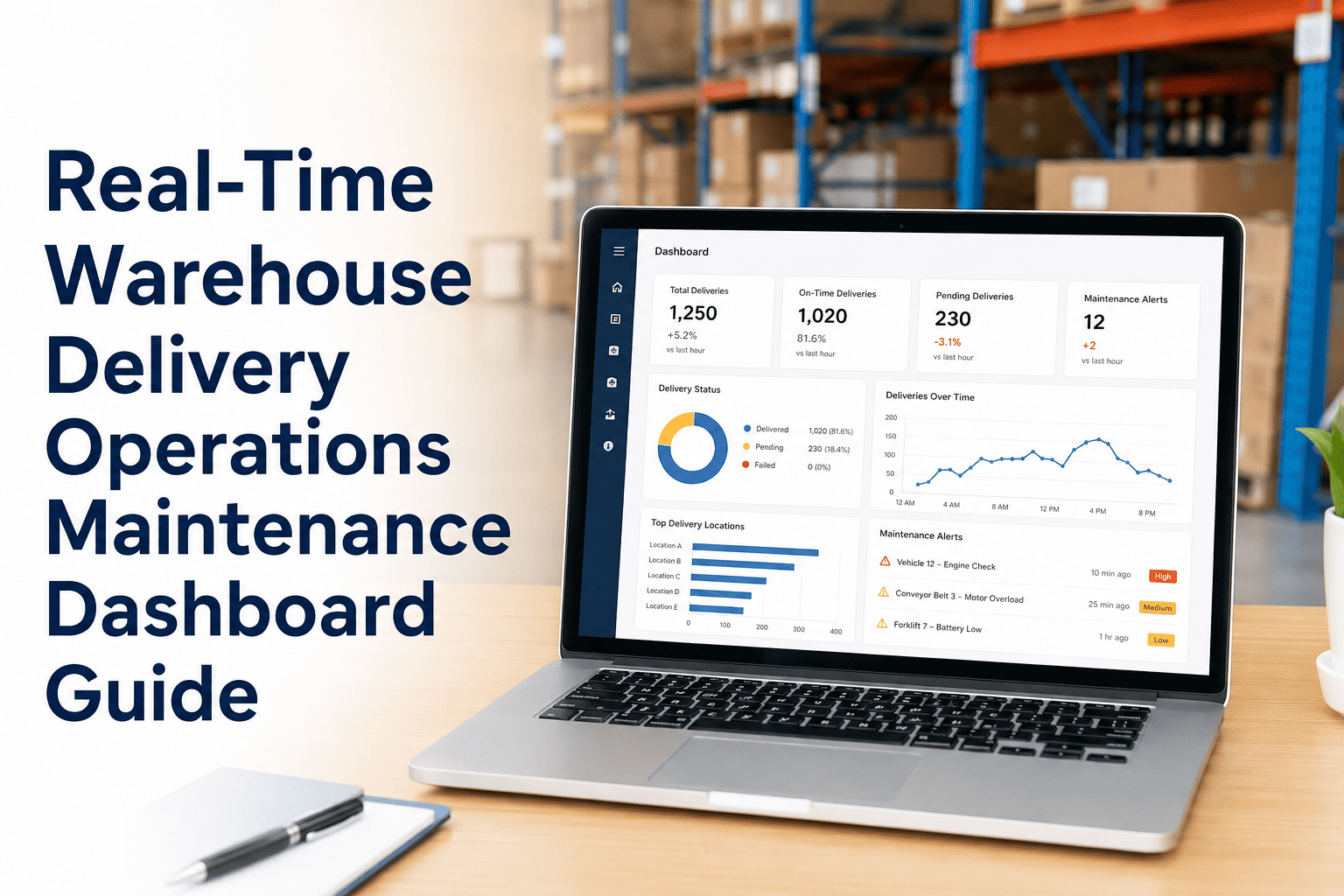
Shift supervisors and operations managers see equipment health scores, open work orders, and predicted maintenance windows on a single dashboard — integrated with dispatch scheduling so that planned maintenance windows align with throughput lows rather than competing with peak periods.
Frequently Asked Questions
Does AI maintenance require replacing our existing sorter or conveyor control systems?
No. OxMaint connects to existing equipment data streams via API or standard industrial protocols. Your sorter controller, conveyor PLC, and robotics fleet management systems remain unchanged — OxMaint reads the data they already generate and applies maintenance intelligence on top.
Book a demo to review your specific equipment integrations.
How long does it take for AI models to learn equipment baselines?
The baseline learning period for most warehouse automation assets is 14–21 days of normal operation. During this period, OxMaint observes operating patterns across different load levels, shifts, and throughput volumes before anomaly detection goes live. Calendar PM continues uninterrupted during this window.
Start your free trial to begin the baseline period today.
What is the typical reduction in unplanned downtime after implementing AI maintenance?
Facilities moving from reactive or calendar-only PM to AI-driven predictive maintenance typically see 55–70% reduction in unplanned downtime events within 90 days. The reduction is largest for high-cycle equipment like sorters and conveyors, where degradation patterns are most consistent and predictable.
Can OxMaint handle a mixed automation environment with equipment from multiple vendors?
Yes. OxMaint is equipment-agnostic and manages assets from different vendors within a single platform. Each asset has its own sensor configuration, threshold settings, and maintenance schedule — regardless of manufacturer. Multi-vendor environments are the norm in warehouse automation, and OxMaint is built for exactly this complexity.
Discuss your equipment mix in a demo call.
At what scale does AI maintenance become cost-justified for warehouse automation?
For facilities with 10 or more automated assets — sorters, conveyor lines, or robotics — the ROI on AI maintenance is typically positive within 60–90 days. A single prevented unplanned sorter stoppage during a peak dispatch window generally covers months of platform cost. The break-even calculation becomes straightforward once you know your hourly throughput value.
Deploy the AI Maintenance Playbook
Your Sorters, Conveyors, and Robotics Are Sending Failure Signals Right Now. Is Anyone Reading Them?
OxMaint connects to your automation telemetry, learns what healthy looks like, and flags degradation before it reaches the floor — automatically creating work orders, assigning technicians, and integrating maintenance windows with dispatch scheduling. The playbook is ready. The question is whether your equipment will fail before or after you implement it.