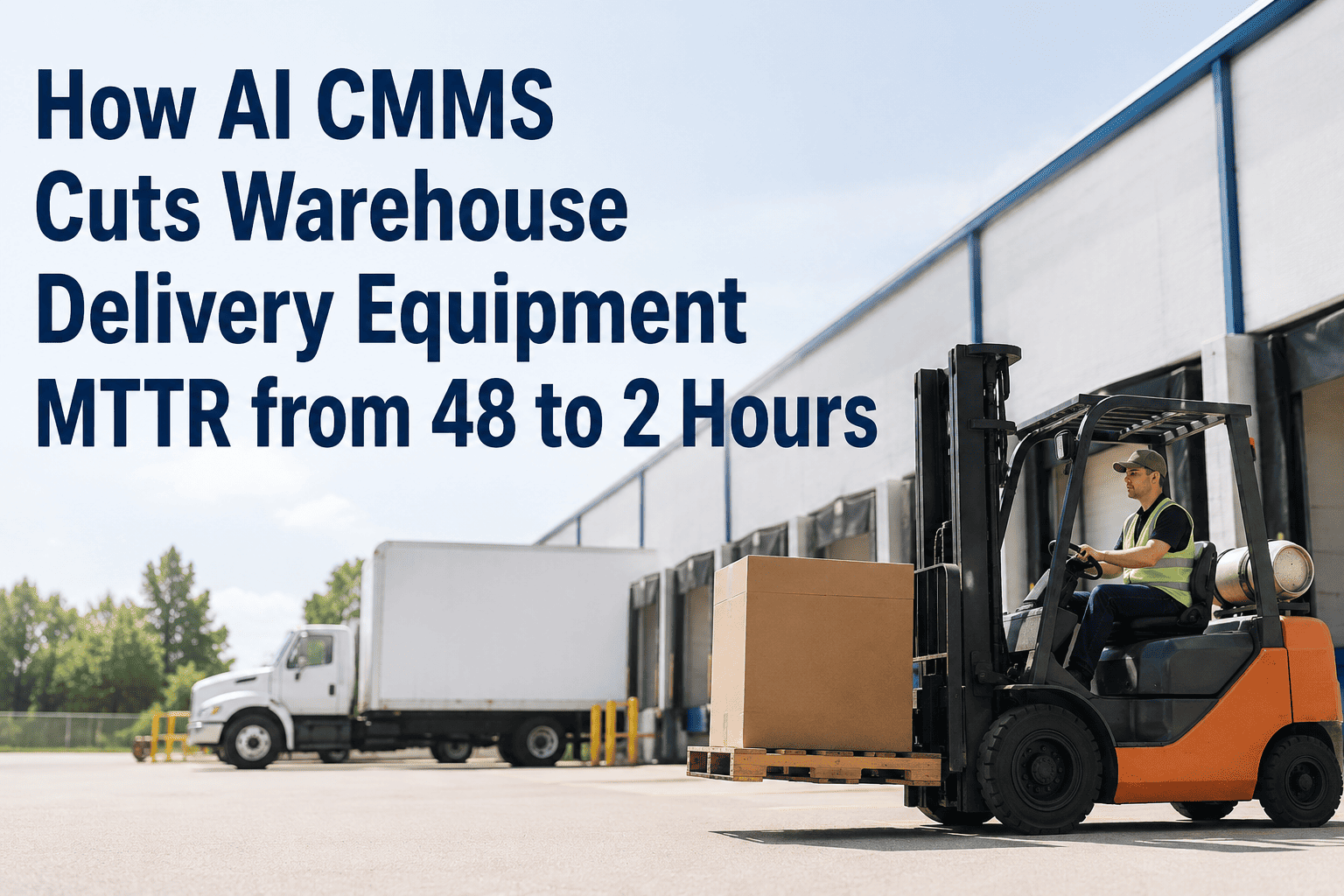
When a warehouse conveyor stops during a peak delivery window, the cost is not the repair bill — it is the cascade. Orders back up, dock schedules slip, carrier SLAs breach, and every downstream fulfilment commitment shifts. The difference between a 48-hour repair window and a 2-hour one is not technician speed — it is whether the right diagnosis, the right part, and the right procedure were pre-staged before the failure happened. AI CMMS changes the repair equation by predicting failure windows, pre-positioning spare parts, and delivering asset-specific repair history to the technician's mobile device before they reach the equipment. Start a free trial to see how OxMaint AI CMMS compresses warehouse equipment MTTR across your delivery operation.
From 48 Hours to 2 Hours: How AI CMMS Cuts Warehouse Equipment Repair Time
Conveyor down. Dock idle. Sorter jammed. Every hour of unplanned equipment downtime during a peak delivery window multiplies cost across the entire pipeline. AI CMMS with predictive failure alerts and pre-staged parts compresses warehouse equipment MTTR from industry-average 48 hours to 2–4 hours — documented across delivery operations running high-volume fulfilment.
The Four Phases of MTTR — and Where AI Compresses Each One
MTTR is not one problem — it is four sequential delays, each adding hours to the repair window. AI CMMS attacks all four simultaneously. Understanding where time disappears is the first step to understanding how OxMaint eliminates it.
Every Hour of Downtime Has a Real Dollar Value. Stop Losing It.
OxMaint AI CMMS predicts warehouse equipment failures before they stop your operation, pre-stages the right parts, and delivers complete asset history to your technician's mobile — compressing MTTR from 48 hours to 2–4 hours across conveyor, dock, and sortation equipment.
Warehouse Equipment Where MTTR Reduction Has the Highest Impact
Not all warehouse equipment carries equal downtime risk. These are the asset categories where a single failure during a peak delivery window creates the largest operational cascade — and where AI CMMS predictive maintenance delivers the fastest ROI.
| Equipment Category | Typical Failure Mode | Downtime Impact | MTTR (Reactive) | OxMaint AI Capability |
|---|---|---|---|---|
| Belt Conveyor Systems | Belt wear, bearing degradation, motor failure | Full lane shutdown — order backlog compounds within 15 minutes | 6–24 hours | Vibration and temperature monitoring — failure predicted 48–72 hrs in advance |
| Sorter and Diverter Units | Actuator failure, sensor drift, belt misalignment | Cross-docking halted — manual sortation cannot absorb volume | 4–16 hours | Sensor drift trending — alerts issued before sorter begins misrouting |
| Dock Levellers and Seals | Hydraulic failure, seal deterioration, lip plate jamming | Dock bay out of service — carrier turnaround delayed | 2–8 hours | Scheduled inspection triggers with hydraulic pressure monitoring |
| Automated Guided Vehicles (AGVs) | Battery degradation, navigation sensor failure | Pick-and-place throughput drops — manual substitution required | 4–12 hours | Battery health trending — replacement scheduled before capacity drops below threshold |
| Overhead Doors and Access Systems | Motor failure, track misalignment, safety sensor fault | Building security breach or vehicle access blocked | 2–6 hours | Cycle count monitoring — PM triggered before failure interval is reached |
| Goods-to-Person Robotic Systems | Joint actuator wear, navigation map drift, gripper failure | Pick station offline — wave plan rebuild required | 8–48 hours | Joint torque and actuator load trending — highest-criticality asset priority queue |
The OxMaint AI MTTR Reduction Workflow — Step by Step
OxMaint integrates with IoT sensors on conveyor motors, bearing housings, sorter actuators, and dock equipment. Vibration, temperature, power draw, and cycle count data streams into the AI model in real time — establishing baselines and tracking deviation from normal operating signature.
When sensor data indicates degradation trending toward failure threshold, OxMaint AI issues a predictive maintenance alert — typically 48–72 hours before breakdown. The alert includes the asset ID, estimated remaining useful life, likely failure mode, and recommended maintenance action.
A work order is automatically created and assigned to the right technician based on asset location, technician certification, and shift schedule. The work order includes the full repair history for that asset, the AI-suggested failure mode, the required parts list with current stock status, and the SOP for that repair type.
OxMaint cross-references the required parts list against live inventory. If critical spares are below the AI-calculated safety stock threshold, a purchase order is auto-generated. Parts are confirmed as staged and available before the technician is dispatched — eliminating parts-waiting as a source of MTTR delay.
The technician receives the complete work package on their mobile device — asset history, procedure, parts, and diagnostic data. Repair completion is logged in real time with root cause coding. The AI model updates with actual failure data, improving prediction accuracy for every subsequent heat cycle on that asset class.
OxMaint automatically calculates MTTR, MTBF, and planned-to-reactive maintenance ratio per asset, location, and time period. Leadership dashboards show downtime cost trends, top failure assets by downtime impact, and PM compliance rates — giving maintenance managers the data to justify investment in reliability improvements.
MTTR and AI CMMS — Questions from Warehouse Operations Teams
Your Next Peak Window Is Coming. Will Your Equipment Be Ready?
OxMaint AI CMMS connects warehouse equipment sensor data, spare parts inventory, technician workflows, and repair history into one platform — predicting failures before they happen, pre-staging parts before they are needed, and delivering everything a technician needs at the point of repair. The result: MTTR from 48 hours to 2–4 hours, documented across warehouse delivery operations running high-volume fulfilment.