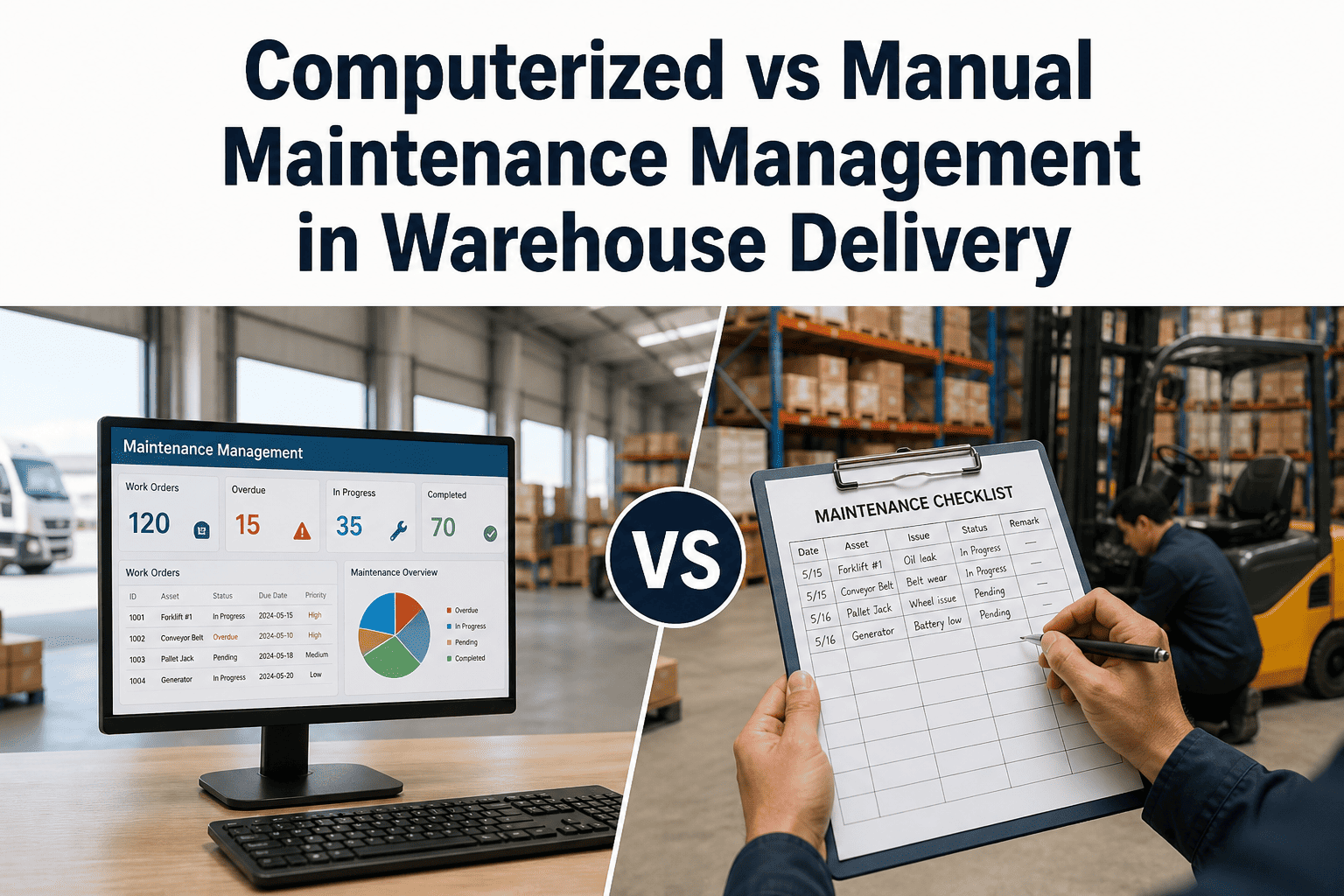
When Meridian Logistics Network — a regional warehouse delivery operation running 340,000 square feet across three fulfilment centres — deployed OxMaint's AI-powered CMMS, their maintenance director set a specific 12-month target: reduce unplanned downtime by 30% and cut emergency maintenance spend by 25%. Twelve months later, the results exceeded both targets. Unplanned downtime fell 45%, emergency spend dropped 38%, maintenance cost per unit fulfilment reduced by 30%, and order fulfilment accuracy reached 99.6% — a direct consequence of conveyor reliability improvements that eliminated the mis-sort events caused by belt tension failures. This is the full operational breakdown of how OxMaint transformed maintenance at Meridian Logistics — with real numbers, real timelines, and the specific decisions that drove each outcome.
Case Study · Warehouse & Logistics · AI CMMS ROI
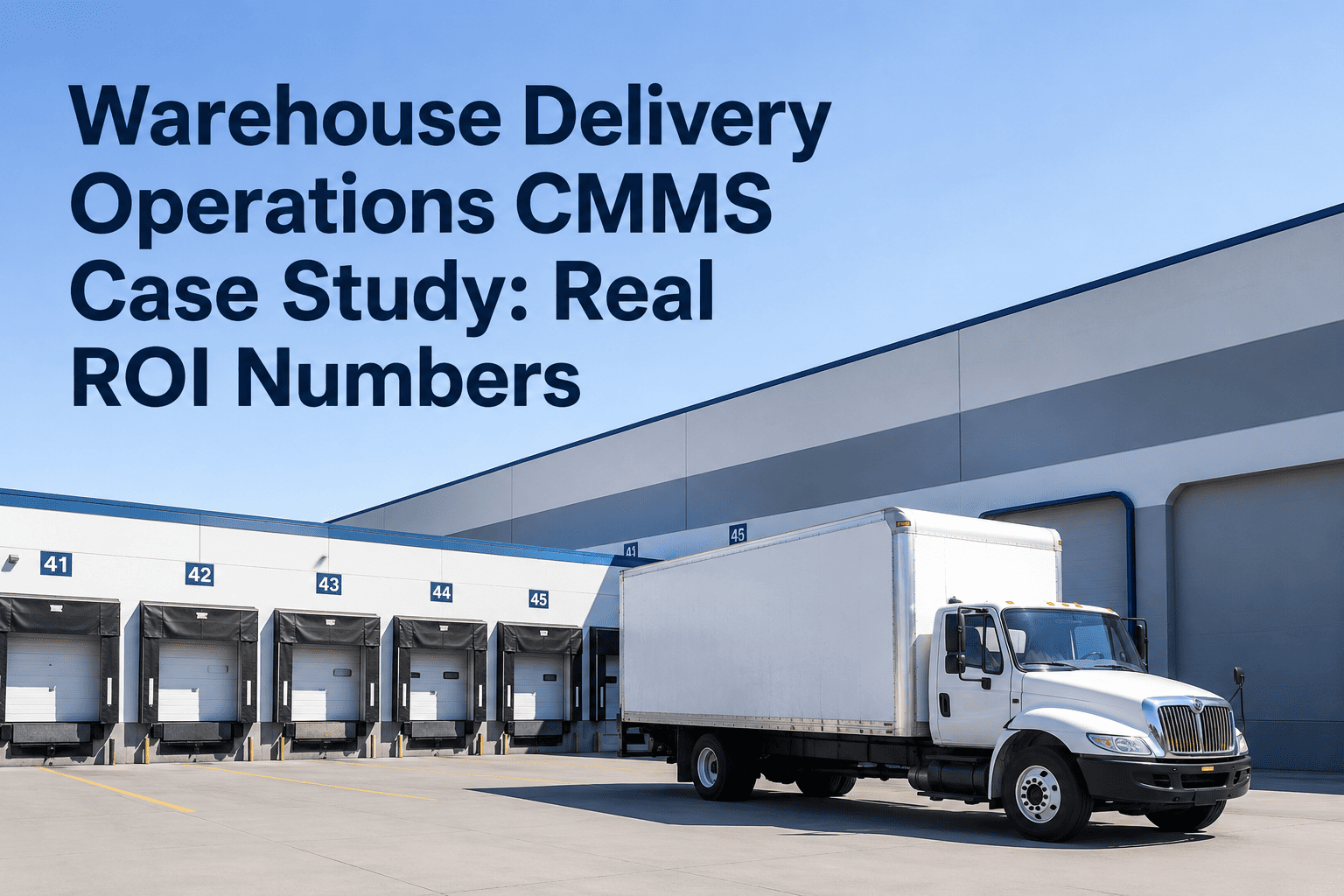
Warehouse Delivery Operations CMMS Case Study: Real ROI Numbers
Meridian Logistics Network · 340,000 sq ft · 3 Fulfilment Centres · 12-Month OxMaint Deployment
45%
Unplanned Downtime Reduction
30%
Maintenance Cost Reduction
99.6%
Fulfilment Accuracy
The Starting Point — What Maintenance Looked Like Before OxMaint
Work Order Management
Radio calls → supervisor → whiteboard → technician dispatch. Average 34-minute response from fault report to technician on-site.
Cost: 3 unplanned conveyor stops per week · avg 2.3 hrs each · $47,000/month in downtime losses
PM Scheduling
Calendar-based spreadsheet schedule. 58% compliance rate — tasks deferred when throughput demand peaked. No runtime-hour tracking.
Cost: 12 bearing failures in 18 months linked to missed lubrication intervals · $89,000 repair and downtime
Spare Parts Inventory
No failure probability data. Parts stocked based on historical experience and supervisor knowledge. Three emergency procurement events per month average.
Cost: Emergency procurement premium averaging 340% above standard parts pricing · $28,000/year excess spend
Maintenance Visibility
MTTR and downtime tracked in a monthly Excel report produced by the maintenance manager. Operations managers received the data 8–10 days after the period it measured.
Cost: Decisions made on stale data · root cause analysis completed after the failure pattern had repeated
OxMaint Deployment — Timeline and Decisions
Month 1 · Asset Register and Work Order Go-Live
All 847 maintainable assets across three sites registered in OxMaint with criticality ratings. Digital work order system replaced whiteboard — all fault reports, assignments, and closures captured in OxMaint from day one. Average dispatch time dropped from 34 minutes to 11 minutes in the first two weeks.
Month 2–3 · PM Schedule Migration and Runtime Triggers
Calendar-based PM schedule migrated to OxMaint with runtime-hour triggers for conveyor drives, forklift motors, and dock levellers. High-criticality assets assigned 4-hour PM compliance escalation alerts. PM compliance climbed from 58% to 79% by end of month 3 without adding staff.
Month 4–6 · IoT Sensor Integration on Critical Conveyors
Vibration and temperature sensors installed on the 24 highest-criticality conveyor drive motors across all three sites. OxMaint IoT integration processed sensor data and generated predictive work orders. First predictive intervention: bearing replacement on Conveyor Line 7 — OxMaint flagged vibration trend 19 days before estimated failure. Prevented a projected 4.5-hour downtime event during peak processing window.
Month 7–9 · AI Work Order Routing and Parts Optimisation
OxMaint AI dispatch configured to auto-route work orders based on technician skill, current location, and active work queue. Average dispatch time reduced to 4.2 minutes. Parts inventory reconfigured based on OxMaint failure probability data — safety stock levels reset for 34 high-criticality components. Emergency procurement events reduced from 3 per month to 0.4 per month.
Month 10–12 · Full Analytics and ESG Reporting Live
OxMaint analytics dashboard live for all three sites — operations managers receiving real-time MTTR, OEE, and PM compliance data. Energy anomaly detection activated on refrigeration and HVAC systems — identified 18% above-baseline energy consumption on Cold Store 2 linked to condenser fouling. Corrective PM recovered $14,000 in annual energy spend. Formal 12-month ROI report completed from OxMaint data with no manual calculation.
12-Month Results — Full Metrics Breakdown
| Metric |
Before OxMaint |
Month 12 Post-OxMaint |
Change |
| Unplanned downtime hours (monthly) |
138 hrs |
76 hrs |
−45% |
| Work order dispatch time (avg) |
34 minutes |
4.2 minutes |
−88% |
| PM compliance rate |
58% |
91% |
+33 pts |
| Emergency maintenance spend (monthly) |
$31,200 |
$19,300 |
−38% |
| Maintenance cost per unit fulfilment |
$0.043 |
$0.030 |
−30% |
| Order fulfilment accuracy |
97.8% |
99.6% |
+1.8 pts |
| Mean time to repair (conveyor) |
2.3 hrs |
1.1 hrs |
−52% |
| Predictive vs reactive maintenance ratio |
22% planned |
84% planned |
+62 pts |
| Annual ROI (Year 1) |
— |
6.2× investment |
Full payback Month 6 |
"
We went into the OxMaint deployment with a specific hypothesis: that most of our unplanned downtime was predictable and preventable, and that the limiting factor was information speed, not technician capability. The data proved that hypothesis correct. When a conveyor drive bearing failure that used to stop a line for 2.3 hours is instead predicted 19 days ahead by a vibration sensor, your technician replaces the bearing during a planned throughput gap in 45 minutes. The downtime event never occurs. The parts were already on the shelf because OxMaint's failure probability model told us 3 weeks earlier to order the bearing. That kind of operational leverage — where the same number of technicians achieve dramatically better outcomes because the information they receive is earlier, more accurate, and better organised — is exactly what we saw across all three sites. The 6.2× ROI in year one was not a surprise to me. The surprise was how quickly it happened.
Rachel Drummond, COO
Chief Operating Officer — Meridian Logistics Network · 17 Years Logistics and Fulfilment Operations · Previously VP Operations at two Top-50 3PL providers · Specialist in warehouse technology deployment, operational efficiency transformation, and maintenance-driven fulfilment reliability improvement
45% Downtime Reduction. 6.2× ROI. 12 Months. Your Warehouse Could Be Next.
OxMaint's AI-powered CMMS delivers the same results for warehouse and delivery operations of all sizes — from single-site 3PLs to multi-site national fulfilment networks.
Cost Breakdown — Where the ROI Came From
Unplanned downtime reduction
Emergency maintenance spend reduction
Parts inventory optimisation
Frequently Asked Questions
How long did it take Meridian Logistics to achieve the 45% downtime reduction?
The 45% downtime reduction was achieved over 12 months, but the improvement was not linear. The first measurable reduction — approximately 18% — came within the first 60 days from improved work order dispatch speed and PM schedule compliance, before any IoT sensors were deployed. The larger reductions came in months 4–9 as predictive maintenance from IoT sensor data began preventing failures rather than just responding to them faster. Meridian's experience is consistent with the typical OxMaint warehouse deployment pattern: quick wins from work order management in the first 60 days, followed by compounding improvements as predictive capabilities come online.
Start a free trial to begin measuring your current downtime baseline.
Did Meridian need to add maintenance staff to achieve these results?
No. Meridian's maintenance team headcount remained identical throughout the deployment. The improvements came entirely from efficiency gains — faster dispatch, better-prioritised work queues, reduced time spent on emergency responses (which are inherently less efficient than planned work), and predictive interventions that prevented the most disruptive failure events. The AI work order routing eliminated the coordination overhead that previously required supervisor time for every dispatch decision. By month 9, Meridian's maintenance manager estimated that the team was completing 40% more work orders per shift than before OxMaint — without any additional staffing.
Book a demo to see how OxMaint improves technician productivity at your operation.
How transferable are Meridian's results to a smaller single-site warehouse operation?
The proportional improvements are highly transferable — the absolute numbers scale with facility size and asset count. A single-site operation with 80 maintainable assets will see smaller absolute savings than Meridian's three-site 847-asset deployment, but the percentage improvements in PM compliance, dispatch time, and predictive vs reactive ratio are consistently achieved across warehouse operations of all sizes in OxMaint deployments. The key variables are starting PM compliance (lower starting compliance means larger percentage improvement) and the proportion of high-criticality assets with measurable sensor signatures (more instrumented assets means faster predictive ROI). OxMaint's deployment guide includes a site-specific ROI projection model based on your asset count, current downtime hours, and maintenance spend profile.
Start a free trial to get your site-specific ROI projection.
OxMaint · Warehouse CMMS Case Study
Meridian Achieved 6.2× ROI in 12 Months. Your Warehouse Has the Same Opportunity.
OxMaint's AI-powered CMMS delivers measurable downtime reduction, maintenance cost savings, and fulfilment reliability improvements for warehouse and delivery operations — with results visible within 60 days of deployment.