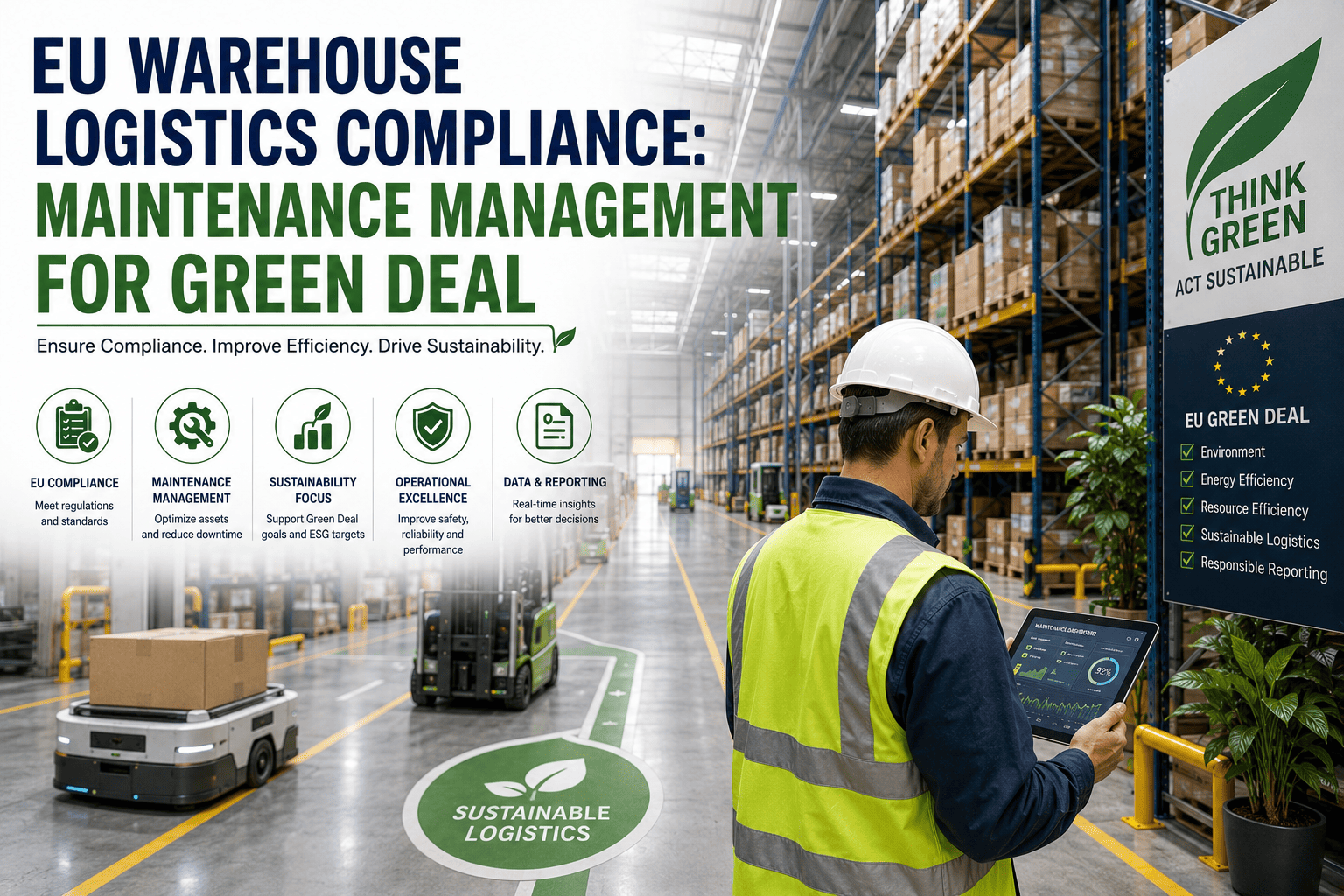
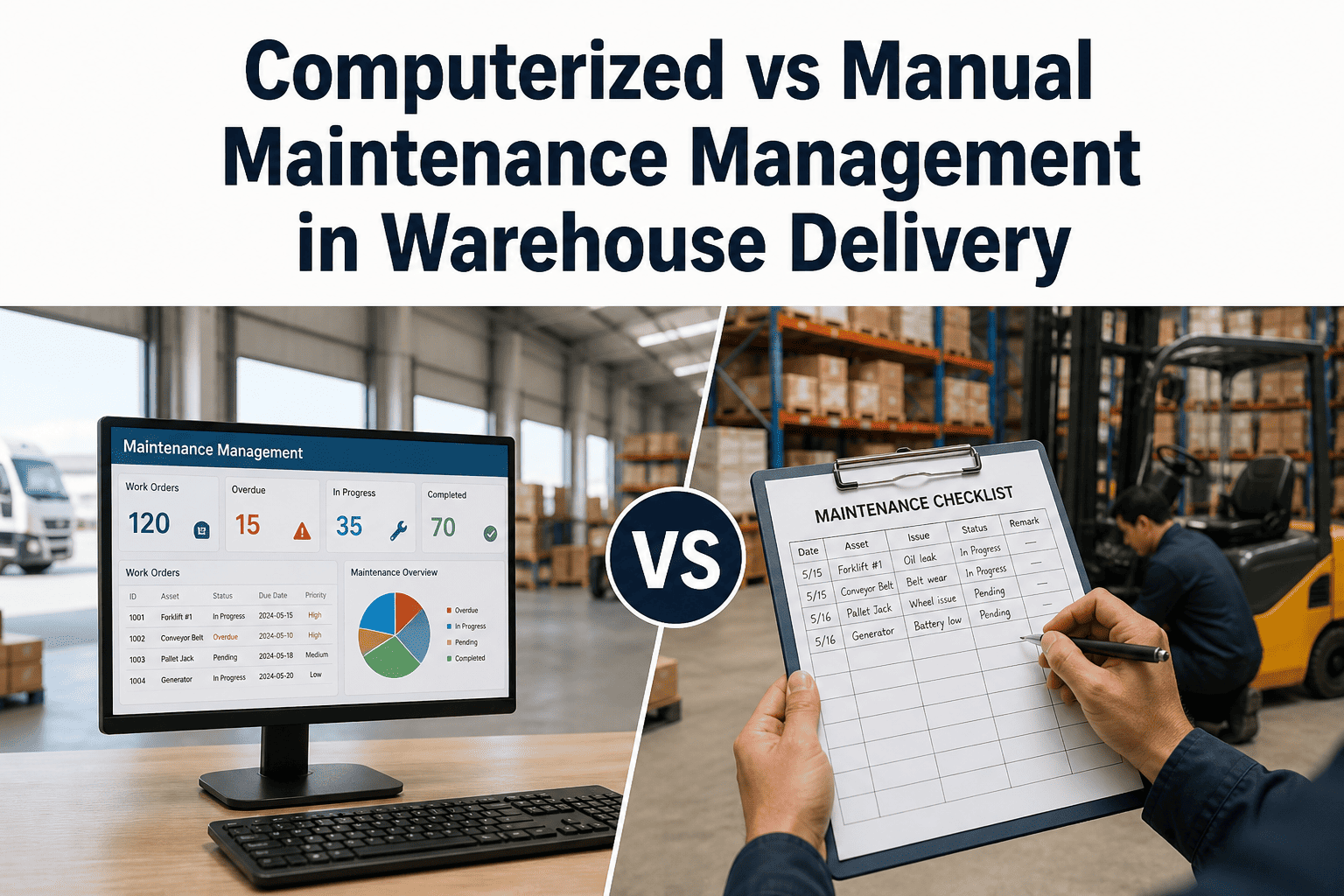
European warehouse operators are navigating a compliance environment that has no precedent — EU Green Deal mandates, CSRD sustainability disclosures, and asset traceability requirements are arriving simultaneously, and most maintenance teams are still running on spreadsheets and paper records that cannot survive a regulatory audit. CMMS-driven maintenance management turns compliance from a reactive scramble into a documented, traceable, and audit-ready process — without adding headcount or manual reporting overhead. Book a 30-minute demo to see how OxMaint's CMMS keeps European warehouse operations compliant, traceable, and audit-ready across every asset, every shift.
EU Green Deal · CSRD · Warehouse Compliance
EU Warehouse Logistics Compliance: CMMS-Driven Maintenance for the Green Deal Era
CSRD reporting. Asset traceability mandates. Green Deal sustainability obligations. European warehouse delivery operations face overlapping compliance demands — and paper-based maintenance records fail every one of them. OxMaint CMMS gives you structured, timestamped, audit-ready documentation from day one.
2025
CSRD Wave 1 reporting live — large EU companies publishing FY2024 sustainability data now
68%
of logistics managers say information requirements for their supply chain have significantly increased due to EU mandates
80%
reduction in companies required to report under revised CSRD Omnibus — but those in scope face full audit-grade scrutiny
5 min
Time to pull a complete 12-month asset maintenance history with CMMS — vs 4+ hours searching paper records
The Compliance Gap
Why Paper-Based Maintenance Records Fail EU Regulatory Audits
EU compliance auditors do not ask for summaries — they ask for evidence. Who maintained this asset, when, what was done, and what did the equipment read before and after? Warehouse maintenance teams running on spreadsheets and paper work orders cannot answer those questions at the speed an audit demands. The gap is not effort — it is infrastructure.
01
No Traceable Data Lineage
CSRD assurance engagements require that every ESG data point — energy consumption, emissions, waste — is traceable from the source activity to the reported figure. Spreadsheet-assembled data has no lineage. CMMS records create the timestamped, technician-signed chain of evidence that assurance providers require.
02
Incomplete Asset History
Regulators treat maintenance records as legal documents. A missing signature, an undocumented corrective action, or a gap in inspection history is treated as non-compliance — not as an administrative oversight. Paper systems cannot guarantee completeness across shifts, sites, and years of operational history.
03
No Equipment-Level Energy Data
CSRD requires equipment-level energy consumption data tied to maintenance events — not just monthly utility invoices. Warehouse conveyor systems, dock equipment, and refrigeration units each need before-and-after energy readings attached to every maintenance work order. Standard paper records capture none of this.
04
Manual Contractor Qualification Gaps
EU supply chain due diligence directives require evidence that maintenance contractors and spare parts suppliers meet sustainability criteria. Managing contractor qualification records, certifications, and chemical product data sheets manually creates documentation gaps that auditors flag as governance failures.
OxMaint CMMS for EU Compliance
Your Auditors Want Evidence. OxMaint Produces It Automatically.
Every work order timestamped. Every technician action logged. Every asset history retrievable in minutes. OxMaint's CMMS embeds EU compliance documentation into daily maintenance workflows — so audit preparation is not a project, it is already done.
Regulation Landscape
EU Compliance Mandates Affecting Warehouse Maintenance Teams
Three interconnected EU regulatory frameworks are creating documentation and traceability obligations that warehouse maintenance teams were not designed to meet — but that a CMMS can systematically address.
CSRD
Corporate Sustainability Reporting Directive
Wave 1 companies (1,000+ employees, €450M+ turnover) are now reporting FY2024 data. CSRD requires equipment-level energy consumption records, maintenance contractor sustainability documentation, and ESG data traceable from source activity to disclosed figure — all with limited or reasonable assurance from an external auditor.
CMMS Impact: Work orders must capture energy readings before and after each maintenance event, chemical product data, and contractor qualification records as structured fields — not free-text notes.
Green Deal ETS
EU Emissions Trading System — Logistics Extension
The EU ETS has been extended to cover logistics and transport operations, with phased emissions pricing reaching 100% coverage from 2026. Warehouse operations must demonstrate documented energy efficiency programmes and equipment condition records to support emissions calculations and regulatory submissions.
CMMS Impact: Preventive maintenance completion rates and equipment energy performance records become regulatory evidence, not just operational metrics.
CSDDD
Corporate Sustainability Due Diligence Directive
Requires companies to audit both upstream and downstream supply chain partners — including those that transport, store, and distribute products. Warehouse operators handling goods for in-scope companies must demonstrate that their maintenance and environmental practices meet the due diligence standards their supply chain partners are required to evidence.
CMMS Impact: Structured maintenance records, contractor qualification logs, and waste management documentation serve as the due diligence evidence your supply chain partners will request.
What CMMS Documents
Six Maintenance Data Dimensions EU Compliance Requires
Standard work orders capture labour hours, parts used, and completion status. EU regulatory compliance requires six additional data dimensions per maintenance event. OxMaint captures all six as structured fields on every work order — automatically, without changing technician workflows.
| Data Dimension |
EU Regulation Requiring It |
What Auditors Check |
OxMaint Capture Method |
| Energy consumption — before and after maintenance |
CSRD / ESRS E1 |
Equipment-level kWh reading with timestamp |
Mandatory meter reading field per work order |
| Refrigerant and chemical use per event |
CSRD / EU F-Gas Regulation |
Product name, quantity, and disposal method |
Structured chemical log with product data sheet link |
| Waste generated — type and volume |
CSRD / ESRS E5 |
Waste category, weight, and disposal route |
Waste disposal field with category selector |
| Technician certification and competency |
ISO 45001 / CSDDD governance |
Certification current, task-qualified technician assigned |
Technician certification tracking with task-role matching |
| Contractor qualification documentation |
CSDDD / CSRD governance disclosures |
Supplier ESG documentation on file |
Contractor profile with sustainability document storage |
| Asset condition score pre and post maintenance |
ISO 55000 / CSRD asset management |
Documented basis for maintenance decision |
Condition rating field with photo attachment |
Audit Readiness
What Happens When Auditors Arrive — With and Without CMMS
Without CMMS — Paper and Spreadsheets
Auditor requests 12-month maintenance history for dock conveyor — team searches paper files for 4+ hours
Missing signatures on 3 work orders — auditor issues Non-Conformance Report
No equipment-level energy data — CSRD assurance provider flags incomplete disclosures
Contractor sustainability records stored in email — cannot be retrieved or verified during audit
PM completion rate must be calculated manually — cannot be demonstrated in real time
With OxMaint CMMS
Auditor requests maintenance history — technician filters by asset and exports PDF in under 5 minutes
Every work order timestamped and technician-signed at point of completion — no gaps, no NCRs
Energy readings captured per work order — CSRD assurance data complete and traceable
Contractor qualification records stored in CMMS profile — retrievable instantly during audit
PM completion rate visible on live dashboard — demonstrated to auditor in real time
EU Warehouse Asset Categories
Warehouse Equipment That Requires Compliance-Grade Maintenance Documentation
EU Green Deal compliance is not a head-office reporting exercise — it starts on the warehouse floor. Every asset that consumes energy, uses refrigerants, or generates waste needs documented, traceable maintenance records. OxMaint tracks maintenance compliance across all critical warehouse equipment categories.
Conveyor and Sortation Systems
High energy consumers. Maintenance events must capture before/after power draw readings. Downtime events require documented corrective action with root cause. CSRD energy data originates at conveyor-level metering.
Key compliance data: Energy kWh, component replacement, PM frequency
Refrigeration and Cold Chain Equipment
EU F-Gas regulations require documented refrigerant use, recovery, and disposal per maintenance event. Cold storage facilities must maintain F-Gas logbooks that are audit-accessible. OxMaint integrates F-Gas logging into standard work order workflow.
Key compliance data: Refrigerant type, quantity added, disposal route
Loading Dock Equipment
Dock levellers, dock seals, and vehicle restraint systems are safety-critical assets. EU workplace safety regulations require documented inspection records with technician sign-off. Gaps in dock equipment inspection history create liability during safety audits.
Key compliance data: Inspection date, technician certification, safety status
Forklifts and Material Handling Vehicles
Electric forklift battery maintenance directly affects energy consumption reporting. Hydraulic fluid changes require documented waste disposal records under EU waste regulations. Service intervals must be logged against vehicle-level asset records for fleet compliance.
Key compliance data: Battery energy readings, fluid disposal, service intervals
HVAC and Ventilation Systems
Large warehouse HVAC units are among the highest energy consumers on site. Filter changes, coil cleaning, and refrigerant service must all be documented with energy performance data to support CSRD E1 disclosures on energy intensity and efficiency improvements.
Key compliance data: Energy consumption, filter replacement, refrigerant service
Fire Safety and Suppression Systems
EU fire safety regulations require documented inspection and testing records for suppression systems. Inspection intervals, test results, and remediation actions must be traceable to specific assets and technicians — not summarised in annual reports.
Key compliance data: Test results, inspection dates, remediation records
Frequently Asked Questions
CMMS Compliance Questions from European Warehouse Teams
Does our warehouse fall under CSRD reporting obligations?
Under the revised Omnibus I rules (February 2026), mandatory CSRD reporting applies to companies with more than 1,000 employees and over €450 million in annual turnover. Even if your warehouse operation falls below these thresholds, supply chain partners who are in scope will increasingly require your maintenance and ESG documentation as part of their own due diligence obligations — making CMMS documentation strategically important regardless of direct reporting requirements.
Book a call to assess how OxMaint fits your compliance position.
Can OxMaint integrate with our existing ERP and WMS systems?
OxMaint integrates with existing ERP, WMS, and SCADA systems via REST API and OPC-UA protocols. Asset master data, work order history, and energy readings flow between systems without duplicate data entry. For warehouse teams without existing digital maintenance infrastructure, OxMaint provides mobile data capture workflows that digitise maintenance records from day one.
Start a free trial to test integration with your current systems.
How quickly can OxMaint produce audit-ready maintenance documentation?
Basic work order documentation with timestamps, technician records, and asset history is audit-ready from the first day of deployment. CSRD-structured ESG data — energy readings, chemical logs, waste records — accumulates as technicians complete work orders in the standard workflow, requiring no additional reporting steps at year end.
What German-specific warehouse compliance requirements does OxMaint support?
German warehouse operations face the Lieferkettensorgfaltspflichtengesetz (LkSG — Supply Chain Due Diligence Act), Arbeitsschutzgesetz workplace safety documentation requirements, and Kreislaufwirtschaftsgesetz waste management records. OxMaint's structured work order fields capture the contractor qualification, safety inspection, and waste disposal data that LkSG and workplace safety auditors require.
Book a demo to review German compliance specifics for your operation.
How does OxMaint handle multi-site warehouse operations across EU countries?
OxMaint supports multi-site asset management with site-level reporting and cross-site rollup. Each warehouse location maintains its own asset register and maintenance history, while group-level ESG reporting aggregates data across all sites — matching the CSRD reporting boundary requirement for complete, site-inclusive disclosures.
OxMaint CMMS · EU Green Deal Compliance · European Warehouse Operations
EU Compliance Is Already Active. Your Maintenance Documentation Should Be Too.
OxMaint CMMS gives European warehouse and delivery logistics operations structured, timestamped, audit-ready maintenance records from day one — capturing the energy data, contractor qualifications, and asset history that CSRD assurance providers, Green Deal regulators, and supply chain due diligence auditors require. No manual reporting overhead. No documentation scrambles before audits.