Power plant spare parts outage planning is the single highest-leverage activity in a maintenance turnaround — a missing $2,000 valve can stall a 500 MW unit and burn $250,000+ in lost generation per day. Effective outage spare parts management means identifying critical components, pre-staging them, coordinating with vendors on lead times, and tracking every part through work-order completion inside a CMMS built for power generation. This guide walks reliability engineers and outage managers through the full process — from critical spare identification to parts staging, inventory control, and vendor coordination — and shows how OxMaint's AI-powered CMMS eliminates the spreadsheet chaos that causes 40% of outage delays. Ready to modernize? You can Start Free Trial or read on for the complete outage parts management framework.
Are missing spare parts quietly adding days to your next outage?
Industry studies show that 60–70% of unplanned outage extensions trace back to parts availability failures — late deliveries, wrong quantities, or critical components nobody flagged. OxMaint's spare parts CMMS for power plants cuts parts-related delays by up to 80% by linking every work order to real-time inventory, vendor lead times, and automated reorder triggers.
How to identify power plant critical spares before an outage begins
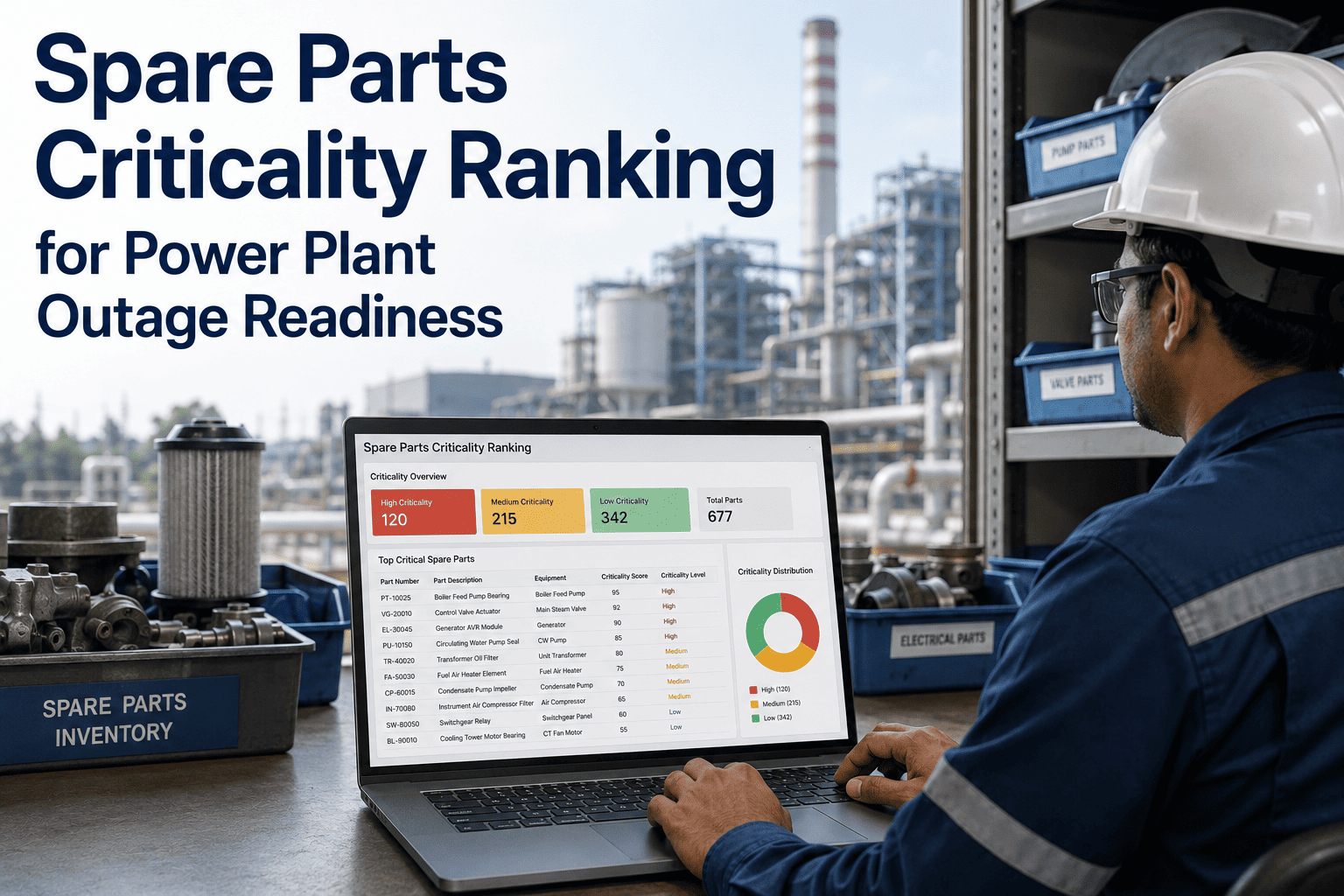
Critical spare identification is the foundation of outage parts planning. A typical 500 MW thermal plant carries 15,000–40,000 SKUs, yet only 3–8% are truly outage-critical — components whose failure would force a unit trip or extend a planned outage by more than 24 hours.
Turbine & generator spares
Long-lead items: turbine blades, rotor seals, journal bearings, generator retaining rings. OEM lead times run 16–52 weeks. These parts must be on-site or under bonded vendor agreements before outage scope is frozen.
- HP/IP/LP turbine blade sets
- Bearing assemblies & seals
- Valve internals (stop, control, intercept)
Boiler & aux spares
Moderate lead items: boiler tubes, sootblower elements, feedwater pump internals, FD/ID fan bearings. Lead times 4–16 weeks. Pre-stage based on outage scope and condition-assessment findings.
- Boiler tube sections & weld prep
- Feedwater pump cartridges
- Valve bodies & actuators (2"+)
Consumables & standard parts
Short-lead items: gaskets, fasteners, filters, O-rings, packing. Lead times under 2 weeks. Maintain min/max stock; auto-reorder via CMMS when consumption triggers fire.
- Gaskets, packing & seals
- Filter elements & strainers
- Bolting, fasteners, consumables
Worked example: a 180-asset coal plant
A 500 MW coal-fired plant spending $42K/yr on reactive expediting fees implemented tiered critical spare classification in OxMaint. By pre-identifying 312 Tier-1 items and bonding 68 long-lead turbine components with their OEM, they eliminated $31K in expedited freight and cut outage duration by 1.5 days — saving $375K in replacement energy costs on a single turnaround.
Power plant outage parts planning timeline: 12 months to T-minus zero
Outage parts planning is not a week-of activity. Best-in-class plants begin critical spare identification 9–12 months before the outage window. Here is a month-by-month staging cadence used by top-quartile reliability teams.
Scope freeze & criticality analysis
Finalize outage scope from PM compliance, condition assessments, and RCA findings. Run criticality analysis (RCM-style) on every in-scope asset. Tag required parts Tier 1–3 in your CMMS. Begin OEM RFQs for any item with lead time > 20 weeks.
Long-lead procurement & bonded inventory
Place POs for all Tier-1 turbine spare parts and boiler components with lead times exceeding 16 weeks. Negotiate bonded inventory agreements with OEMs for items too costly to stock outright. Verify material certifications (MTRs) on receipt.
Inventory audit & gap analysis
Cycle-count all outage-critical SKUs. Cross-reference CMMS bill-of-materials (BOM) against physical stock. Identify shortfalls and place supplemental orders. Confirm 95%+ BOM accuracy on in-scope equipment — a common failure point that costs plants 4–8 hours per missing part during execution.
Vendor coordination & logistics lock
Confirm delivery dates with all vendors. Lock staging-area assignments. Verify that special tooling, lifting rigs, and consumables (welding gas, NDE materials) are reserved. Set up CMMS kitting workflows so each work order auto-pulls its parts package.
Parts pre-staging & kitting
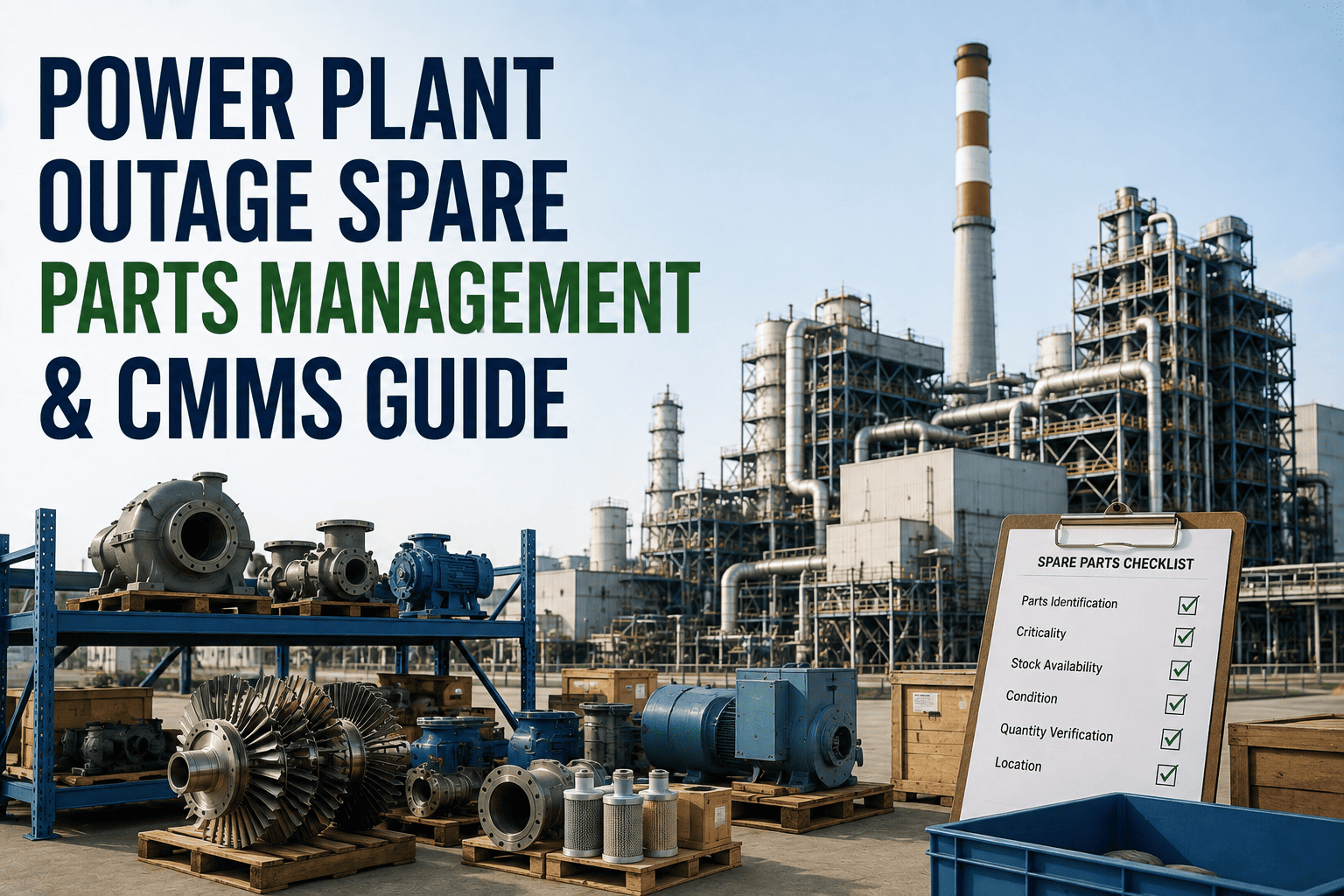
Physically stage all parts in labeled kits mapped to work orders. Bar-code every kit into the CMMS. Conduct a dry-run parts verification with outage supervisors. Any item not verified by T-14 days escalates to expediting — not the night before the job.
Spare parts availability math: the formula that predicts outage success
Outage inventory management comes down to one number: parts availability at the moment a work order goes active. If it is below 97%, your outage will extend. Here are the three formulas reliability engineers should track weekly during the planning cycle.
Outage Parts Availability
Target: ≥ 97% by T-7 days. Below 92% means 1+ day of outage extension is likely. A 500 MW combined-cycle plant with 94% availability on 2,800 required parts will average 168 missing items — each costing 2–6 hours of schedule slippage.
Critical Spare Coverage Ratio
Target: 100% by T-30 days. Tier-1 items cannot be expedited — a single uncovered turbine blade set can delay restart by 3–8 weeks. Bonded inventory agreements count if the vendor contractually guarantees delivery within the outage window.
Parts-Related Downtime Cost
Example: a 6-hour delay on a 500 MW unit at $55/MWh replacement cost = $165,000 in avoidable loss. Run this for every Tier-1 part not pre-staged to build the business case for bonded inventory or capital spares investment.
| Metric | Reactive (No CMMS) | CMMS-Managed | World-Class |
|---|---|---|---|
| Outage parts availability | 78–85% | 94–97% | ≥ 98% |
| BOM accuracy on critical assets | 60–70% | 90–95% | ≥ 98% |
| Parts-related outage delays | 2–4 days | 0.5–1 day | < 4 hours |
| Expediting fees per outage | $25K–$60K | $5K–$12K | < $3K |
| Tier-1 spare coverage ratio | 70–80% | 95–100% | 100% |
| Inventory carrying cost (as % of asset value) | 18–25% | 12–16% | 8–10% |
How OxMaint solves power plant outage spare parts management
OxMaint is an AI-powered CMMS and EAM platform purpose-built for maintenance and reliability teams. It replaces spreadsheets, siloed inventory databases, and reactive expediting with a single system that links work orders, asset BOMs, real-time stock levels, vendor lead times, and predictive reorder logic.
Asset-linked BOMs & criticality tagging
Every asset carries a verified bill-of-materials with Tier 1–3 criticality flags. When an outage work order is created, OxMaint auto-generates the complete parts list — no manual lookups, no missed components. Plants report 40% faster kitting and 95%+ BOM accuracy within 90 days.
Real-time inventory & auto-reorder
Live stock levels across all storerooms, with min/max and reorder-point logic tuned to lead time and criticality. OxMaint automatically generates purchase requisitions when stock dips below threshold — cutting stockouts by 60–80% and eliminating last-minute expediting fees.
Outage kitting & barcode staging
Create work-order kits that pull parts from inventory and assign them to staging locations. Bar-code scan every kit in and out. Supervisors see a real-time kitting dashboard — green for verified, red for short — so gaps surface at T-14 days, not T-minus-2-hours.
Vendor lead-time tracking & predictive analytics
OxMaint tracks actual vs. promised lead times per vendor and per SKU, then uses AI to predict delivery slippage before it happens. Reliability teams get early-warning alerts on any part at risk of missing the outage window — typically 3–5 weeks ahead, while there is still time to act.
Vendor coordination for outage spare parts: what to lock down and when
Vendor coordination failures are the second-leading cause of outage delays (after BOM inaccuracy). A single OEM that ships 10 days late can cascade into a full-week extension. Here is what to confirm with each vendor and when.
Turbine, generator & boiler OEMs
Confirm at M-9: PO acknowledgement, factory test dates, shipping method, customs clearance (if imported), and on-site delivery window. Negotiate bonded inventory for items over $50K. Require MTRs and certificates of conformance with every shipment.
Valve, bearing & motor distributors
Confirm at M-3: stock verification, commitment-to-ship date, and freight terms. For standardized items (bearings, seals, filters), maintain two qualified suppliers per SKU to eliminate single-source risk. OxMaint tracks vendor performance scores automatically.
Repair & refurbishment shops
Confirm at M-6: scope of work, turnaround time, QA/QC hold points, and return-shipping date. Track shop WIP in your CMMS as a virtual location so parts in for repair are visible — not invisible — in your inventory picture.
Freight forwarders & customs brokers
Confirm at M-2: routing, import documentation, duty status, and last-mile delivery to the plant gate. For international OEM shipments, build a 5-day customs buffer. OxMaint's lead-time tracking flags any shipment that misses its milestone checkpoint.
"Before OxMaint we were running outage parts off 14 linked spreadsheets and a whiteboard. We missed a $4,200 turbine seal kit that cost us 22 hours and $610K in replacement energy. After implementing OxMaint, our last two outages had zero parts-related delays."
— Reliability Manager, 1,200 MW combined-cycle plant
See OxMaint on your assets — book a 30-minute demo
Watch how fast your team can move from spreadsheet chaos to real-time outage parts visibility. We will load your asset list, BOMs, and current inventory into a live sandbox during the call.
Power plant outage spare parts management: FAQ
What are critical spare parts in a power plant outage?
Critical spare parts (Tier-1) are components whose unavailability would force a unit trip, prevent unit restart, or extend a planned outage by more than 24 hours. Typical examples include turbine blade sets, journal bearings, generator retaining rings, main steam valve internals, and large feedwater pump cartridges. These items have OEM lead times of 16–52 weeks, so they must be pre-staged or held under bonded inventory agreements before the outage begins.
How does a CMMS improve outage parts management?
A CMMS like OxMaint links every outage work order to a verified bill-of-materials, real-time stock levels, vendor lead times, and automated reorder triggers. This eliminates the spreadsheet silos that cause 40% of parts-related delays. Teams gain live kitting dashboards, barcode-verified staging, and early-warning alerts when any part is at risk of missing the outage window — typically cutting parts-related delays by 60–80%. You can Start Free Trial to test it on your assets.
How far in advance should outage spare parts be ordered?
Order long-lead turbine and boiler spare parts 9–12 months before the outage window. Tier-2 items (moderate lead, 4–16 weeks) should be ordered at M-6. Standard consumables can be ordered at M-1 based on final kitting counts. The key rule: every Tier-1 item must be physically on-site or contractually bonded by T-30 days — no exceptions.
What is parts pre-staging and why does it matter?
Parts pre-staging is the process of physically gathering, verifying, barcoding, and labeling all parts required for a specific work order into a kit before the outage begins. It matters because the number-one cause of outage-day slippage is a technician discovering a missing or incorrect part after the job has started. Pre-staged kits verified at T-7 days reduce parts-related delays to under 4 hours and eliminate the $25K–$60K in expediting fees typical of reactive plants.
How do you track vendor lead times for outage spare parts?
Track vendor lead times in your CMMS by recording the PO date, promised delivery date, and actual receipt date for every spare part order. OxMaint automatically calculates vendor performance scores and uses AI to predict delivery slippage 3–5 weeks before it happens, giving you time to expedite or source from an alternate supplier. Plants using lead-time analytics report 70% fewer late deliveries during outage windows.
Stop betting your outage on spreadsheets
Join the power plants that eliminated parts-related outage delays with OxMaint's AI-powered CMMS. Load your assets, BOMs, and inventory in days — not months. Your next outage runs on real-time data, not hope.
Free 14-day trial · No credit card