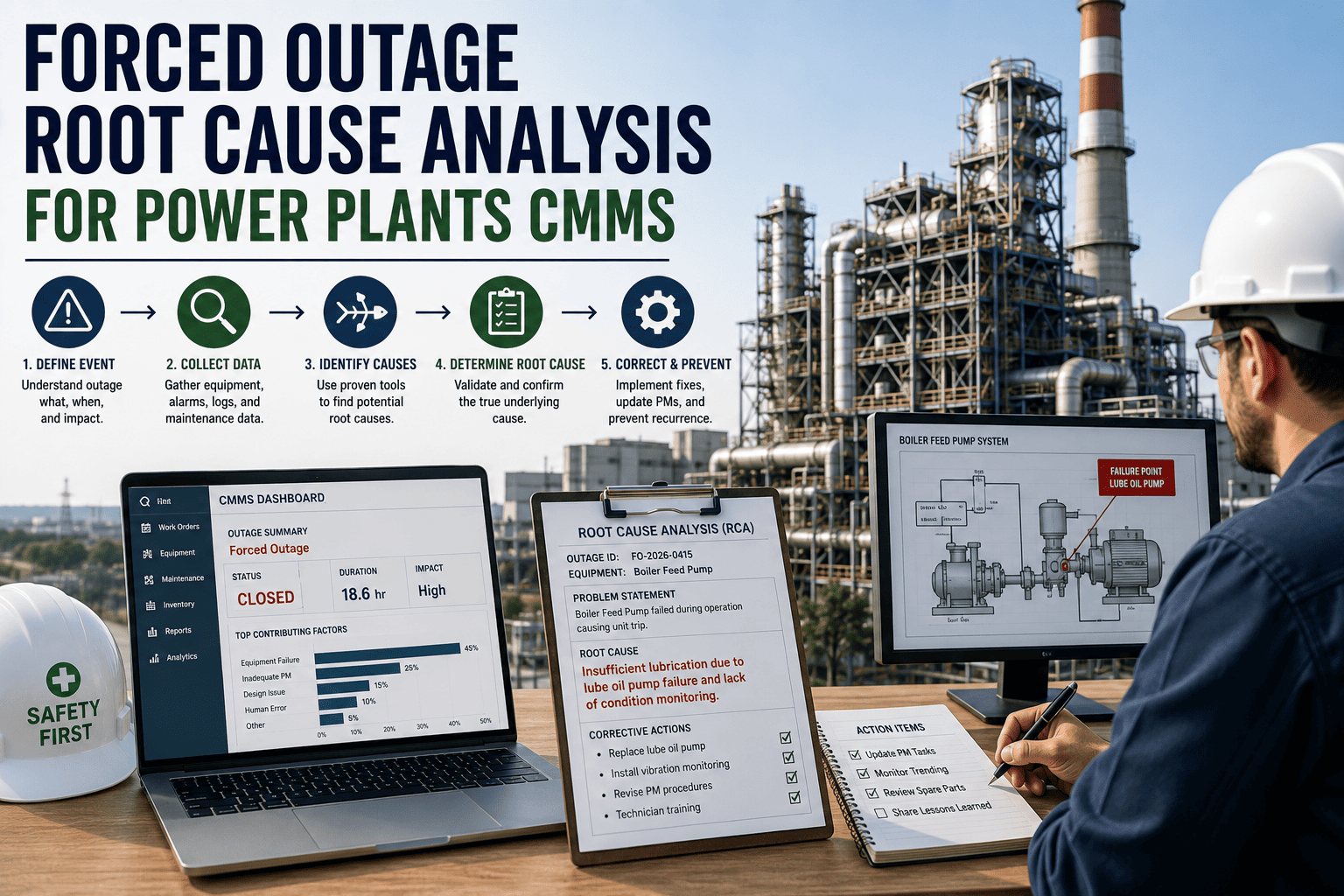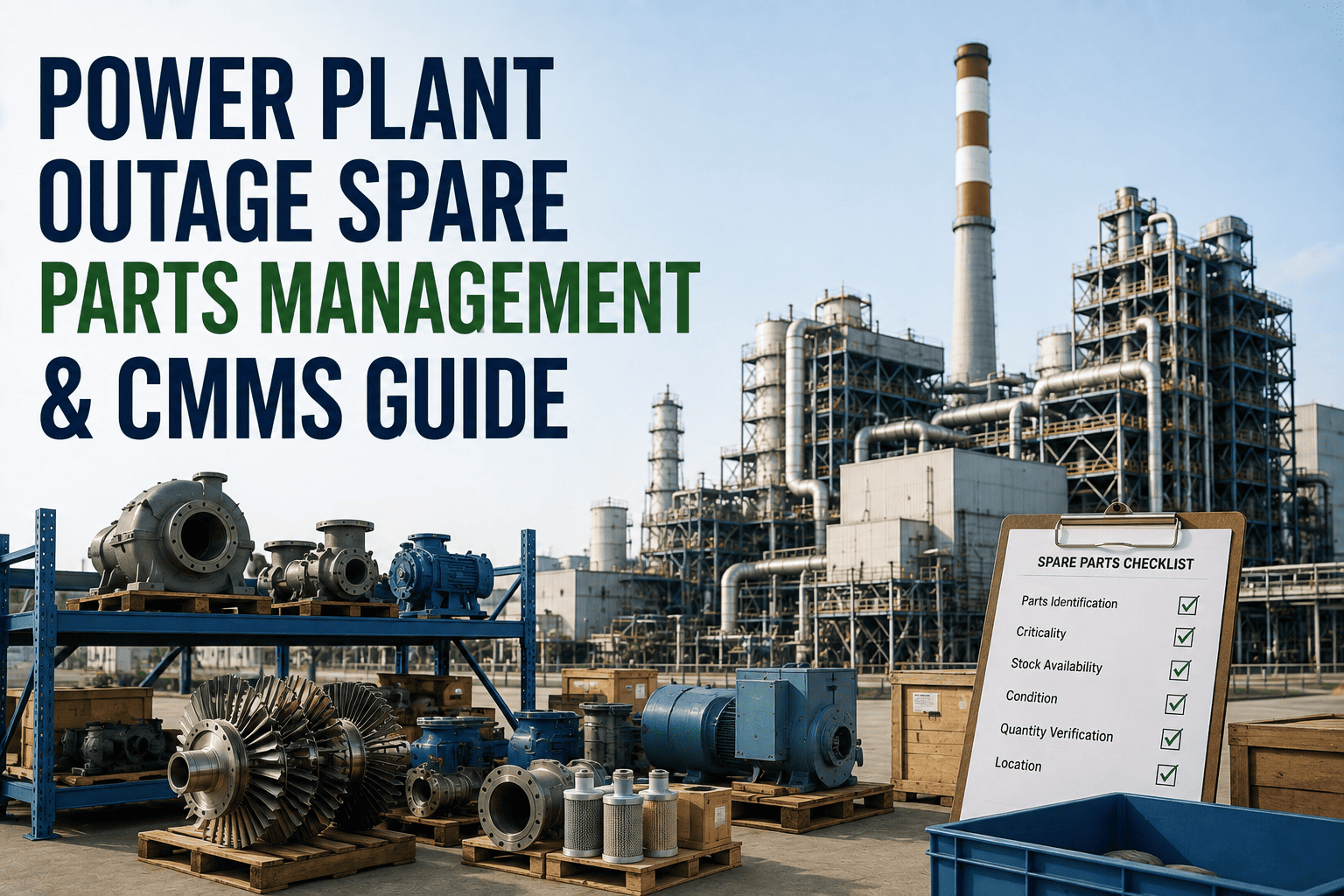
Outage critical path management for power plants determines whether a planned turbine outage finishes in 21 days or bleeds into 35 — and every extra day can cost $500K–$1.2M in lost generation revenue alone. The critical path is the longest sequence of dependent activities — from turbine rotor lift to reassembly and testing — where any delay pushes the entire outage timeline outward. This guide breaks down how maintenance and reliability teams sequence outage tasks, identify float, parallelize non-critical work, and use a CMMS to compress the power plant outage schedule without absorbing hidden risk. Ready to see it on your assets? You can Start Free Trial or book a personalized walkthrough below.
Is your next turbine outage critical path holding together — or quietly slipping by 4–6 days?
Power plants that manage the outage critical path inside a connected CMMS compress outage duration 15–25%, recover $750K–$2M in generation revenue per event, and cut schedule overruns from 12% to under 3%. OxMaint gives you the visibility to sequence, parallelize, and execute every outage activity on time.
reduction with CMMS-driven
critical path management
What defines the outage critical path in a power plant?
The outage critical path is the chain of sequential, time-dependent activities whose combined duration sets the minimum possible outage window. If any single task on the critical path slips — a rotor lift delayed by 8 hours, a casing bolt stuck, a non-destructive examination finding requiring rework — the entire outage extends by the same amount. In a typical 600 MW coal or combined-cycle plant outage, the critical path runs through turbine major inspection, generator rotor removal, HP/IP casing inspection, valve overhaul, and the reassembly-to-barring-gear sequence.
Cool-down verification, lockout/tagout, scaffolding erection, and opening of turbine casings. Critical path starts the moment the unit is declared offline and isolated.
HP/IP rotor extraction, generator rotor pull, and casing half-joint removal. Crane availability and rigging crew readiness directly gate this milestone.
Non-destructive examination of rotor blades, diaphragms, and casings. Critical-path findings — cracks, erosion, fretting — trigger scope additions that must be sequenced without blocking reassembly.
Rotor re-installation, casing closure, bolting torque/tension, and bearing clearance verification. Parallel non-critical work (valve overhaul, piping) must converge here without collision.
Barring gear engagement, overspeed trip test, vacuum raise, synchronization, and full-load ramp. The outage closes when the unit holds full megawatt output for 24 hours.
How to sequence outage tasks and identify float
Effective outage sequencing separates critical-path activities from non-critical tasks that have float — the slack time a task can slip without delaying the overall outage. A 400-asset outage may carry 1,200–1,800 work orders, but only 60–90 sit on the critical path. The rest can be parallelized, deferred, or rescheduled. Identifying float lets planners pull non-critical work into parallel execution windows, freeing crews and cranes for the activities that actually govern the outage end date.
The cost of a day: outage delay economics
A single day of unplanned outage extension on a 600 MW unit at $65/MWh spark or market spread translates to roughly $936,000 in foregone gross margin — before contractual penalties, extended contractor day-rates, and crew overtime. That is why outage critical path management is not a planning nicety; it is a board-level financial control. The formula below shows how duration compression and schedule certainty drive measurable returns.
A 600 MW combined-cycle plant budgets a 24-day turbine major outage. Without critical-path visibility in a CMMS, the outage runs 4 days over due to a delayed rotor lift and a bolt-failure rework finding. At $65/MWh, the 4-day extension costs $3.74M in lost generation margin alone. With OxMaint's outage timeline tracking and real-time critical-path alerts, the same plant compresses the outage to 19 days by parallelizing NDE work and pre-staging rotor bolts — recovering $2.8M in margin and $180K in contractor overtime.
on a 600 MW unit
with CMMS sequencing
industry-typical 12%
major outage event
How OxMaint streamlines outage critical path management
OxMaint brings the entire outage schedule into a single AI-powered CMMS — linking work orders, asset records, spare-parts inventory, and real-time progress tracking so planners, supervisors, and contractors all execute against the same critical path. Instead of siloed spreadsheets and static Gantt charts, OxMaint gives you a live outage timeline that flags slippage the moment it happens and automatically re-sequences non-critical work to protect the end date.
OxMaint maps every outage work order to a dependency-linked timeline and sends instant alerts when a critical-path task slips — so planners can re-allocate crews and cranes before the delay cascades. Teams cut schedule overruns from 12% to under 3%.
Automatically tag each work order as critical-path or float-available. OxMaint highlights parallel execution windows so you can pull non-critical tasks forward, maximizing crew utilization and compressing total outage duration 15–25%.
OxMaint links every outage work order to its required parts in inventory, flagging shortages 30–60 days before mobilization. Pre-staged kits eliminate the #1 cause of mid-outage delay — waiting on bolts, bearings, or gaskets — cutting parts-related idle time by 80%.
OxMaint captures actual vs. planned duration, labor hours, and scope growth for every outage activity — feeding a post-outage review that sharpens the next cycle's baseline. Plants using OxMaint analytics reduce repeat-outage duration 8–12% year over year.
See OxMaint manage your next outage critical path — book a 30-min demo
Walk through a live outage timeline, critical-path alerting, and parallel-task sequencing on your own asset hierarchy. Discover how plants cut outage duration 15–25% and recover millions in generation margin.
Power plant outage timeline: parallel execution vs. serial execution
The fastest path through an outage is rarely the most obvious one. Serial execution — completing one activity before starting the next — feels safe but wastes float and stretches the timeline. Parallel execution overlaps non-conflicting tasks, but requires a CMMS that tracks dependencies and resource availability in real time. The table below contrasts the two approaches on a typical 18-day major turbine outage.
| Outage Activity | Serial (Days) | Parallel (Days) | Dependency & Float |
|---|---|---|---|
| Unit isolation & LOTO | 1.0 | 1.0 | Critical path — zero float |
| Casing bolt removal & opening | 2.0 | 2.0 | Critical path — gates rotor lift |
| HP/IP rotor lift | 1.5 | 1.5 | Critical path — zero float |
| Condenser tube cleaning | 2.0 | 0.0 (parallel) | Float: 48 hrs — runs during NDE |
| NDE & blade inspection | 3.0 | 3.0 | Critical path — findings may extend |
| Control valve overhaul | 3.0 | 0.0 (parallel) | Float: 72 hrs — concurrent with NDE |
| Rotor re-install & casing closure | 3.0 | 3.0 | Critical path — zero float |
| Testing & return to service | 2.5 | 2.5 | Critical path — closes outage |
| Total Outage Duration | 18.0 days | 13.5 days | 25% compression |
Outage critical path checklist: what to verify before mobilization
A disciplined pre-outage readiness review catches the issues that derail critical-path schedules — missing parts, unclear scope, unverified contractor crews. Use this checklist 30–60 days before the outage window to confirm every critical-path prerequisite is in place. Plants that complete this review inside a CMMS report 40% fewer mid-outage scope additions and 60% fewer parts-related delays.
- Critical-path activities identified and dependency-linked in CMMS
- Work orders generated for all planned and contingency scope
- Float-bearing tasks tagged for parallel execution windows
- Baseline schedule reviewed and approved by reliability team
- Spare parts kitted and staged for every critical-path work order
- Long-lead items (rotor bolts, bearings, seals) verified in inventory
- Consumables quantified and replenished to min-max levels
- Shortage report reviewed and PO expedited for gaps
- OEM and specialty contractor scope confirmed with signed schedules
- Crane and rigging bookings locked for rotor-lift window
- NDE vendor mobilization date aligned with disassembly milestone
- Shift rotation plan validated for 24/7 critical-path execution
- LOTO procedures verified and isolation points tagged in CMMS
- Confined-space and hot-work permits pre-authorized
- JSA completed for each critical-path activity
- Audit trail and electronic sign-off workflow configured
Outage critical path management: frequently asked questions
Compress your next outage by 15–25% with OxMaint
Join the maintenance and reliability teams using OxMaint to sequence outage critical paths, parallelize float-bearing work, and recover millions in generation margin per outage event.
Free 14-day trial · No credit card