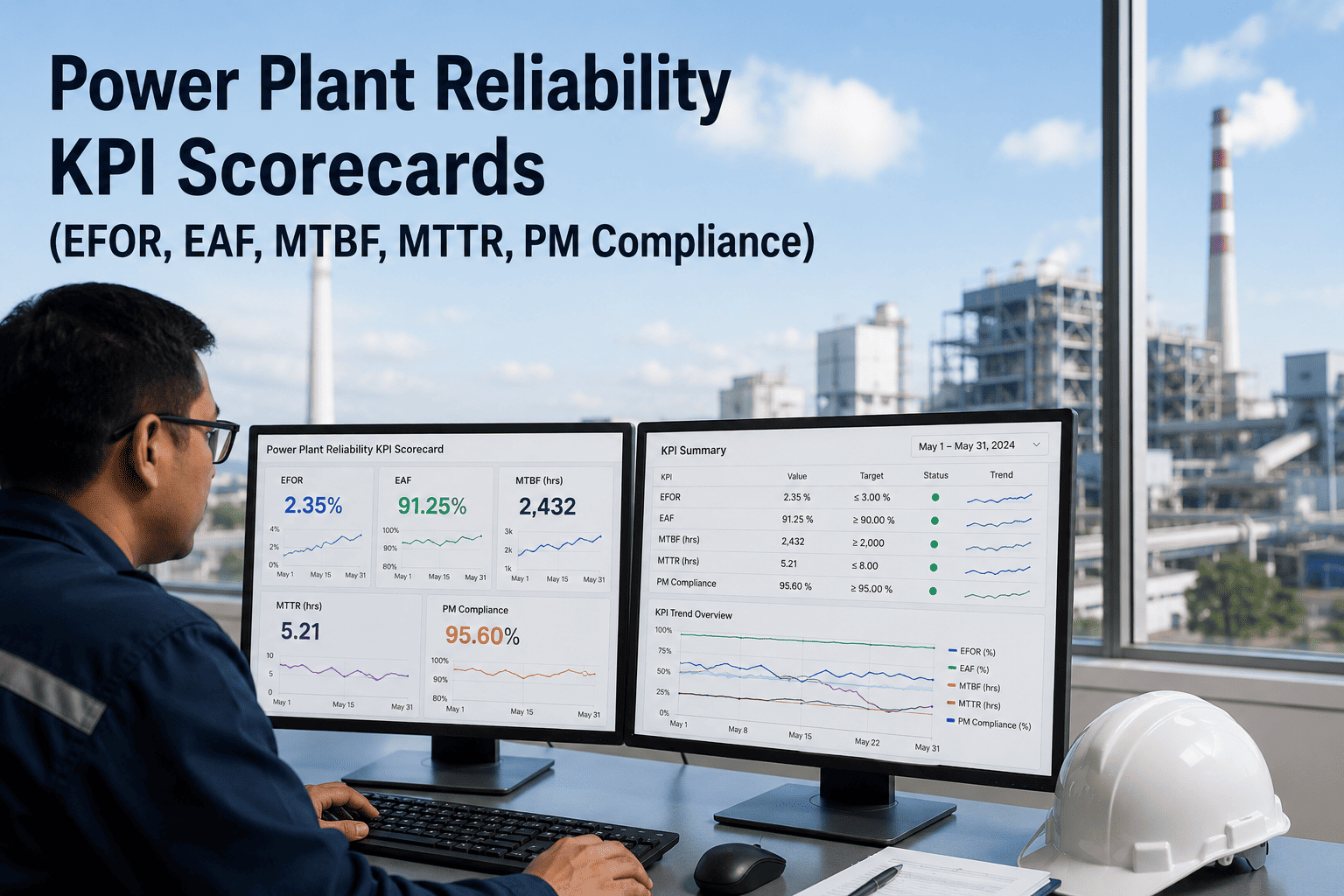
A power plant maintenance program without KPIs is a schedule, not a strategy. You can complete every PM on time and still have a chronic reliability problem — if no one is measuring how long assets run between failures, how fast the team responds when they do fail, or what each megawatt-hour of generation costs to maintain. MTBF, MTTR, PM compliance rate, reactive maintenance ratio, and maintenance cost per MWh are the five numbers that separate a maintenance organization from a world-class reliability program. They are also the five numbers that most power plants cannot calculate on demand because their work order data lives in spreadsheets, shift logs, and the institutional memory of senior technicians who have worked there for twenty years. OxMaint's KPI dashboard makes all five numbers visible, current, and actionable — in the same platform where your team creates and closes work orders. Start your free trial and see your plant's first maintenance KPI report within 30 days.
MAINTENANCE KPI ANALYTICS
If You Can't Measure MTBF, MTTR, and Cost per MWh — You Can't Manage Reliability.
OxMaint's KPI dashboard turns work order history into live reliability metrics — MTBF, MTTR, PM compliance, reactive ratio, and maintenance cost per MWh — so plant managers and reliability engineers can benchmark, target, and improve.
MTBF (Critical Assets)
1,847 hrs
↑ 12% vs last quarter
MTTR
6.4 hrs
↓ Target: 4.0 hrs
PM Compliance
91%
↑ Target: 95%
Cost / MWh
$3.40
↑ Industry: $2.80
Reactive Maintenance Ratio
38%
Target: Below 20%
The Five KPIs That Define a World-Class Plant Maintenance Program
Reliability engineering in power generation has converged on five metrics that, taken together, describe the health of a maintenance organization with more accuracy than any single indicator. Here is what each one measures, why it matters, and what a best-in-class target looks like for thermal generation.
Total operating hours ÷ Number of failures
Measures how long assets run between unplanned failures. The primary indicator of whether your PM program is actually preventing breakdowns. Rising MTBF means your maintenance is working. Flat or falling MTBF means something is being deferred or missed.
Best-in-class target:
Critical rotating equipment: > 2,000 hrs between failures
Total repair hours ÷ Number of repairs
Measures how quickly your team restores failed equipment to service. MTTR is driven by parts availability, diagnostic speed, crew size, and procedure quality. High MTTR with low failure rate is better than low MTTR with high failure rate — but both must be managed.
Best-in-class target:
Critical equipment: < 4 hours average MTTR
PMs completed on schedule ÷ PMs due × 100
The leading indicator for all other reliability KPIs. PM compliance below 90% predicts MTBF decline 60–90 days later. It measures whether your maintenance program is actually being executed — not just planned. Plants that manage MTBF without tracking PM compliance are reading the wrong number.
Best-in-class target:
Critical assets: > 95% on-time PM completion
Reactive work order hours ÷ Total maintenance hours × 100
Measures what share of your team's time is spent fighting fires versus executing the plan. RMR above 30% is the clearest signal that a maintenance program is in trouble. It also directly measures the hidden cost of reactive work: overtime, expedited parts, and extended outages that planned work never causes.
Best-in-class target:
Total reactive work: < 20% of maintenance hours
Total maintenance cost ÷ Net MWh generated
The financial summary KPI that connects every maintenance decision to generation economics. Tracks labor, materials, and contractor costs against output. A rising cost per MWh with stable generation signals either a maintenance backlog being cleared or a reliability decline in progress — the other KPIs tell you which.
Industry benchmark:
Coal/gas thermal: $2.50–$4.50 per MWh depending on age and load factor
Your KPIs Are Already in Your Work Order Data. OxMaint calculates MTBF, MTTR, PM compliance, reactive ratio, and cost per MWh automatically from the work orders your team creates every day — no separate analytics tool, no manual spreadsheet, no weekly data export required.
How OxMaint Calculates Your KPIs — From Work Order Data to Dashboard
Most plants understand these KPIs in theory. The challenge is that calculating them requires connecting asset uptime data, work order history, labor hours, and parts costs — data that typically lives in four different systems. OxMaint unifies it all in one place.
| KPI |
Data Source in OxMaint |
Update Frequency |
Alert Threshold |
| MTBF |
Failure work order timestamps + asset operating hours from meter readings |
Updated with every corrective WO closure |
Alert when 30-day MTBF drops below 90-day rolling average by 15% |
| MTTR |
Work order creation timestamp to completion timestamp, filtered by corrective type |
Real-time on WO closure |
Alert when MTTR for critical asset class exceeds 6 hours |
| PM Compliance |
PM work orders due vs. completed within scheduled window, per asset class |
Daily recalculation |
Alert when compliance drops below 90% for any critical system |
| Reactive Ratio |
Corrective work order hours as share of total work order hours, rolling 30 days |
Updated hourly from active WOs |
Alert when reactive ratio exceeds 25% in a rolling 7-day window |
| Cost per MWh |
Labor hours × rate + parts cost + contractor invoices ÷ net generation from SCADA |
Monthly close, updated weekly |
Alert when monthly cost per MWh exceeds quarterly average by 20% |
| Outage Cost |
Lost generation hours × capacity × avoided revenue rate + direct repair cost |
Per outage event on WO closure |
Reported for every forced outage event, compared to planned outage cost basis |
What Good KPI Benchmarks Look Like — and Where Most Plants Stand
Industry benchmarking data from EPRI, NERC GADS, and independent reliability studies consistently shows the same gap: plants in the top quartile of maintenance performance achieve 40–60% lower maintenance cost per MWh and 2–3 times better MTBF than median performers. The difference is almost always program discipline, not equipment age.
MTBF — Critical Rotating Equipment
Industry Median
1,200–1,800 hrs
Bottom Quartile
< 800 hrs
MTTR — Critical Systems
Top Quartile
< 3.5 hrs average
Industry Median
5–9 hrs average
Bottom Quartile
> 12 hrs average
Maintenance Cost per MWh
Industry Median
$3.50–$4.50
Frequently Asked Questions
How does OxMaint calculate MTBF from work order data?
OxMaint identifies corrective work orders on an asset, calculates the elapsed time between each failure event using asset operating hours logged through meter readings, and computes the rolling MTBF automatically. No manual calculation or data export is needed.
Start free to see your first MTBF calculation.
Can OxMaint benchmark our KPIs against industry standards?
Yes. OxMaint's KPI dashboard includes configurable target bands for MTBF, MTTR, PM compliance, reactive ratio, and cost per MWh. Plants can set targets based on EPRI benchmarks, NERC GADS data, or their own historical performance goals — and the dashboard shows actual vs. target at all times.
Book a demo to see the benchmarking configuration.
What is a realistic reactive maintenance ratio target for a power plant?
Industry best practice targets reactive maintenance below 20% of total maintenance hours. Most plants running without a structured CMMS report reactive ratios of 35–50%. Getting from 40% to 20% reactive typically requires 12–18 months of consistent PM execution and is associated with 25–35% reductions in maintenance cost per MWh.
How does OxMaint track outage cost per event?
Every forced outage work order in OxMaint captures the start and end time of the outage, the affected unit capacity, the direct repair cost, and the associated labor and parts. OxMaint calculates the total outage cost — including lost generation value — automatically and trends it against planned outage benchmarks.
Start free to capture your first outage cost event.
How quickly does a plant see KPI data after deploying OxMaint?
MTTR and PM compliance data populate immediately from the first work orders completed after deployment. MTBF calculations require a minimum of 2–3 failure events per asset class to be statistically meaningful — most plants have sufficient baseline data within 60–90 days of use.
You Can't Improve What You Don't Measure. Start Measuring Today.
OxMaint gives power plant maintenance teams a live KPI dashboard for MTBF, MTTR, PM compliance, reactive ratio, outage cost, and maintenance cost per MWh — all calculated automatically from the work orders your team already closes every day. No separate analytics tool. No manual reporting. Just the numbers that drive reliability decisions.