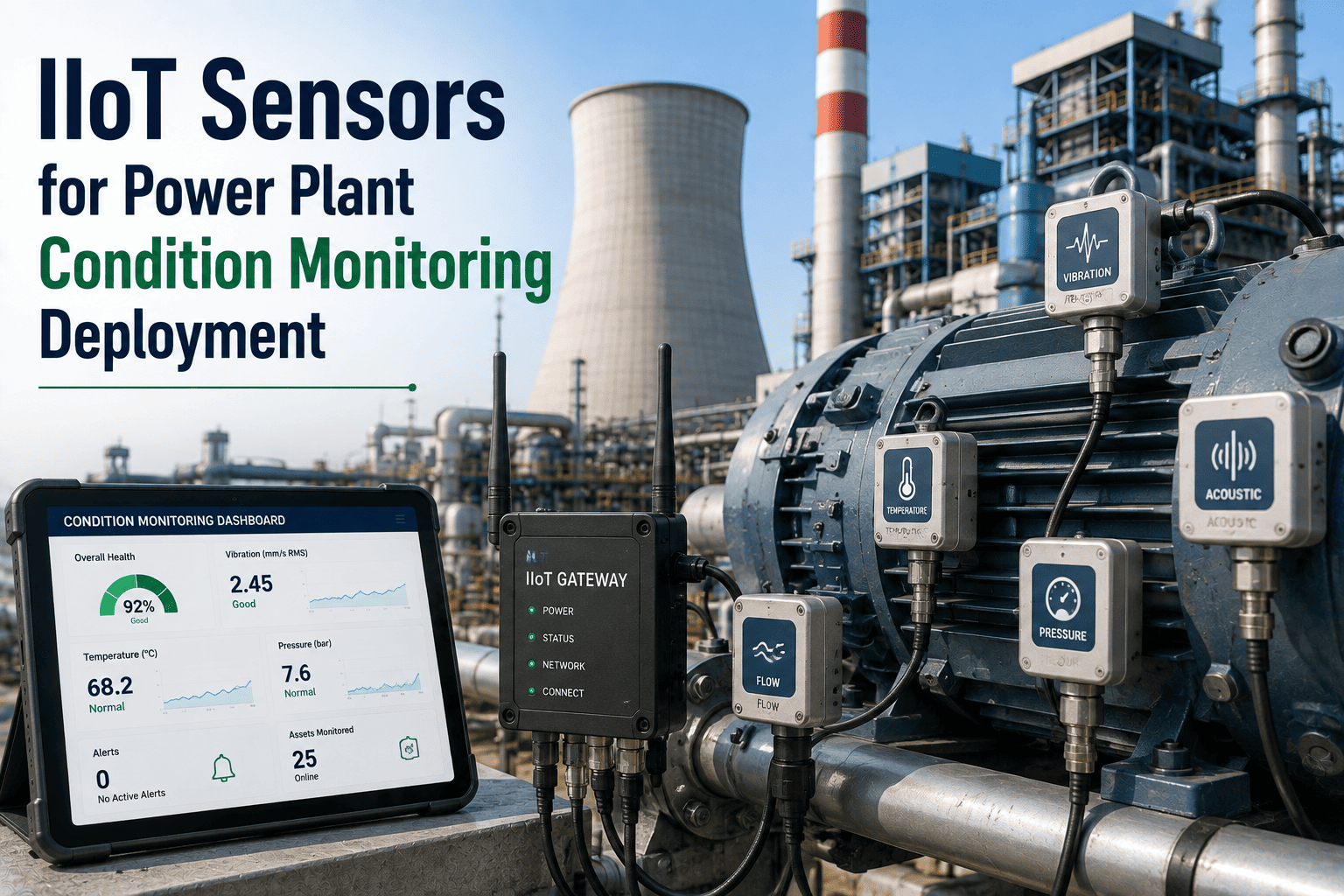
A 640 MW combined-cycle plant generates 4.2 million sensor data points per hour across turbines, heat exchangers, pumps, compressors, and auxiliaries — but without an integration layer that converts raw telemetry into maintenance intelligence, that data sits trapped in historian silos while technicians still walk rounds with clipboards. An IIoT gateway architecture for power plant CMMS integration bridges the gap between operational technology and maintenance systems by aggregating SCADA tags, PLC registers, vibration sensors, thermal cameras, and ultrasonic monitors into a unified data pipeline — so condition thresholds trigger work orders, trend deviations flag emerging failures, and equipment health scores drive predictive maintenance scheduling without manual intervention.
Design Industrial IoT Gateway Systems for Connected Maintenance
Deploy edge compute, protocol translation, sensor aggregation, and CMMS integration in a secure, scalable architecture — connecting SCADA, PLCs, historians, wireless sensors, and predictive analytics into one maintenance data ecosystem.
Why Power Plants Need Purpose-Built IIoT Gateway Architecture
Power generation facilities were never designed for connected maintenance. Control systems run on proprietary protocols. SCADA networks live behind air-gapped firewalls. Vibration sensors speak Modbus. Thermal cameras output RTSP streams. Ultrasonic thickness gauges store readings on SD cards. Historians use vendor-specific APIs. Every data source is an island — and maintenance decisions still depend on integrating all of them into a single operational view.
Five-Layer IIoT Gateway Architecture for Power Plant Maintenance
This architecture spans from field sensors through edge compute to CMMS integration — handling protocol translation, data normalization, condition logic, and secure cloud connectivity in a single deployment. Each layer solves a specific integration problem that prevents raw sensor data from becoming actionable maintenance intelligence.
Function: Generate raw process and condition monitoring data
Components: RTDs, pressure transmitters, vibration sensors, acoustic monitors, thermal cameras, ultrasonic thickness gauges, oil analysis sensors, electrical metering
Protocols: 4-20mA analog, HART, Modbus RTU/TCP, Profibus, Foundation Fieldbus, wireless ISA100, WirelessHART
Output: Raw time-series data streams at millisecond to second intervals
Function: Translate disparate industrial protocols into unified data format
Components: OPC-UA client, Modbus master, BACnet gateway, MQTT broker, REST API endpoints
Protocols Supported: OPC-UA, OPC-DA, Modbus TCP/RTU, DNP3, BACnet, EtherNet/IP, Profinet, MQTT, HTTP/HTTPS
Output: Normalized tag-value pairs with timestamps in JSON or OPC-UA structure
Function: Local signal processing, condition logic evaluation, alarm filtering
Processing: FFT vibration analysis, thermal image processing, oil debris counting, statistical process control, anomaly detection algorithms
Hardware: Industrial edge servers with 8-16 core CPUs, 16-32 GB RAM, SSD storage, dual NICs for OT/IT separation
Output: Processed features, alarm states, trend indicators, health scores
Function: Asset context enrichment, historian archival, CMMS synchronization
Capabilities: Asset hierarchy mapping, sensor-to-equipment linking, maintenance history lookup, work order API calls, historian write-back
Storage: Time-series database for local buffering during network outages
Output: Contextualized maintenance events with equipment IDs and work order triggers
Function: Maintenance workflow orchestration, analytics, reporting
Ingest: Condition monitoring alerts, equipment health scores, predictive failure probabilities
Actions: Auto-generate work orders, schedule inspections, dispatch technicians, track completion
Output: Maintenance KPIs, reliability analytics, closed-loop performance feedback
Industrial Protocol Support Matrix for Power Plant IIoT Gateways
Every plant runs a different mix of control systems, field instruments, and monitoring equipment — each with vendor-specific communication protocols. Gateway selection depends on covering the installed base without requiring forklift upgrades to existing infrastructure.
| Protocol / Standard | Typical Use Case in Power Plants | Data Access Method | Real-Time Capability | Security Considerations |
|---|---|---|---|---|
| OPC-UA (Unified Architecture) | DCS / SCADA data aggregation | Client-server with node browsing | Sub-second polling | Certificate-based authentication, encrypted transport |
| OPC-DA (Classic) | Legacy SCADA / historian access | COM/DCOM Windows-only | 1-10 second polling | Windows authentication, firewall complexity |
| Modbus TCP / RTU | PLC registers, motor drives, power meters | Master-slave polling of holding registers | 100ms - 1 second | No built-in encryption, typically isolated network |
| DNP3 (Distributed Network Protocol) | Utility SCADA, remote substation telemetry | Master-slave with event-driven reporting | Event-triggered or polled | DNP3 Secure Authentication, IEC 62351 standard |
| BACnet (Building Automation) | HVAC controls, cooling tower automation | COV (Change of Value) subscriptions | Event-driven | BACnet/SC with TLS encryption |
| EtherNet/IP | Rockwell PLCs, Allen-Bradley devices | Implicit messaging or explicit requests | 10-100ms | Network segmentation, no native encryption |
| Profinet | Siemens PLCs, motor control centers | Real-time cyclic data exchange | 1-10ms | VLAN isolation, Profinet Security standard |
| HART (Highway Addressable Remote Transducer) | Field instruments, smart transmitters | Digital signal overlay on 4-20mA | 2-3 updates per second | Physical access required, wired protocol |
| MQTT (Message Queuing Telemetry) | IoT sensors, wireless condition monitors | Publish-subscribe broker architecture | Real-time event push | TLS encryption, username/password or certificate auth |
| RESTful HTTP/HTTPS | Cloud service integration, historian APIs | Request-response web services | Seconds to minutes | OAuth2, API keys, HTTPS transport encryption |
Most industrial gateway appliances support 10-15 protocols simultaneously with protocol conversion and unified tag namespace management. Protocol selection is driven by installed base, not gateway capability.
Connect Every Sensor, PLC, and SCADA Tag to Your CMMS
OxMaint deploys IIoT gateway infrastructure on-premise or at the edge — with protocol translation, asset context mapping, condition logic, and work order API integration pre-configured for power plant maintenance workflows. See it running on your plant architecture in a live demo.
Three Deployment Models for Power Plant IIoT Gateways
Architecture topology depends on IT security policy, network access constraints, and real-time processing requirements. These three patterns cover 95% of power generation deployments — from fully air-gapped facilities to cloud-native greenfield projects.
Sensor Type Integration Patterns
Different condition monitoring technologies require different data handling strategies — from high-frequency vibration waveforms to daily oil analysis reports. The gateway architecture must accommodate sampling rates spanning six orders of magnitude while maintaining synchronized timestamps for multi-sensor correlation.
OT Network Security for IIoT Gateway Deployments
Power plant IT security teams treat IIoT gateways as potential attack vectors into SCADA networks. Deployment architecture must satisfy NERC CIP, IEC 62443, and NIST cybersecurity framework requirements while maintaining read-only access to control systems and unidirectional data flow to the cloud.
Measured Impact of IIoT-Connected Maintenance Systems
These operational metrics shift within 12 months of deploying integrated sensor-to-CMMS architecture — measured across coal, gas, hydro, and renewable generation portfolios with IIoT gateway infrastructure connecting condition monitoring to maintenance workflows.
Frequently Asked Questions
Turn Sensor Data Into Maintenance Actions
OxMaint deploys industrial IoT gateway architecture that connects SCADA, PLCs, vibration sensors, thermal cameras, and condition monitors to your CMMS — with protocol translation, edge analytics, and work order automation built in. Start free or see it running on your plant data in a live walkthrough.