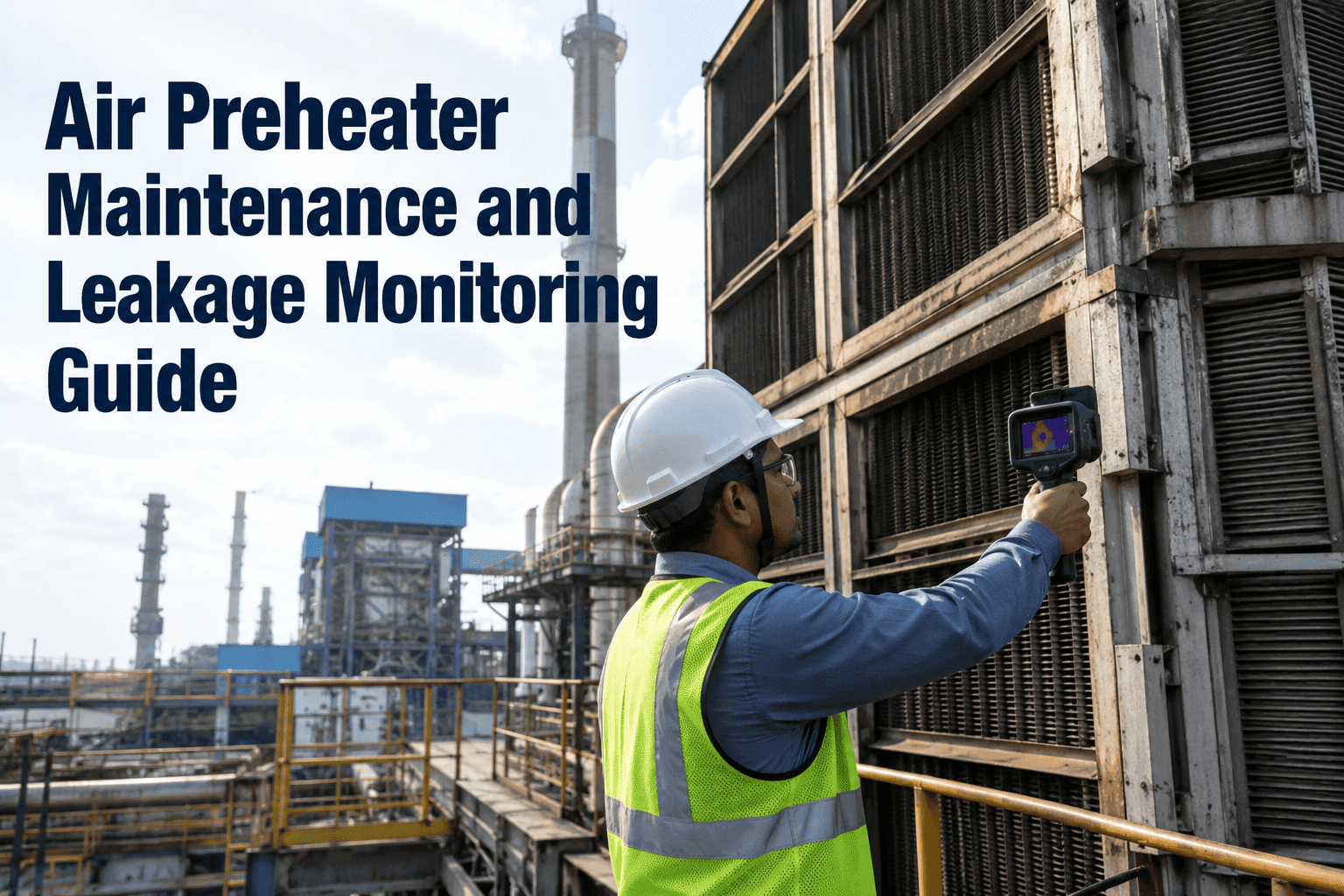
Air Preheater Maintenance and Leakage Monitoring Guide

By Johnson on May 14, 2026

air-preheater-maintenance-leakage-monitoring-power-plant

A 2% increase in air preheater leakage at a 500 MW coal-fired unit costs $340,000 annually in lost efficiency — fuel burned to heat air that bypasses the combustion process entirely — yet most plants discover the problem only when heat rate calculations drift upward over quarterly reviews. A CMMS with integrated APH leakage tracking and maintenance scheduling closes the gap between real-time differential pressure monitoring and coordinated basket cleaning, seal replacement, and rotor balancing workflows — so leakage stays below 8%, heat rate holds target, and boiler efficiency degradation triggers preventive action instead of reactive troubleshooting six months too late.

2-4%
Typical APH leakage rate in well-maintained coal units
0.5%
Heat rate penalty per 1% increase in APH leakage
18-24 mo
Seal replacement interval for Ljungstrom-style APH
$170K
Annual fuel cost impact of 1% leakage at 500 MW unit
The Hidden Efficiency Drain

Why Air Preheater Leakage Compounds Faster Than Plants Detect It

Air preheaters recover waste heat from flue gas to preheat combustion air — the single largest opportunity for efficiency gain in the Rankine cycle after the condenser. A well-sealed APH returns 15-20% of boiler input energy that would otherwise exit the stack. But seals wear, baskets foul, rotors warp, and leakage creeps upward at 0.3-0.5% per quarter. By the time operations notices the heat rate deviation, six months of excess fuel consumption have already occurred and seal damage has progressed from repairable to replacement-required.

A
Leakage Detection Lags Behind Damage Accumulation
Most plants calculate APH leakage monthly from flue gas O2 measurements. Seal damage occurs daily. By the time the trend is visible in reports, 30-60 days of efficiency loss have passed and seal scoring requires machining instead of adjustment.
B
Basket Fouling Invisible Until Differential Pressure Spikes
Fly ash, sulfur deposits, and ammonia salts accumulate in APH baskets for months before differential pressure rises enough to trigger attention. Gradual fouling reduces heat transfer by 8-12% before cleaning gets scheduled.
C
Seal Replacement Scheduled by Calendar, Not Condition
Standard practice replaces APH seals every 18-24 months regardless of actual wear state. Some seals fail at 14 months. Others run 30 months without issue. Calendar-based replacement wastes budget and risks unplanned outages.
D
Heat Rate Impact Attributed to Multiple Causes
When quarterly heat rate rises 1.2%, the investigation looks at condenser performance, turbine efficiency, feedwater heater TTD, and combustion tuning. APH leakage is often the culprit but gets diagnosed last because the data lives in separate systems.

How to Calculate and Monitor APH Leakage Rate

Air preheater leakage is the percentage of combustion air that bypasses the furnace by leaking from the high-pressure air side to the low-pressure gas side through worn seals and gaps. Accurate measurement requires continuous monitoring of inlet and outlet O2 concentrations with correction for air infiltration at other points in the gas path.

Standard Leakage Calculation Method
APH Leakage Formula:
L = [(O₂out - O₂in) / (21 - O₂in)] × 100
L = APH leakage percentage
O₂out = Oxygen concentration in flue gas leaving APH (dry basis, %)
O₂in = Oxygen concentration in flue gas entering APH (dry basis, %)
21 = Oxygen concentration in ambient air (%)
Example Calculation:
APH inlet O₂ = 3.8%, APH outlet O₂ = 5.2%
L = [(5.2 - 3.8) / (21 - 3.8)] × 100 = [1.4 / 17.2] × 100 = 8.14%
This 8.14% leakage is at the upper threshold for acceptable performance. Seal inspection and adjustment should be scheduled within the next planned outage window.
Continuous Monitoring Strategy
Install O₂ analyzers at APH inlet and outlet with 0.1% accuracy
Log measurements to historian at 1-minute intervals
Calculate leakage rate in real-time using DCS logic or edge gateway
Trigger CMMS work order when 7-day rolling average exceeds 8%
Trend leakage rate against differential pressure and seal position
Cost Impact Analysis
Each 1% leakage increase = 0.5% heat rate penalty
500 MW coal unit at 85% capacity factor = 3.72 billion kWh/year
Heat rate penalty of 0.5% = 18.6 million additional kWh fuel input
At $2.10/MMBtu coal, 1% leakage costs $170,000 annually
APH seal replacement cost: $45,000. Payback in 3 months if leakage is 1% high

Air Preheater Preventive Maintenance Schedule

APH maintenance spans multiple time scales — from weekly differential pressure checks to multi-year rotor overhauls. Effective scheduling balances condition-based interventions with planned outage coordination to minimize both forced outages and efficiency degradation between major inspections.

Maintenance Task Frequency Duration Triggers & Conditions Key Inspection Points
Differential Pressure Monitoring Continuous Real-time Alert if ΔP increases 15% above baseline Air side ΔP, gas side ΔP, fouling indicators
Leakage Rate Calculation Continuous Real-time Work order if 7-day average exceeds 8% Inlet/outlet O₂, seal position, bearing temps
Seal Visual Inspection Quarterly 2-4 hours During unit shutdown or low-load window Radial seals, axial seals, bypass dampers, wear patterns
Basket Water Wash 6-12 months 8-16 hours When gas-side ΔP rises 20% or outlet temp drops 15°F Basket plugging, ash deposits, soot buildup, corrosion
Seal Adjustment & Tightening 12 months 12-24 hours Leakage >7% or seal clearance >design tolerance Seal clearances, hold-down springs, guide tracks, alignment
Seal Replacement (radial/axial) 18-24 months 3-5 days Wear depth >50%, scoring, permanent deformation Seal material condition, rotor plate wear, sealing surfaces
Bearing Inspection & Lubrication 12 months 4-8 hours Vibration >4.5 mm/s or bearing temp >180°F Bearing clearances, oil condition, vibration signature, alignment
Rotor Basket Replacement 8-12 years 2-4 weeks Corrosion perforation, structural damage, heat transfer loss >15% Basket corrosion state, tube plugging, heat transfer performance
Rotor Balancing 3-5 years 1-2 weeks Vibration trend upward or uneven basket loading Dynamic balance, runout, structural integrity, drive coupling
Full APH Overhaul 10-15 years 4-8 weeks Major outage, end of rotor life, design upgrade Complete disassembly, rotor replacement, housing refurbishment, seal redesign

Frequency intervals assume coal-fired operation with typical fly ash loading. Gas-fired units extend basket cleaning intervals but may have shorter seal life due to higher temperature differentials.

Boiler Efficiency Analytics

Track APH Leakage, Heat Rate, and Seal Condition in One Platform

OxMaint links APH differential pressure, O₂ analyzer data, and heat rate calculations to maintenance scheduling — so leakage trends trigger seal inspections, basket fouling schedules water washes, and efficiency losses drive corrective work orders before fuel costs compound. See it running on your boiler data in a 30-minute demo.

Common APH Failure Modes and Root Causes

Air preheater failures rarely happen suddenly. Most develop over months through gradual seal wear, basket plugging, or structural degradation. Recognizing early indicators prevents minor issues from escalating into forced outages or major efficiency losses.

Radial Seal Wear and Scoring
Indicators: Leakage rate increasing 0.2-0.5% per month, uneven seal clearances, hot spots on APH casing, increased bearing vibration
Root Causes: Rotor eccentricity, thermal distortion, inadequate seal tensioning, abrasive fly ash erosion, improper material selection
Corrective Actions: Adjust seal clearances to 0.020-0.030 inches, replace worn seal segments, verify rotor runout <0.040 inches, balance rotor if needed
Basket Fouling and Plugging
Indicators: Gas-side differential pressure rising, APH outlet temperature dropping, reduced heat transfer effectiveness, visible ash deposits during inspection
Root Causes: High fly ash loading, sulfur trioxide condensation below acid dew point, ammonia salt formation from SCR, incomplete combustion, low excess air operation
Corrective Actions: High-pressure water wash (200-300 psi), chemical cleaning for sulfate deposits, increase APH cold-end temperature above 280°F, optimize SCR ammonia injection
Bearing Failure and Overheating
Indicators: Bearing temperature exceeding 180°F, vibration >4.5 mm/s RMS, oil darkening or metallic debris, unusual noise from drive end
Root Causes: Inadequate lubrication, contaminated oil, misalignment between motor and APH rotor, excessive thrust load from rotor imbalance, bearing wear from fatigue
Corrective Actions: Replace bearing and inspect journal for scoring, align drive coupling within 0.003 inches, verify oil quality and flow rate, check rotor balance
Cold-End Corrosion
Indicators: Basket tube perforation, metal thinning on cold-end layers, white or yellow deposits on baskets, increased leakage at cold end
Root Causes: Sulfuric acid condensation below 280°F dew point, high sulfur coal, low combustion air preheat temperature, inadequate steam coil heating
Corrective Actions: Increase cold-end temperature with steam coil or hot air bypass, install corrosion-resistant baskets (Corten steel, enamel coating), improve excess air control
Rotor Drive System Failure
Indicators: Rotor speed fluctuation, motor overcurrent, drive chain or gear noise, uneven basket loading, intermittent rotor stoppage
Root Causes: Worn drive gears, loose chain tension, motor coupling misalignment, excessive rotor drag from seal interference, inadequate motor sizing
Corrective Actions: Inspect and replace drive components, verify motor torque capacity, check rotor drag torque, align motor coupling, adjust seal clearances to reduce friction
Bypass Damper Leakage
Indicators: APH outlet temperature lower than expected, leakage calculation shows high air-to-gas transfer, damper actuator position not matching command signal
Root Causes: Worn damper seals, warped damper blades from thermal cycling, actuator linkage failure, inadequate damper closure force
Corrective Actions: Replace damper seals and gaskets, straighten or replace warped blades, verify actuator stroke and linkage integrity, test damper closure under operating temperature
Operational Performance

Measured Impact of APH Maintenance on Heat Rate and Fuel Cost

These performance shifts are measured before and after APH seal replacement, basket cleaning, and leakage reduction at coal and gas-fired units — showing the direct link between APH condition and boiler efficiency.

1.8%
Average heat rate improvement after APH seal replacement and basket cleaning
3.2%
Typical leakage reduction from 9.5% to 6.3% after seal maintenance
$420K
Annual fuel cost savings at 500 MW unit from reducing leakage by 2.5%
35°F
Combustion air temperature increase after basket water wash and seal adjustment
22%
Differential pressure reduction after high-pressure basket cleaning
18 mo
Extended interval between forced seal replacements with condition-based monitoring

Frequently Asked Questions

What is an acceptable APH leakage rate for coal-fired units?
Industry standard is 6-8% for Ljungstrom-style regenerative air preheaters. Leakage below 6% is excellent. Above 10% requires immediate seal inspection and corrective action during the next available outage. Book a demo to see leakage tracking dashboards.
How often should APH baskets be cleaned in coal-fired service?
High-pressure water washing every 6-12 months depending on coal ash content and sulfur levels. Units burning high-ash coal may require cleaning every 6 months, while low-ash fuels can extend to 12-18 months between washes.
Can APH leakage be monitored in real-time or only during manual testing?
Real-time monitoring is possible with continuous O₂ analyzers at APH inlet and outlet connected to DCS or historian. OxMaint pulls analyzer data automatically and calculates leakage rate every minute with trending and alarm thresholds. Sign up free to test integration.
What causes cold-end corrosion in air preheaters?
Sulfuric acid condensation when cold-end metal temperature drops below 280°F acid dew point. High-sulfur coal worsens corrosion. Corrective actions include raising cold-end temperature with steam coils or hot air bypass, and installing corrosion-resistant basket materials.
How much does APH seal replacement cost and how long does it take?
Material cost for radial and axial seal replacement is $35,000-$65,000 depending on APH size. Labor and outage time add $20,000-$40,000. Total duration is 3-5 days during a planned outage with experienced contractors.
Heat Recovery System Optimization

Stop Losing Efficiency to APH Leakage and Fouling

OxMaint tracks air preheater differential pressure, leakage rates, seal condition, and heat rate impact in real-time — with automated work order generation for basket cleaning, seal adjustment, and efficiency recovery before fuel costs escalate. Start free or see it live on your boiler performance data.

Share This Story, Choose Your Platform!