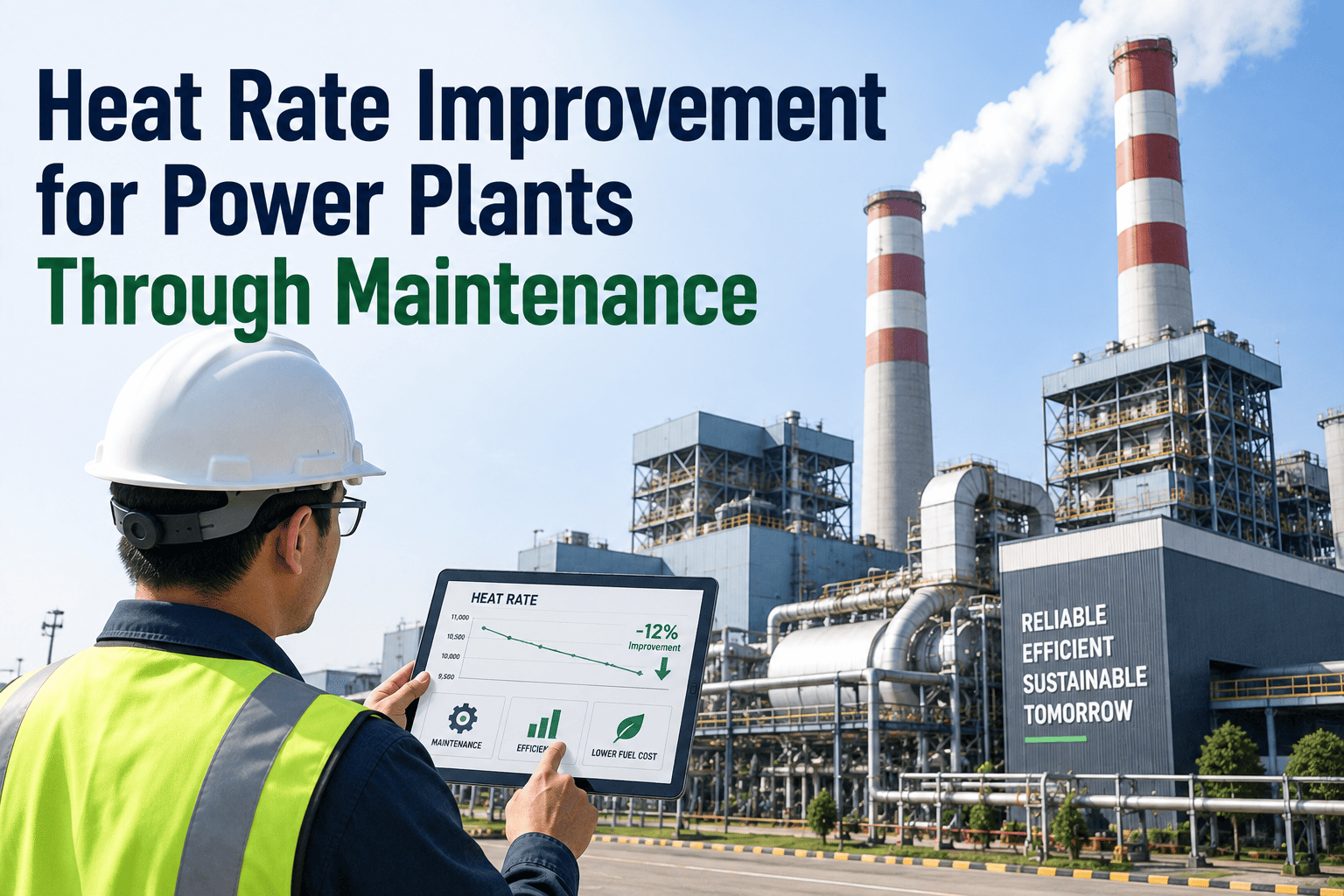
Heat rate improvement for power plants through maintenance is one of the highest-leverage operational strategies available to generation managers today, because every 1% reduction in heat rate can translate to thousands of dollars in daily fuel savings. Power plant heat rate maintenance directly impacts turbine efficiency, condenser vacuum, boiler performance, and auxiliary power consumption—areas where reactive, paper-driven maintenance silently drains millions in annual revenue. By implementing a proactive, CMMS-driven maintenance strategy, reliability teams can recover lost efficiency, extend asset life, and ensure compliance with stringent 2026 performance standards. See how OxMaint makes this transition seamless when you Start Free Trial today.
How Much Revenue Is Slipping Through Your Condenser and Turbine?
A 1,000 MW plant operating at a 10,000 BTU/kWh heat rate loses an estimated $3.2M annually for every 100 BTU/kWh of undetected degradation. Targeted power plant heat rate maintenance closes that gap—fast.
Quantifying the Cost of Heat Rate Deviation
When heat rate degrades by just 2%, a 500 MW coal-fired plant burning $4/MMBtu fuel absorbs over $1.4M in avoidable annual fuel costs. The formula below illustrates the baseline calculation reliability engineers use to size the problem.
Four Critical Areas for Power Plant Heat Rate Improvement
Heat rate optimization is not a single task—it requires synchronized maintenance across turbine, boiler, condenser, and auxiliary systems. Here is where reliability teams find the fastest paybacks.
Compressor fouling in gas turbines can increase heat rate by 2-5% within weeks of operation. Implementing offline water washing schedules triggered by CMMS predictive monitoring restores 1-2% efficiency per cycle. A 200 MW gas turbine recovering just 1% heat rate saves approximately $600,000 annually in fuel costs.
Impact: 1-5% Heat Rate RecoveryA 25 mmHg drop in condenser backpressure raises heat rate by 1.5-3%. Automated condenser tube cleaning systems paired with scheduled invasive inspections via work orders prevent micro-fouling and air in-leakage, protecting the cold-end vacuum that drives thermal efficiency.
Impact: 1.5-3% Heat Rate RecoverySoot and ash accumulation on boiler heat transfer surfaces increases exit gas temperature, raising heat rate by 0.5-1.5%. Optimizing soot blower frequency based on real-time slagging indices—rather than static timers—keeps the boiler clean without wasting blowing steam.
Impact: 0.5-1.5% Heat Rate RecoveryPlant auxiliary equipment (BFPs, ID/FD fans, CWP) consumes 5-8% of gross generation. Using vibration analysis and thermal imaging to maintain pumps and motors at peak efficiency reduces internal parasitic load, directly netting more saleable megawatts without touching the primary thermal cycle.
Impact: 0.5-1.5% Net Output GainHow OxMaint Drives Heat Rate Improvement
Manual tracking and spreadsheet-based PMs cannot keep pace with the dynamic degradation of a 500+ MW thermal cycle. OxMaint’s AI-powered CMMS and EAM platform integrates work orders, predictive analytics, and asset tracking to lock in heat rate gains permanently.
Predictive Condition Monitoring
OxMaint ingests vibration, temperature, and performance data to predict turbine fouling and pump degradation before they impact heat rate. Reliability teams shift from reactive firefighting to scheduled interventions, cutting unplanned downtime by 30-50%.
Automated PM Work Orders
Trigger soot blowing, water washing, and tube cleaning work orders automatically based on runtime, performance deviation, or predictive alerts. Ensure no efficiency-critical maintenance task is ever skipped or delayed again.
Heat Rate Monitoring Dashboards
Track real-time heat rate deviations against baseline ISO conditions. OxMaint flags anomalies in condenser vacuum or boiler efficiency instantly, correlating performance drops to specific asset events and maintenance history.
Spare Parts & Inventory Optimization
Maintain critical spares for heat exchangers, condenser tubes, and turbine seals. OxMaint ensures parts are available when predictive alerts fire, slashing mean time to repair (MTTR) and minimizing efficiency downtime.
Case Study: A 180-Asset Combined Cycle Plant
Consider a 180-asset combined cycle plant spending $42K annually on reactive maintenance and losing an estimated $1.8M to heat rate degradation. Here is the 6-month transformation timeline after implementing OxMaint.
Baseline & Digital Transition
Migrated 1,200 paper work orders to OxMaint. Deployed asset hierarchy mapping for gas turbine, HRSG, steam turbine, and condenser. Identified 14 missing PMs on critical heat transfer equipment.
Predictive Integration
Integrated DCS performance data with OxMaint CMMS. Predictive alerts caught a 12 mmHg condenser vacuum drop caused by tube fouling 11 days before traditional thresholds would have triggered an alarm.
Measurable Heat Rate Recovery
Automated water washing and soot blowing recovered 120 BTU/kWh (0.9% heat rate improvement). Estimated annual fuel savings: $1.15M. Unplanned downtime dropped 38%, saving $310K in lost generation margins.
Stop Letting Heat Rate Degradation Drain Your Margins
See how OxMaint’s AI-powered maintenance platform maps to your thermal cycle and recovers lost efficiency. Book a 30-minute demo with our power generation specialists.
Power Plant Heat Rate Maintenance FAQs
What is heat rate improvement in a power plant?
Heat rate improvement is the process of reducing the amount of fuel (BTUs) required to generate one kilowatt-hour of electricity. It is achieved through proactive maintenance of turbines, boilers, condensers, and auxiliary systems, lowering fuel costs and reducing carbon emissions per megawatt generated.
How does a CMMS improve heat rate efficiency?
A CMMS like OxMaint improves heat rate efficiency by automating preventive maintenance schedules, tracking asset degradation, and integrating predictive analytics. This ensures critical tasks—like condenser tube cleaning and turbine water washing—happen exactly when needed, preventing the performance drift that silently increases fuel consumption. You can explore these features with a Start Free Trial.
How often should turbine compressor washing be performed?
Offline turbine compressor washing frequency depends on ambient air quality and fouling rates, typically ranging from weekly to monthly. Instead of static schedules, OxMaint triggers wash cycles based on performance degradation metrics, ensuring washing occurs only when heat rate deviation justifies the cost.
What is the typical ROI for heat rate maintenance software?
For a mid-sized 500 MW plant, recovering just 0.5% of heat rate through structured CMMS maintenance can yield $700,000 to $1.2M in annual fuel savings. Most OxMaint implementations achieve full payback within 3 to 6 months of deployment. To see the math for your specific plant, Book a Demo.
Can heat rate monitoring help with environmental compliance?
Yes. By lowering heat rate, power plants burn less fuel per megawatt, directly reducing CO2, NOx, and SOx emissions. OxMaint maintains a digital audit trail of all maintenance activities, supporting compliance with ISO 50001 energy management and EPA emissions reporting standards for 2026 and beyond.
Ready to Optimize Your Plant's Heat Rate?
Join the reliability teams using OxMaint to predict failures, automate work orders, and recover lost megawatts. Start your free trial or book a personalized demo today.
Free 14-day trial · No credit card required