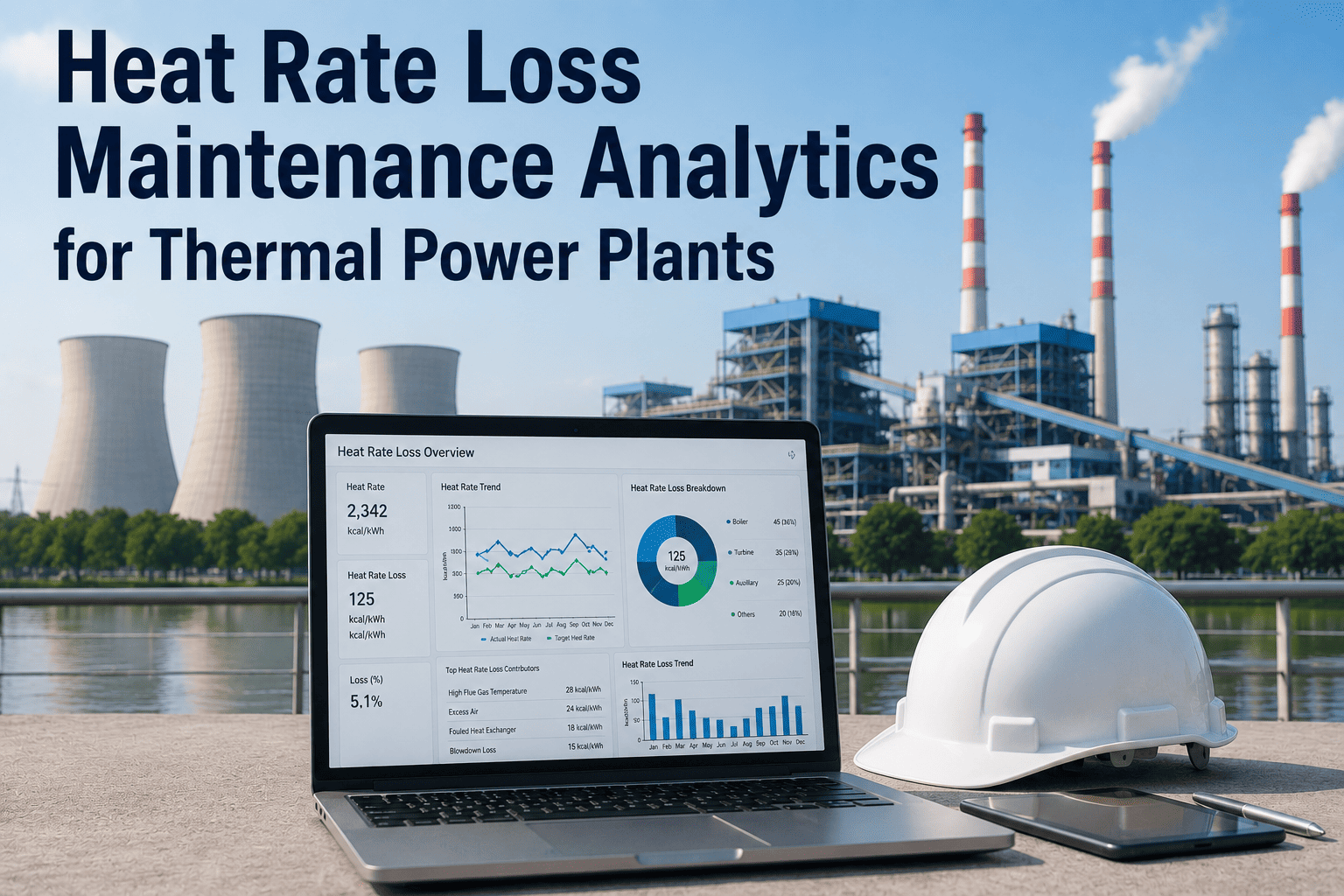
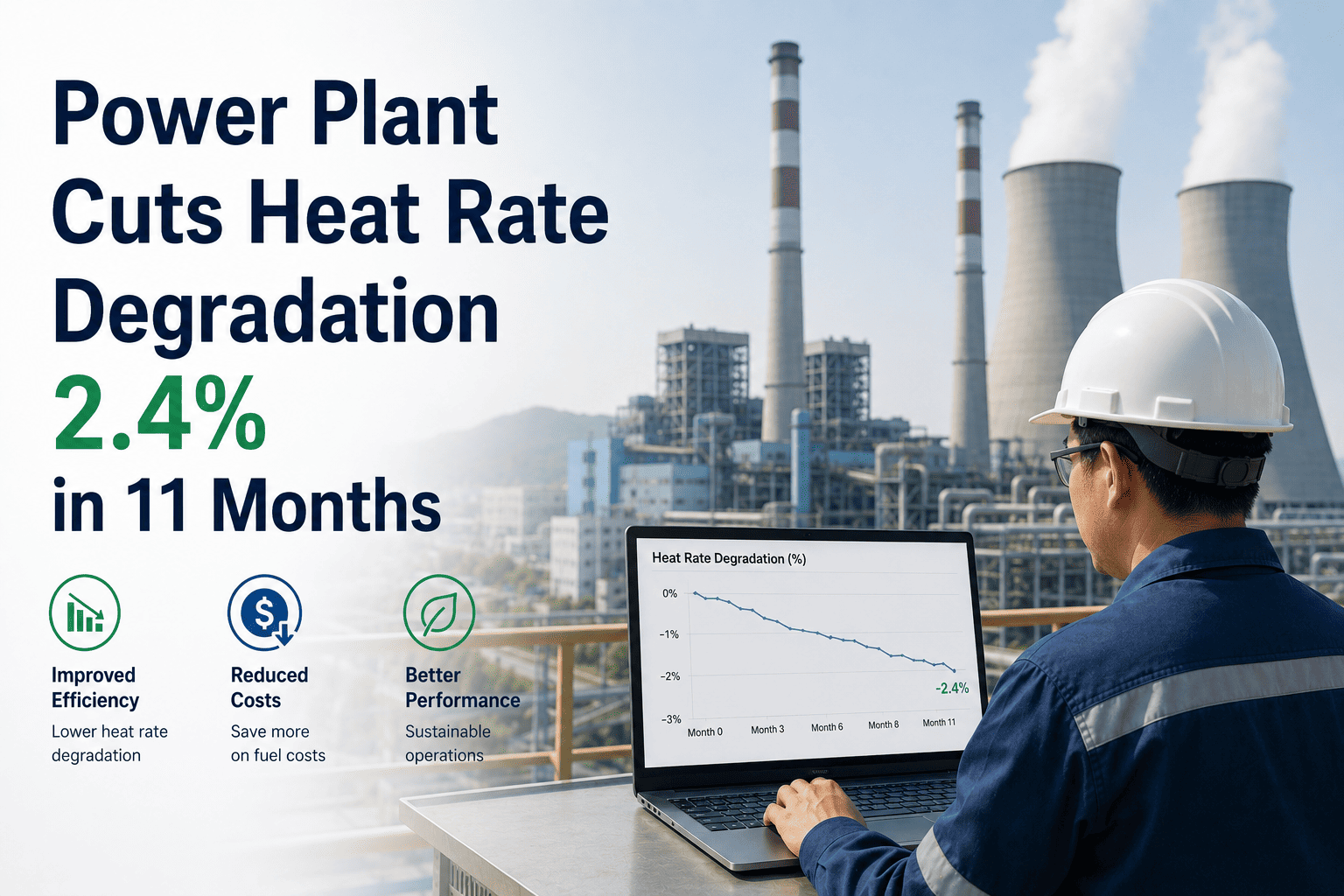
Thermal power plants burning fuel at 9,000–11,000 Btu/kWh leave significant money on the table every operating hour — not because of broken equipment, but because heat rate degradation accumulates silently across cycle leaks, condenser fouling, BFW heater defects, and untracked operating deviations. A structured heat rate improvement program, backed by OxMaint's CMMS platform, gives operations and maintenance teams the baseline data, PM scheduling, and corrective work tracking to systematically close the gap between current and design heat rate — and keep it closed. Even a 1% heat rate reduction on a mid-size unit translates to roughly $850,000 in annual fuel savings. Book a free demo to see how OxMaint supports heat rate programs across thermal fleets.
Thermal Power · Heat Rate · CMMS · OxMaint
Heat Rate Improvement Programs for Thermal Power Plants
Heat rate is the single most measurable indicator of a thermal plant's financial health. Every Btu/kWh above design baseline is fuel you're burning without generating revenue. A structured heat rate improvement program — cycle isolation, condenser optimization, BFW heater monitoring, and CMMS-anchored records — is how top-performing plants recover that gap and sustain it across outage cycles.
$850K
Annual savings per 100 Btu/kWh improvement on a typical mid-size unit
1–5%
Heat rate improvement range documented in EPRI Production Cost Optimization studies
50 Btu/kWh
Typical gain from cycle isolation alone — with benefit-cost ratios exceeding 100:1
33%
Average thermal efficiency of coal-fired plants — most are running well below design
The Core Problem
Why Heat Rate Degrades — And Why Most Plants Can't Track It
Heat rate degradation is not a single event. It accumulates across dozens of small performance losses — a leaking bypass valve here, biofouled condenser tubes there, a feedwater heater with a failed terminal temperature difference. Each individual loss is small. Together, they can push a well-designed plant 5–8% above its design heat rate without triggering a single alarm.
~35%
Cycle Isolation Losses
Leaking control valves, bypasses, and extraction steam lines allow high-energy steam to bypass the turbine — direct fuel waste that compounds with each undetected valve.
~28%
Condenser Backpressure
Tube fouling, air ingress, and elevated cooling water temperatures each add inHg backpressure penalty. EPRI guidelines: 2.5% efficiency loss per 1.0 inHg BP penalty.
~22%
BFW Heater Degradation
Failed heater tubes, high terminal temperature differences, and bypassed heaters reduce feedwater temperature entering the boiler — increasing fuel consumption to reach operating conditions.
~15%
Auxiliary & Boiler Losses
Boiler air in-leakage, dirty air preheater coils, and unoptimised excess air levels each erode turbine cycle efficiency with losses that are invisible without structured monitoring.
Program Architecture
The Four Pillars of a Structured Heat Rate Improvement Program
A heat rate improvement program is not a one-time audit. It is an ongoing operational discipline built on four interconnected pillars — each requiring scheduled work, documented findings, and CMMS-tracked corrective actions to deliver sustained improvement.
01
Baseline Establishment and Heat Rate Audit
Every program begins with a documented performance baseline — actual heat rate versus design heat rate across load points, with deviations assigned to specific systems. Without a verified baseline, improvement cannot be measured, and corrective investments cannot be prioritized. OxMaint stores baseline readings against assets, tracks deviation trends, and flags when actual performance crosses defined thresholds from the last verified baseline.
Baseline · Audit · KPI Tracking
02
Cycle Isolation Program
Cycle isolation (also called cycle alignment) systematically identifies and corrects high-energy fluid leakage through valves. Every leaking bypass valve, drain valve, or extraction line adds directly to heat rate. An effective cycle isolation program assigns valve-level leak testing as scheduled PMs, routes findings to corrective work orders with priority weighting by heat rate impact, and tracks valve condition across outage cycles — so no valve goes untested and no confirmed leak goes unscheduled for repair.
Valve Leak Testing · PM Scheduling · Corrective WOs
03
Condenser Performance Monitoring
Condenser backpressure is one of the fastest-moving heat rate variables — a 1.0 inHg backpressure penalty causes roughly 250 Btu/kWh of additional heat rate. Structured condenser monitoring tracks backpressure, terminal temperature difference (TTD), cleanliness factor, and dissolved oxygen at defined intervals. OxMaint links condenser performance readings to asset-level PM work orders, triggers corrective actions when cleanliness thresholds are crossed, and maintains the full measurement history for outage planning and insurance documentation.
Backpressure Tracking · TTD · Cleanliness Factor
04
BFW Heater Program and Records
Feedwater heater condition directly determines the temperature entering the boiler — and therefore how much fuel is required to reach operating steam conditions. A bypassed heater or a heater with a high TTD imposes a measurable and continuous fuel penalty. A structured BFW heater program schedules TTD checks, tube leak inspections, and heater performance tests as CMMS work orders, records as-found and as-left conditions at each outage, and trends heater performance across years to support early replacement planning before tube failures force unplanned outages.
TTD Monitoring · Tube Inspection · Outage Records
Performance Impact
What Each Program Component Is Worth in Btu/kWh
These are documented improvement ranges from EPRI studies and industry performance appraisals — not projections. The financial translation assumes a mid-size thermal unit operating 6,000 hours per year at $3.50/MMBtu fuel cost.
| Program Component |
Typical Heat Rate Gain |
Estimated Annual Value |
B/C Ratio Range |
CMMS Requirement |
| Cycle Isolation / Alignment |
50–150 Btu/kWh (0.5–1.5%) |
$425K–$1.3M |
1× to 100+× |
Valve leak test PMs, corrective WOs by heat rate impact |
| Condenser Cleaning and Tube Maintenance |
50–250 Btu/kWh (0.5–2.5%) |
$425K–$2.1M |
5× to 50× |
Backpressure PMs, TTD records, cleaning work orders |
| BFW Heater Restoration |
30–100 Btu/kWh (0.3–1.0%) |
$255K–$850K |
3× to 20× |
TTD trending, tube inspection PMs, outage records |
| Boiler Air In-Leakage Repair |
30–150 Btu/kWh (0.3–1.5%) |
$255K–$1.3M |
2× to 30× |
Thermal imaging PMs, air in-leakage corrective WOs |
| Air Preheater Cleaning |
20–80 Btu/kWh (0.2–0.8%) |
$170K–$680K |
5× to 40× |
Scheduled cleaning PMs, differential pressure records |
Still tracking heat rate deviation in spreadsheets with no corrective work order linkage?
OxMaint connects heat rate monitoring to scheduled PMs, corrective work orders, and outage records — so every deviation becomes a documented, trackable, closeable action. Free to start, no infrastructure changes required.
OxMaint Role
How CMMS Records Make or Break a Heat Rate Program
Heat rate programs fail not because the technical recommendations are wrong — but because findings are not converted to scheduled work, corrective actions are not tracked to closure, and performance data is not retained across outage cycles in a format that supports trending and audit. OxMaint addresses all three gaps.
Performance Readings Linked to Assets
Heat rate KPIs — backpressure readings, TTD values, cycle isolation test results — are recorded directly against the asset in OxMaint, not in a separate spreadsheet. Every reading is timestamped and tied to the work order that captured it, creating an auditable chain from measurement to corrective action.
Threshold-Triggered Corrective Work Orders
Define acceptable performance windows for each heat rate parameter. When a reading crosses a threshold — backpressure exceeds X inHg, TTD rises above Y°F — OxMaint auto-generates a corrective work order, assigns it to the responsible team, and tracks it to closure. No deviation goes unactioned because no one remembered to file a ticket.
Outage-to-Outage Trend Records
Heat rate programs only sustain improvement when as-found and as-left conditions are recorded at every outage and trended over time. OxMaint retains complete outage work order records — including before/after measurements, repair scope, and contractor sign-offs — so the next outage team has the full history of what was found, what was fixed, and what the improvement delivered.
Regulatory and Audit Documentation
Environmental permit requirements, fuel efficiency standards, and insurance audits increasingly require documented evidence of heat rate monitoring and corrective programs. OxMaint provides this automatically — every PM completed, every reading recorded, every corrective action closed — with digital signatures and timestamped evidence ready for export at any point.
Implementation Roadmap
Standing Up a Heat Rate Program in OxMaint: From Week 1 to First Outage
Most plants can have a functioning heat rate PM structure live in OxMaint within two to three weeks — without disrupting existing operations or waiting for a major capital project. Here is the typical deployment sequence.
Week 1–2
Asset Register and Baseline Load
Key heat-rate-affecting assets — condensers, BFW heaters, major isolation valves, air preheaters — are loaded into OxMaint with design parameters, current condition notes, and last-known performance readings. This becomes the baseline against which all future readings are measured and trended.
Week 2–3
PM Structure Build — Cycle Isolation, Condenser, BFW
Scheduled PM work orders are created for each program pillar: valve leak testing routes, condenser backpressure and TTD checks, BFW heater performance tests, and boiler air in-leakage surveys. Frequency, responsible crew, and acceptance criteria are defined per work order type — not left to individual technician discretion.
Week 3–4
Threshold Configuration and Corrective WO Workflow
Performance thresholds are configured for each asset and parameter. When a reading crosses the defined limit, OxMaint auto-generates a corrective work order with the right priority, team assignment, and required documentation. The threshold logic ensures no finding is left unactioned regardless of shift rotation or staff turnover.
First Outage Cycle
Outage Work Package Integration
Outstanding corrective actions from the heat rate program are automatically elevated into the outage work package register. Valve repairs, condenser cleaning, BFW heater tube work, and air in-leakage corrections are scoped, parts-verified, and contractor-assigned before shutdown — using the same outage optimization workflow that compresses outage duration.
Common Questions
What Thermal Plant Teams Ask About Heat Rate Improvement Programs
What is a realistic heat rate improvement target for a plant with no existing program?
EPRI Production Cost Optimization studies across coal and gas thermal plants consistently show 2–4% improvement in the first full program cycle, with some plants achieving up to 5% through a combination of cycle isolation, condenser restoration, and BFW heater work. In financial terms, that represents $1.7M–$4.3M in annual fuel savings for a mid-size plant at typical fuel costs.
Start building your heat rate PM structure in OxMaint to establish the baseline that makes these gains trackable.
How does cycle isolation differ from cycle alignment, and which should we prioritize first?
The terms are interchangeable in industry practice — both refer to the systematic identification and correction of high-energy fluid leakage through valves in the steam cycle. It is almost always the highest-priority starting point because benefit-cost ratios regularly exceed 100:1, implementation requires only valve testing and repair work orders, and the heat rate gain of 50–150 Btu/kWh is achieved with no capital expenditure.
Book a demo to see how OxMaint structures cycle isolation PMs and corrective work order workflows.
Can OxMaint integrate with existing plant historian or DCS systems for heat rate data input?
Yes. OxMaint integrates with SCADA, PI Historian, and DCS platforms via API, allowing performance readings to flow directly into asset-linked PM records without manual data entry. This is particularly valuable for condenser backpressure and BFW heater TTD monitoring, where readings change continuously.
Book a technical call to map the integration against your current historian configuration.
How do we document heat rate program results for regulatory or insurance audit purposes?
OxMaint automatically builds the audit trail — every PM completed, every reading recorded, every corrective work order opened and closed, with technician signatures, timestamps, and evidence attachments at each step. The complete heat rate program record is exportable from OxMaint at any point, without manual reconstruction.
Create a free account and explore the compliance documentation structure before your next audit cycle.
Heat Rate Improvement · Cycle Isolation · Condenser Performance · CMMS
Every Btu/kWh Above Design Baseline Is Fuel Cost With No Generation Return.
OxMaint gives thermal plant operations and maintenance teams the structured PM framework, performance record tracking, and corrective work order automation to build and sustain a heat rate improvement program that delivers measurable fuel savings — not just a one-time audit report that sits on a shelf.