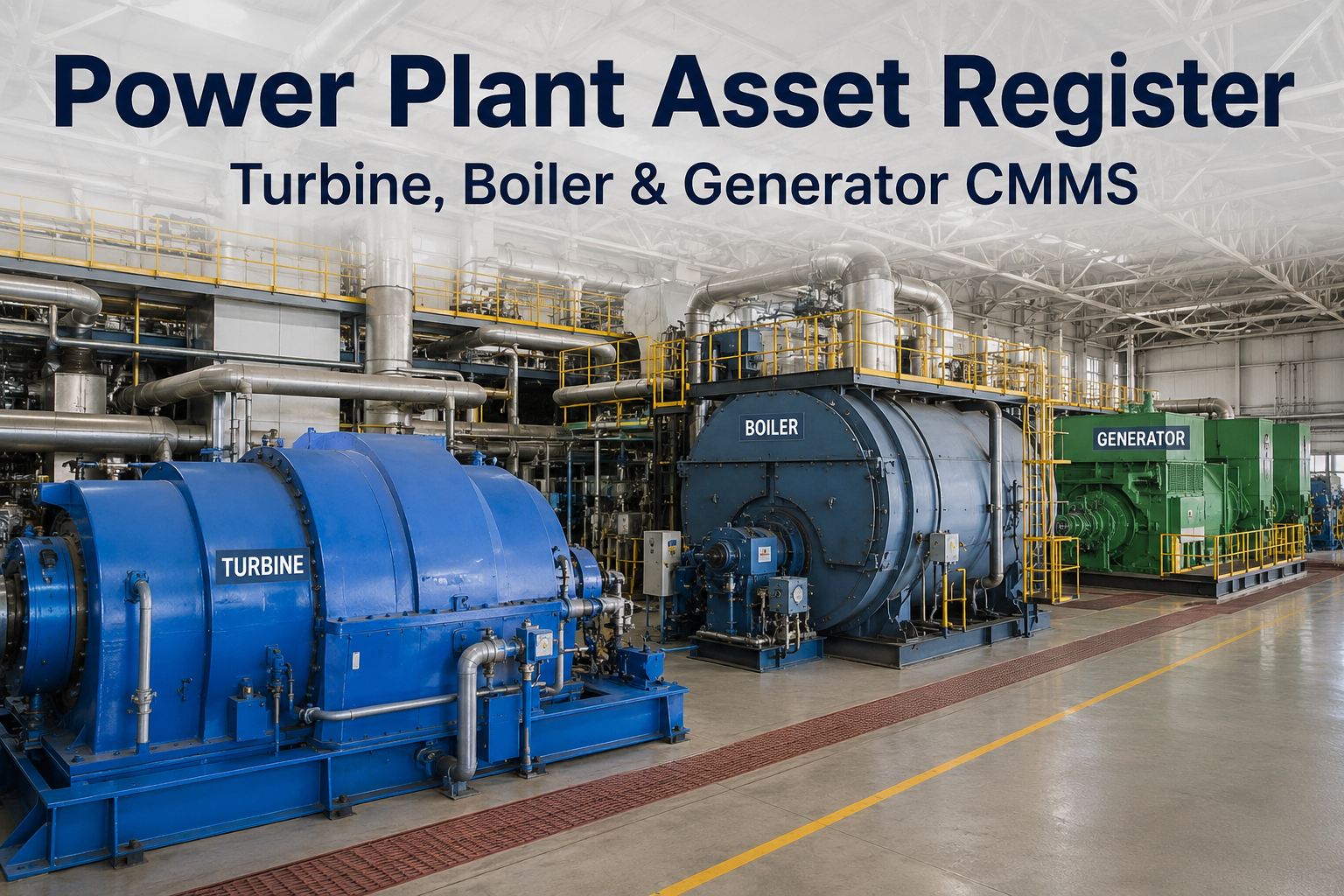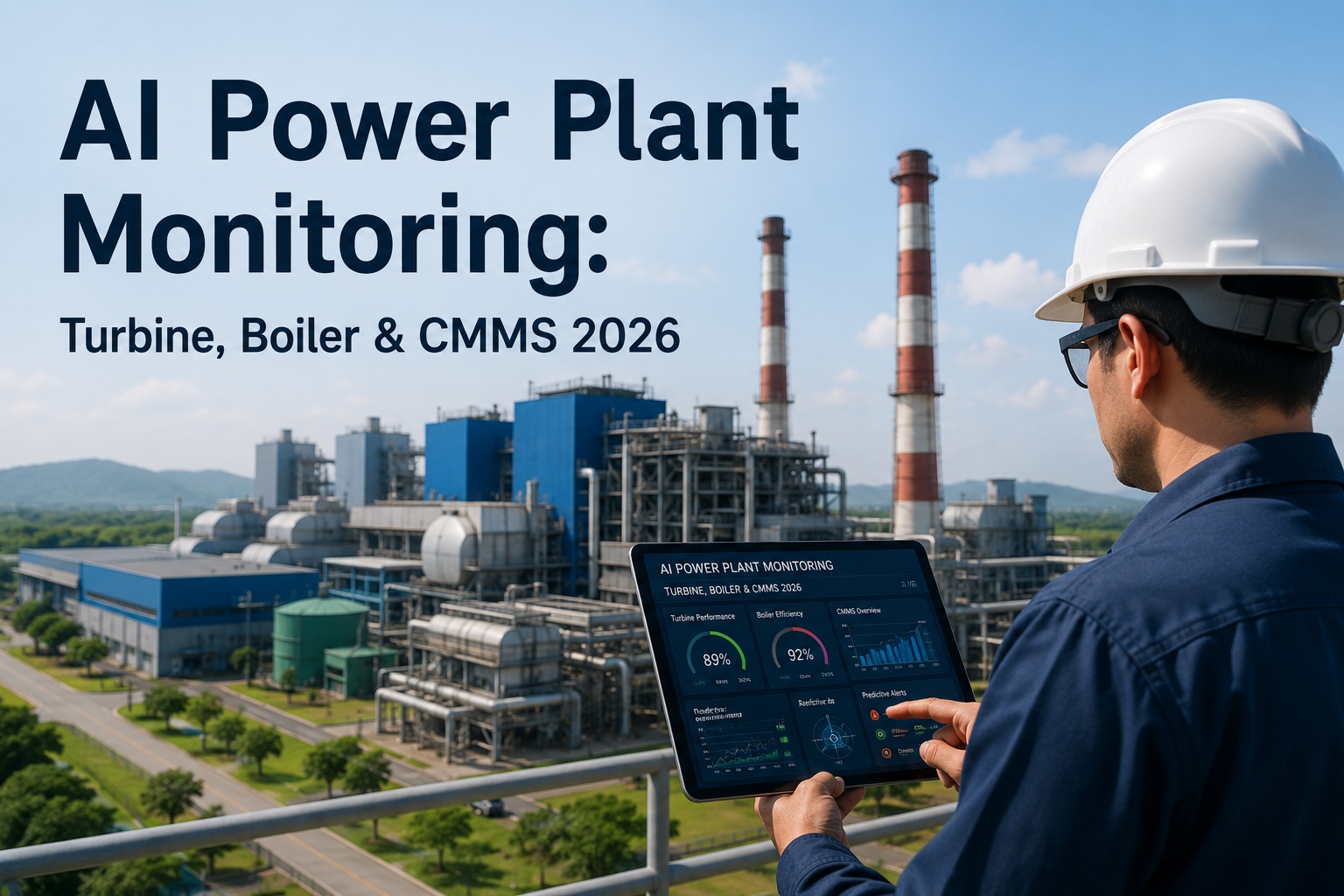
AI power plant monitoring is reshaping how utilities manage turbine efficiency, boiler integrity, and asset reliability — by catching failures 2 to 6 weeks earlier than rule-based alarms and auto-generating work orders the instant an anomaly is detected. Modern power plant AI 2026 platforms use machine learning to trend exhaust gas temperature (EGT) spread, bearing vibration, boiler tube wall temperature, and auxiliary equipment health in real time, reducing unplanned downtime by up to 30-50% and slashing maintenance costs by 15-25% annually. Whether you operate a 200 MW gas turbine combined cycle or a 600 MW coal-fired boiler, integrating AI anomaly detection with a CMMS closes the gap between "something looks wrong" and "the work order is already assigned." OxMaint unifies predictive analytics and maintenance execution in a single AI-powered CMMS, so your reliability team can act on every alert — try it yourself with a Start Free Trial today.
Power Plant AI 2026
Predict Turbine & Boiler Failures Weeks Before They Happen
AI monitoring layers machine learning over your existing SCADA, DCS, and sensor data — detecting micro-anomalies in EGT spread, bearing temperature, and boiler tube wall trending that rule-based alarms miss. Every alert auto-generates a CMMS work order with parts, priority, and procedure attached.
Why AI Monitoring
Why Power Plants Are Moving from Reactive to AI-Driven Maintenance
A single unplanned gas turbine outage costs $50,000–$150,000 per day in lost generation, purchased power, and startup fuel. For a combined-cycle plant with two units, that's $200K–$450K per forced outage event — before you count penalty clauses or grid reliability fines. Yet 65% of power plants still run maintenance on fixed time-based schedules or wait for an alarm threshold to trip, meaning they either over-maintain (wasting labor and parts) or under-maintain (and take the hit).
The cost of waiting is compounding. Every delayed inspection, every paper work order that never closed, every spare part that wasn't in stock when the bearing failed — these gaps add up to millions per year. AI power plant monitoring closes that loop: detect early, auto-generate the work order, dispatch the technician, and verify the fix — all inside one CMMS.
Turbine & Boiler AI
How AI Turbine Monitoring & AI Boiler Monitoring Actually Work
AI turbine monitoring and AI boiler monitoring don't replace your SCADA or DCS — they sit on top of the data you already collect (temperatures, pressures, vibration, flow rates, emissions) and learn the normal operating envelope for every load condition. Once the model knows what "healthy at 80% load" looks like, it flags deviations that are statistically significant — even if no individual sensor has crossed an alarm limit.
A 250 MW gas turbine combined-cycle plant with 1,200+ temperature, pressure, and vibration sensors deployed an AI anomaly detection model on its turbine exhaust and boiler feedwater data. Within the first 90 days, the model flagged a gradual EGT spread increase of 7°C on burner row 3 — well below the 15°C trip threshold but statistically anomalous for the current load. The CMMS auto-generated a work order; maintenance found a partially clogged fuel nozzle during the next planned window. Avoided cost: an estimated $340,000 in forced outage and startup fuel.
| Monitoring Approach | Detection Lead Time | False Alarm Rate | Work Order Automation | Typical Outcome |
|---|---|---|---|---|
| Reactive (run-to-failure) | 0 days | N/A | Manual / paper | $50K–150K/day outage |
| Time-based preventive | Fixed intervals | Low | Manual CMMS entry | Over-maintenance, 20% waste |
| Rule-based threshold alarms | Hours to 1–2 days | 15–30% | Alarm only, no WO | Often too late for low-cost fix |
| AI anomaly detection + CMMS | 2–6 weeks early | 3–8% | Auto-generated work order | 30–50% less unplanned downtime |
Key Anomaly Targets
What AI Monitors on Turbines, Boilers & Balance-of-Plant
Power plant machine learning models are trained on the highest-value failure modes — the ones that cause forced outages, safety incidents, or environmental excursions. Here are the primary anomaly detection targets for a 2026-era AI monitoring stack:
EGT Spread Anomaly
Monitors exhaust gas temperature distribution across the turbine. AI flags uneven combustion, nozzle clogging, or liner distress 2–4 weeks before a trip — at deviations as small as 5–8°C from the learned baseline.
Bearing Temperature & Vibration
Trends journal and thrust bearing temps alongside vibration spectra. Machine learning detects bearing wear, oil degradation, and alignment drift early — preventing $80K–$200K bearing failures and rotor damage.
Boiler Tube Wall Trending
Tracks tube wall temperature, flue gas exit temp, and steam flow ratios. AI identifies creep, fouling, and slagging patterns — targeting the 40% of boiler forced outages caused by tube leaks.
Auxiliary Equipment Health
Covers BOP systems — feedwater pumps, condensate pumps, fans, motors, and heat exchangers. AI anomaly models catch cavitation, seal degradation, and motor bearing faults before they cascade into unit trips.
How OxMaint Helps
How OxMaint Turns AI Anomalies into Completed Work Orders
Most AI monitoring tools stop at the alert. OxMaint goes further — when the model detects an anomaly, OxMaint's CMMS AI automatically generates a work order with the right priority, assigned technician, required spare parts, and step-by-step procedure. That's the gap that costs plants millions: between "we detected it" and "we fixed it." Here's how OxMaint closes it:
AI-Generated Work Orders
Every anomaly alert auto-creates a CMMS work order — priority, asset, parts list, and checklist pre-filled. Cuts work-order creation time from 20 minutes to under 60 seconds and eliminates missed alerts.
Predictive + Preventive in One Platform
Run condition-based predictive triggers and time-based PM schedules side by side. OxMaint prioritizes predictive work orders over routine PMs so your team fixes what matters first — not what's on the calendar.
Spare-Parts Auto-Reservation
When an AI work order is generated, OxMaint checks inventory and reserves the needed spares — or triggers a purchase requisition if stock is below the safety threshold. No more "we found the problem but the part isn't here."
Maintenance Analytics & Audit Trail
Every anomaly, work order, parts usage, and completion record is logged and timestamped. OxMaint's analytics dashboard tracks MTBF, MTTR, OEE, and PM compliance — ready for NERC, ISO 55000, and internal audit reviews.
Implementation Timeline
Deploying AI Power Plant Monitoring: A 3-Month Roadmap
A typical 200–600 MW plant can go from data connection to live AI monitoring with auto-generated CMMS work orders in 8–12 weeks. Here's the phased rollout:
Data Integration & Asset Registry
Connect OxMaint to your SCADA/DCS historian and import your asset hierarchy. Map 500–2,000 assets (turbine, boiler, BOP) with criticality ratings. Configure sensor tags for EGT, bearing temp, vibration, tube wall, and feedwater flow.
AI Model Training & Baseline
OxMaint's ML engine learns the normal operating envelope for each asset across load ranges (30%, 50%, 80%, 100%). Models are validated against 6–12 months of historical data. False-positive rate is tuned to under 8% before go-live.
CMMS Automation Go-Live
Anomaly alerts now auto-generate work orders with parts, priority, and procedure. Reliability team reviews the AI dashboard daily. First predictive work orders are typically executed within 2 weeks of go-live — often catching a real early-stage issue.
ROI & Payback
What's the ROI of AI Power Plant Monitoring with a CMMS?
For a mid-sized 400 MW combined-cycle plant with two units, the math is straightforward. Here's a representative payback model — your numbers will vary based on fuel costs, unit size, and current maintenance maturity:
| Value Driver | Baseline (Reactive) | With OxMaint AI + CMMS | Annual Savings |
|---|---|---|---|
| Unplanned outage days/year | 14 days | 5–7 days | $450K–$675K |
| Maintenance labor (overtime + contractors) | $1.2M/yr | $960K–$1.02M/yr | $180K–$240K |
| Spare parts (emergency + expedited) | $680K/yr | $510K–$560K/yr | $120K–$170K |
| Startup fuel (from avoided trips) | $220K/yr | $90K–$130K/yr | $90K–$130K |
| Total annual savings | — | — | $840K–$1.21M |
| OxMaint annual cost (typical) | — | $36K–$72K/yr | — |
| Payback period | — | — | 3–6 weeks |
Even a conservative scenario — one avoided forced outage per year — covers the entire OxMaint subscription 5 to 10 times over. The real question isn't whether AI monitoring pays back; it's how much you're losing every month you wait.
See OxMaint AI Monitoring on Your Turbines & Boilers
Book a 30-minute demo and we'll walk you through anomaly detection, auto-generated work orders, and spare-parts reservation — using your asset types and failure modes.
FAQ
Frequently Asked Questions About AI Power Plant Monitoring
What is AI power plant monitoring and how does it differ from traditional SCADA alarms?
AI power plant monitoring uses machine learning to learn the normal operating behavior of each asset across all load conditions, then flags statistically significant deviations — not just threshold crossings. Traditional SCADA alarms trigger when a single sensor exceeds a fixed limit; AI detects multi-sensor pattern shifts 2–6 weeks earlier, with a false-positive rate of 3–8% compared to 15–30% for rule-based alarms.
Can AI turbine monitoring predict bearing failures before they cause a trip?
Yes. AI models trend bearing temperature, vibration spectra, and oil quality data together, detecting early signs of wear, misalignment, or lubrication degradation typically 3–5 weeks before a trip-level threshold is reached. When integrated with OxMaint's CMMS, the detection auto-generates a work order with the bearing part number, procedure, and assigned technician — so the fix is scheduled before the failure escalates. Book a demo to see this workflow live.
How does AI boiler monitoring detect tube leaks before they escalate?
AI boiler monitoring tracks tube wall temperature trends, flue gas exit temperature, steam-to-fuel ratios, and makeup water flow. A gradual tube wall temperature rise or a subtle increase in makeup water (indicating a small leak) can be flagged days to weeks before the leak grows large enough to trigger a boiler trip or a visible plume. This early window lets you plan the repair during a scheduled outage instead of a forced one.
How long does it take to implement CMMS AI monitoring in a power plant?
A typical 200–600 MW plant goes live in 8–12 weeks: Month 1 covers data integration and asset registry setup, Month 2 trains and validates the AI models against historical data, and Month 3 activates auto-generated work orders in the CMMS. OxMaint connects to existing SCADA/DCS historians via standard protocols, so no sensor rip-and-replace is required. You can start a free trial to explore the platform while your data integration is in progress.
What's the typical ROI and payback period for power plant AI monitoring?
Most plants see a 3–6 week payback period. A single avoided forced gas turbine outage ($50K–$150K/day) covers the annual OxMaint subscription 5–10 times over. Total annual savings typically range from $840K to $1.2M for a 400 MW combined-cycle plant, combining downtime cost avoidance, reduced overtime, optimized spare-parts inventory, and fewer emergency startups.
Stop Catching Failures Late. Start Predicting Them.
OxMaint's AI-powered CMMS detects turbine and boiler anomalies weeks early, auto-generates work orders, and reserves the parts — so your team fixes problems before they become outages.
Free 14-day trial · No credit card
.png)