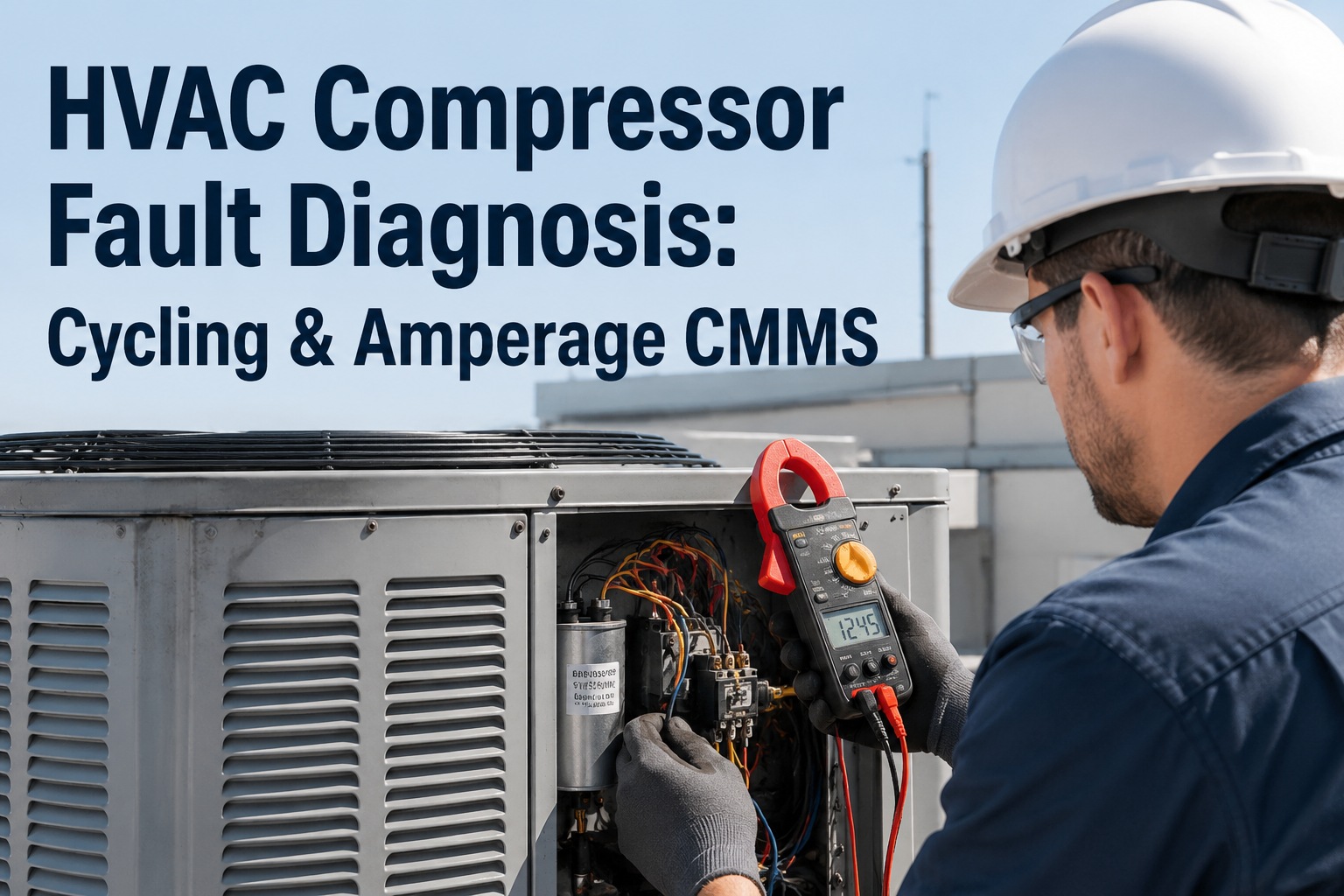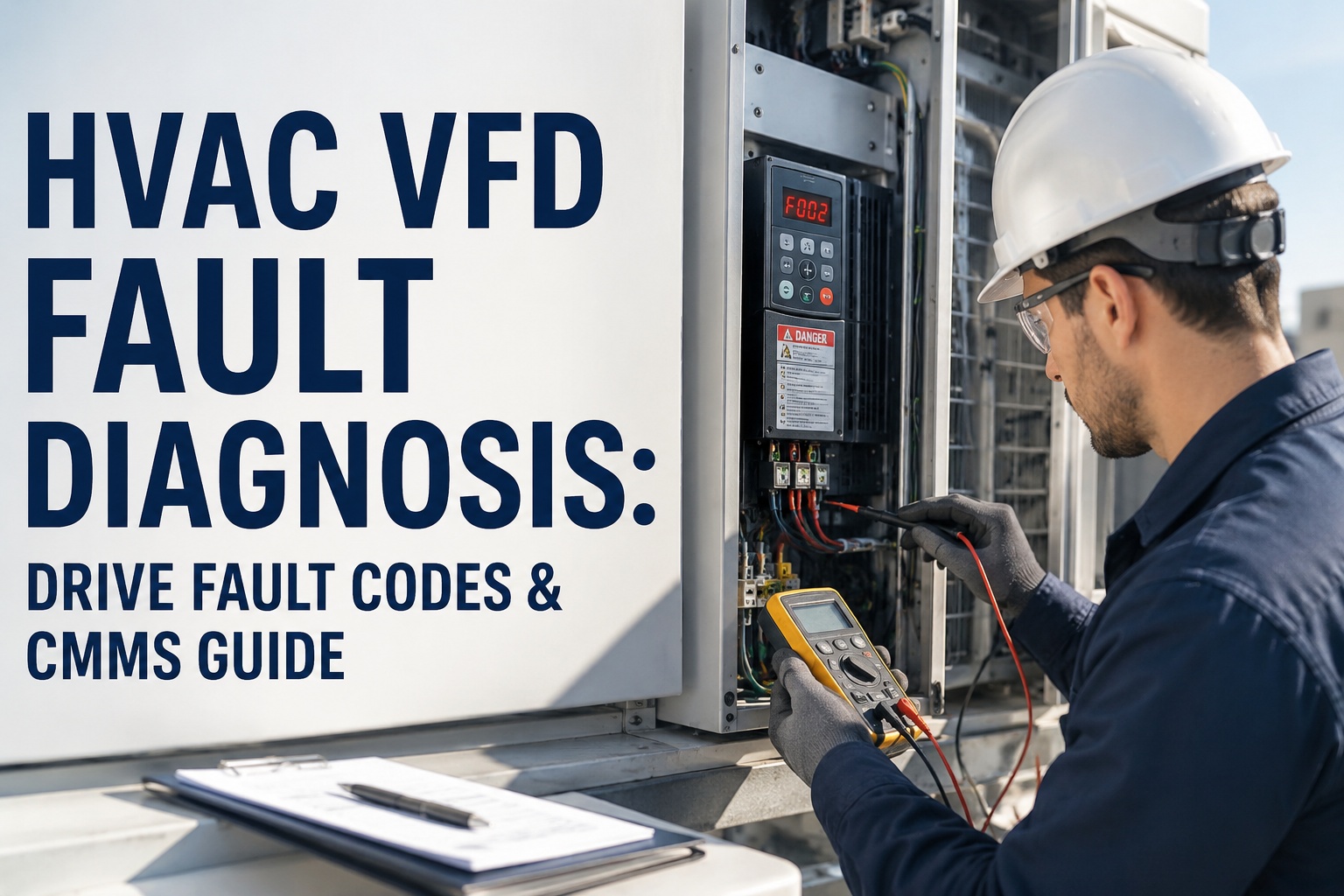
HVAC VFD fault diagnosis is the process of identifying, interpreting, and resolving variable frequency drive errors—such as overcurrent, overvoltage, and ground faults—before they escalate into catastrophic equipment failures and costly building downtime. When a drive faults, the alphanumeric code displayed on the keypad is your first clue, but interpreting that code and tracking the underlying failure pattern across dozens of rooftop units requires a systematic approach. This guide breaks down the most common VFD fault codes for HVAC systems, explains how to interpret drive diagnostics, and shows how modern maintenance teams use a CMMS to track VFD faults and prevent recurring breakdowns. Ready to eliminate reactive maintenance? You can Start Free Trial with OxMaint today.
Is a Single VFD Fault Code Costing You $15K in Unplanned Downtime?
Stop guessing at drive fault codes and start tracking failure patterns. HVAC VFD fault diagnosis becomes predictable when you centralize fault data, maintenance history, and asset health in one AI-powered platform.
Common HVAC VFD Fault Codes & What They Mean
Variable frequency drives protect HVAC motors by shutting down when electrical or thermal limits are breached. Understanding these VFD diagnostic codes is the first step in effective fault diagnosis.
| Fault Code | Fault Type | Primary Causes | Diagnostic Action |
|---|---|---|---|
| OC / F2 | VFD Overcurrent Fault | Short circuit in motor leads, grounded output phase, sudden load jam, acceleration time too short. | Inspect motor leads for insulation breakdown; measure phase-to-ground resistance; extend ramp-up time. |
| OV / F3 | Overvoltage Fault | Deceleration time too short, regenerative load, high input line voltage, failing brake chopper. | Increase decel ramp; verify DC bus voltage; install or replace dynamic braking resistor. |
| OL1 / F7 | Motor Overload | Undersized motor, excessive mechanical load, restricted airflow in HVAC ductwork. | Check actual motor amps vs. nameplate FLA; inspect fan belts and bearings for drag. |
| OH / FH | Drive Overheat | Blocked heatsink, failed cooling fan, ambient temperature exceeding 40°C (104°F), dirty enclosure filters. | Clean heatsink fins; replace drive cooling fan; verify enclosure ventilation and ambient temp. |
| UV / LU | Undervoltage | Voltage sag on incoming line, phase loss, failing DC bus capacitors, undersized power supply. | Measure incoming line voltage across all three phases; check for loose input terminals. |
| GF / EF | Ground Fault | Motor winding shorted to ground, compromised cable insulation, moisture in junction box. | Megger the motor and conductors; dry out any moisture; replace compromised cabling. |
The Hidden Cost of a Recurring Overcurrent Fault
A 180-asset commercial facility ignored intermittent VFD overcurrent faults (Code OC) on a 50 HP supply fan motor for three months. Technicians simply reset the drive each time. When the motor finally shorted internally, the emergency replacement, crane rental, and lost tenant occupancy cost $14,800. The root cause—a degraded output cable slowly losing insulation—was detectable via trending resistance checks in a CMMS.
VFD Failure Ripple Effect
When a critical HVAC drive goes down, it is rarely just a VFD replacement. Building pressure drops, IAQ alarms trigger, and occupants complain. Unplanned VFD replacements carry a 3x premium over scheduled preventive maintenance. Tracking VFD fault detection data allows teams to shift from reactive resets to predictive replacements during scheduled outages.
Step-by-Step HVAC VFD Fault Diagnosis Process
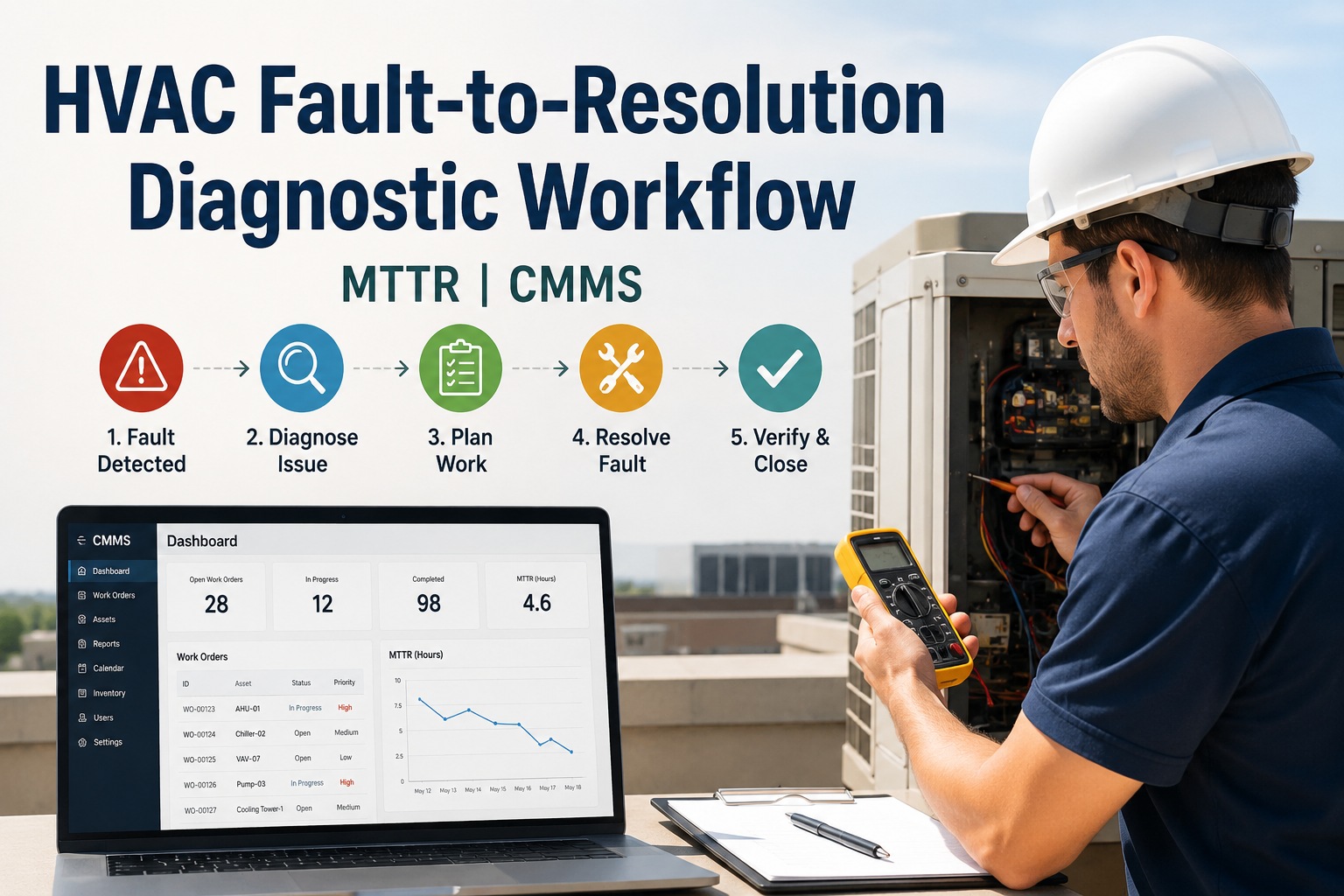
A structured diagnostic approach reduces misdiagnosis and repeat failures. Follow this four-step timeline to standardize how your team responds to drive faults HVAC systems trigger.
Capture the Exact Fault Code & Context
Record the exact alphanumeric code, active frequency (Hz), output current (Amps), and DC bus voltage at the moment of the trip. Do not reset the drive before photographing the keypad. Log this directly into a mobile CMMS work order to establish a baseline for failure tracking.
Isolate Drive vs. Motor vs. Load
Disconnect the motor leads and run the VFD in a safe test mode. If the drive faults with no load attached, the issue is internal to the drive. If it runs cleanly, use a megohmmeter to test motor windings and insulation resistance. Always check mechanical load components (bearings, sheaves, belts) for excessive drag.
Analyze Environmental & Power Quality Factors
VFD overvoltage and overheat faults are often environmental. Measure ambient temperature inside the electrical panel, verify cooling fan operation, and use a power quality analyzer to check for incoming phase imbalances or voltage sags that exceed IEEE 519 tolerances.
Document, Repair, and Schedule Predictive Follow-up
Once resolved, document the root cause and parts replaced in the asset history. Set a recurring preventive maintenance task to inspect the drive and motor quarterly. Schedule infrared thermography to catch early thermal stress before it triggers another fault code.
How OxMaint CMMS Solves HVAC VFD Fault Tracking
Diagnosing a single VFD fault is easy. Preventing it across 200 rooftop units is impossible without software. OxMaint translates drive fault data into automated, preventive maintenance workflows.
Centralized Asset & Fault History
Every VFD fault code, reset, and repair is time-stamped to the specific asset. Stop relying on paper logs—OxMaint instantly shows you the last 5 times a drive threw an overcurrent fault and what was replaced.
Automated Preventive Triggers
Set automated PM triggers based on fault frequency. If a VFD logs 3 ground faults in 30 days, OxMaint auto-generates a high-priority work order for cable meggering and infrared inspection.
Predictive Analytics & Trending
OxMaint AI analyzes vibration, temperature, and electrical trend data alongside VFD diagnostic codes to predict failures weeks before the drive trips, allowing planned replacements during off-hours.
Spare Parts Inventory Integration
Know exactly which VFD spare boards, cooling fans, and capacitors you have in stock. OxMaint automatically reserves parts against work orders and alerts you when minimum stock levels for critical drives are hit.
Stop Resetting Faults. Start Predicting Them.
See how OxMaint maps your VFD fault data to automated preventive maintenance. Book a 30-minute demo and we will build a live fault-tracking workflow on your actual asset list.
Key Metrics for HVAC VFD Reliability in 2026
World-class maintenance teams don't just fix drives—they track the metrics that prevent failure. Monitor these KPIs to benchmark your HVAC VFD diagnosis effectiveness.
HVAC VFD Fault Diagnosis & CMMS FAQs
What causes a VFD overcurrent fault on an HVAC motor?
A VFD overcurrent fault (often coded as OC or F2) is caused by a short circuit in the motor wiring, a grounded output phase, a seized mechanical load, or an acceleration ramp time that is set too short for the inertia of the HVAC fan. Technicians should immediately disconnect the motor leads to isolate whether the fault is inside the drive or downstream in the motor and circuit. You can standardize this isolation process by logging Start Free Trial workflows in OxMaint.
How do I clear an overvoltage fault on a VFD?
To clear a VFD overvoltage fault (OV or F3), increase the deceleration time so the motor does not regenerate power back into the DC bus faster than the drive can absorb it. If the fault persists, verify the incoming line voltage is not too high and check if a dynamic braking resistor is required for high-inertia loads. Always document the parameter changes in your CMMS to track what fixes work.
Can a CMMS track VFD fault codes automatically?
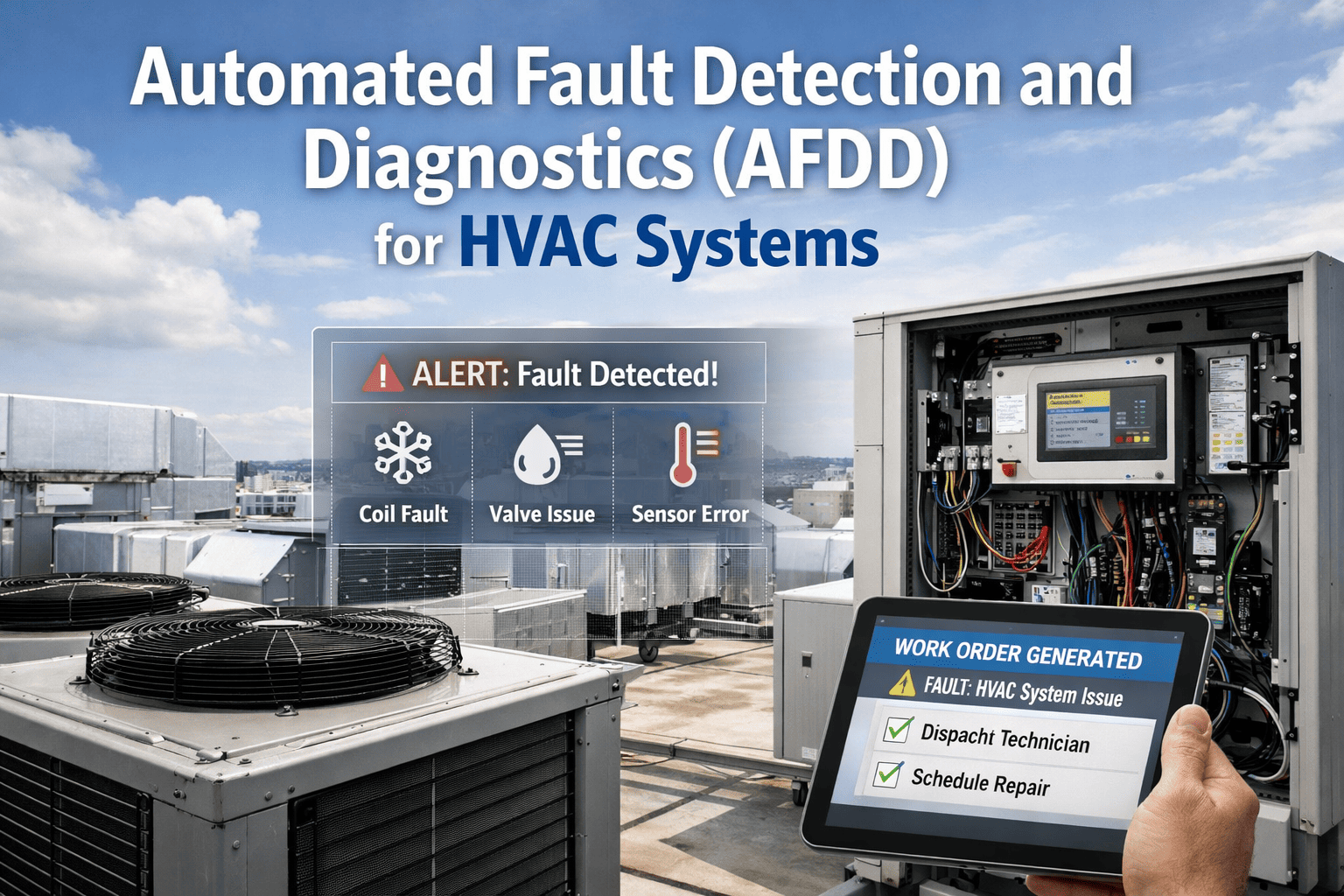
Yes, a modern CMMS like OxMaint tracks VFD fault codes by allowing technicians to input exact diagnostic codes via mobile work orders, and in advanced setups, by integrating with BMS/SCADA systems to auto-generate maintenance tickets when a drive trips. This creates a searchable history of fault frequencies per asset.
Why does my HVAC VFD keep tripping on overheat?
VFD overheat faults (OH or FH) usually occur because the drive's cooling fan has failed, the heatsink fins are blocked by dust, or the ambient temperature inside the electrical enclosure exceeds the drive's 40°C (104°F) rating. Cleaning the heatsink and replacing the small internal fan typically resolves this immediately, but persistent issues require improving panel ventilation.
What is the difference between a ground fault and a phase loss on a VFD?
A ground fault (GF) indicates current is leaking from a motor winding or output cable to earth, usually due to insulation breakdown. Phase loss (PHL or UV) means one of the three input power phases has dropped out or is severely imbalanced. Ground faults require meggering the motor and cables, while phase loss requires checking the facility's incoming power supply and input terminals.
Turn VFD Fault Data Into Zero Downtime
Join maintenance teams using OxMaint to predict HVAC drive failures, automate preventive maintenance, and eliminate reactive troubleshooting. See it live on your assets.
Free 14-day trial · No credit card required