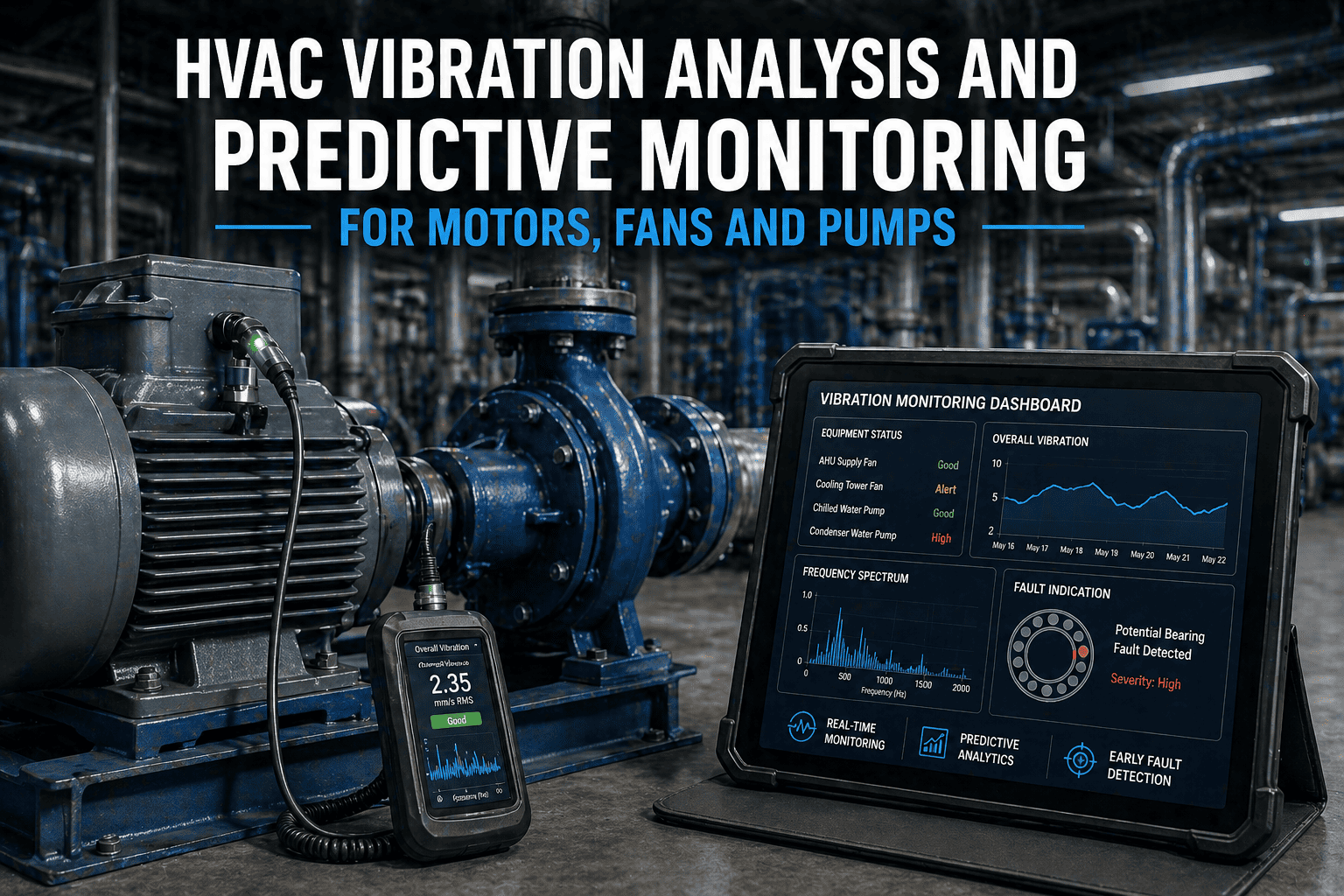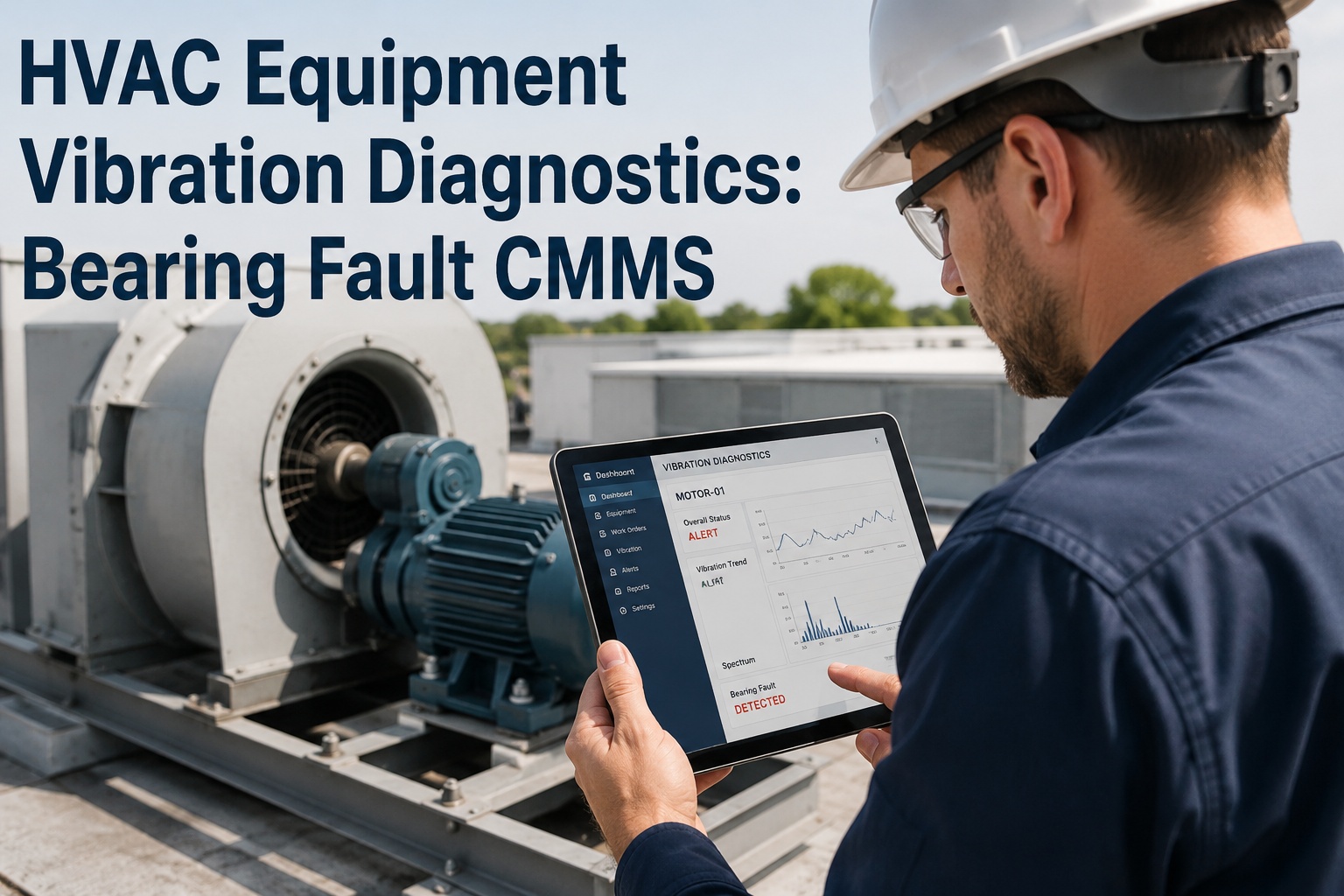
HVAC vibration diagnostics is the practice of measuring and analyzing the mechanical vibration signatures of fans, pumps, motors and bearings in heating, ventilation and air-conditioning systems to detect developing faults before they cause unplanned downtime. A focused HVAC vibration guide will walk you through bearing fault detection, motor imbalance diagnosis and the threshold standards that separate normal operation from impending failure. By pairing wireless vibration sensors with a modern CMMS, maintenance and reliability teams can shift from reactive repairs to predictive maintenance — cutting unplanned HVAC downtime by 30–50% and extending equipment life by years. The strategies below map directly to how OxMaint automates work-order triggers, asset tracking and vibration analytics so your team can act on data faster. Ready to modernize your maintenance program? Start Free Trial and connect your sensors in minutes.
Can your CMMS catch a bearing fault before the fan seizes?
Most HVAC teams find out about bearing wear when a motor smokes or a tenant calls about no cooling. Vibration diagnostics changes that — detecting faults weeks or months before failure, so you can plan repairs instead of reacting to emergencies. OxMaint turns sensor data into prioritized work orders automatically.
Wireless vibration monitoring catches bearing faults up to 9× earlier than periodic route-based inspection — enough lead time to order parts and schedule the repair during off-hours.
How to diagnose HVAC bearing faults with vibration analysis
Rolling-element bearings in HVAC fans and pumps rarely fail without warning. Each fault type — outer race, inner race, ball defect or cage — produces a characteristic vibration frequency that a sensor can isolate and trend over time. The table below maps the four defect frequencies, their root causes and the ISO 10816 severity zones that indicate action is needed.
| Bearing Defect | Vibration Signature | Root Cause | ISO 10816 Zone | Recommended Action |
|---|---|---|---|---|
| Outer-race spalling | BPFO peak — high energy at calculated defect frequency | Misalignment, overloading, shaft deflection | Zone C (amber) | Schedule repair within 2–4 weeks |
| Inner-race crack | BPFI peak with sidebands at shaft RPM | Fretting from loose fit, current discharge | Zone D (red) | Immediate shutdown & replacement |
| Ball / rolling-element wear | BSF peak, often modulated by cage frequency | Contamination, inadequate lubrication | Zone C → D | Re-lubricate, then re-scan; plan replacement |
| Cage (separator) damage | FTF sidebands around defect peaks | Impact loading, improper mounting | Zone B (yellow) | Increase monitoring frequency to weekly |
Real-world scenario: 250-ton AHU supply fan
A commercial office building's 75 HP AHU supply fan showed vibration velocity of 4.8 mm/s RMS — Zone C under ISO 10816-3. Spectrum analysis revealed a dominant peak at the calculated BPFO (ball-pass frequency, outer race), confirming early-stage outer-race spalling. Because the fault was caught 11 weeks before catastrophic failure, the maintenance team ordered the $1,200 bearing kit, scheduled the repair during a weekend shutdown, and avoided an estimated $18,500 in emergency labor, tenant downtime and secondary damage to the fan shaft. The entire workflow — from alert to work-order completion — was managed inside OxMaint.
Step-by-step HVAC vibration diagnostics workflow
A repeatable diagnostic workflow turns raw vibration data into maintenance decisions. These five steps cover sensor placement, baseline capture, threshold monitoring, fault confirmation and corrective action — the same sequence OxMaint automates inside its CMMS platform.
Mount wireless sensors on critical assets
Install tri-axial accelerometers on fan and pump bearings at the radial and axial load zones. Typical mounting: one sensor per bearing housing, magnetically attached or stud-mounted for high-frequency readings. Wireless vibration HVAC sensors transmit data every 15–60 minutes without conduit or wiring costs.
Capture a healthy baseline signature
Record vibration spectra for 7–14 days during normal operation after installation or post-repair. This baseline becomes the reference for deviation alerts. OxMaint stores baseline spectra per asset and automatically flags statistically significant changes from the rolling baseline.
Set vibration thresholds in your CMMS
Configure alarm bands based on ISO 10816 severity zones or your own historical data. Common HVAC thresholds: <2.8 mm/s RMS = normal, 2.8–4.5 mm/s = caution, 4.5–7.1 mm/s = alert, >7.1 mm/s = critical. OxMaint's vibration threshold CMMS engine evaluates every incoming reading against these bands in real time.
Confirm the fault with spectrum analysis
When an alert fires, pull the FFT spectrum and time-waveform to identify the dominant defect frequency. Compare peaks against calculated bearing defect frequencies (BPFO, BPFI, BSF, FTF) using the bearing's geometry data. This step distinguishes a real bearing fault from resonance, looseness or electrical noise.
Auto-generate a prioritized work order
Once the fault is confirmed, the CMMS should create a work order with the asset ID, fault description, recommended parts and priority level — automatically. OxMaint generates the work order, reserves the spare bearing from inventory and notifies the assigned technician, all within seconds of the threshold breach.
What does HVAC vibration monitoring cost vs. save?
The business case for vibration diagnostics is built on avoided downtime, reduced emergency labor and extended equipment life. Use the formula below to estimate annual savings for your facility, then compare it against the cost of wireless sensors and a CMMS subscription.
Example: A facility with 120 unplanned HVAC downtime hours/year at $2,500/hour, achieving a 40% reduction through vibration monitoring, saves $120,000 in downtime alone. Add $15,000 in avoided emergency labor and $22,000 in deferred capital replacement = $157,000 annual savings against a ~$18,000 sensor + CMMS investment — an 8.7× ROI.
| Cost / Savings Factor | Reactive Maintenance | With Vibration CMMS | Difference |
|---|---|---|---|
| Annual unplanned downtime (hours) | 120 hrs | 48 hrs | –72 hrs |
| Emergency labor cost / year | $32,000 | $12,000 | –$20,000 |
| Average bearing replacement cost | $8,500 (emergency) | $3,200 (planned) | –$5,300 |
| Secondary damage (shaft, housing) | $15,000/yr | $2,000/yr | –$13,000 |
| Sensor + CMMS investment | $0 | $18,000/yr | +$18,000 |
| Net annual impact | — | — | +$139,000 |
How OxMaint CMMS powers HVAC vibration diagnostics
OxMaint connects wireless vibration sensor data directly to work orders, asset records and inventory — eliminating the spreadsheet-and-clipboard gap that lets bearing faults slip through. These four capabilities map to the most common pain points in HVAC bearing diagnostics and deliver measurable outcomes within the first quarter of deployment.
Real-time vibration threshold alerts
OxMaint ingests continuous vibration data and evaluates every reading against ISO 10816 or custom thresholds. When a bearing crosses into Zone C or D, the system fires an alert within seconds — no manual data download or spreadsheet analysis required.
Automated work-order generation
Every confirmed alert auto-creates a prioritized work order with the asset ID, fault type, recommended action and required parts. OxMaint assigns it to the right technician based on skill level, availability and proximity — turning diagnosis into action without a phone call.
Asset-level vibration trend dashboards
Every fan, pump and motor has a living asset record in OxMaint that stores its baseline spectrum, alarm history, repair log and trend chart. Maintenance managers see at a glance which assets are healthy, degrading or critical — across one facility or a hundred.
Spare-parts auto-reservation
When a work order is generated, OxMaint checks the spare-parts inventory for the correct bearing, reserves it and flags low stock for reordering. No more arriving at the job site without the right part — or over-ordering "just in case."
Wireless vibration sensors for HVAC: what to look for in 2026
The wireless vibration sensor market has matured significantly, with purpose-built HVAC devices now offering tri-axial measurement, edge FFT processing and 3–5 year battery life. Choosing the right sensor class depends on asset criticality, data resolution needs and whether your CMMS can ingest the data stream natively.
Wi-Fi vibration puck
- Single-axis or tri-axial accelerometer
- Overall velocity + temperature only
- $150–$400 per sensor
- Best for: non-critical fans, small RTUs
- Limitation: No FFT spectrum, no raw waveform
Wireless tri-axial with edge FFT
- Tri-axial, 0–10 kHz bandwidth
- Onboard FFT spectrum + time waveform
- $500–$1,200 per sensor
- Best for: AHUs, chillers, primary pumps
- Native OxMaint integration via API/MQTT
Continuous monitoring gateway
- Wired sensors, 24/7 high-resolution stream
- Full-order analysis & envelope detection
- $2,000–$5,000 per asset point
- Best for: Critical chillers, data-center CRACs
- Requires structured cabling infrastructure
See OxMaint on your assets — book a 30-min demo
Watch a live vibration alert trigger a work order, reserve a bearing and notify a technician — all in real time. Then map it to your own HVAC equipment list.
HVAC vibration diagnostics: frequently asked questions
What is HVAC vibration diagnostics and why does it matter?
HVAC vibration diagnostics is the process of measuring and analyzing the vibration signatures of fans, pumps and motors to detect mechanical faults — primarily bearing wear, imbalance, misalignment and looseness — before they cause unplanned failure. It matters because bearing faults account for roughly 40–50% of all rotating-equipment failures, and early detection can extend equipment life by 2–3 years while cutting emergency repair costs by 50% or more. When integrated with a CMMS like OxMaint, vibration data flows directly into work orders and asset health dashboards, closing the gap between detection and action.
What vibration threshold should I set for HVAC bearings?
For most HVAC rotating equipment operating between 600 and 3,600 RPM, ISO 10816-3 provides the benchmark: below 2.8 mm/s RMS is considered normal (Zone A/B), 2.8–4.5 mm/s is caution (Zone C), 4.5–7.1 mm/s is alert (Zone D), and above 7.1 mm/s warrants immediate shutdown. However, the optimal threshold depends on your asset's baseline signature, mounting rigidity and operating speed. OxMaint lets you set custom thresholds per asset and automatically evaluates every incoming sensor reading against them — you can Book a Demo to see threshold configuration on live equipment.
How do wireless vibration sensors work with a CMMS?
Wireless vibration sensors mount magnetically or via stud on bearing housings and transmit vibration data — either overall RMS values or full FFT spectra — over Wi-Fi, Bluetooth or LoRaWAN to a gateway or cloud endpoint. A CMMS like OxMaint ingests that data stream via API or MQTT, evaluates each reading against configured thresholds, and auto-generates a work order when a fault is detected. The sensor-to-work-order loop can run in under 60 seconds, eliminating the manual data-download and spreadsheet-analysis steps that delay action.
Can vibration analysis detect motor imbalance in HVAC fans?
Yes — motor imbalance is one of the easiest faults to diagnose with vibration analysis. An imbalanced rotor produces a dominant vibration peak at 1× running speed (1× RPM) in the radial direction, with very little energy at higher harmonics. If the 1× peak exceeds your threshold and the phase difference between horizontal and vertical readings is approximately 90°, imbalance is confirmed. OxMaint's trend dashboards display the 1× amplitude over time so you can see imbalance developing as fan blades accumulate dirt or as balance weights shift.
How much does an HVAC vibration monitoring system cost?
A typical mid-size deployment of 30–50 wireless tri-axial sensors costs $15,000–$60,000 for hardware, plus $8,000–$25,000 per year for CMMS software like OxMaint that processes the data and generates work orders. Against that, a single avoided catastrophic bearing failure on a critical AHU or chiller pump can save $15,000–$50,000 in emergency labor, secondary damage and downtime — meaning most facilities achieve full payback within 8–14 months. You can Start Free Trial of OxMaint to map the ROI to your own asset count and downtime cost.
Stop reacting to HVAC failures — start predicting them
Deploy OxMaint's AI-powered CMMS with vibration diagnostics and catch bearing faults, imbalance and misalignment weeks before they become emergencies. Your equipment, tenants and budget will thank you.
Free 14-day trial · No credit card