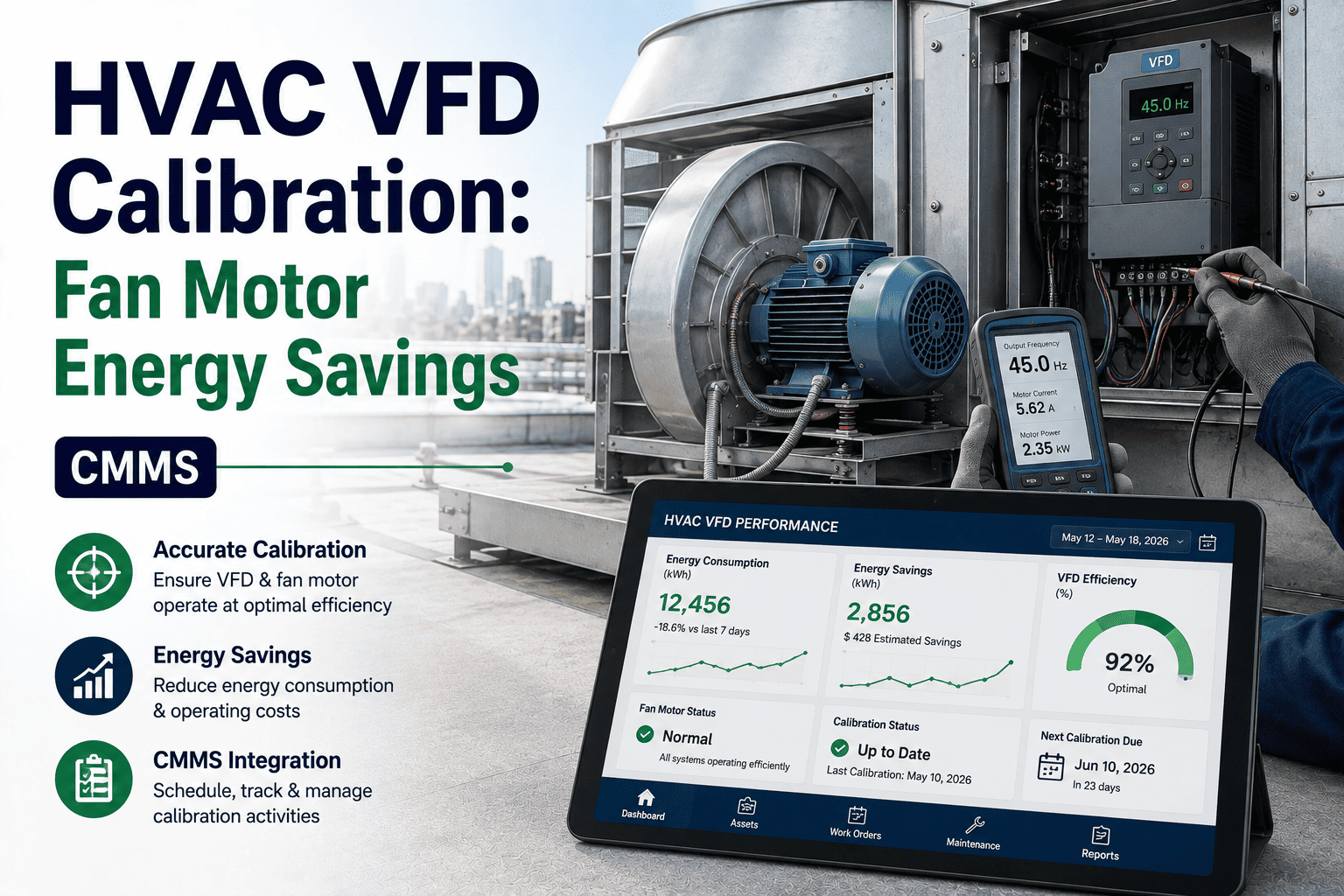
HVAC VFD calibration is the single fastest payback lever for maintenance teams chasing fan motor energy savings — a properly tuned variable frequency drive can cut motor energy consumption by 15–35%, yet misaligned belts, drifted parameters, and skipped alignment checks silently waste 5–15% of that savings every month. This VFD maintenance guide walks reliability engineers and facility managers through belt tension verification, fan motor alignment, and CMMS-based scheduling so no calibration task slips through the cracks. Whether you manage a single rooftop unit or a 500-asset portfolio, pairing VFD efficiency best practices with a centralized CMMS turns one-time tune-ups into repeatable, auditable workflows. Ready to stop wasting kilowatts? Start Free Trial and digitize your HVAC VFD maintenance program today.
HVAC VFD Calibration Guide 2026
Is your HVAC fan VFD silently wasting 5–15% of your motor energy?
Most facilities tune a VFD once at commissioning and never look again. Within 12 months, belt stretch, parameter drift, and misalignment erode the energy savings you paid for — costing a typical 180-asset plant $8,000–$14,000 per year in avoidable kilowatt-hours. OxMaint's CMMS catches the drift before the bill does.
The Cost of Skipping Calibration
Why HVAC VFD efficiency decays — and what it costs you
A variable frequency drive running an HVAC fan motor is only as efficient as its last calibration. Industry benchmark data shows that VFD parameter drift, belt wear, and shaft misalignment compound at 1–2% per quarter when left unchecked — translating to a 5–15% energy penalty within the first year.
"We audited 40 rooftop VFDs and found two-thirds had never been re-tuned since install. Belt tension alone was costing us $920 a month in extra draw on three units."
— Facilities Manager, 220K sq ft commercial office portfolioStep-by-Step VFD Calibration Workflow
How to calibrate an HVAC fan VFD: a 6-step maintenance guide
Follow this sequence every six months — or after any belt, sheave, or motor replacement — to lock in VFD energy savings and prevent the gradual efficiency decay that plagues unmanaged HVAC systems.
Lock out and document baseline
De-energize the motor circuit, verify zero voltage at the VFD terminals, and record the current drive parameters (min/max Hz, acceleration ramps, PID setpoints). Snap a photo of the parameter screen and attach it to the work order in OxMaint for an auditable baseline.
Inspect and verify fan belt tension
Check belt deflection at mid-span using a tension gauge — target 1/64" of deflection per inch of span length. A belt running 10% under-tension slips under load, forcing the VFD to command higher Hz and wasting 3–7% in motor energy. Replace belts that show glazing, cracking, or edge wear.
Check sheave and motor alignment
Use a laser alignment tool across the motor and fan sheaves. Angular misalignment beyond 0.5° or parallel offset over 1/32" increases belt friction, bearing load, and motor amperage — the silent driver behind most belt misalignment energy losses in HVAC fans.
Verify VFD parameters against design intent
Confirm the drive's max frequency, V/Hz curve, and sleep/wake thresholds still match the balancer's original report. Drift often occurs after a power reset or firmware update — compare live settings to the stored baseline in your CMMS asset record.
Measure motor current and harmonics
At full speed and at the typical operating point (often 60–70% speed), clamp the motor leads and log current against the nameplate FLA. A reading 8–12% above expected signals mechanical drag or a mistuned V/Hz curve — both correctable without replacing the motor.
Schedule the next calibration cycle
Set a 6-month recurring preventive maintenance trigger in your CMMS, linked to the specific asset and spare-parts kit (belt, sheave, filters). Auto-generate the next work order so calibration never depends on someone remembering to schedule it.
VFD Energy Savings Math
How much can VFD calibration save? A worked example
Fan energy follows the affinity laws — power scales with the cube of speed. That means even small calibration corrections produce outsized kilowatt savings. Here's the math for a typical 25 HP supply-fan motor running 5,000 hours per year.
Fan Affinity Law — Power
P₂ = P₁ × (N₂ ÷ N₁)³
A 5% speed reduction (e.g., from a VFD correctly tuned to hold 57 Hz instead of 60 Hz) cuts motor power draw by roughly 14.3% — before accounting for improved belt efficiency and alignment.
Annual Savings Calculation
Savings = kW × hrs × $/kWh × %recoverable
25 HP motor ≈ 18.6 kW at full load. At 70% speed, draw is ~6.4 kW. Recovering a conservative 8% from calibration drift saves ~$2,560/year on one fan — multiply across a 50-fan portfolio for $128K annually.
| Calibration Issue | Energy Penalty | Detection Method | Annual Cost (25 HP fan, $0.14/kWh) |
|---|---|---|---|
| Belt under-tension (>10%) | 3–7% | Tension gauge at mid-span | $960–$2,240 |
| Sheave angular misalignment (>0.5°) | 2–5% | Laser alignment tool | $640–$1,600 |
| VFD parameter drift (V/Hz curve) | 4–8% | Compare to stored CMMS baseline | $1,280–$2,560 |
| Stuck bypass or sleep-mode misconfiguration | 5–12% | Log drive status over 7 days | $1,600–$3,840 |
| Combined uncalibrated state (typical) | 5–15% | Full 6-step calibration workflow | $1,600–$4,800 |
CMMS + VFD Maintenance
How OxMaint eliminates VFD calibration drift with a CMMS
Manual spreadsheets and clipboard PMs are why calibration intervals get skipped. OxMaint's AI-powered CMMS turns HVAC VFD maintenance into a scheduled, tracked, and auditable workflow — so every fan gets re-tuned on time, every time, with the data to prove it.
Automated 6-month calibration triggers
OxMaint auto-generates VFD calibration work orders on a fixed interval or runtime-hour basis. Each work order arrives pre-loaded with the 6-step checklist, the asset's parameter baseline, and the required spare-parts kit — eliminating 90% of planning overhead.
Energy-savings analytics per asset
Track motor current readings, belt-tension logs, and alignment measurements over time on a per-fan dashboard. OxMaint flags trends that indicate accelerating drift — so you calibrate before the 5% penalty becomes a 15% penalty, cutting unplanned energy waste by 30–50%.
Predictive maintenance alerts
OxMaint's AI engine correlates VFD fault codes, vibration data, and current-draw anomalies to predict belt failure or bearing wear before it impacts efficiency. Teams receive alerts 2–4 weeks in advance — enough lead time to plan the shutdown instead of reacting to it.
Audit-ready compliance records
Every calibration — technician name, timestamp, before/after readings, photos of the parameter screen — is stored permanently against the asset record. When an auditor or energy manager asks for proof of VFD maintenance, the full history is one click away.
Real-World Scenario
A 180-asset HVAC portfolio: from spreadsheets to structured VFD CMMS
Consider a regional facilities team managing 180 fan motors across 12 buildings. Calibrations were tracked in a shared spreadsheet, updated manually, and routinely missed — especially across the 60 rooftop units that were hard to access.
Before OxMaint
- VFD calibrations completed on only 34% of assets annually
- Average belt misalignment energy penalty: 8.2%
- $42,000/year in avoidable kWh across the portfolio
- No audit trail — technician notes lost in paper work orders
- Spare belts ordered reactively, causing 3-day downtimes
After OxMaint CMMS
- 98% of VFD calibrations completed on schedule (6-month cycle)
- Average energy penalty reduced to 1.5% (from 8.2%)
- $34,600/year recovered in energy savings — payback in under 4 months
- Full digital audit trail with photos, readings, and timestamps
- Parts auto-reordered from min/max triggers — zero stockouts
See OxMaint calibrate your HVAC VFDs on a 30-minute demo
We'll load your fan-motor asset list, set up a 6-month VFD calibration workflow, and show you exactly how much energy waste you can recover — before you spend a dollar.
FAQ
HVAC VFD calibration — your questions answered
How often should HVAC fan VFDs be calibrated?
HVAC fan VFDs should be calibrated every 6 months under continuous duty, or at minimum annually for intermittent-duty fans. Any belt, sheave, or motor replacement should also trigger an immediate recalibration, as should a VFD firmware update or power-loss event that may reset parameters to factory defaults.
What causes VFD energy savings to drop over time?
The three primary culprits are belt stretch and wear (causing slip and higher motor amperage), sheave or shaft misalignment (increasing mechanical drag), and VFD parameter drift after power events. Together, these account for 5–15% of wasted fan motor energy within 12 months when left uncorrected. A CMMS like OxMaint catches all three on a scheduled cycle — Book a Demo to see the workflow.
How much does belt misalignment cost in HVAC fan energy?
A belt running 10% under proper tension or with angular misalignment beyond 0.5° typically wastes 3–7% of motor energy. On a 25 HP supply fan running 5,000 hours per year at $0.14/kWh, that translates to $960–$2,240 in avoidable costs — per fan. Across a 50-fan portfolio, uncorrected belt misalignment can cost $48,000–$112,000 annually.
Can a CMMS automate VFD maintenance scheduling?
Yes. A CMMS like OxMaint auto-generates recurring VFD calibration work orders on a time-based or runtime-hour interval, attaches the correct checklist and spare-parts kit, and routes the task to the assigned technician. It also stores before/after readings so you can track energy-savings trends and prove compliance during audits — all without spreadsheets.
What VFD parameters should I check during HVAC calibration?
At minimum, verify the minimum and maximum frequency (Hz) limits, the V/Hz voltage curve, acceleration and deceleration ramps, PID setpoints, sleep/wake thresholds, and current limit. Compare every value to the balancer's original commissioning report — which should be stored as a document attachment on the asset record in your CMMS for instant reference.
Stop wasting kilowatts on uncalibrated HVAC fan VFDs
Deploy OxMaint's AI-powered CMMS in days, not months. Schedule VFD calibrations, track energy savings, and prove compliance — all from one platform built for maintenance and reliability teams.
Free 14-day trial · No credit card