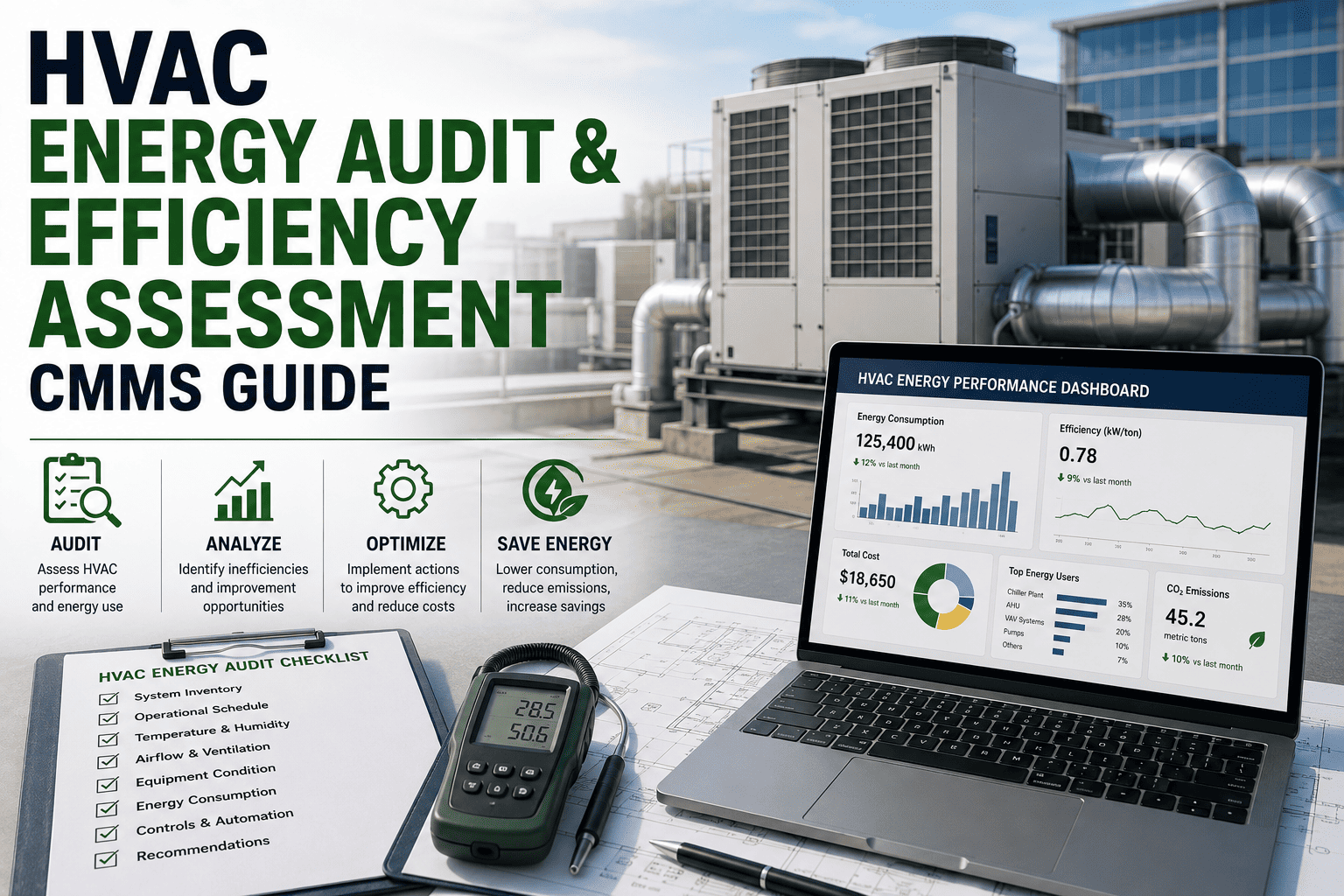
An HVAC energy audit examines cooling, heating, and ventilation equipment to find inefficiencies that quietly drain electricity and gas — and most of those losses are preventable with better maintenance. A facility spending $0.85 per square foot on avoidable HVAC energy waste can recover thousands of dollars annually by connecting audit findings to work-order action. When you run an HVAC efficiency audit through a CMMS, every defective coil, clogged filter, and drifting setpoint becomes a tracked task with an owner, a deadline, and a cost-savings outcome. This guide walks through the audit process, the financial impact, and how OxMaint turns an energy assessment into measurable ROI — or you can Start Free Trial right now to see it on your assets.
$0.85 per sq ft of HVAC energy is preventable waste — is yours being tracked?
An HVAC energy audit finds the leaks, drift, and degradation draining your utility budget. A CMMS closes the loop — turning every finding into a tracked work order with a measurable kWh and dollar recovery. Stop auditing into spreadsheets that no one acts on.
The hidden cost of skipping an HVAC energy review
Roughly 40–60% of a commercial building's energy bill flows through HVAC systems. Yet most maintenance teams run energy assessments reactively — after a complaint, a spike, or a failed compressor. The result: chronic low-grade waste that compounds for months.
Consider a real-world scenario: a 180-asset manufacturing plant spending $42,000 per year on HVAC electricity ran a maintenance-lens energy audit and discovered 22 air-handling units with simultaneous heating-and-cooling conflicts, clogged condenser coils adding 18% compressor run-time, and three chilled-water pumps operating 24/7 against closed valves. Fixing those items through CMMS-tracked work orders cut HVAC energy cost by 19% — an $8,000 annual saving — with zero capital expenditure, only labor and calibration. The audit took four days; the fixes took three weeks; the savings recur every year.
How to conduct an HVAC energy audit through a maintenance lens
An HVAC energy audit is only valuable if findings convert into completed work orders. The five-step process below — aligned to ASHRAE Level 1–2 survey methodology — shows how a CMMS-based energy audit turns a one-time report into continuous improvement.
Baseline energy & asset inventory
Pull 12 months of utility data and map every HVAC asset — AHUs, chillers, boilers, RTUs, pumps, fans — into the CMMS asset registry. Record nameplate kW, installed filters, setpoints, and last-service date. A complete digital twin of your HVAC estate is the foundation; without it, findings can't be assigned or tracked.
Equipment-level energy survey
Walk down each asset with a checklist: measure filter pressure drop, coil cleanliness, belt tension, refrigerant charge, economizer lockout status, and control-sensor calibration. Flag any reading outside ASHRAE / manufacturer tolerance. Each flag becomes a CMMS work-order trigger with a severity code and estimated kWh waste.
Quantify waste & prioritize fixes
Convert each deficiency into a dollar figure using the formula below. Prioritize by payback: no-cost calibration and setpoint fixes first, low-cost coil cleaning and sensor replacement next, capital upgrades last. The CMMS dashboard ranks work orders by estimated energy savings so teams attack the highest-ROI items first.
Execute via tracked work orders
Generate work orders for every audit finding — assigned, dated, and linked to the parent asset. Technicians log parts, labor hours, and before/after readings inside the CMMS mobile app. Nothing falls through the cracks; every fix is auditable for compliance and future energy-review cycles.
Verify savings & schedule prevention
Compare post-fix utility data against baseline. Convert successful one-time fixes into recurring preventive maintenance (PM) tasks — quarterly coil cleaning, semi-annual sensor calibration, monthly filter inspection — so the waste never returns. The CMMS auto-schedules these PMs and alerts on missed cycles.
HVAC energy waste formula: what each deficiency actually costs
You can't manage what you don't measure — and you won't act on what you can't quantify. Use this formula to put a dollar value on every HVAC inefficiency so prioritization is data-driven, not guesswork.
Worked example: clogged condenser coil on a 50-ton RTU
A single dirty 50-ton RTU wastes over $1,600 per year. Coil cleaning costs roughly $150 in labor and materials. Payback: under five weeks. Across a 20-unit rooftop fleet, that is $32,000 in annual recoverable waste — all controllable through PM scheduling inside a CMMS.
HVAC energy audit checklist: what to inspect at each asset
Use this tiered checklist as the field-work template for your HVAC energy survey. Each item maps to a measurable energy impact and a CMMS work-order category so findings are instantly actionable.
Calibration & Controls
- Verify thermostat & sensor calibration (±2°F tolerance)
- Confirm deadband settings (no simultaneous heat/cool)
- Check economizer free-cooling lockout & damper stroke
- Review scheduling & setbacks — eliminate 24/7 defaults
- Inspect VFD minimum-speed and ramp settings
Mechanical & Airside
- Measure filter pressure drop — replace if > 0.5" WC above clean
- Inspect & clean evaporator / condenser coils
- Check belt tension, sheave alignment & bearing condition
- Verify refrigerant charge & subcooling / superheat
- Inspect duct sealing & insulation on exposed runs
Retrofit & Upgrade
- Replace constant-volume motors with VFD / ECM upgrades
- Upgrade to high-efficiency boilers / chillers if > 15 yrs old
- Install demand-control ventilation with CO₂ sensors
- Add heat-recovery to exhaust / relief airstreams
- Integrate BAS / IoT sensors for predictive maintenance
HVAC audit improvement payback — ranked by ROI
Not every fix deserves equal urgency. This table benchmarks common HVAC energy audit findings by typical annual savings, implementation cost, and payback period so maintenance managers can sequence work orders for maximum financial impact.
| Audit Finding | Typical Annual Savings | Cost to Fix | Payback | CMMS Action |
|---|---|---|---|---|
| Thermostat / sensor recalibration drift | $200–$800 / unit | $0 (labor only) | Immediate | PM task — semi-annual |
| Simultaneous heating & cooling conflict | $500–$2,500 / unit | $0 (programming) | < 1 month | Work order — control logic fix |
| Dirty condenser / evaporator coils | $600–$1,800 / unit | $100–$300 | 1–3 months | PM task — quarterly cleaning |
| Clogged / wrong-spec filters | $150–$600 / unit | $50–$150 | 1–2 months | PM task — monthly inspect |
| Economizer damper failure (stuck / disabled) | $800–$3,000 / unit | $200–$800 | 2–6 months | Work order — actuator + calibration |
| VFD retrofit on supply fan | $1,200–$4,500 / unit | $2,500–$6,000 | 1–2.5 years | Capital project + PM |
CMMS vs spreadsheet: closing the energy-audit action gap
The #1 reason HVAC energy audits fail to deliver savings is not bad data — it is lost follow-through. Findings sit in a PDF or spreadsheet; no one owns the action; six months later the waste is still running. A CMMS closes that gap permanently.
| Capability | Spreadsheet / PDF Audit | CMMS Energy Audit (OxMaint) |
|---|---|---|
| Finding-to-work-order conversion | Manual entry — 30–60% of findings never become tasks | One-click generation; 100% of findings tracked to completion |
| Asset-level energy history | Static snapshot; no trend over time | Full asset lifecycle log — every reading, fix, and cost since install |
| Verification of savings | Re-audit required; labor-intensive | Dashboard auto-compares pre/post energy use per asset |
| Recurring prevention scheduling | Calendar reminders — easily ignored | Auto-scheduled PMs with escalation on missed cycles |
| Compliance & audit trail | Scattered files; hard to produce on demand | ISO 55000-aligned records, instantly exportable |
Turn your HVAC energy survey into tracked, measurable savings
OxMaint is built for maintenance and reliability teams who need audit findings to become action — not another binder on a shelf. Four capabilities map directly to the HVAC energy audit workflow and deliver concrete, measurable outcomes.
Audit-to-work-order automation
Convert every energy-audit finding into a prioritized work order in one click — assigned to the right technician with severity, estimated kWh waste, and deadline pre-filled. Eliminates the 30–60% of findings that typically never become action items.
Preventive maintenance scheduling
Auto-schedule quarterly coil cleaning, semi-annual sensor calibration, and monthly filter inspections as recurring PMs tied to each HVAC asset. The system escalates missed cycles so preventable energy waste never returns after the initial fix.
Energy-savings analytics dashboard
Track estimated dollar and kWh recovery per completed work order. Compare pre- and post-fix utility data at the asset level. Report ROI to leadership with one screen — no spreadsheet reconciliation, no manual formulas.
Asset registry & predictive readiness
Maintain a complete digital twin of every HVAC asset — nameplate data, meter readings, service history, and spare-parts inventory. AI-driven predictive alerts flag degradation trends before they become energy-wasting failures.
See OxMaint on your HVAC assets — book a 30-min demo
Watch a live energy-audit finding become a tracked work order, a scheduled PM, and a measured savings outcome — all in one workflow. Bring your asset list; we'll map it live.
HVAC energy audit FAQs
What is an HVAC energy audit and why does it matter for maintenance teams?
An HVAC energy audit is a systematic inspection of heating, cooling, and ventilation equipment to identify inefficiencies — dirty coils, sensor drift, scheduling errors, simultaneous heating/cooling — that waste energy. For maintenance teams it matters because 15–35% of HVAC energy waste is preventable through maintenance actions, and an audit quantifies exactly where the dollars are leaking so work orders can be prioritized by ROI.
How often should I conduct an HVAC efficiency audit?
ASHRAE recommends a Level 1 walk-through survey annually and a Level 2 energy survey every 3–5 years. However, if your CMMS schedules quarterly preventive-maintenance inspections that capture energy-relevant readings (filter pressure drop, coil condition, sensor calibration), you effectively run a rolling mini-audit year-round and only need a full formal audit when energy bills spike or equipment ages past 10 years.
How does a CMMS improve the HVAC energy audit process?
A CMMS like OxMaint turns audit findings into assigned, tracked work orders with deadlines and cost-savings estimates — eliminating the gap where 30–60% of audit recommendations are documented but never acted on. It also auto-schedules recurring PMs (coil cleaning, calibration, filter changes) so fixes are permanent, and provides an analytics dashboard to verify energy savings post-implementation. You can Book a Demo to see the full audit-to-savings workflow live.
How much can I save with a CMMS-based HVAC energy audit?
Typical savings range from 10–20% of total HVAC energy cost, driven by no-cost fixes (calibration, scheduling, deadband correction) and low-cost fixes (coil cleaning, filter upgrades, economizer repair). A 200,000 sq ft facility spending $0.85/sq ft on preventable waste can recover up to $170,000 annually. Most no-cost and low-cost fixes pay back in under 90 days.
What standards apply to an HVAC energy review?
ASHRAE Level 1, 2, and 3 audit procedures are the primary framework. ISO 50001 (energy management systems) and ISO 55000 (asset management) apply to the ongoing management of energy-related assets. A CMMS supports compliance by maintaining a full audit trail of inspections, work orders, and verified savings — records that are instantly exportable for ISO certification or utility-incentive reporting.
Stop auditing into spreadsheets. Start saving with OxMaint.
Turn your next HVAC energy audit into tracked work orders, scheduled PMs, and measured dollar recovery — all in one AI-powered CMMS platform built for maintenance and reliability teams.
Free 14-day trial · No credit card