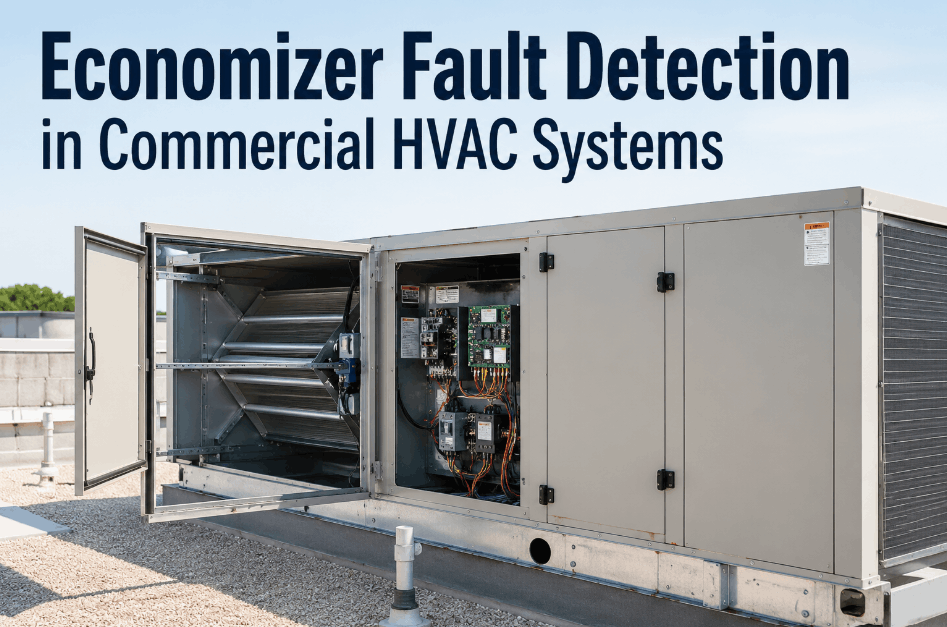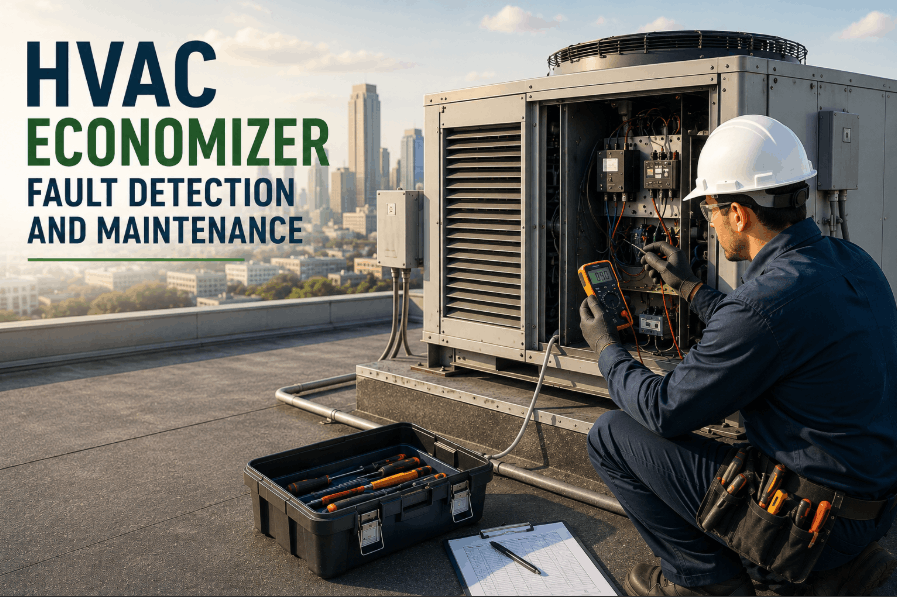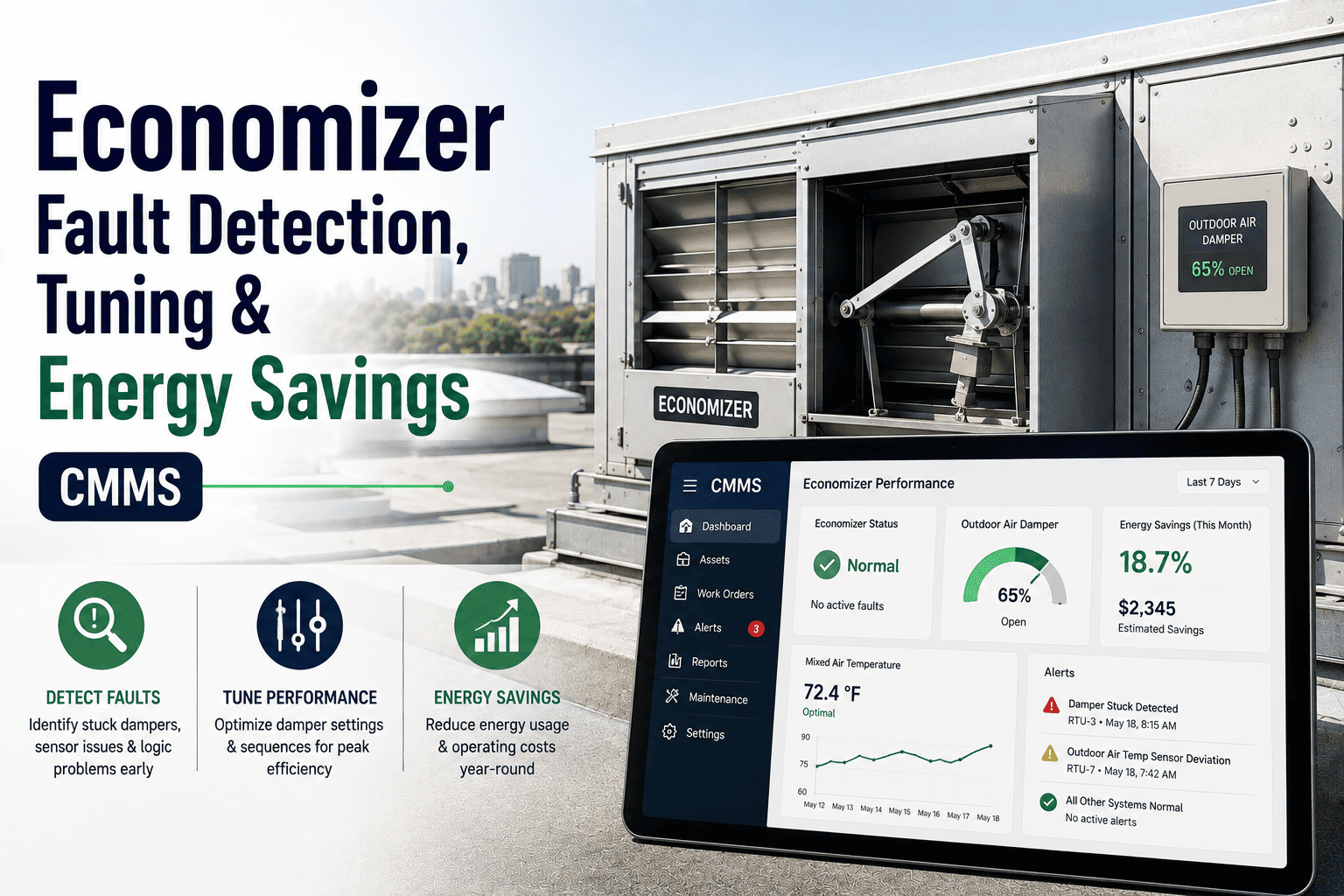
Economizer fault detection and tuning is one of the highest-ROI maintenance tasks in commercial HVAC, with a single stuck or drifted economizer damper wasting $3,000 to $8,000 per unit annually in unnecessary cooling and heating energy. This economizer maintenance guide covers damper calibration, sensor drift correction, performance monitoring, and how a CMMS automates the scheduling and documentation needed to capture those savings consistently. By integrating economizer maintenance software into your preventive maintenance workflow, you can eliminate reactive repairs, restore free cooling, and verify energy savings with defensible audit trails. Ready to stop losing money to hidden HVAC faults? Start Free Trial and put your economizer PMs on autopilot today.
$50B+ Lost Annually to HVAC Faults — Is Your Building Leaking Energy?
Over 50% of commercial rooftop economizers fail within their first two years of operation. Stuck dampers, drifted sensors, and jammed actuators silently disable free cooling and force compressors to run overtime. OxMaint's AI-powered CMMS catches these faults early, automates economizer tuning, and puts real energy savings back on your balance sheet.
How Much Do Economizer Failures Actually Cost?
When an economizer fails, it stops using outside air for "free cooling" and relies entirely on mechanical refrigeration. The result is a silent spike in energy consumption that often goes unnoticed until the utility bill arrives.
Example: A 20-ton RTU with a stuck closed damper adds ~6 kW of compressor load. Running 2,500 economizer-eligible hours/year at $0.12/kWh equals $1,800/year in wasted energy per unit — plus accelerated compressor wear and premature failure.
| Fault Type | Impact on System | Energy Waste / Yr | Repair Cost if Ignored |
|---|---|---|---|
| Stuck Damper (Closed) | Zero free cooling, max compressor load | $3,000 – $5,000 | Compressor burnout ($4K+) |
| Stuck Damper (Open) | Over-ventilation, excessive heating/humidity load | $2,500 – $4,500 | Coil freezing, water damage |
| Sensor Drift (Temperature) | Incorrect mixed-air temps, short cycling | $1,500 – $3,000 | Actuator failure, uneven comfort |
| Failed CO2 / Enthalpy Sensor | DCV disabled, constant over-ventilation | $2,000 – $4,000 | IAQ complaints, compliance fines |
Economizer Fault Detection: What to Check and When
Proactive economizer performance monitoring catches degradation before it becomes a catastrophic failure. Use this checklist during quarterly preventive maintenance to verify damper calibration, sensor accuracy, and actuator response.
Visual & Remote Inspection
- Review BAS/BMS trends for mixed-air temp anomalies
- Verify damper position matches controller output
- Check for alarm history or fault codes on the RTU
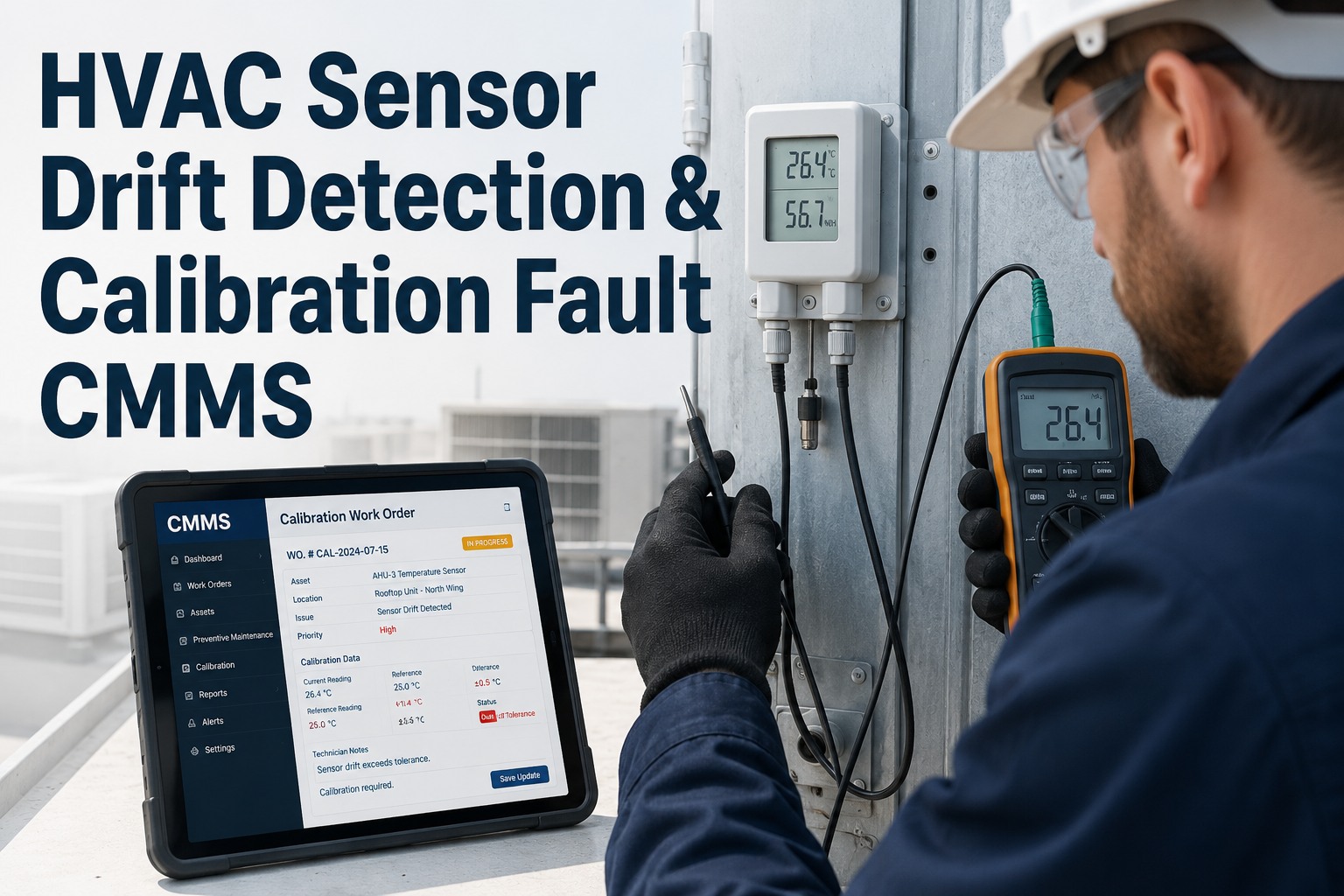
Sensor Drift Correction
- Calibrate mixed-air, return-air, and outside-air sensors
- Replace enthalpy sensors if reading outside 2% tolerance
- Verify CO2 sensor calibration for demand-controlled ventilation
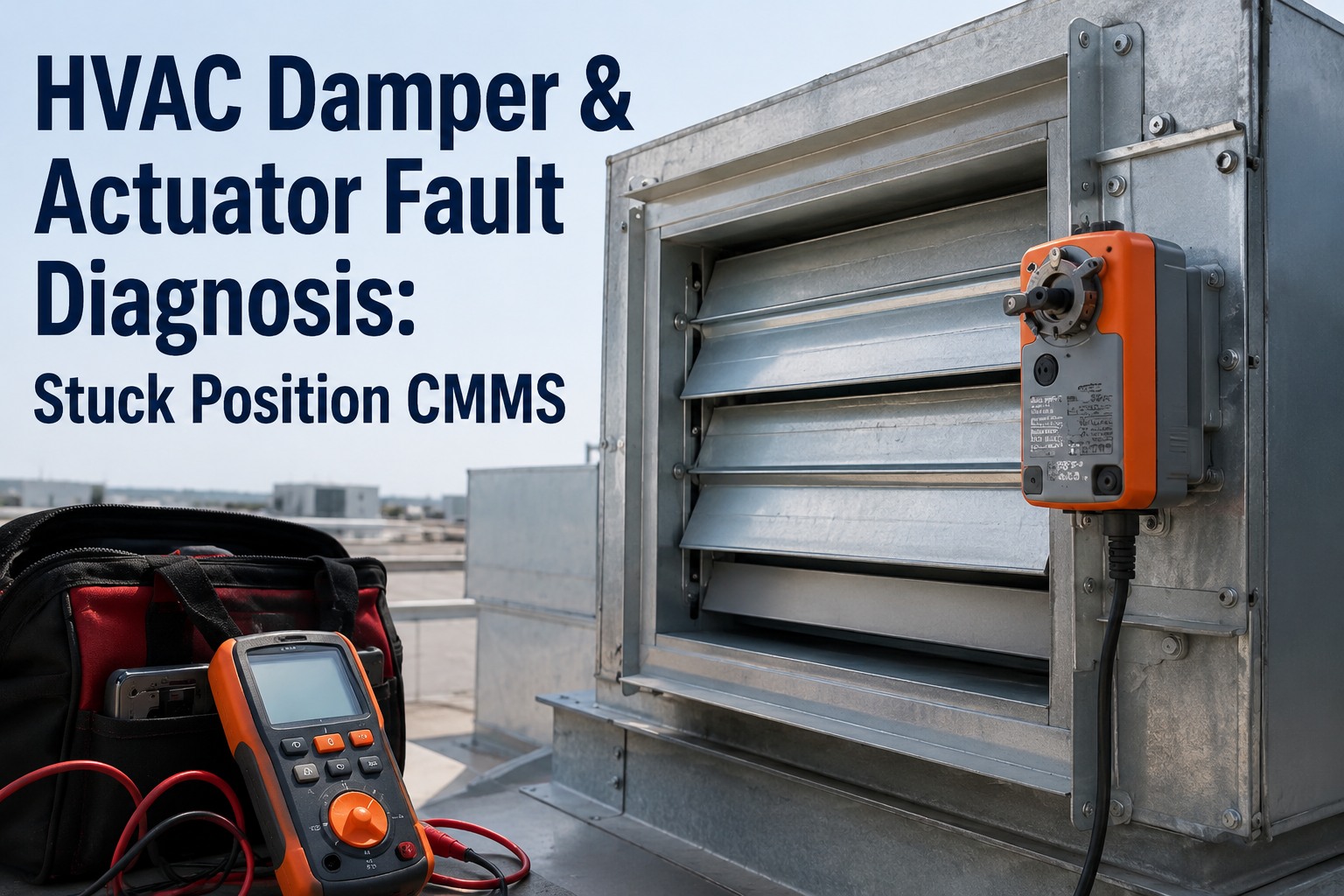
Damper & Actuator Tuning
- Perform economizer damper calibration (min/max stroke)
- Lubricate linkages and tighten set screws
- Test high/low limits and free-cooling lockout logic
Stop Wasting $3K+ Per Unit on Hidden HVAC Faults
See how OxMaint automates economizer PM scheduling, fault tracking, and sensor calibration logs — so you never miss a tune-up again.
CMMS for HVAC Economizer Optimization & Energy Savings
OxMaint is an AI-powered CMMS and EAM platform that transforms your economizer maintenance from a reactive, paper-based headache into a data-driven, automated workflow. Here is how maintenance teams use OxMaint to lock in HVAC energy savings:
Automated PM Scheduling
Auto-generate quarterly economizer tuning and sensor calibration work orders based on runtime, calendar dates, or BAS fault triggers. Eliminate missed PMs and cut reactive maintenance by 40%.
Predictive Fault Alerts
OxMaint's AI analyzes asset history and sensor data to flag potential economizer failures — like a drifting mixed-air sensor — before it spikes your energy bill, reducing unplanned downtime 30–50%.
Digital Calibration Logs
Replace paper checklists with mobile work orders. Technicians capture damper calibration readings, sensor offsets, and photos directly in the app — creating a defensible audit trail for ISO 50001 and energy code compliance.
Spare Parts & Inventory Tracking
Keep critical economizer components (actuators, sensors, linkages) in stock with real-time inventory tracking. OxMaint auto-reorders parts when minimum thresholds are hit, eliminating emergency procurement costs.
A 180-Asset Portfolio: From Reactive to Proactive
Consider a facilities team managing 180 rooftop units across a commercial real estate portfolio. Before implementing a CMMS, economizer PMs were tracked on spreadsheets, resulting in missed calibrations and an estimated $42K in annual energy waste from stuck dampers and drifted sensors.
Wasted on hidden economizer faults and compressor overuse. PMs completed late or skipped entirely due to chaotic manual scheduling.
Energy waste reduced by 71%. Automated PMs, predictive sensor alerts, and real-time parts tracking saved $30K annually and cut technician overtime by 15 hours per month.
"Within three months of deploying OxMaint, we identified and repaired 14 faulty economizer dampers that were silently draining our energy budget. The platform paid for itself before the first quarter ended."
— Director of Facilities, Commercial Real Estate PortfolioEconomizer Maintenance & CMMS Questions Answered
What is economizer fault detection and why does it matter?
Economizer fault detection is the process of identifying mechanical, electrical, or sensor failures in an HVAC economizer system that prevent it from using outside air for free cooling. It matters because a faulty economizer can waste $3,000 to $8,000 per unit annually in unnecessary energy consumption and lead to premature compressor failure. Using a CMMS like OxMaint automates the detection and documentation of these faults so teams can fix them before costs escalate. Book a Demo to see automated fault tracking in action.
How often should economizer tuning and damper calibration be performed?
Economizer tuning and damper calibration should be performed at least twice a year (semi-annually), ideally during spring and fall seasonal PMs. Sensor drift correction should be done quarterly, while remote performance monitoring via the BAS should be reviewed monthly. OxMaint's CMMS allows you to set these schedules automatically so no PM slips through the cracks.
How much energy can you save with proper economizer maintenance?
Proper economizer maintenance and tuning can reduce HVAC energy consumption by 15% to 40%, depending on climate, building load, and the severity of pre-existing faults. In mild climates, a fully functional economizer can provide up to 100% of cooling load using outside air, drastically cutting mechanical refrigeration runtime and energy bills.
What is sensor drift and how does it affect economizer performance?
Sensor drift occurs when temperature, enthalpy, or CO2 sensors gradually lose accuracy over time due to dirt, age, or environmental factors. A drifted sensor feeds incorrect data to the controller, causing the economizer to open or close dampers at the wrong times, which disables free cooling or over-ventilates the space. Regular calibration logged in a CMMS ensures sensors stay within their 2% tolerance.
Can a CMMS help with economizer maintenance and compliance?
Yes. A CMMS like OxMaint centralizes work order generation, tracks calibration results, and stores digital maintenance records for every asset. This not only ensures PMs are completed on schedule but also provides the defensible audit trails required for ISO 50001 energy management compliance and local building energy codes. Start Free Trial to build your compliance-ready asset history today.
Ready to Capture Your Economizer Energy Savings?
Join the maintenance teams using OxMaint to automate PMs, detect faults early, and stop wasting thousands on hidden HVAC failures.
Free 14-day trial · No credit card