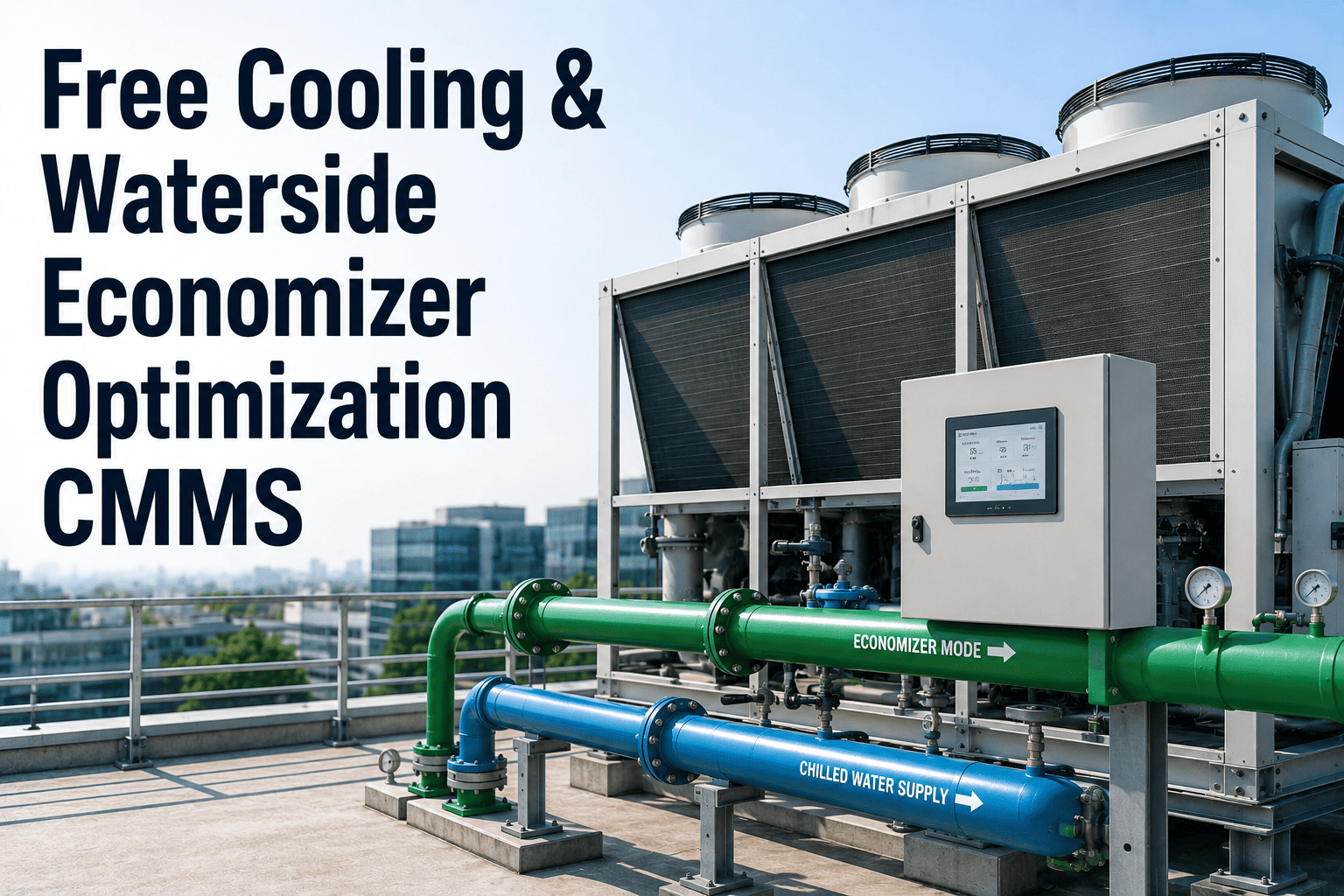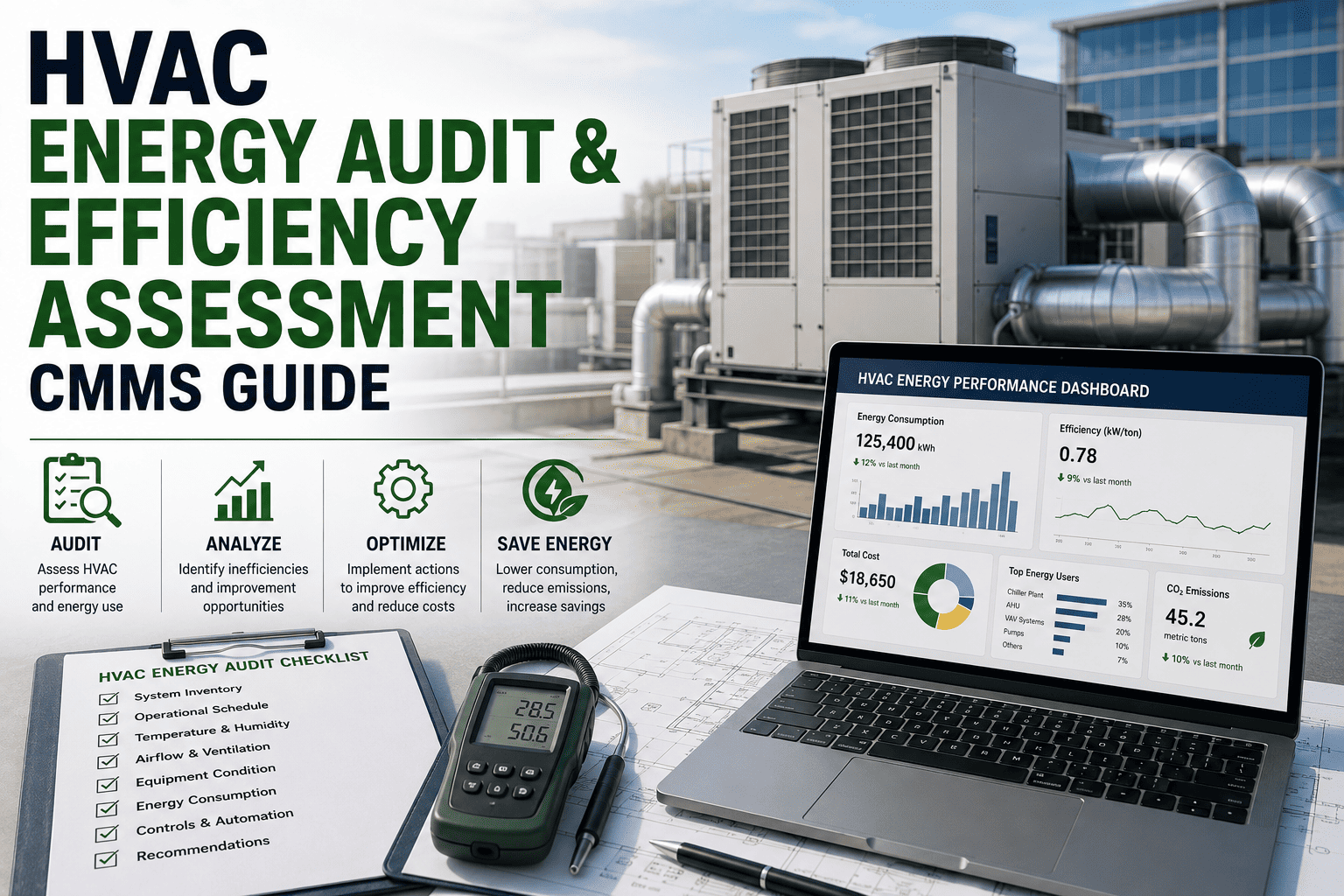
HVAC cooling efficiency optimization is the single fastest payback lever available to maintenance and reliability teams in 2026, with most commercial and industrial facilities able to cut cooling energy consumption by 15–30% simply by tuning economizers, calibrating variable frequency drives (VFDs), and shifting from reactive to predictive coil maintenance. A modern, CMMS-orchestrated HVAC efficiency program eliminates the spreadsheet chaos that causes missed filter changes and undetected refrigerant leaks, turning your cooling system optimization into a measurable, automated workflow. This guide breaks down the exact steps, formulas, and software-driven maintenance strategies your team needs to maximize HVAC energy savings this year. Ready to stop wasting energy and start tracking every asset? You can Start Free Trial of OxMaint today.
Is your HVAC cooling system quietly draining 30% of your energy budget?
Most facilities lose thousands of dollars annually to undetected drift in economizers, poorly calibrated VFDs, and fouled coils. A CMMS-orchestrated efficiency program reverses that drain — automatically.
Why HVAC cooling efficiency optimization matters in 2026
Cooling accounts for up to 40% of total energy spend in commercial buildings and even more in data centers and manufacturing plants. Yet most maintenance teams still manage HVAC assets on reactive cycles or disconnected spreadsheets. The Department of Energy estimates that a poorly maintained cooling system consumes 15–30% more energy than one operating at peak efficiency. For a 180-asset facility spending $42,000 annually on cooling energy, that is $7,500 to $12,600 wasted every year — before factoring in unplanned downtime and premature compressor failure.
The 4-pillar HVAC efficiency program for maximum energy savings
A structured cooling efficiency program targets the four areas where HVAC systems lose the most energy. Each pillar maps directly to a preventive or predictive maintenance workflow inside a CMMS, ensuring the work gets done on time and the results are documented for compliance.
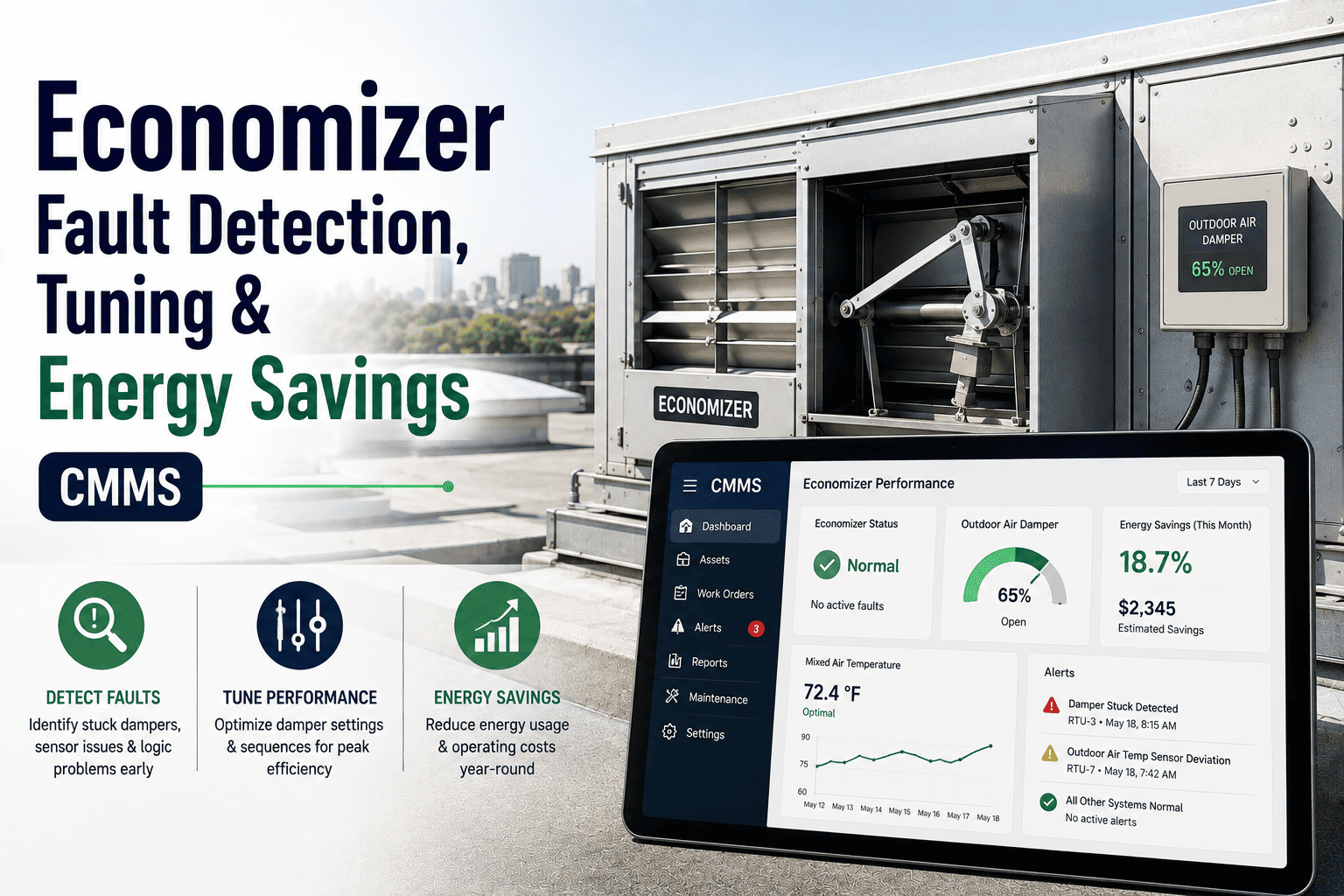
Economizer Tuning
A mis-calibrated economizer can waste up to 30% of cooling energy. Tune dry-bulb and enthalpy sensors, verify damper actuation, and program correct lockout temperatures. CMMS scheduling ensures quarterly calibration checks are never missed.
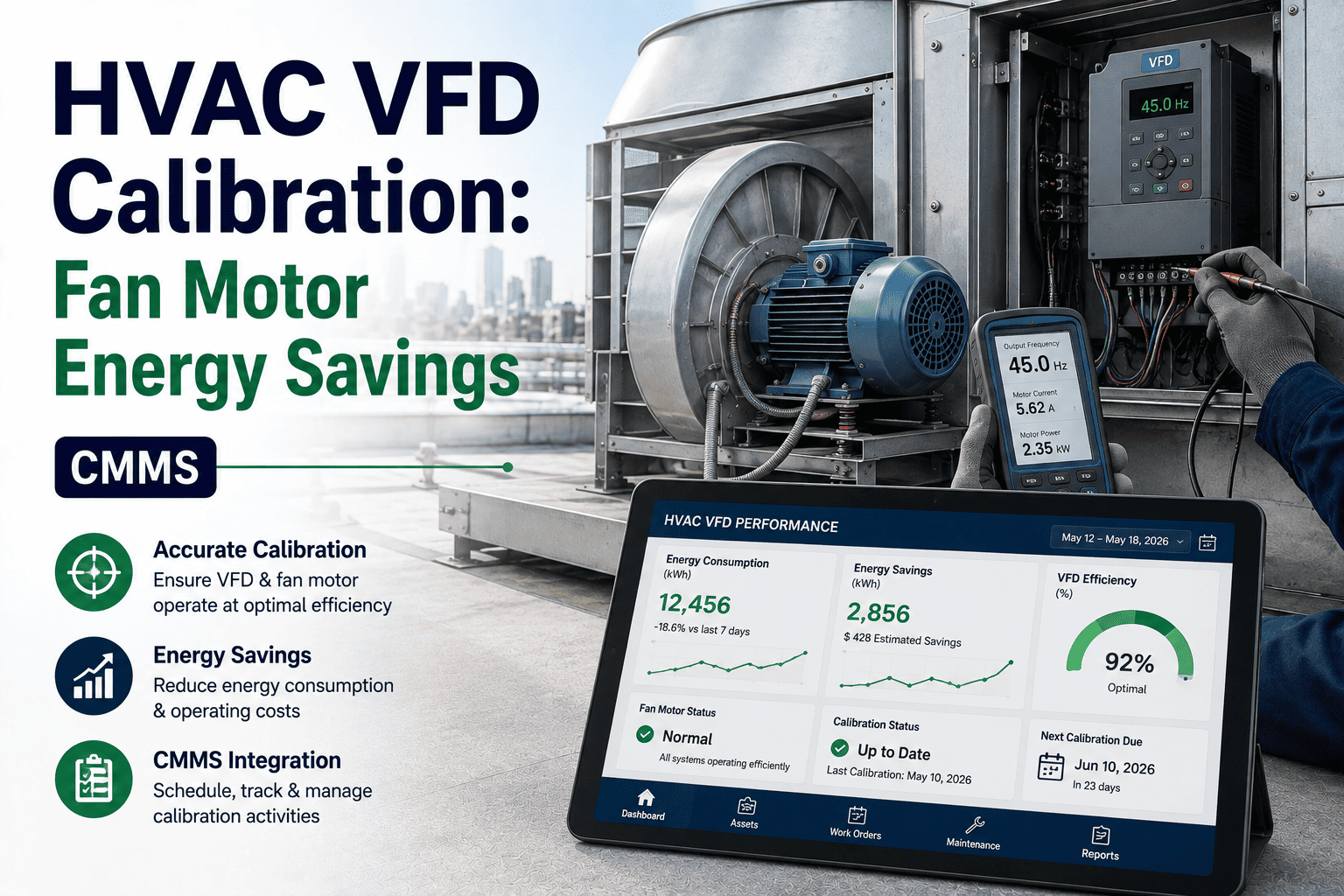
VFD Calibration & Control
Variable Frequency Drives reduce fan and pump energy by matching motor speed to load, but drift in PID loops and sensor inputs erodes those savings. Regular VFD calibration HVAC maintenance preserves the 20–50% energy reduction these drives are designed to deliver.
Predictive Coil Maintenance
Dirty evaporator and condenser coils increase compressor head pressure and energy draw by 10–20%. Instead of fixed-interval cleaning, use predictive maintenance analytics to flag coil fouling based on runtime, pressure differentials, and temperature trends.
Refrigerant Leak Monitoring
A 10% refrigerant charge loss cuts cooling efficiency by 20% and risks EPA Section 608 violations. Automate leak inspection work orders and log every recharge event in your CMMS to maintain compliance and system performance.
How to calculate HVAC cooling energy savings and ROI
Quantifying cooling efficiency ROI requires comparing current energy baselines against post-optimization consumption. Use these industry-standard formulas to build a business case for your maintenance budget.
If a 50 kW condenser unit draws 58 kW due to fouling and runs 2,000 hours/year, the waste is (58−50) × 2,000 = 16,000 kWh. At $0.12/kWh, that is $1,920 lost per unit annually.
A 30 kW motor running 4,000 hours at $0.12/kWh with a VFD achieving 35% reduction saves 30 × 4,000 × $0.12 × 0.35 = $5,040 per year in energy costs alone.
A $15,000 CMMS implementation and optimization program yielding $8,500 in first-year energy savings delivers a 1.8-year payback — before counting downtime and labor savings.
| Optimization Measure | Energy Savings | Implementation Cost | Typical Payback |
|---|---|---|---|
| Economizer Tuning | 10–20% | Low ($500–$2,000) | 3–6 months |
| VFD Calibration & Retrofit | 20–50% | Medium ($3K–$12K) | 1–2 years |
| Predictive Coil Cleaning | 5–15% | Low ($1K–$4K/yr) | 6–12 months |
| Refrigerant Leak Repair | 5–10% | Low ($500–$3,000) | 3–9 months |
| CMMS-Orchestrated Program | 15–30% | Medium ($8K–$20K) | 1.5–2.5 years |
See how OxMaint automates your cooling efficiency program
Stop chasing spreadsheets and missing PM cycles. Book a 30-minute demo and see how AI-powered work orders, predictive analytics, and asset tracking transform your HVAC maintenance.
How OxMaint drives HVAC cooling efficiency with AI-powered CMMS
OxMaint connects your cooling system optimization to a unified maintenance platform. Instead of sticky notes and calendar reminders, your team gets AI-generated work orders, predictive failure alerts, and real-time energy analytics — all mapped to individual HVAC assets. Here is how OxMaint capabilities translate directly into measurable HVAC energy savings.
Automated PM Scheduling
Auto-generates economizer, VFD, and coil maintenance work orders based on runtime, calendar intervals, or sensor triggers. Eliminates 95% of missed preventive maintenance tasks that cause energy drift.
Predictive Maintenance Analytics
AI models analyze vibration, temperature, and pressure data from HVAC assets to predict compressor and fan failures before they cause efficiency losses or catastrophic downtime.
Asset & Equipment Tracking
Maintain a complete digital twin of every RTU, chiller, AHU, and cooling tower. Track model, install date, warranty, parts, and full maintenance history for instant audit readiness.
Maintenance Analytics Dashboard
Real-time KPI tiles for MTBF, MTTR, energy consumption, and work order completion rates. Spot efficiency trends across facilities and prove ROI to leadership with one-click reports.
A 180-asset plant cut cooling energy 22% in 90 days
A Midwest food processing plant operating 180 HVAC assets across 4 buildings was spending $42,000 annually on cooling energy, with maintenance tracked entirely in Excel spreadsheets. After implementing OxMaint, the reliability team standardized quarterly economizer checks, set runtime-based coil cleaning triggers, and used predictive analytics to flag three failing VFDs before they impacted efficiency.
Within 90 days, the plant reduced cooling energy consumption by 22% — saving $9,240 annually — while cutting unplanned HVAC downtime by 35%. The CMMS paid for itself in 14 months on energy savings alone.
We were flying blind on HVAC maintenance. OxMaint gave us automated work orders and predictive alerts that caught efficiency losses we never would have seen on spreadsheets. The 22% energy reduction paid for the system in just over a year.
HVAC cooling efficiency optimization FAQs
What is HVAC cooling efficiency optimization?
HVAC cooling efficiency optimization is the process of tuning, calibrating, and maintaining cooling system components — economizers, VFDs, coils, and refrigerant circuits — so they operate at peak performance with minimal energy waste. A CMMS-orchestrated program automates the preventive and predictive maintenance tasks required to sustain those efficiency gains year-round.
How much energy can a CMMS cooling efficiency program save?
Most facilities achieve 15–30% HVAC energy savings by implementing a CMMS-driven efficiency program. The exact figure depends on baseline condition, equipment age, and how much maintenance was previously deferred. To see exactly how OxMaint would calculate your savings, Book a Demo for a personalized assessment.
How often should economizer tuning and VFD calibration be performed?
Economizers should be inspected and tuned at least quarterly, while VFD calibration and PID loop verification should occur every 6 months or after any major sensor replacement. A CMMS like OxMaint automates these schedules based on runtime or calendar intervals so no task is missed.
Can OxMaint integrate with existing HVAC BMS or BAS systems?
Yes. OxMaint can ingest alerts and runtime data from Building Management Systems to automatically generate work orders. This bridges the gap between your BMS monitoring and your maintenance execution, ensuring efficiency alarms are actually resolved rather than ignored.
How long does it take to implement an HVAC efficiency CMMS?
Most teams are live on OxMaint within 2–4 weeks. Asset import, PM schedule setup, and user onboarding are streamlined so you can begin capturing energy and maintenance data quickly. You can also Start Free Trial immediately to explore the platform on your own.
Stop wasting energy. Start optimizing your HVAC cooling today.
Join the maintenance teams using OxMaint to automate preventive maintenance, predict failures, and cut cooling energy by up to 30%. Your assets — and your budget — will thank you.
Free 14-day trial · No credit card