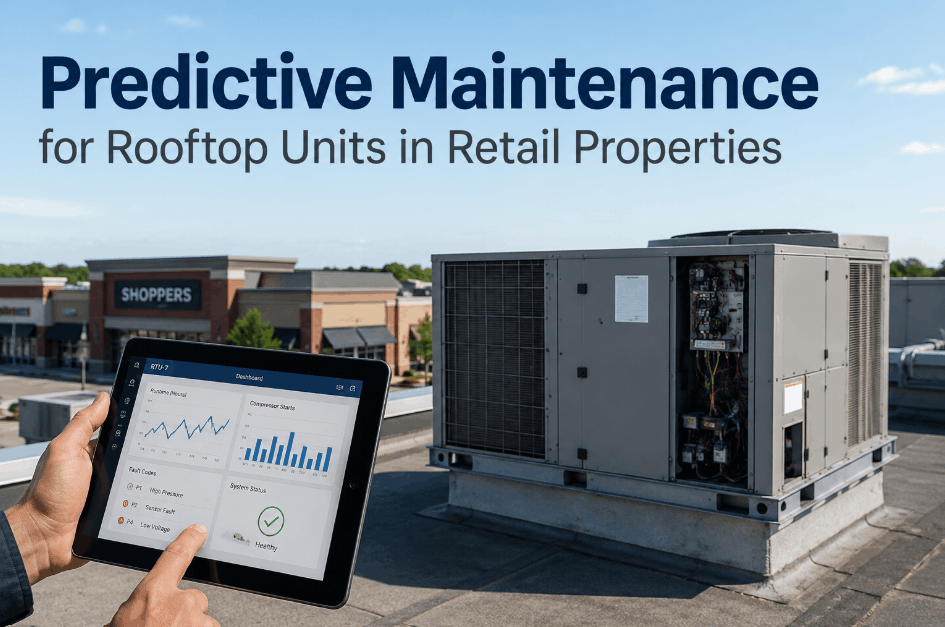
Rooftop units are the workhorses of commercial HVAC — and among the most expensive assets to repair when failures are left undetected. Compressor failures, condenser fan motor burnouts, and economizer damper failures rarely announce themselves until equipment has already degraded beyond efficient operation. Predictive maintenance for rooftop units changes that dynamic by continuously monitoring compressor discharge pressure, suction temperature, supply air deviation, and runtime patterns to detect fault signatures days or weeks before breakdown. Sign Up Free to connect your RTU assets to OxMaint's condition-based maintenance workflows and stop managing rooftop units reactively. This guide covers the essential analytics, monitoring strategies, and Book a Demo pathways for implementing RTU predictive maintenance at commercial facilities.
Stop Reacting to RTU Failures — Start Predicting Them
OxMaint monitors rooftop unit performance data in real time and converts predictive fault signals into automated maintenance work orders — before compressor failures, airflow drops, or economizer faults cause downtime.
Why RTU Predictive Maintenance Matters for Commercial HVAC
Rooftop units operate in punishing outdoor conditions — thermal cycling, precipitation exposure, UV degradation, and airborne particulate loading — all while delivering continuous cooling and heating across occupied spaces. Fixed-interval PM schedules cannot account for the wide variance in RTU degradation rates driven by load profile, local climate, equipment age, and installation quality. Predictive maintenance frameworks replace assumptions with data — monitoring compressor, fan, economizer, temperature, airflow, and runtime analytics to build an accurate picture of each RTU's actual condition. Facility teams that Sign Up Free with OxMaint can activate condition-based triggers for their RTU fleet without replacing existing BMS infrastructure or building custom integrations.
Monitor discharge pressure, suction pressure, compression ratio, and current draw trends to identify refrigerant charge loss, valve degradation, and bearing wear before compressor failure.
Track condenser and evaporator fan motor current, vibration, and RPM deviation to detect bearing failures, belt wear, and motor winding degradation ahead of burnout.
Analyze damper position, outside air temperature differential, and CO2 levels to detect stuck dampers, actuator failures, and missed free cooling opportunities that inflate energy costs.
Continuously evaluate supply air vs. return air temperature differential against expected values — flagging refrigerant issues, dirty coils, and heat exchanger degradation from deviation trends.
Monitor static pressure and airflow volume trends across filter banks, evaporator coils, and ductwork to detect progressive restriction that reduces efficiency and thermal comfort delivery.
Analyze RTU runtime cycles, short-cycling frequency, and lock-out events to identify control system faults, refrigerant issues, and capacity degradation under representative load conditions.
RTU Fault Detection: Key Failure Modes and Predictive Signals
Refrigerant undercharge is the leading cause of compressor failure in rooftop units — and one of the most detectable through analytics. Falling suction pressure, rising superheat, increasing compression ratio, and elevated discharge temperature in combination indicate refrigerant loss with high confidence. Predictive maintenance models trained on these signals can detect undercharge conditions 3–6 weeks before compressor damage becomes irreversible, allowing leak detection and recharge during a planned maintenance window rather than an emergency service call. OxMaint converts these multi-signal detections into prioritized work orders with pre-attached refrigerant system checklists automatically.
Condenser coil fouling from airborne debris, biological growth, and environmental deposits progressively increases condensing pressure — forcing the compressor to work harder and consuming 10–20% more energy before the fault becomes operationally visible. Predictive analytics track the relationship between outdoor ambient temperature and condensing pressure over time, detecting fouling-driven drift from established baseline curves. Book a Demo to see OxMaint's condition-based coil cleaning triggers in action.
Evaporator icing results from low airflow, low refrigerant charge, or low ambient operation and causes rapid capacity loss. Predictive signals include falling suction pressure combined with declining supply air temperature and reduced airflow volume. Early detection prevents progressive ice buildup from damaging evaporator coil fins and causing refrigerant flood-back events that destroy compressor valves.
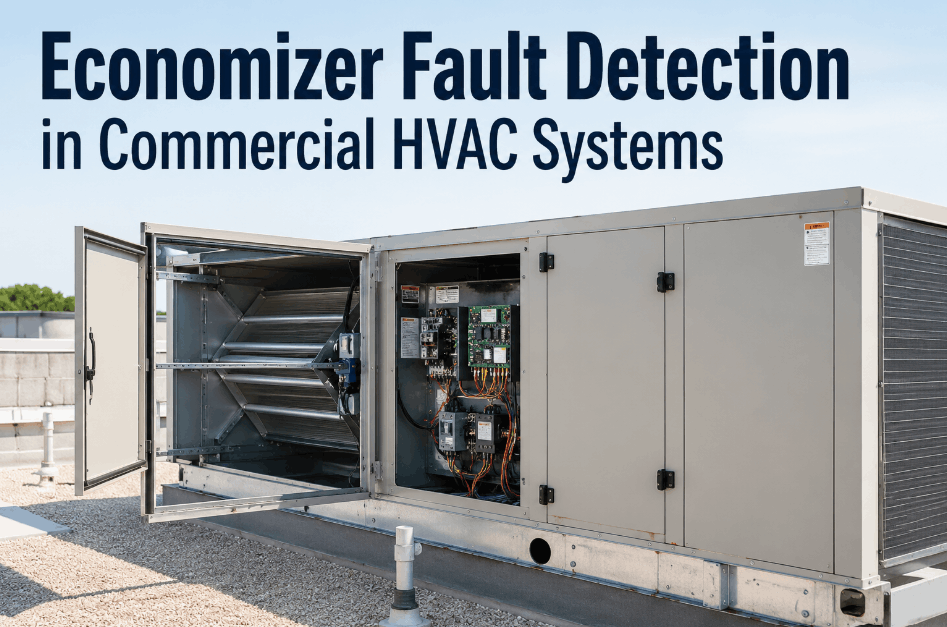
Stuck economizer dampers — whether frozen open or closed — cause significant hidden energy losses. A damper stuck open during mechanical cooling increases compressor load and humidity issues. A damper stuck closed eliminates free cooling during favorable outdoor conditions, adding unnecessary compressor runtime. Analytics comparing damper position commands to actual airflow and temperature outcomes detect both failure modes reliably. Sign Up Free to set up economizer fault detection workflows in OxMaint.
Fan motor current draw trending upward without corresponding load changes indicates bearing wear or winding degradation approaching failure. Vibration signature changes detectable through accelerometer data provide even earlier warning. Predictive maintenance models correlate fan runtime hours, ambient temperature, and current trends to estimate bearing replacement windows — scheduling work during planned maintenance rather than emergency response.
RTU short cycling — compressor starts exceeding four per hour — significantly reduces compressor lifespan through repeated thermal and mechanical stress. Analytics that monitor cycle count per hour against load conditions identify control system failures, oversized unit conditions, and refrigerant pressure anomalies that drive short cycling. OxMaint work order alerts triggered by runtime analysis help maintenance teams resolve root causes before compressor damage accumulates. Book a Demo to configure runtime-based fault triggers for your RTU fleet.
RTU Predictive Maintenance Signal Reference
| Fault Mode | Primary Signal | Secondary Signal | Detection Lead Time | OxMaint Trigger Type |
|---|---|---|---|---|
| Refrigerant Undercharge | Suction pressure drop | Rising superheat | 3–6 weeks | Multi-signal condition |
| Condenser Fouling | Condensing pressure rise | Ambient temp ratio drift | 2–4 weeks | Trend-based PM |
| Evaporator Icing | Suction pressure drop | Reduced airflow | Hours to days | Threshold alarm |
| Economizer Fault | Damper position mismatch | OA temp vs. supply air | Immediate | Logic-based fault |
| Fan Motor Wear | Current draw increase | Vibration signature | 2–8 weeks | Trend deviation |
| Short Cycling | Cycle count per hour | Runtime duration | Immediate | Runtime counter |
How OxMaint Powers RTU Predictive Maintenance
OxMaint connects rooftop unit monitoring data to structured maintenance execution — taking the output of condition monitoring systems and turning it into assigned, tracked, documented work orders without manual dispatcher involvement. When a compressor anomaly signal fires, OxMaint creates a work order, assigns the HVAC technician with the appropriate skills, attaches the refrigerant system diagnostic checklist, verifies parts availability, and records the outcome against the asset history. Facility teams can Sign Up Free and configure their first condition-based RTU trigger within an hour — no IT project required.
Build Your RTU Predictive Maintenance Program Today
OxMaint gives commercial HVAC teams condition-based work order automation, mobile RTU checklists, parts inventory sync, and compliance documentation — deployable across your rooftop unit fleet in hours.
Frequently Asked Questions
What is predictive maintenance for rooftop HVAC units?
RTU predictive maintenance uses real-time monitoring of compressor, fan, airflow, and temperature data to detect fault conditions before failure — converting predictions into scheduled maintenance actions rather than emergency repairs.
Which RTU faults are most detectable through predictive analytics?
Refrigerant undercharge, condenser fouling, economizer faults, fan motor wear, and short cycling are all reliably detectable through sensor-based analytics — often 2–6 weeks before operational failure occurs.
How does OxMaint connect to RTU monitoring data?
OxMaint integrates via API with BMS platforms, IoT gateways, and SCADA systems — mapping RTU data points to asset records and enabling condition-based work order triggers without replacing existing monitoring infrastructure.
Can OxMaint manage EPA refrigerant compliance records for RTUs?
Yes. OxMaint auto-generates refrigerant handling records, leak inspection logs, and service histories per unit — supporting EPA Section 608 compliance documentation requirements automatically.
How quickly can a facility activate RTU predictive maintenance with OxMaint?
Most facilities configure their first RTU assets, condition triggers, and mobile technician workflows within a single day — with no IT resources or implementation consultants required.
Predict RTU Failures Before They Cost You
Join commercial HVAC teams using OxMaint to monitor rooftop units, detect faults early, automate maintenance dispatch, and keep every RTU performing at peak efficiency and reliability.