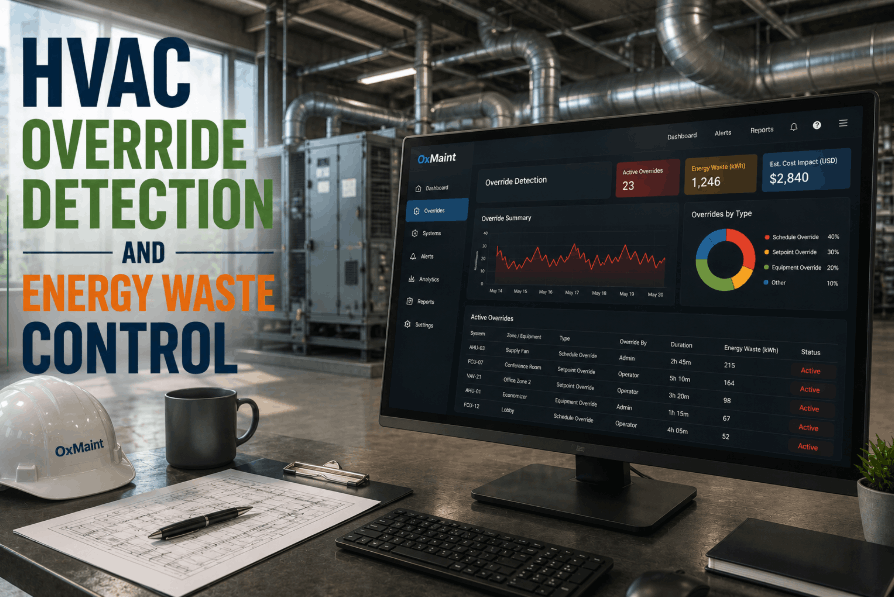
HVAC overrides are the silent budget leak in commercial building operations. A technician sets a manual setpoint during a complaint call, a BMS schedule gets disabled for a weekend event, a control point gets forced to fix a sensor fault — and then stays that way for weeks. Each unresolved override drains energy, skews maintenance data, and masks the root-cause problem that prompted it. Sign Up Free to see how OxMaint tracks active HVAC overrides, links them to open work orders, and flags unresolved overrides that are driving abnormal energy consumption across your facility portfolio. Override detection is not a BMS feature — it is a maintenance operations discipline. Book a Demo to see how OxMaint's energy and ESG reporting module surfaces override-driven waste with the asset-level detail your team needs to act on it.
Detect HVAC Overrides Before They Become Energy Waste
OxMaint tracks every active BMS override, links it to a work order, and flags unresolved overrides that are increasing energy cost — automatically, across every site you manage.
Why HVAC Overrides Persist and Compound Energy Waste
Most commercial buildings have dozens of active BMS overrides at any given time — and no reliable process for tracking which overrides are authorized, which are temporary, and which are simply forgotten. These are the operational conditions that turn a 10-minute control adjustment into a months-long energy drain.
No Override Expiry Enforcement
BMS platforms allow indefinite overrides with no automatic expiry. A temperature override set during a winter event persists through summer without triggering any alert or work order.
Overrides Without Work Orders
Technicians frequently force control points to resolve immediate complaints without creating a corrective work order. The override persists; the root cause stays unaddressed; energy waste compounds daily.
Stuck Schedules After Events
Extended-hours overrides for events, inspections, or tenant requests are routinely not reversed. Facilities with dozens of zones have no visibility into which schedules are still in a temporary state.
Manual Setpoints Masking Faults
When a zone sensor fails, the quickest fix is a manual setpoint override. This keeps occupants comfortable but prevents the fault from surfacing in maintenance reporting — delaying repair and increasing long-term energy waste.
ESG Reporting Gaps
Energy and carbon reporting programs require documented evidence of energy efficiency controls. Facilities with persistent untracked overrides cannot demonstrate effective control compliance during ESG audits or utility benchmarking reviews.
Multi-Technician Override Accumulation
On sites serviced by multiple technicians across shifts, override accumulation accelerates. Each shift inherits the previous one's forced points without context — and adds new ones to compensate.
10 HVAC Override Types That Drive Energy Waste
The override categories below represent the most energy-impactful forced control states found in commercial BMS environments. Each type maps to a detection trigger and an OxMaint work order response. Sign Up Free to configure override detection thresholds for your HVAC assets in OxMaint.
Detection Signal
- Zone setpoint deviating from scheduled value for 24+ hours
- Setpoint manually set outside approved range
- Override active outside occupancy hours
- No associated work order for setpoint change
OxMaint Response
OxMaint flags overrides with no linked work order after a configurable duration threshold. Facilities managers receive a priority-ranked list of orphaned setpoints daily — with duration, zone, and estimated energy impact per override.
Detection Signal
- Occupancy schedule override active beyond planned event end
- Extended hours mode running on non-event days
- HVAC runtime exceeding facility operating hours by 15%+
- Unoccupied setback temperature not engaging at night
OxMaint Response
Schedule overrides active beyond their authorized window are flagged with abnormal runtime hours. OxMaint calculates excess runtime versus baseline and includes this figure in the work order to support energy cost attribution.
Detection Signal
- Damper position output not responding to control signal
- Fixed position persisting across changing load conditions
- Outdoor air damper forced closed — ventilation deficit
- Economizer damper forced open — overcooling in winter
OxMaint Response
Forced damper positions generate compliance-tagged work orders when ventilation minimums are at risk. For energy-impacting stuck positions, OxMaint estimates daily overcooling or overheating cost and includes it in the work order priority score.
Detection Signal
- Chiller or boiler enable forced on during lockout conditions
- Plant operating outside ambient temperature design range
- Lead unit forced on while lag unit remains idle unnecessarily
- Runtime accumulating outside scheduled plant hours
OxMaint Response
Central plant override detection triggers high-priority work orders with runtime data, ambient conditions, and energy consumption trend.
Book a Demo to see how OxMaint routes central plant alerts to senior facilities managers automatically.
Detection Signal
- VFD output fixed at 100% regardless of load conditions
- Static pressure setpoint not influencing fan speed
- Fan kWh trend diverging from seasonal baseline
- Manual speed command active on drive control panel
OxMaint Response
Fixed-speed VFD operation generates a work order with fan kWh deviation versus the 30-day baseline. This allows the energy team to quantify the cost of the override while the controls team addresses the underlying static pressure or drive fault.
Detection Signal
- HWS temperature not tracking outdoor air reset curve
- Fixed high HWS temperature during mild weather conditions
- Boiler firing rate inconsistent with expected load reduction
- Reset setpoint command overridden at BAS controller
OxMaint Response
Hot water reset failures during mild weather are among the most persistent energy wastes in commercial HVAC. OxMaint flags these by comparing actual HWS temperature against the expected reset curve for current outdoor conditions — isolating the deviation daily.
Detection Signal
- Cooling valve output forced open while heating active
- Zone supply air temperature inconsistent with valve position
- Cooling and heating coil valves simultaneously active
- Zone energy consumption spiking without occupancy change
OxMaint Response
Simultaneous heating and cooling is the highest-cost single override type in commercial HVAC. OxMaint generates an immediate high-priority corrective work order with the zone ID, duration, and estimated daily energy waste to drive rapid resolution.
Detection Signal
- Alarm suppression active beyond policy duration limit
- Suppressed alarm point with no associated open work order
- Suppressed alarms on energy or compliance-critical points
- Alarm suppression added by technician with no shift note
OxMaint Response
Every BMS alarm suppression must link to an OxMaint work order to remain authorized. Suppressed alarms without a work order are surfaced daily in OxMaint's override dashboard — giving facilities managers a real-time view of undocumented control exceptions.
Detection Signal
- Zone cooling demand elevated beyond expected occupancy load
- Lighting override causing HVAC to compensate with increased cooling
- HVAC runtime increasing without corresponding occupancy change
- Cross-system control conflict between lighting and HVAC BMS
OxMaint Response
Cross-system override impacts are tracked in OxMaint as multi-asset work events. When lighting overrides drive excess HVAC demand, OxMaint links both asset records in the work order — enabling root-cause attribution across systems rather than treating each system in isolation.
Detection Signal
- Zone setpoint locked at tenant-controlled value outside policy range
- Facility-level schedule command not overriding zone control
- Tenant control system conflicting with BMS setpoint commands
- After-hours HVAC running without an approved override request
OxMaint Response
Unauthorized tenant overrides are flagged in OxMaint with zone ID and control hierarchy level.
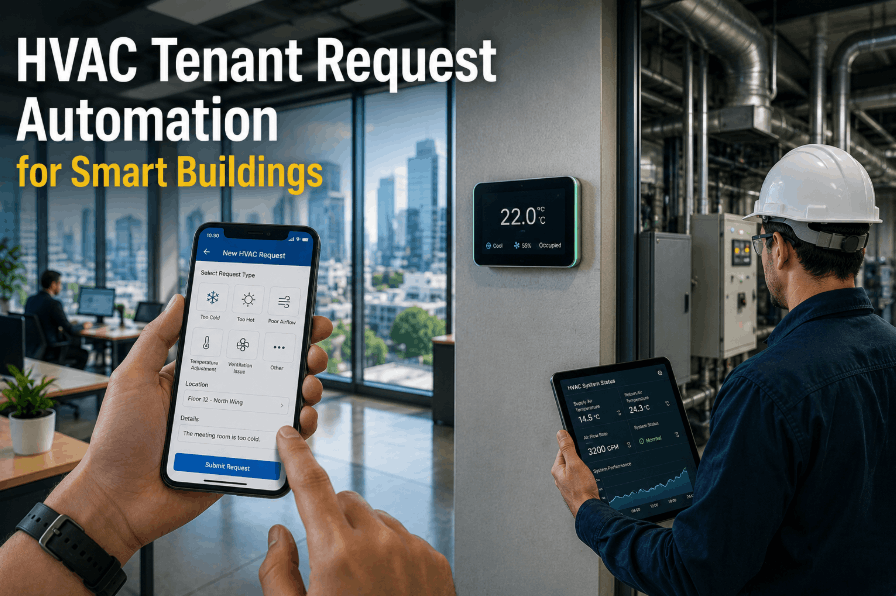
Book a Demo to see how OxMaint's tenant work order portal manages override authorization requests within the CMMS workflow, eliminating undocumented after-hours control access.
Override Detection Impact by Facility Type
Energy waste from undetected overrides varies by building type, occupancy pattern, and HVAC system complexity. The table below maps override risk to facility category and the OxMaint detection feature most relevant to each. Sign Up Free to configure override detection thresholds matched to your facility type in OxMaint.
| Facility Type |
Highest Override Risk |
Typical Energy Impact |
OxMaint Detection Feature |
| Office Buildings |
After-hours occupancy overrides |
8–15% excess HVAC energy |
Schedule Override Tracker |
| Retail / Mixed-Use |
Manual setpoints during events |
10–20% excess cooling cost |
Setpoint Deviation Monitor |
| Healthcare Facilities |
Pressurization override for clinical areas |
Compliance and energy risk |
Compliance-Tagged Work Orders |
| Data Centers / Server Rooms |
Cooling plant forced on outside load range |
15–25% excess chiller cost |
Central Plant Override Detection |
| Education / Campuses |
Summer schedule not reverting post-event |
12–18% seasonal waste |
Abnormal Runtime Alerts |
| Industrial / Manufacturing |
VFD bypassed to fixed speed during maintenance |
20–30% fan energy excess |
VFD Override Monitoring |
How OxMaint Closes the Override Detection Loop
01
Override Inventory Dashboard
OxMaint maintains a live inventory of all active BMS overrides across every site — showing override type, duration, zone, authorizing technician, and linked work order status. No spreadsheet. No manual BMS polling.
02
Mandatory Work Order Linkage
Every BMS override must link to an open OxMaint work order to be classified as authorized. Overrides without a work order are flagged immediately — creating accountability at the point of control change, not during the next audit.
03
Override Duration Alerting
Configurable duration thresholds trigger escalating alerts as overrides persist. A 4-hour temporary override that reaches 48 hours generates an escalation notification to the facilities manager — before it becomes a 2-week energy waste event.
04
Energy Cost Attribution per Override
OxMaint calculates excess energy consumption for each active override by comparing runtime and setpoint data against the approved baseline — giving energy managers a daily cost figure for each unresolved control exception.
05
ESG and Compliance Reporting
OxMaint's energy and ESG reporting module aggregates override data into compliance-ready reports — showing override frequency, duration, resolution rate, and energy impact for LEED, ISO 50001, and utility benchmarking programs.
Book a Demo to configure ESG reporting for your portfolio.
06
Multi-Site Override Visibility
Facilities directors managing multiple properties see override inventory, energy waste, and work order status across all sites in a single OxMaint dashboard — updated in real time as technicians log and resolve control events in the field.
Sign Up Free to activate multi-site visibility for your team.
Turn Override Detection Into Measurable Energy Savings
OxMaint tracks HVAC overrides, quantifies energy waste per control exception, and closes the loop with work order automation — across every building in your portfolio.
HVAC Override Detection — Frequently Asked Questions
What is HVAC override detection in building management systems?
HVAC override detection is the process of identifying control points that have been manually forced to a fixed state — bypassing the BMS's automatic control logic. Detection systems flag overrides by duration, type, and energy impact so facilities teams can resolve them systematically.
How much energy does an undetected HVAC override waste?
The energy impact depends on the override type. Simultaneous heating and cooling overrides or VFD bypasses can waste 15–30% of an asset's normal energy consumption per day. Schedule overrides in unoccupied buildings typically add 8–15% to monthly HVAC operating costs.
Can OxMaint detect BMS overrides automatically?
Yes. OxMaint's BMS integration layer ingests override status data from building automation systems and compares active control states against approved baselines — flagging deviations and generating work orders without requiring manual BMS polling by technicians.
How does OxMaint link HVAC overrides to work orders?
Every override detected in OxMaint generates or links to a corrective work order capturing the control point, duration, technician responsible, and resolution action — creating a closed-loop audit trail that satisfies ESG reporting and commissioning requirements.
What is an abnormal HVAC runtime and how is it detected?
Abnormal runtime occurs when HVAC equipment runs significantly longer than its baseline operating hours without a corresponding change in occupancy or load. OxMaint detects this by comparing daily runtime against a rolling 30-day baseline per asset and flagging deviations above a configurable threshold.
Does OxMaint support HVAC energy waste reporting for ESG programs?
Yes. OxMaint's Energy and ESG Reporting module aggregates override data, abnormal runtime, and energy deviation metrics into compliance-ready reports for LEED, ISO 50001, ENERGY STAR, and corporate sustainability disclosure programs.
How often should facilities teams audit BMS overrides?
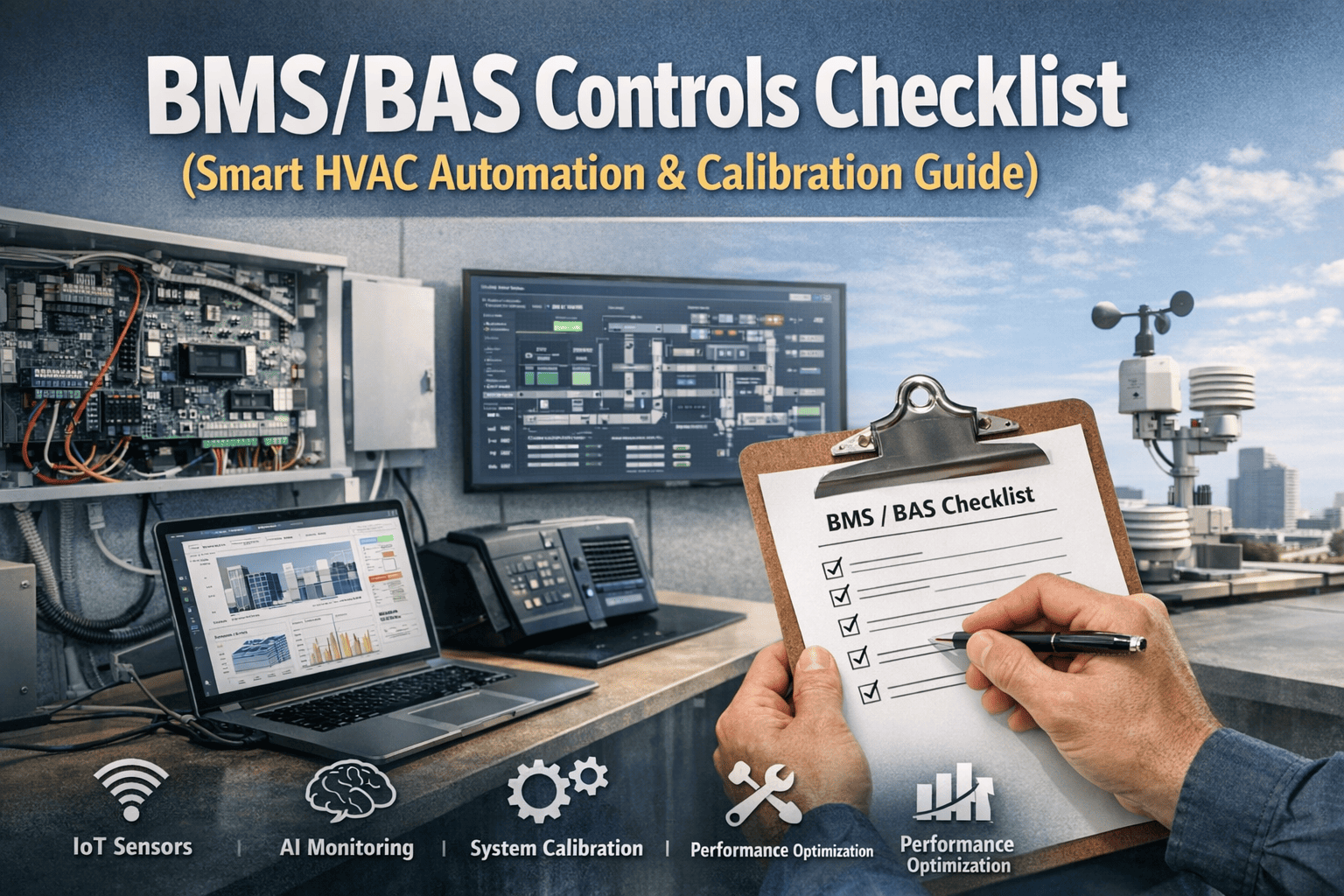
High-complexity commercial facilities should review active override inventories weekly. OxMaint automates this review by surfacing overrides exceeding policy duration thresholds daily — eliminating the need for manual BMS audits and ensuring no override persists unnoticed for more than 24 hours.
Stop Energy Waste From Undetected HVAC Overrides
Override detection. Work order automation. Energy cost attribution. ESG reporting. One platform built for commercial facilities teams who need full control visibility.