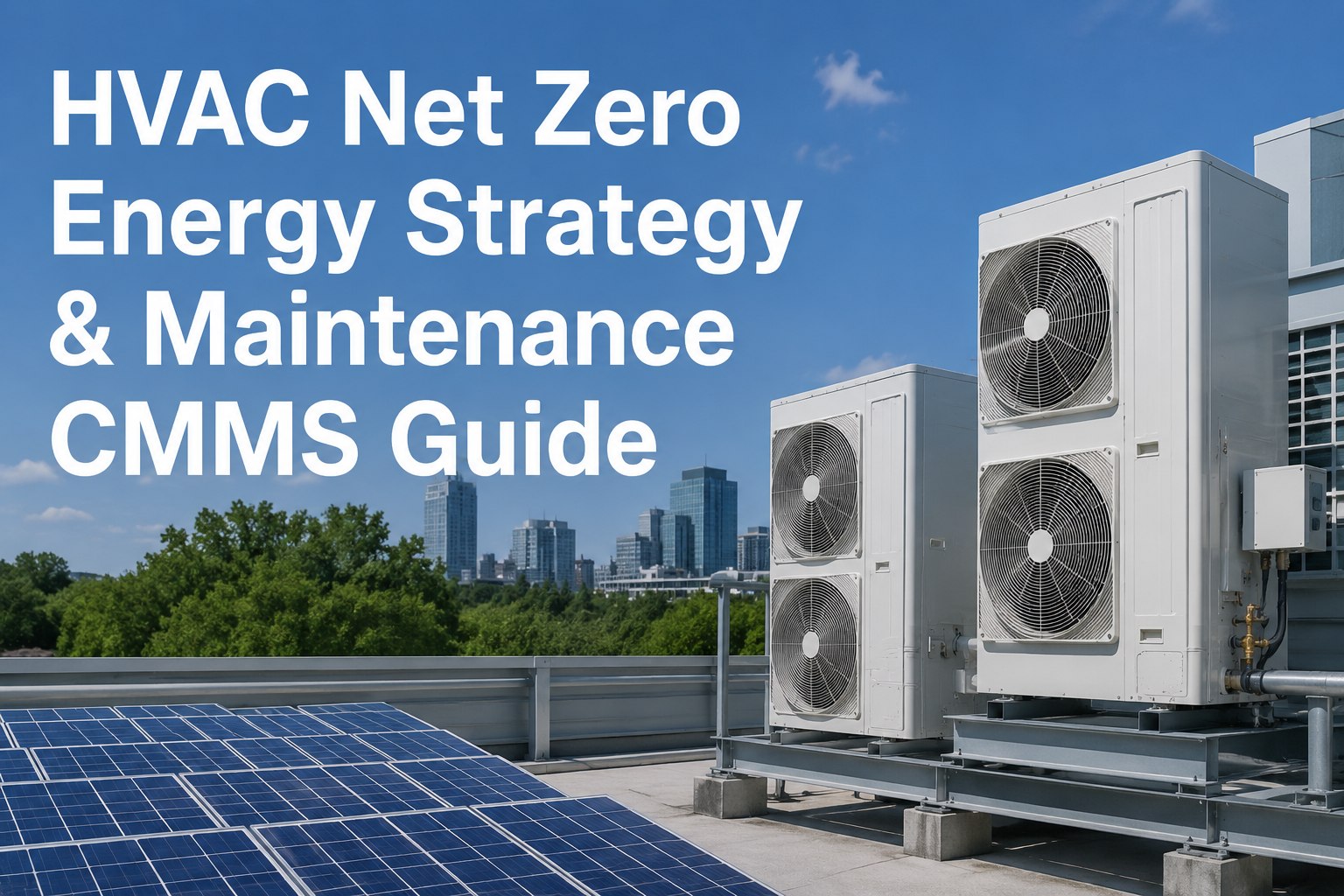
An HVAC net zero energy strategy combines efficiency-first maintenance, electrification, and renewable integration to drive building systems toward carbon-neutral operations — and a CMMS is the engine that keeps that strategy measurable, repeatable, and audit-ready. For maintenance and reliability teams targeting net zero by 2026, the gap between aspiration and execution usually comes down to data: without real-time asset performance tracking, preventive scheduling, and energy-linked work orders, net zero targets drift into wishful thinking. OxMaint gives you the AI-powered CMMS backbone — work orders, predictive maintenance, asset tracking, and analytics — to turn your HVAC sustainability net zero program into provable progress. Start Free Trial and see how fast your team can operationalize net zero.
HVAC Net Zero Energy Guide
Can your HVAC maintenance program actually deliver net zero by 2026?
Forty percent of a commercial building's energy flows through HVAC equipment — and up to 30% of that is wasted on poorly maintained, reactive, or mis-tuned systems. A net zero HVAC strategy without a CMMS to track, schedule, and measure maintenance progress is a pledge, not a plan. OxMaint turns that pledge into a data-driven program.
The Business Case
Why HVAC net zero energy is a maintenance problem first
Net zero isn't achieved by buying solar panels or specifying a high-efficiency chiller — it's achieved by keeping every component in that system performing at design intent across its full lifecycle. A 15% degradation in compressor efficiency, a fouled condenser coil, or a stuck economizer damper can erase the energy savings you budgeted for. The Department of Energy estimates that effective O&M programs can reduce whole-building energy consumption by 5–20% with no capital expenditure — making maintenance the single highest-ROI lever in any net zero energy strategy.
Worked Example
A 220,000 sq ft medical office building running 180 HVAC assets was spending $412K annually on energy, with maintenance fully reactive on spreadsheets. After implementing a CMMS-based net zero HVAC strategy — quarterly coil cleaning, monthly filter changes tied to pressure-drop readings, quarterly belt tension and bearing checks, and sub-metered energy tracking per air handler — the facility cut HVAC energy consumption by 18% in year one, saving $74K and avoiding 312 metric tons of CO₂e. The CMMS paid for itself in under four months.
Four-Pillar Framework
How to build a net zero HVAC strategy with a CMMS
A net zero HVAC program stands on four pillars — each one a maintenance workflow that a CMMS like OxMaint operationalizes, schedules, and tracks. Skipping any pillar leaves a gap that energy dashboards alone cannot close.
Efficiency-First Preventive Maintenance
Schedule coil cleaning, filter replacement, belt inspection, refrigerant charge verification, and damper calibration at frequency intervals tied to runtime hours — not calendar guesses. OxMaint auto-generates PM work orders from asset-meter triggers so efficiency never drifts unchecked.
Predictive Maintenance & Condition Monitoring
Vibration analysis, motor current signature, and IoT sensor data feed OxMaint's AI models to flag bearing wear, refrigerant leaks, and performance decay weeks before failure — keeping equipment at peak efficiency and preventing the energy waste that precedes breakdowns.
HVAC Renewable Integration Coordination
Solar thermal, geothermal heat pumps, and heat-recovery chillers only deliver net zero results when they're sequenced and maintained alongside conventional equipment. OxMaint tracks renewable-asset PM, coordinates switchover logic with work orders, and logs energy production against consumption.
Net Zero Progress Tracking & Carbon Accounting
Every completed work order, every asset's energy consumption, and every avoided kilowatt-hour is logged and reportable. OxMaint analytics dashboards roll maintenance activity into Scope 1 and Scope 2 emission reductions — giving leadership a defensible net zero progress audit trail.
Net Zero Roadmap
HVAC net zero maintenance timeline: from reactive to carbon-neutral by 2026
Reaching net zero is a phased journey. The timeline below maps the maintenance milestones a typical mid-size commercial facility must hit each quarter to be net zero-ready by 2026. OxMaint's CMMS platform is the system of record for each phase — tracking completion, capturing data, and measuring outcomes.
Baseline & Audit
Upload all HVAC assets into OxMaint, capture nameplate data, sub-meter energy on top-consuming equipment (chillers, AHUs, boilers), and establish a kWh-per-ton or kWh-per-cfm baseline. Identify the worst 20% of assets by energy intensity — they typically account for 60% of waste.
PM Optimization
Migrate from calendar-based PMs to runtime-triggered preventive maintenance. Deploy OxMaint's PM templates for coil cleaning, filter changes, belt tension, refrigerant top-off, and controls calibration. Target: 90% PM compliance within 60 days.
Predictive & IoT Integration
Install vibration, temperature, and current sensors on critical rotating equipment. Connect sensor feeds to OxMaint's predictive analytics so AI-generated alerts auto-create work orders before efficiency degrades — cutting unplanned downtime by 30–50%.
Renewable Coordination & Reporting
Integrate solar, heat-recovery, or geothermal assets into the CMMS. Sequence maintenance to align renewable output with HVAC demand profiles. Generate quarterly net zero progress reports with verified kWh saved and CO₂e avoided.
Net Zero Operations
Ongoing: maintain efficiency gains through AI-driven PM, continuous condition monitoring, and renewable integration. OxMaint dashboards prove net zero status to stakeholders, auditors, and regulators — backed by work-order-level evidence.
Efficiency Formula
Measuring HVAC efficiency gains for net zero progress
Net zero progress is only credible when it's quantified. The formula below is the core calculation maintenance teams use to measure the energy impact of their CMMS-driven HVAC program. OxMaint automates this by linking completed PM work orders to pre- and post-maintenance energy meter readings.
Annual Net Energy Savings
E_saved = (kWh_baseline − kWh_post_PM) × operating_hours × $/kWh × asset_count
Where kWh_baseline is the pre-PM energy intensity per asset, kWh_post_PM is the post-maintenance intensity, and operating_hours is the annual runtime. OxMaint's analytics engine calculates this per asset and rolls it up to facility-level net zero progress automatically.
Coil Cleaning
Dirty evaporator and condenser coils can increase HVAC energy consumption by 20–30%. Quarterly CMMS-scheduled coil cleaning is the fastest payback maintenance task in any net zero program.
Filter Replacement
Clogged filters increase fan energy by up to 15% and reduce cooling capacity. OxMaint triggers filter changes on pressure-drop thresholds, not guesswork — saving $0.08–0.12 per sq ft annually.
Controls Calibration
Drifted sensors and setpoints can waste 5–10% of HVAC energy. OxMaint schedules quarterly calibration of thermostats, CO₂ sensors, and economizer controls to lock in efficiency.
Refrigerant Charge
A 10% undercharge in a chiller can cut efficiency by 20%. OxMaint's predictive analytics flag refrigerant loss from performance data, and auto-generate corrective work orders.
Solution Fit
How OxMaint powers your HVAC net zero CMMS strategy
OxMaint is built for the maintenance and reliability teams responsible for hitting net zero targets. Every feature maps directly to a net zero maintenance workflow — from the work order that triggers a coil cleaning to the analytics dashboard that proves the kWh saved to your sustainability director. Here's how OxMaint capabilities map to net zero outcomes:
AI-Powered Predictive Maintenance
OxMaint's AI analyzes vibration, temperature, and motor-current data to predict bearing failures, refrigerant leaks, and efficiency decay 2–6 weeks before they impact energy performance.
Automated PM Work Orders
Runtime-triggered PM templates auto-generate work orders for coil cleaning, filter changes, belt inspections, and calibration — ensuring efficiency-critical tasks are never missed.
Energy-Linked Asset Tracking
Every HVAC asset's maintenance history is linked to its energy meter data, so you can see exactly which interventions moved the kWh needle — and which assets are net zero laggards.
Renewable Asset Integration
Track PM for solar thermal, heat pumps, and heat-recovery systems alongside conventional HVAC in a single CMMS — coordinating maintenance windows to maximize renewable utilization.
See OxMaint on your HVAC assets — book a 30-min demo
Walk through a live net zero HVAC maintenance workflow: PM scheduling, predictive alerts, energy-linked work orders, and carbon progress dashboards. See how fast your team can move from reactive to net zero-ready.
FAQ
HVAC net zero energy & CMMS — frequently asked questions
What is an HVAC net zero energy strategy?
An HVAC net zero energy strategy is a systematic plan to reduce heating, ventilation, and air conditioning energy consumption to the point where annual HVAC energy use is offset by on-site renewable generation or equivalent offsets. It combines efficiency-first maintenance, equipment electrification, smart controls, renewable integration, and continuous performance monitoring — typically orchestrated through a CMMS that schedules, tracks, and measures every maintenance intervention. Without a CMMS, the strategy lacks the data discipline to prove progress.
How does a CMMS support net zero HVAC maintenance?
A CMMS like OxMaint supports net zero by automating preventive maintenance schedules, tracking asset-level energy consumption, triggering corrective work orders from predictive analytics, and generating audit-ready reports on kWh saved and CO₂e avoided. It ensures that efficiency-critical tasks — coil cleaning, filter changes, controls calibration — are completed on time, every time, which is the foundation of any net zero maintenance program. Start Free Trial to operationalize your net zero plan today.
How much energy can HVAC maintenance save toward net zero?
According to DOE and ASHRAE benchmarks, a well-executed HVAC O&M program can reduce whole-building energy consumption by 5–20% with no capital investment. For a 200,000 sq ft facility spending $400K annually on energy, that's $20K–$80K in savings per year — plus 80–320 metric tons of CO₂e avoided. The largest gains come from quarterly coil cleaning (20–30% HVAC energy recovery), pressure-drop-triggered filter changes (up to 15% fan energy), and controls calibration (5–10% system energy).
What HVAC maintenance tasks are most critical for net zero?
The highest-impact net zero HVAC maintenance tasks are: evaporator and condenser coil cleaning (recovers 20–30% lost efficiency), air filter replacement on pressure-drop triggers (saves 10–15% fan energy), economizer damper and controls calibration (prevents 5–10% energy waste), refrigerant charge verification (a 10% undercharge cuts efficiency 20%), and belt tension alignment on belt-driven fans (reduces motor load 3–8%). A CMMS schedules and tracks all of these automatically.
Can OxMaint track net zero progress for HVAC systems?
Yes. OxMaint links every completed maintenance work order to the asset's energy meter data, calculates pre- and post-PM energy consumption, and rolls the savings up to facility-level net zero progress dashboards. You can report kWh saved, CO₂e avoided, and cost reductions by asset, building, or portfolio — giving sustainability teams and auditors a defensible, work-order-level evidence trail. Book a Demo to see the dashboards live.
Start your HVAC net zero program in days — not quarters
Upload assets, deploy PM templates, connect energy meters, and generate your first net zero progress report within the first week. OxMaint makes the switch from spreadsheets and reactive maintenance fast, guided, and measurable.
Free 14-day trial · No credit card