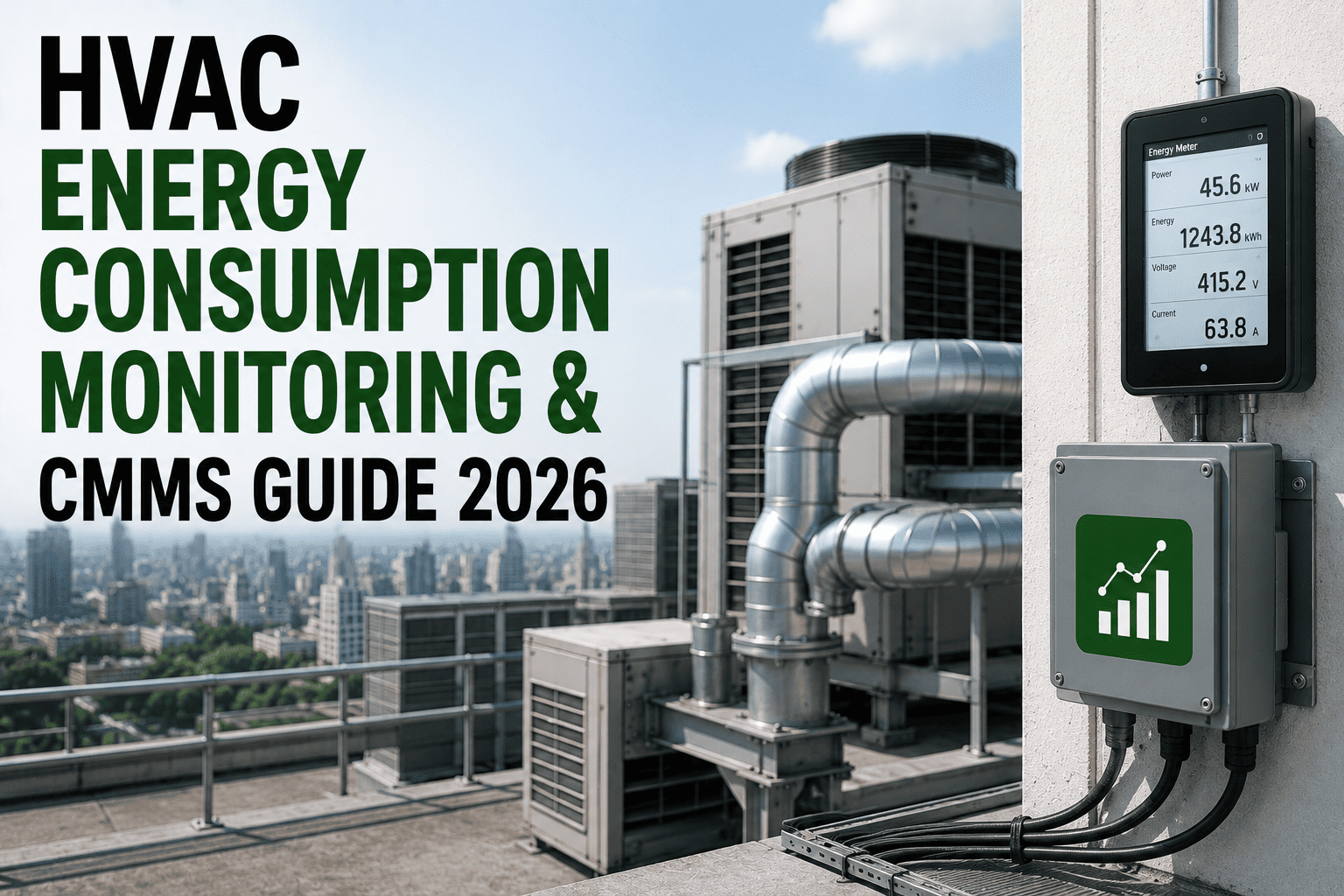
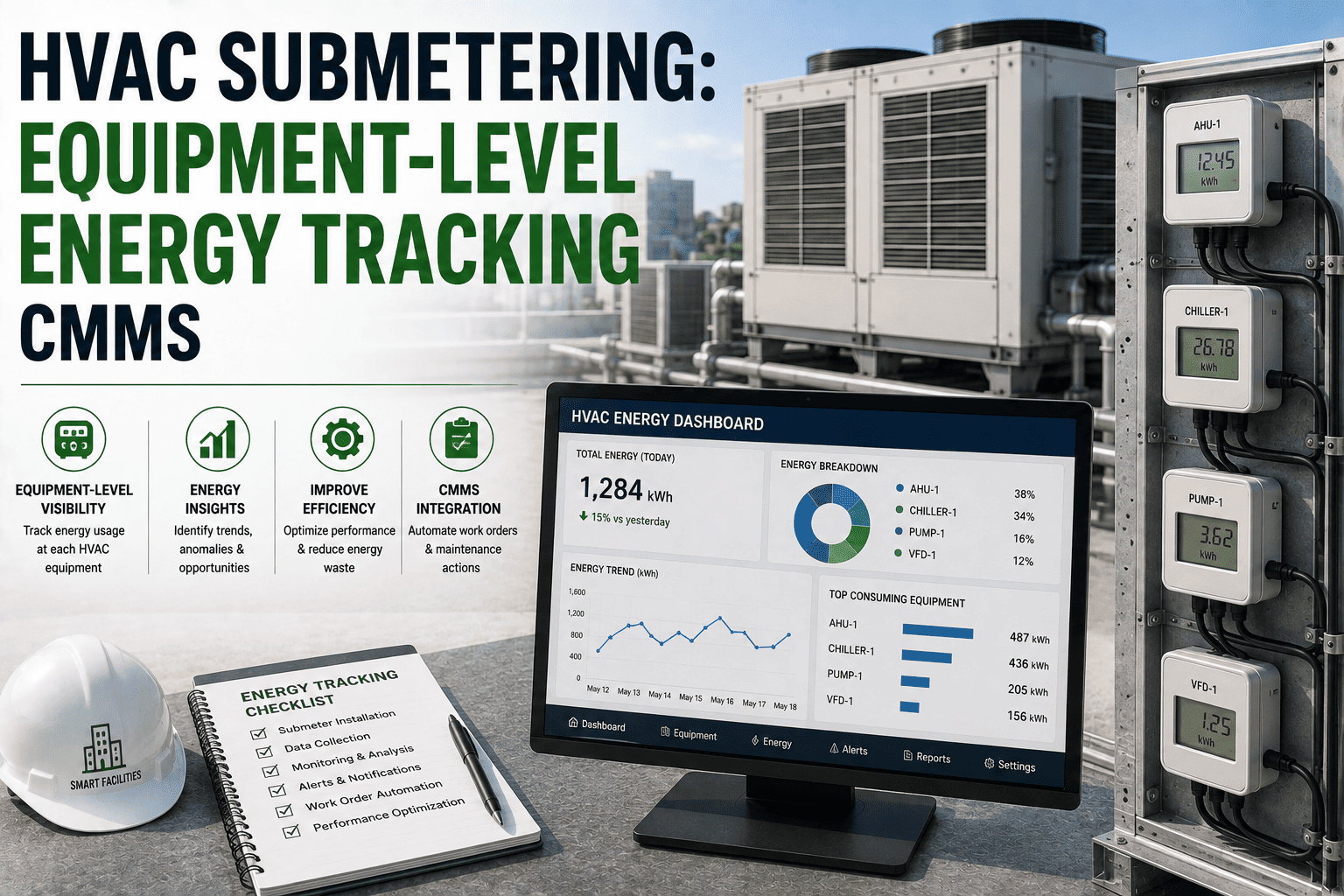
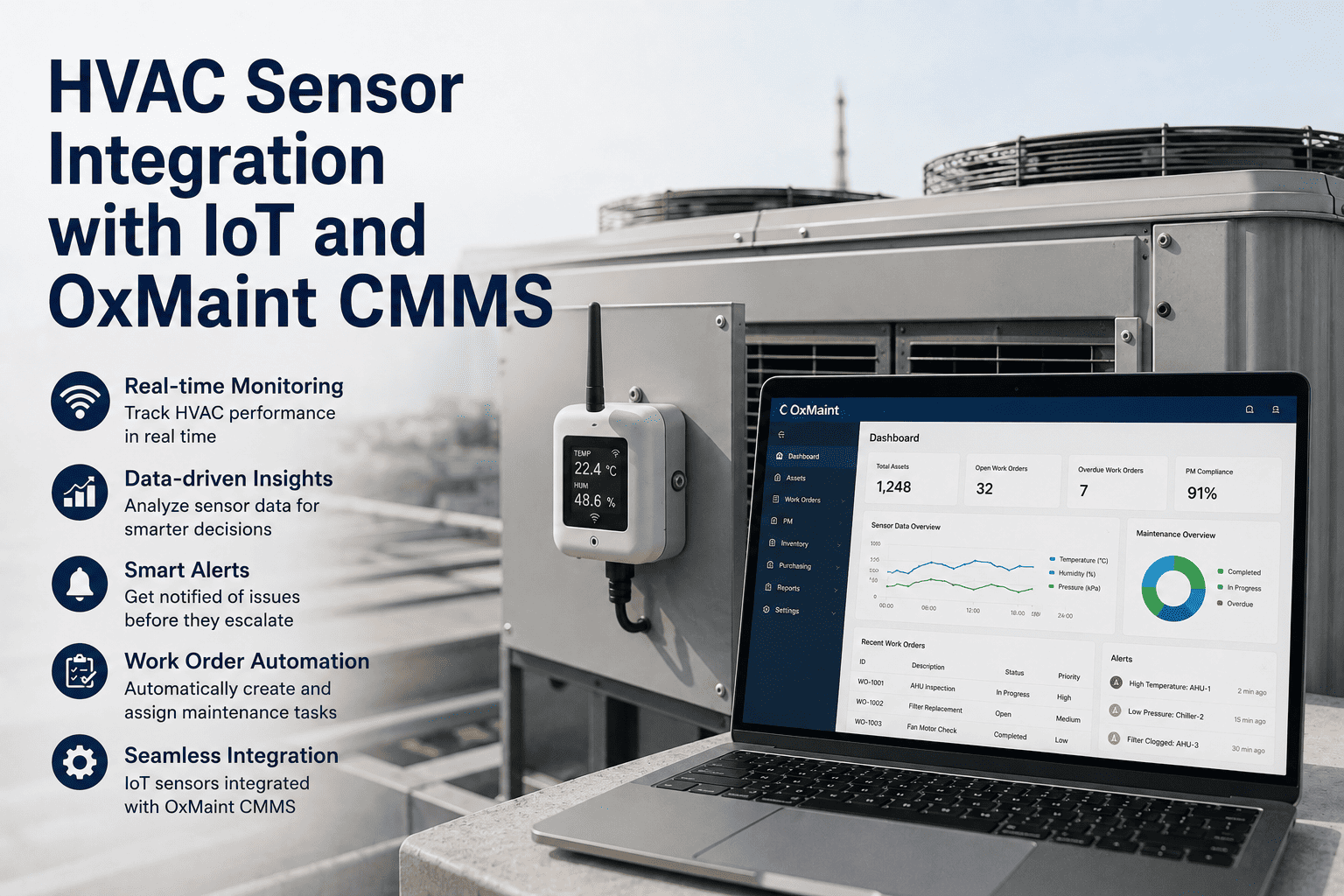
Every HVAC maintenance action changes an energy reading — a cleaned condenser coil runs at lower kW/ton, a replaced belt reduces fan amp draw, a refrigerant top-up restores evaporator efficiency. The problem in most facilities is that the maintenance system and the energy monitoring system are completely separate: the work order closes in the CMMS, the meter keeps recording, and no one ever correlates the two. The result is that maintenance investment is invisible — CFOs see energy bills but cannot see which PM events moved the needle, and maintenance managers cannot prove the financial return of their programme. OxMaint's energy meter integration connects HVAC energy meters directly to the CMMS — linking every kWh reading to the asset it belongs to, every meter deviation to the work order that explains it, and every PM event to the energy saving it delivered.
Article · Energy Integration · ESG Reporting
HVAC Energy Meter Integration with CMMS
Meter-to-Maintenance Correlation · PM Energy ROI · Smart Meter API · ESG Reporting · Asset-Level kWh Tracking
Energy Meter Dashboard · Chiller Plant
Chiller-1
0.58 kW/ton
Baseline
Chiller-2
0.74 kW/ton
+28% · WO Raised
AHU-05 Fan
14.2 kW
Normal
CHW Pump-1
22.8 kW
+15% Baseline
Last PM Event Impact
Chiller-1 condenser clean · -$1,840/month energy saving confirmed
23%
Average HVAC energy waste from degraded assets running undetected between scheduled PMs
$0
Proven PM energy ROI without meter-maintenance correlation — energy impact remains invisible
48 hrs
Time for energy deviation to appear in OxMaint dashboard after a meter threshold is breached
1 API
Single integration point connects smart meters, BMS energy data, and CMMS asset records in OxMaint
How OxMaint Connects Energy Meters to Maintenance Records
01
Meter Linked to Asset
Each energy meter or sub-meter is mapped to a specific HVAC asset in OxMaint — Chiller-2 power meter → Chiller-2 asset record. Every reading belongs to an asset, not just a circuit.
→
02
Baseline Established
OxMaint calculates a rolling 30-day energy baseline per asset post-commissioning or post-PM. Deviations above the configured threshold percentage automatically trigger an alert.
→
03
Deviation Raises Work Order
When Chiller-2 kW/ton rises 20% above baseline, OxMaint auto-creates a maintenance work order — "Investigate Chiller-2 energy deviation — condenser fouling suspected" — assigned and prioritised immediately.
→
04
PM Completed — Saving Quantified
After condenser clean, OxMaint records the kW/ton return to baseline and calculates the monthly energy saving against the PM cost — giving the maintenance manager a documented financial outcome for every PM event.
Energy Meter Integration Methods — What OxMaint Supports
01
Smart Meter API Integration
OxMaint connects to smart sub-meter platforms via REST API — receiving interval energy data (15-min or hourly) directly from meters installed on chiller circuits, AHU panels, pump DBs, and HVAC main incomer panels. Compatible with Schneider Electric PowerTag, Siemens SENTRON, ABB EnergyMeter, and most Modbus-enabled smart meters.
02
BMS / SCADA Energy Pull
For buildings with existing BMS energy monitoring, OxMaint pulls kWh, kW demand, and power factor data via BACnet/IP or OPC-UA — eliminating the need for new metering hardware where energy points are already configured in the building management system.
03
Manual Meter Reading Entry
For assets without smart metering, technicians log manual meter readings during PM visits using the OxMaint mobile app. Readings are timestamped, linked to the asset and work order, and plotted in the same energy trend dashboard as automated meter data — providing a consistent view regardless of metering technology.
04
Utility Bill Import
For portfolio-level benchmarking, OxMaint imports utility bill data by CSV or direct API integration with energy suppliers — allowing site-level energy performance to be compared against asset-level sub-meter data to identify unmeasured consumption and distribution losses between the main meter and the HVAC sub-meters.
Energy Deviation Events — Real Maintenance Correlations
| Asset |
Energy Deviation Detected |
Root Cause (Found at PM) |
PM Action |
Energy Saving Confirmed |
| 500-ton Chiller |
+22% kW/ton vs baseline |
Condenser coil 40% fouled — scale deposit |
Full chemical condenser clean |
$2,100/month · 3-week ROI |
| AHU-08 Supply Fan |
+18% fan kW vs 30-day avg |
Filter 85% blocked — bypass damper starting to open |
Filter replacement + damper reset |
$340/month · Immediate |
| CHW Pump-3 |
+31% pump kW vs design |
Impeller wear — pump running off curve |
Impeller replacement + balancing |
$890/month · 6-week ROI |
| Cooling Tower Fan |
+14% fan kW — increasing |
Drive belt worn — 12% slip detected at load |
Belt replacement + tension set |
$180/month · Immediate |
| VRF Outdoor Unit Bank |
+26% EER degradation |
Condenser fin fouling — 60% blocked |
Fin clean + refrigerant check |
$1,240/month · 2-week ROI |
Connect Your Energy Meters to OxMaint — And Finally See the ROI of Every PM.
OxMaint links your HVAC energy meters to your maintenance records — so every kWh deviation triggers a work order, every PM event has a confirmed energy saving, and your maintenance budget justifies itself with real data.
ESG and Sustainability Reporting — What OxMaint Generates
Scope 2 Carbon from HVAC
OxMaint applies grid emission factors to HVAC energy meter data — generating Scope 2 CO₂e per asset, per building, and per portfolio for GHG Protocol, TCFD, or GRESB disclosure.
HVAC Energy Intensity Report
Energy use intensity by kWh/m² per building, normalised for occupancy and degree days — formatted for ENERGY STAR, NABERS, or internal sustainability reporting submission.
Maintenance-to-Carbon Linkage
Each PM work order is linked to its energy and carbon impact — allowing the sustainability team to quantify carbon savings from maintenance investment and report them as verified emission reductions.
Year-on-Year Energy Trend
Annual HVAC energy trend by asset and building — showing the cumulative impact of the maintenance programme on energy consumption over time, suitable for board reporting and investor disclosure.
"
The integration of energy metering data with CMMS records is one of the most underutilised opportunities in commercial building management. Most facilities have sub-metering that captures HVAC energy at circuit level, and most have a work order system that records PM completions — but the two datasets sit in completely different platforms with no connection between them. The consequence is that you have an energy manager who sees consumption trends without understanding the maintenance context, and a maintenance manager who cannot prove energy impact. OxMaint closes that loop in a way I have not seen in most competing CMMS platforms. When the maintenance team can show the CFO that the quarterly condenser cleaning programme delivered $28,000 in confirmed energy savings last year at a cost of $4,200 in labour and materials, the budget conversation changes completely. That is the data-driven maintenance case that energy and ESG reporting requirements are increasingly demanding — and OxMaint is structured to provide it.
Dr. Claire Forsythe, CEng MCIBSE, MRICS
Director of Engineering and Sustainability · Pan-European Real Estate Asset Manager · 26 Years Building Energy Management, CMMS Integration, and ESG Reporting · Chartered Engineer (CIBSE) · Member of the Royal Institution of Chartered Surveyors · Specialist in HVAC energy sub-metering, BMS-CMMS integration, Scope 2 carbon reporting, and maintenance-linked ESG performance measurement for institutional property portfolios
Frequently Asked Questions
What smart meter and BMS platforms does OxMaint integrate with for HVAC energy data?
OxMaint's energy integration layer supports Modbus TCP/RTU, BACnet/IP, OPC-UA, and REST API connections to a wide range of metering and BMS platforms. Validated integrations include Schneider Electric EcoStruxure, Siemens Desigo CC, Honeywell Enterprise Buildings Integrator, Johnson Controls Metasys, and standalone smart meter platforms including Panoramic Power, GridPoint, and Wattics. For buildings using pulse-output meters without communication protocols, OxMaint supports manual meter reading entry via the mobile app as a bridge to full integration. Integration setup typically takes two to four hours for a standard commercial building with existing BMS infrastructure, and OxMaint's integration team provides setup support included with the enterprise subscription.
Start a free trial to assess integration options for your building's metering setup.
How does OxMaint calculate the energy saving from a specific PM work order?
OxMaint uses a before/after energy comparison methodology anchored to PM event timestamps. For each asset with an energy meter, the platform calculates average daily energy consumption for the 30 days prior to the PM work order completion date and compares it with the 30-day post-PM average — controlling for occupancy and weather data where available. The difference in daily consumption, multiplied by the local utility rate, produces a monthly energy saving figure that is attached to the completed work order and reported in the maintenance ROI dashboard. For seasonal assets like chillers, OxMaint applies degree-day normalisation to ensure the before/after comparison reflects actual equipment performance change rather than weather variation.
Book a demo to see OxMaint's PM energy ROI calculation methodology in action.
Can OxMaint energy reports be used directly for ESG or sustainability disclosures?
Yes — OxMaint's energy reporting module generates structured exports suitable for a range of sustainability disclosure frameworks including GHG Protocol (Scope 2), ENERGY STAR Portfolio Manager, NABERS, GRESB, TCFD, and EPC evidence requirements. Reports include HVAC energy by asset, by building, and by portfolio with year-on-year comparison, intensity metrics (kWh/m², kWh/occupant), and Scope 2 CO₂e calculations using national or regional grid emission factors. Maintenance event linkage is included in the report footnotes, enabling auditors to verify the causal relationship between PM activities and energy performance changes. Reports can be scheduled for automatic monthly or quarterly generation and exported in PDF or CSV format.
Explore OxMaint's ESG energy reporting with a free trial.
OxMaint · HVAC Energy Meter Integration
Every Meter Reading Linked to an Asset. Every PM Event Linked to an Energy Saving.
OxMaint connects your HVAC energy meters to your maintenance system — so deviations become work orders, PM events become proven savings, and your sustainability reporting is backed by real asset-level data.