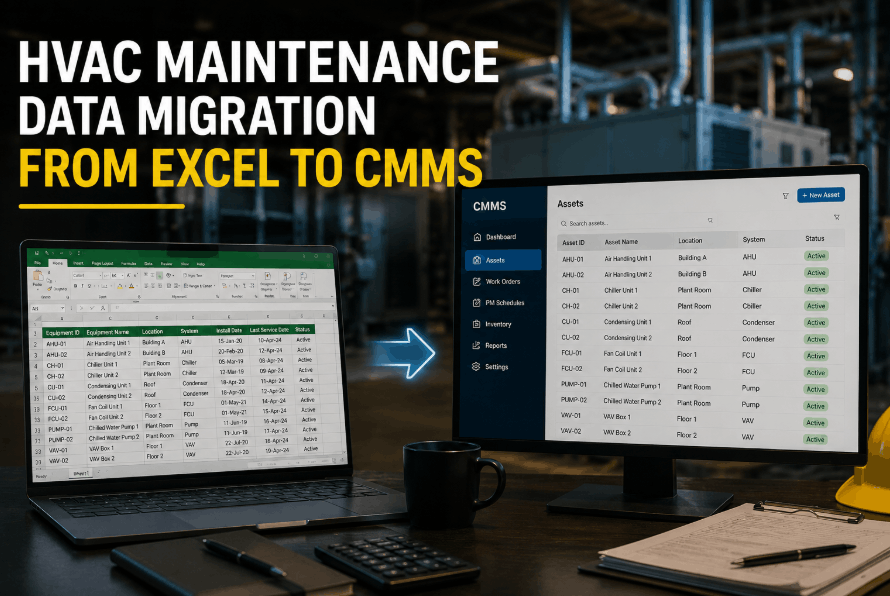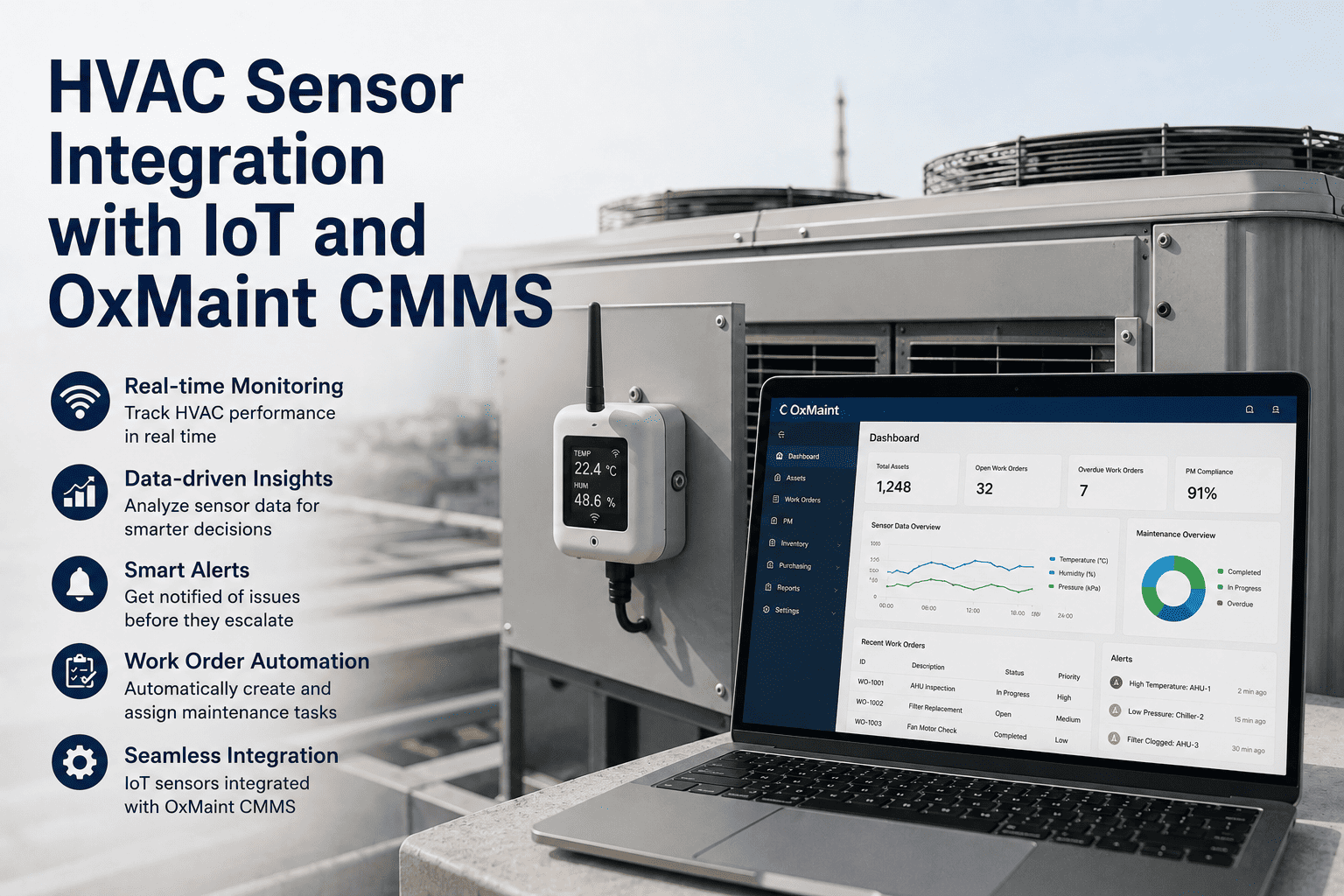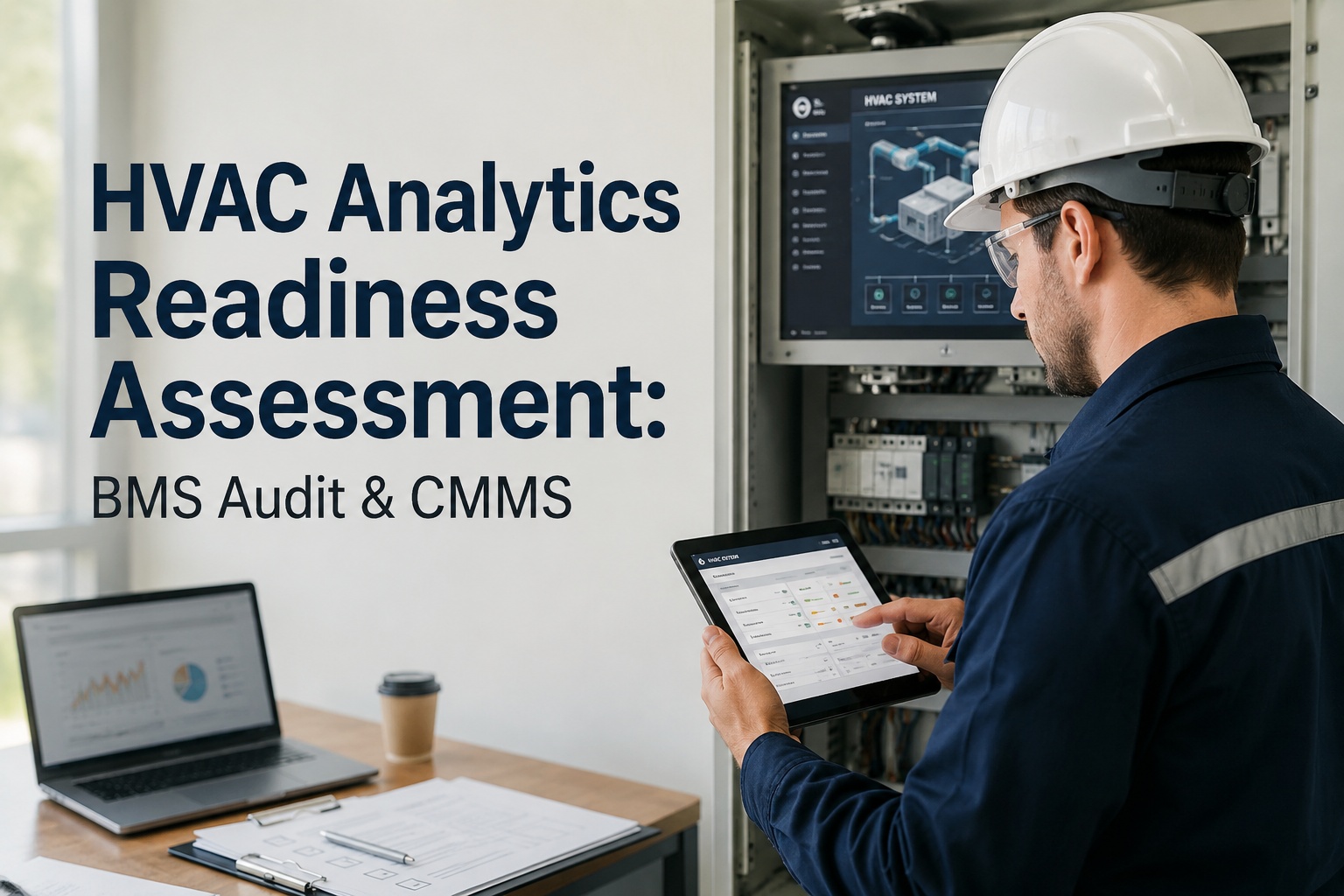
An HVAC analytics readiness assessment tells you whether your building automation, sensor network and maintenance platform can actually support predictive maintenance — before you invest in analytics tooling. Most teams discover too late that their BMS points audit reveals 30–50% of critical assets lack metering, that data accessibility is blocked by vendor silos, or that their CMMS has no structured asset hierarchy to receive alerts. This guide walks through a proven four-phase HVAC readiness assessment — BMS coverage, sensor verification, data accessibility and CMMS readiness — so you can close gaps fast and deploy analytics with confidence. Ready to skip the spreadsheet phase? You can Start Free Trial of OxMaint and build your asset hierarchy today.
HVAC READINESS ASSESSMENT GUIDE
Is your building actually ready for HVAC analytics — or are you flying blind?
Over 60% of HVAC analytics projects stall in the first 90 days because teams skip the readiness audit. A structured BMS points audit, sensor coverage check and CMMS alignment can cut deployment time by 40% and unlock ROI within the first quarter.
PHASE 1 — BMS POINTS AUDIT
How to conduct a BMS points audit for HVAC analytics readiness
Your Building Management System is the backbone of HVAC analytics readiness — but a typical controller exposes 200–600 points, and only 40–55% are mapped, named and trended correctly.
- Export all BMS points per controller and identify orphaned or duplicate tags
- Validate naming convention consistency (ASHRAE BACnet object naming or custom schema)
- Flag points with no trending enabled or short retention windows
- Cross-reference BMS points against your HVAC asset register (AHUs, chillers, RTUs, pumps)
- Confirm each critical asset has supply/return temp, fan status, fault and runtime points
- Identify assets with fewer than 6 monitored points — a gap threshold for analytics
- Verify trend log intervals meet analytics needs (≤15-min resolution for fault detection)
- Confirm minimum 12 months of historical data is stored and retrievable
- Check for data gaps, flatlining sensors and timezone misalignment
A 180-asset commercial facility discovered during its BMS audit that 42% of AHU discharge-air-temperature sensors were flatlined for 6+ months — rendering any analytics model useless until the sensors were replaced and re-trended.
PHASE 2 — SENSOR COVERAGE
HVAC sensor audit: verifying coverage for analytics deployment
Even a well-structured BMS can't feed analytics if physical sensors are missing. A complete HVAC sensor audit checks coverage across six measurement domains critical to fault detection and diagnostics (FDD).
| Sensor Domain | Required for | Min. Points per Critical AHU | Common Gap Rate |
|---|---|---|---|
| Temperature (DAT, RAT, mixed air) | FDD Rule Sets 1–10 (ASHRAE RP-1455) | 4–6 | 22% |
| Pressure (duct static, filter DP) | Fan-fault detection, filter clogging | 2–3 | 35% |
| Airflow (CFM or damper position) | VAV optimization, ventilation compliance | 2 | 48% |
| Power (kW, fan VFD output) | Energy analytics, degredation modeling | 1–2 | 31% |
| Humidity (return / outdoor air) | Enthalpy economizer control | 2 | 27% |
| CO2 / IAQ (zone-level) | Demand-controlled ventilation analytics | 1 per zone | 55% |
Common gap rate = percentage of audited facilities missing one or more sensors in this domain on critical assets. Based on field data across mid-to-large commercial buildings.
PHASE 3 — DATA ACCESSIBILITY
Data accessibility check: can your analytics platform actually reach the data?
Accessible data is the bridge between sensors and analytics. If your BMS data lives behind a proprietary gateway, requires manual exports, or lacks an open API, your HVAC analytics deployment will stall regardless of sensor coverage.
READINESS SCORE FORMULA
Accessibility Score = (Points via API / Total Points) × (Trend Resolution Factor) × (Uptime %) × 100
A score below 70 means your analytics platform will receive incomplete or unreliable inputs. Target ≥ 85 before deployment.
Open Protocol Availability (BACnet/IP, Modbus TCP, OPC-UA)
Confirm your BMS exposes data via at least one open protocol. Proprietary or serial-only systems require a protocol gateway ($2K–$8K per building) before analytics can connect.
REST API or MQTT Streaming Enabled
Modern analytics platforms and CMMS integrations pull data via REST or MQTT push. Verify your BMS supports one — and that write-back capability exists if you plan automated control actions.
Data Latency Under 5 Minutes to Cloud
FDD and predictive models degrade when latency exceeds 5–10 minutes. Test end-to-end latency from sensor to cloud dashboard; on-prem buffering should handle connectivity gaps of at least 72 hours.
Cybersecurity & Network Segmentation
OT/IT segmentation, TLS encryption in transit and role-based access control are non-negotiable. Analytics readiness includes confirming your network architecture won't require a costly re-design mid-deployment.
PHASE 4 — CMMS READINESS
CMMS readiness assessment: connecting analytics to maintenance action
Analytics without action is just dashboards. Your CMMS must be structured to receive automated fault alerts, trigger work orders and track resolution — yet 70% of maintenance teams still rely on spreadsheets or paper, making analytics-to-action impossible.
Asset Hierarchy Completeness
A CMMS-ready hierarchy maps every BMS-monitored asset to a parent system, location and criticality rating. Without this, analytics alerts can't auto-route to the right technician or spare-part bin.
Automated Work Order Generation
The CMMS must accept inbound API alerts and auto-create work orders with priority, asset ID, fault code and recommended action — closing the loop between detection and resolution.
PM Schedule Alignment
Preventive maintenance schedules in the CMMS should align with analytics-driven intervals. If PMs are calendar-only and ignore runtime or condition data, you're either over-maintaining or missing early failures.
Historical Failure Data
At least 18–24 months of structured work-order history (failure codes, MTTR, MTBF) is needed to train predictive models. Messy or incomplete failure coding blocks model accuracy.
See how OxMaint maps analytics alerts to work orders — in 30 minutes
Book a personalized demo and we'll run a live readiness check on your asset hierarchy, PM schedules and integration points.
HOW OXMAINT HELPS
How OxMaint accelerates your HVAC analytics readiness
OxMaint is an AI-powered CMMS and EAM platform purpose-built to close the gap between HVAC analytics and maintenance execution — turning readiness gaps into a structured, measurable action plan.
AI-Driven Asset Hierarchy Builder
Import your existing BMS point list or spreadsheet and OxMaint auto-generates a normalized asset hierarchy — mapping every monitored point to an asset, location and criticality tier in under an hour.
Outcome: Eliminate 80% of manual hierarchy setup time and ensure every analytics alert routes to the correct asset record.
Automated Fault-to-Work-Order Pipeline
OxMaint's open API ingests BMS and FDD alerts in real time, auto-creates prioritized work orders with fault codes and recommended actions, and assigns them to the right technician based on skills and availability.
Outcome: Cut fault-to-resolution time by 30–50% and eliminate the manual alert triage that stalls most analytics deployments.
Predictive Maintenance Analytics
OxMaint's AI models analyze runtime, vibration and temperature trends from your BMS to predict HVAC failures 7–21 days in advance — shifting teams from reactive firefighting to condition-based intervention.
Outcome: Reduce unplanned HVAC downtime by 25–40% and extend asset life by 15–20% through early intervention.
Readiness Dashboard & Gap Reporter
A built-in readiness dashboard scores your BMS coverage, sensor completeness, data accessibility and CMMS alignment — generating a prioritized gap-closure report your team can execute against immediately.
Outcome: Shorten analytics deployment cycles from 6–9 months to 8–12 weeks with a clear, tracked action plan.
"We ran the OxMaint readiness assessment on a 320-unit portfolio and found 1,140 unmonitored HVAC assets in week one. Within 90 days we closed the sensor gaps, connected the BMS via API, and cut emergency work orders by 37%."
FAQ
HVAC analytics readiness — your top questions answered
What is an HVAC analytics readiness assessment?
An HVAC analytics readiness assessment is a structured audit of your BMS point coverage, sensor completeness, data accessibility and CMMS alignment to determine whether your facility can support predictive maintenance and fault detection analytics. It typically takes 2–4 weeks for a mid-sized building and produces a gap-closure roadmap. You can run the CMMS portion immediately inside OxMaint — Start Free Trial and use the built-in readiness dashboard.
How long does a BMS points audit take for a typical commercial building?
For a building with 50–100 HVAC assets and a single BMS, a full points audit takes 3–5 days: 1 day to export and normalize point lists, 1–2 days for critical-asset cross-referencing, and 1–2 days for trend verification. Larger campuses with multiple BMS vendors may require 2–3 weeks. The audit is the highest-ROI step — it uncovers the silent gaps that cause analytics models to fail silently.
What BMS point coverage percentage is needed before deploying HVAC analytics?
A minimum of 85% point coverage on critical HVAC assets (AHUs, chillers, boilers, large RTUs) is the industry threshold for reliable analytics. Below 85%, FDD rule sets generate false negatives and predictive models lack enough signal to train effectively. Aim for 95%+ on temperature, pressure and fan-status points — these drive 80% of common HVAC fault detections.
Can a CMMS improve HVAC analytics deployment without adding new sensors?
Yes — a well-structured CMMS like OxMaint adds immediate value even before sensor upgrades by structuring your asset hierarchy, digitizing work orders, and capturing failure-code history. This creates the data backbone analytics needs: once sensors are added, the CMMS already knows where each asset lives, who maintains it and what failure modes to expect. Book a demo to see this workflow live.
How much does HVAC analytics readiness cost and what is the typical ROI?
A readiness assessment for a single building costs $8K–$25K depending on complexity, while a campus-scale audit runs $40K–$120K. The ROI is typically realized within 6–12 months: facilities that complete a structured readiness audit before deployment report 20–35% lower energy costs, 30–50% fewer emergency work orders and 15–20% extended asset life — versus teams that deploy analytics without auditing first.
Ready to make your HVAC data actionable?
Join hundreds of maintenance teams using OxMaint to turn BMS data into automated work orders, predictive alerts and measurable downtime reduction.
Free 14-day trial · No credit card required