Free cooling HVAC systems using waterside economizer operation can cut chiller energy consumption by 50–75% when outdoor conditions fall below the switchover threshold—yet most plants capture only a fraction of those savings because bypass valves stick, heat exchangers foul, and technicians miss the narrow operating window. A free cooling optimization strategy backed by a modern CMMS tracks real-time wet-bulb temperature, automates economizer bypass operation, and schedules heat-exchanger cleaning before efficiency drops. This guide covers threshold logic, maintenance triggers, and how teams are using OxMaint to reclaim thousands in avoided ton-hours—start your Start Free Trial to see it on your assets today.
Are you losing 60% of your free cooling hours to fouled heat exchangers and stuck bypass valves?
Most facilities capture fewer than 40% of available waterside economizer hours. OxMaint's AI-powered CMMS tracks switchover thresholds, automates plate-frame cleaning, and logs every economizer bypass operation—so your cooling plant runs on nature, not compressors, whenever the air allows it.
What is free cooling and when does the waterside economizer activate?
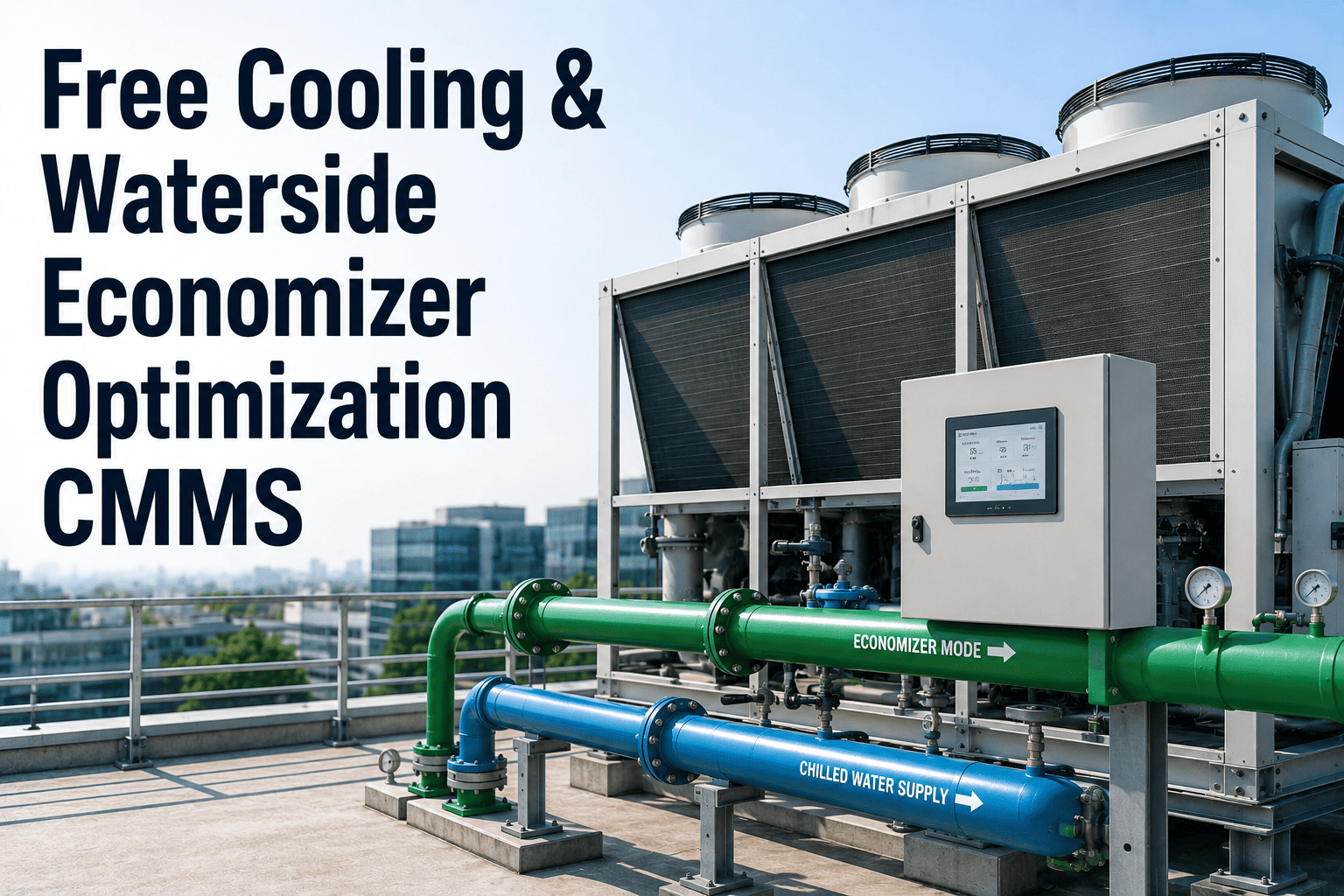
Free cooling HVAC exploits low outdoor air temperatures to produce chilled water without running compressor-based chillers—cutting energy use by up to 75% during shoulder seasons and winter months. A waterside economizer achieves this by routing condenser water through a plate-and-frame heat exchanger that indirectly cools the chilled-water loop once outdoor wet-bulb temperature drops 5–10°F below the chilled-water supply setpoint.
How to optimize economizer bypass operation and prevent efficiency drift
Economizer bypass operation is the control sequence that modulates the plate-frame heat exchanger in and out of the chilled-water loop based on outdoor wet-bulb temperature and cooling load. When the bypass valve sticks open or the approach degrades due to fouling, the plant silently falls back to compressor cooling—burning 3–5× the energy for the same tonnage. A CMMS with free cooling tracking catches the drift early through trend-log alarms and scheduled performance tests.
Monitor switchover wet-bulb threshold in real time
OxMaint ingests BAS trend data and triggers a work order the moment actual switchover deviates more than 2°F from the calculated free cooling threshold—catching sensor drift, stuck dampers, or override conditions before they cost a full day of mechanical cooling.
Schedule plate-frame heat exchanger cleaning on approach, not calendar
Instead of quarterly cleaning regardless of need, OxMaint generates a PM work order when HX approach temperature exceeds 3°F above baseline—typically cutting cleaning frequency by 40% in clean systems while catching fouling events early in dirty-loop plants.
Validate bypass valve stroke and position feedback monthly
Stuck bypass valves are the #1 cause of hidden free-cooling loss. OxMaint auto-schedules a 15-minute valve-stroke test and position-feedback verification, logging pass/fail results to the asset history for audit readiness.
Track and report actual free cooling hours vs. available hours
OxMaint's analytics dashboard compares metered economizer ton-hours against weather-normalized available hours, giving facility managers a monthly energy-savings report that proves ROI to finance and supports utility rebate submissions.
Free cooling energy savings: a worked example
Consider a 1,200-ton data center cooling plant in ASHRAE climate zone 5A running 24/7 at an average 60% load. At a blended electrical rate of $0.11/kWh, mechanical cooling costs roughly $0.52 per ton-hour. Free cooling at the same load costs approximately $0.09 per ton-hour (cooling-tower fans and pumps only). The delta is where optimization pays for itself.
In this scenario, closing the gap from 55% to 85% capture recovers $195,156 per year—payback for a CMMS deployment in under four months on economizer optimization alone. The remaining 15% gap is typically load-limitation, not maintenance-related, and represents diminishing returns.
Waterside economizer maintenance checklist for peak free cooling performance
A disciplined waterside economizer CMMS workflow ties each maintenance task to a measurable performance trigger—not a generic calendar date. Use this checklist as the backbone of your free cooling optimization strategy, then automate it inside OxMaint so nothing falls through the cracks during shoulder-season switchover.
Heat Exchanger Performance
Biweekly / condition-based- Log HX approach temperature (T cond in − T CHW out) and trend vs. baseline
- Trigger plate-frame disassembly and cleaning when approach exceeds baseline + 2°F
- Inspect gaskets, plates, and frame alignment during each cleaning cycle
- Verify isolation valve seats for cross-leakage that dilutes economizer output
Bypass Valve & Actuator
Monthly- Stroke bypass valve full travel and record actuator feedback position
- Compare commanded vs. actual position; flag deviation greater than 5%
- Lubricate valve stem and check for binding or corrosion at packing gland
- Verify spring-return function on fail-safe actuators during power-loss test
Switchover Controls & Sensors
Seasonal (pre & post)- Calibrate outdoor wet-bulb and dry-bulb sensors against a reference instrument
- Verify switchover sequence logic matches current CHW supply setpoint
- Test minimum-runtime and anti-short-cycle timers in the BAS
- Confirm alarm notifications route to OxMaint for work-order auto-generation
Cooling Tower & Condenser Loop
Monthly / seasonal- Test condenser water quality—TDS, pH, hardness—against treatment program targets
- Inspect tower fill, drift eliminators, and distribution nozzles for scale and fouling
- Verify condenser-water supply temperature can achieve design HX approach at peak economizer load
- Clean tower basin and verify sump heater operation before freeze season ends
How OxMaint optimizes free cooling tracking and economizer maintenance
OxMaint's AI-powered CMMS and EAM platform connects your BAS data, asset history, and work-order execution into one closed loop—so free cooling optimization runs on autopilot instead of depending on a seasoned engineer's memory. Here is how four concrete capabilities map directly to economizer performance and energy savings.
Predictive HX fouling alerts
OxMaint's AI engine learns each heat exchanger's baseline approach temperature and generates predictive work orders before fouling erodes free cooling capacity—cutting unplanned efficiency loss by 30–50% and extending plate life by 2–3 years.
Automated switchover PM triggers
Condition-based PM schedules fire when wet-bulb threshold windows open and close, ensuring pre-switchover valve tests and post-season inspections happen exactly when they matter—eliminating missed free cooling hours during unpredictable shoulder seasons.
Digital work orders with sensor data attached
Every economizer work order arrives on the technician's mobile device with the triggering sensor reading, trend chart, last-known-good baseline, and step-by-step procedure—cutting diagnostic time by 40% and ensuring first-time-fix rates above 90%.
Free cooling hours & savings dashboard
OxMaint's analytics module automatically calculates captured vs. available economizer ton-hours, monetizes the energy savings at your blended rate, and exports utility-rebate-ready reports—turning maintenance performance into finance-ready ROI proof.
Free cooling threshold and switchover logic comparison
Different plants use different switchover strategies—some aggressive, some conservative. The right threshold depends on your heat exchanger approach, chilled-water supply temperature, and risk tolerance. Here is how the common strategies compare, and what a CMMS like OxMaint does to optimize the decision dynamically.
| Switchover Strategy | Activation Logic | Pros | Cons | OxMaint Optimization |
|---|---|---|---|---|
| Fixed dry-bulb | Switch at fixed OA dry-bulb (e.g., 50°F) | Simple, minimal sensor count | Misses humid hours; wastes cooling on dry but warm days | Replaces with wet-bulb logic; logs dry-bulb as fallback |
| Wet-bulb with margin | Switch when OA WB ≤ CHWSP − approach − 3°F | Captures maximum available hours | Requires accurate WB sensor; risk of short-cycling | Auto-tunes margin based on valve-cycle history |
| Approach-based (dynamic) | Switch when predicted HX approach ≤ setpoint delta | Adapts to fouling and load in real time | Requires trend data and BAS integration | Native integration; AI predicts approach 24 hrs ahead |
| Time-of-day schedule | Enable economizer only overnight (10 PM–6 AM) | Reduces cycling risk during occupancy hours | Leaves 40–60% of available hours on the table | Removes schedule; relies on condition-based control |
What maintenance teams say about OxMaint free cooling tracking
"We discovered our bypass valve had been sticking open for two winters—OxMaint's valve-stroke PM caught it in the first month. Recovered $48K in free cooling hours we didn't know we were losing."
"Switched from spreadsheet PM tracking to OxMaint and our plate-frame cleaning is now condition-based. We cut cleaning events from 8 per year to 3, but our approach temperature actually improved because we catch fouling earlier."
See OxMaint optimize free cooling on your plant—book a 30-minute demo
We'll connect your BAS trend data, map your economizer assets, and show you exactly how many free cooling hours you're leaving on the table—and how to capture 85%+ of them.
Free cooling and waterside economizer FAQ
What temperature triggers free cooling on a waterside economizer?
Free cooling typically activates when outdoor wet-bulb temperature falls 5–10°F below the chilled-water supply setpoint, accounting for heat exchanger approach. For a 45°F CHW supply with a 3°F HX approach, the switchover threshold is roughly 42°F wet-bulb. The system deactivates when wet-bulb rises 3–5°F above the activation point to prevent short-cycling. OxMaint can auto-tune this threshold based on your actual valve-cycle history and approach performance.
How much energy does a waterside economizer save?
A properly maintained waterside economizer can reduce chiller energy consumption by 50–75% during economizer operating hours, depending on climate zone and cooling load. In temperate climates (ASHRAE zones 4–6), this translates to 1,800–2,400 free cooling hours per year. For a 1,000-ton plant at $0.11/kWh, that's $200K–$400K in annual savings at 85% capture—tracked and reported automatically in your OxMaint dashboard. Start Free Trial to calculate your plant's potential.
Why does my waterside economizer bypass valve keep failing?
Bypass valve failures are most commonly caused by lack of regular stroke testing, stem corrosion from condenser-water exposure, actuator linkage wear, and sediment buildup in the valve seat. Without monthly stroke tests and position-feedback verification, valves can stick partially open for months—silently mixing warm condenser water into the economizer loop and destroying efficiency. OxMaint automates a 15-minute monthly valve-stroke PM with pass/fail logging to catch degradation early.
How often should I clean my plate-and-frame heat exchanger for free cooling?
Cleaning frequency should be condition-based, not calendar-based: clean when the HX approach temperature exceeds your baseline by 2–3°F. In clean closed-loop systems this may be once per season; in plants with poor water treatment it could be monthly. OxMaint tracks approach trends and auto-generates a cleaning work order at the right time—typically reducing unnecessary cleanings by 30–40% while catching fouling events before they impact free cooling hours.
Can a CMMS really improve free cooling energy savings?
Yes—a CMMS like OxMaint directly improves free cooling savings by automating condition-based PM triggers, tracking actual vs. available economizer hours, catching sensor drift and valve failures through trend-log integration, and providing audit-ready savings reports. Plants typically increase economizer hour capture from 50–55% to 80–85% within the first year, recovering $100K–$300K in previously lost energy savings. Book a Demo to see it configured for your plant.
Stop losing free cooling hours to unmaintained economizers
OxMaint's AI-powered CMMS tracks your switchover thresholds, automates heat exchanger cleaning, and validates bypass valve performance—so your plant captures 85%+ of available free cooling hours instead of 55%. See it on your assets in 30 minutes.
Free 14-day trial · No credit card