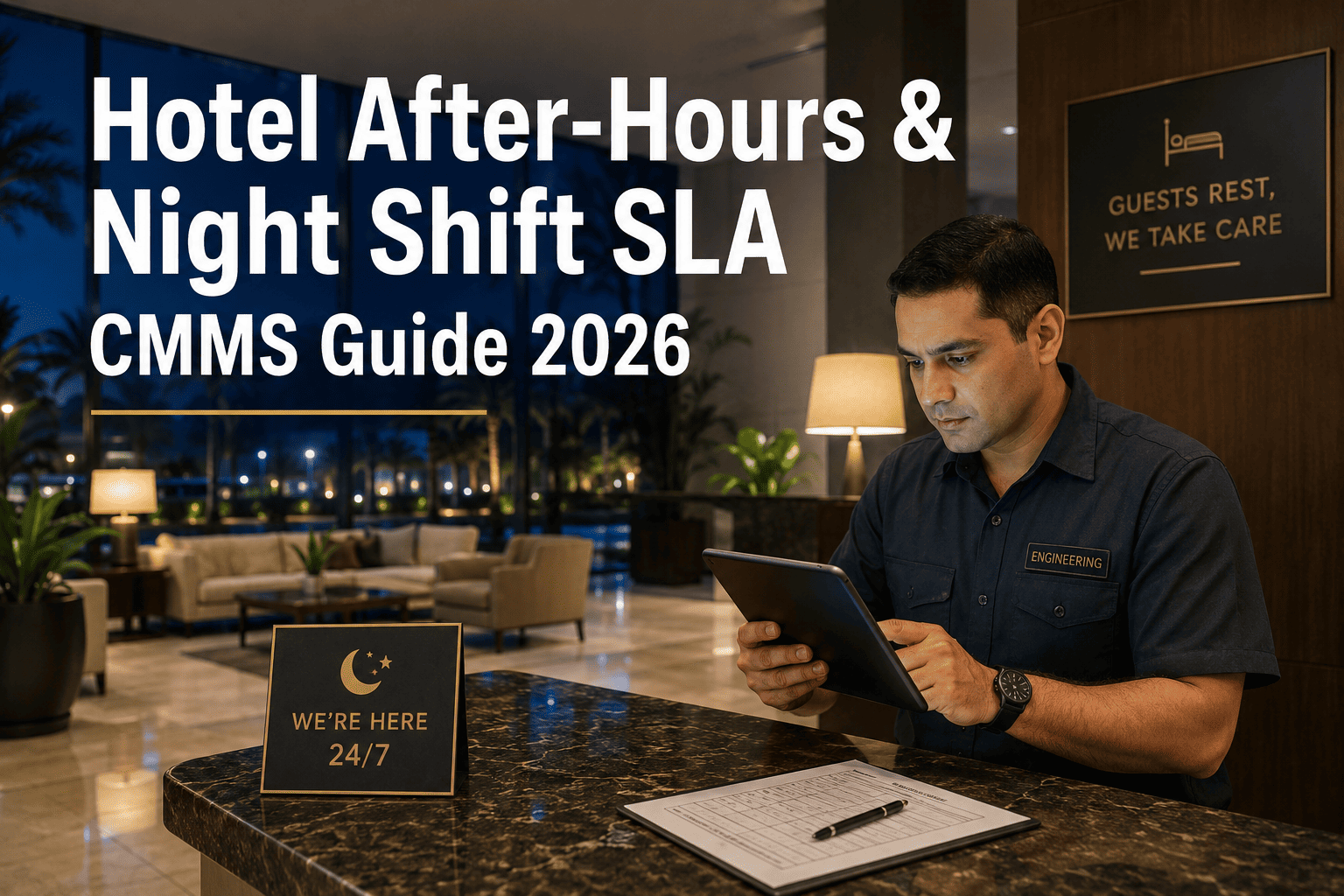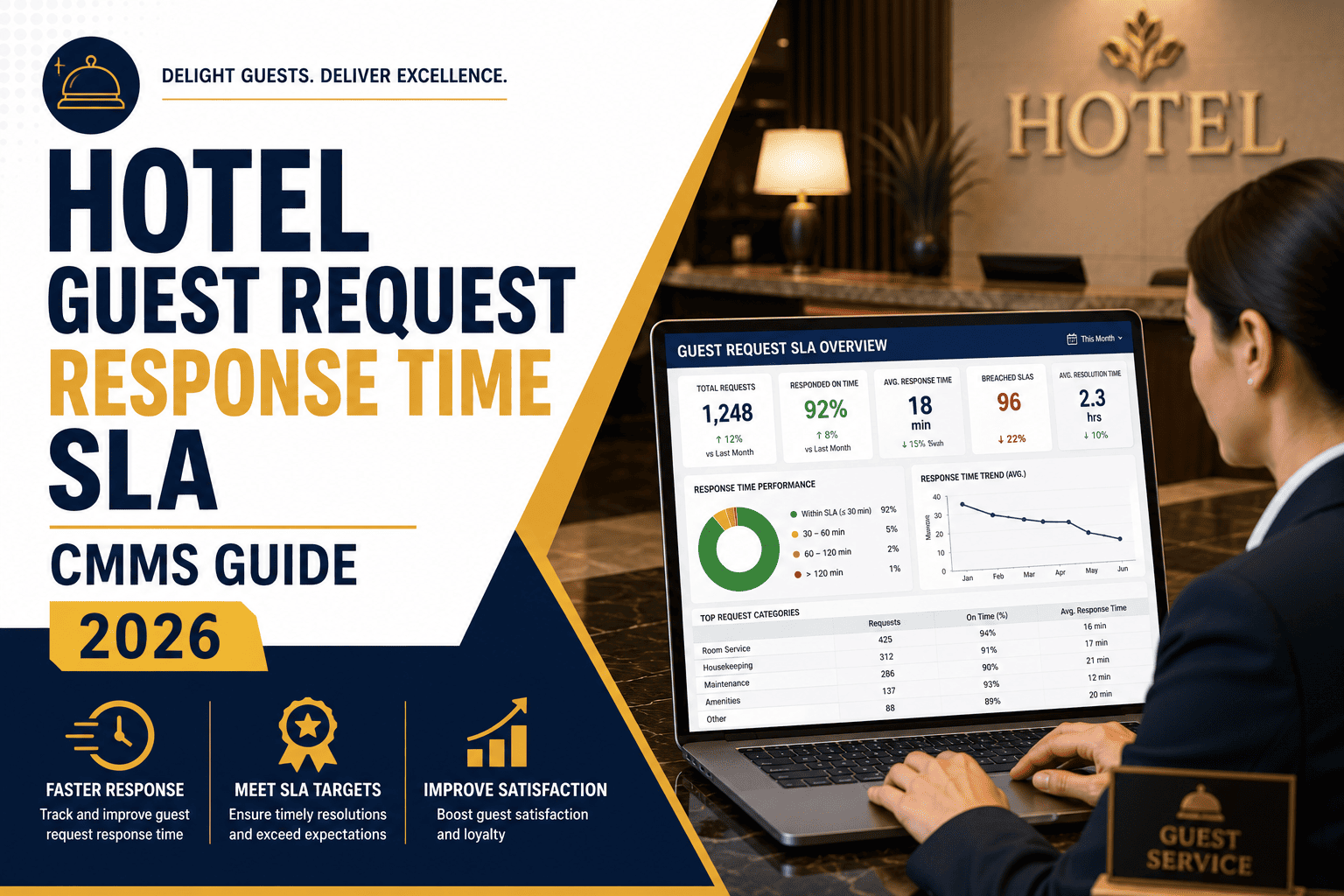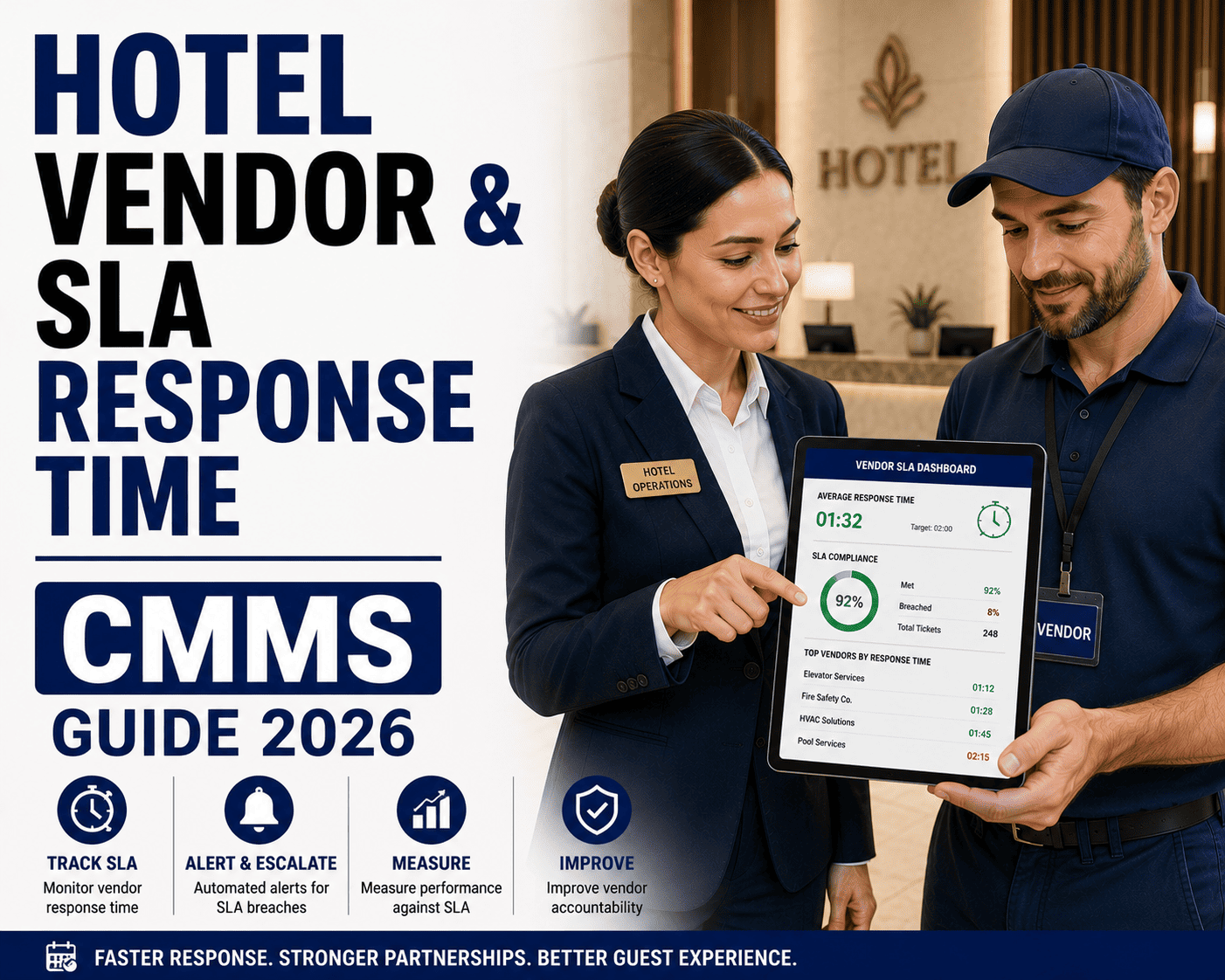
Hotel service SLA tracking is the operational backbone of guest experience in 2026 — every missed SLA is a comped room, a damaged review score, and a preventable revenue leak. This CMMS hotel SLA tracking guide breaks down how modern properties design service-level agreements by request category, measure same-shift response and guest issue resolution times, and use CMMS dashboards to keep SLA performance visible from the frontline technician to the asset owner. If your team is still logging maintenance requests on paper or a shared spreadsheet, you are likely missing 1 in 4 response commitments — you can Start Free Trial to see exactly where your SLA gaps are.
Is Every Guest Issue Resolved Before It Becomes a Review Risk?
Hotel service SLA tracking turns vague response promises into measured, accountable workflows. Define same-shift targets, automate escalations, and give your GM real-time visibility into resolution performance across every department.
How to Design Hotel Service SLAs by Request Category
Not all guest issues carry the same revenue risk. A blown bulb and a backed-up toilet demand entirely different response commitments. A robust CMMS hotel service tracking system segments requests into tiers so technicians respond to true emergencies first.
No hot water, AC failure in extreme heat, plumbing flood, security lock failure, elevator trap. Same-shift resolution mandatory; guest relocation trigger if unresolved in 2 hours.
TV malfunction, partial power outage, noisy HVAC, drain blockage. Same-shift resolution expected; escalation to duty manager if unresolved in 4 hours.
Burnt-out bulb, loose towel rack, minor paint chip, squeaky door. Resolution within 24 hours; batched into PM routes where possible to control labor cost.
Faded signage, low battery in thermostat, minor landscaping issue, cosmetic wear. Resolution within 48 hours; scheduled into the next preventive maintenance cycle.
Response vs. Resolution: What the CMMS Actually Measures
Service SLA tracking in hotels fails when teams confuse "acknowledged" with "resolved." A CMMS must timestamp four distinct milestones to give you a defensible audit trail and accurate guest issue resolution metrics.
Measures how fast a technician claims the task. Targets same-shift acknowledgement for P1/P2 issues.
Measures total guest-visible downtime. This is the number that protects your review score and drives SLA compliance reporting.
Worked Example: A 280-Room Full-Service Hotel
A guest reports a leaking AC unit at 2:14 PM. The PMS auto-creates a P2 work order in the CMMS at 2:15 PM. A technician acknowledges at 2:29 PM (14-minute response — inside the 30-min SLA). The unit is repaired and the work order closed at 3:42 PM (88-minute resolution — inside the 4-hour target). The CMMS logs all four timestamps automatically; the GM's dashboard shows green for that room. Without CMMS hotel SLA tracking, that same request typically sits on a paper log until housekeeping finds it an hour later — breaching the response SLA before anyone even knows there is a problem.
SLA Escalation Workflow: When and How to Intervene
An SLA is only as credible as its escalation path. When a work order reaches 75% of its resolution target without a fix, the CMMS must automatically notify the next tier of leadership — not wait for someone to notice.
| SLA Threshold Reached | Trigger Condition | Auto-Escalation Action | Required Response |
|---|---|---|---|
| 50% elapsed | P1/P2 not yet acknowledged | SMS + push notification to on-duty supervisor | Reassign within 5 minutes |
| 75% elapsed | Work order acknowledged but not closed | Alert duty manager; flag red on SLA dashboard | Manager verifies parts/labor availability |
| 100% breached | Resolution target missed | Notify GM + Front Office; trigger guest recovery protocol | Guest contact + comp evaluation within 15 min |
| 24 hr breached | P1 still unresolved | Escalate to Regional Director of Engineering | Root-cause review + corrective action plan |
How OxMaint Solves Hotel Service SLA Tracking
OxMaint replaces paper logs and disconnected spreadsheets with an AI-powered CMMS that captures, routes, and measures every guest maintenance request against your SLA targets — in real time.
Auto-Routed Same-Shift Work Orders
Guest requests flow from the PMS or front desk directly into OxMaint as priority-tagged work orders, routed to the nearest qualified technician's mobile device in under 60 seconds.
Real-Time SLA Dashboards
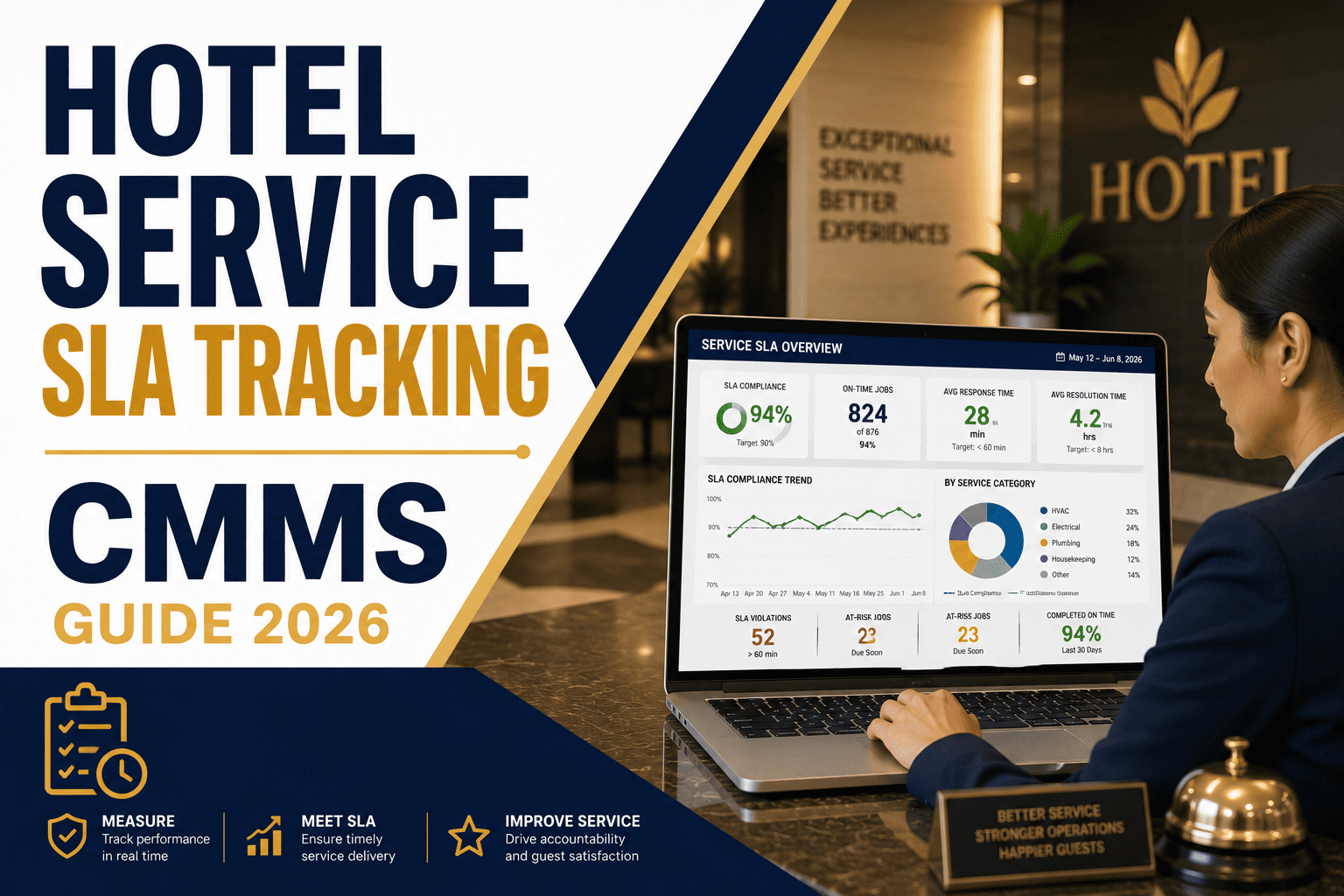
Live tiles show open work orders by priority, elapsed time, and breach risk. GMs and engineering directors see property-wide SLA compliance without chasing paper logs.
Automated Escalation Engine
Configurable rules auto-escalate at 50%, 75%, and 100% of SLA thresholds via SMS, email, and push — ensuring no missed commitment goes unnoticed or undocumented.
Guest Issue Resolution Analytics
Trend analysis by room, asset type, shift, and technician identifies recurring failures — so you fix the root cause instead of logging the same repair five times a quarter.
What Healthy Hotel SLA Performance Looks Like in 2026
Industry benchmarks from full-service and luxury properties show a clear correlation between SLA compliance and guest satisfaction scores. Here is what high-performing maintenance teams are delivering.
A 280-room property that moves from paper-based logging to a CMMS with automated SLA tracking typically cuts average resolution time by 45% and reduces comped-room spend by $18K–$28K per year within the first 6 months.
See OxMaint Track Your Hotel SLAs in Real Time
Book a 30-minute demo and we'll map your request categories, SLA targets, and escalation paths live on the platform.
Hotel Service SLA Tracking: Common Questions
What is hotel service SLA tracking and why does it matter in 2026?
Hotel service SLA tracking is the process of measuring how quickly maintenance and operational teams respond to and resolve guest issues against predefined time targets. It matters because every missed SLA directly correlates with lower review scores, higher comp costs, and reduced repeat-stay revenue — and in 2026, OTAs weigh resolution speed heavily in ranking algorithms.
How does a CMMS improve same-shift response in hotels?
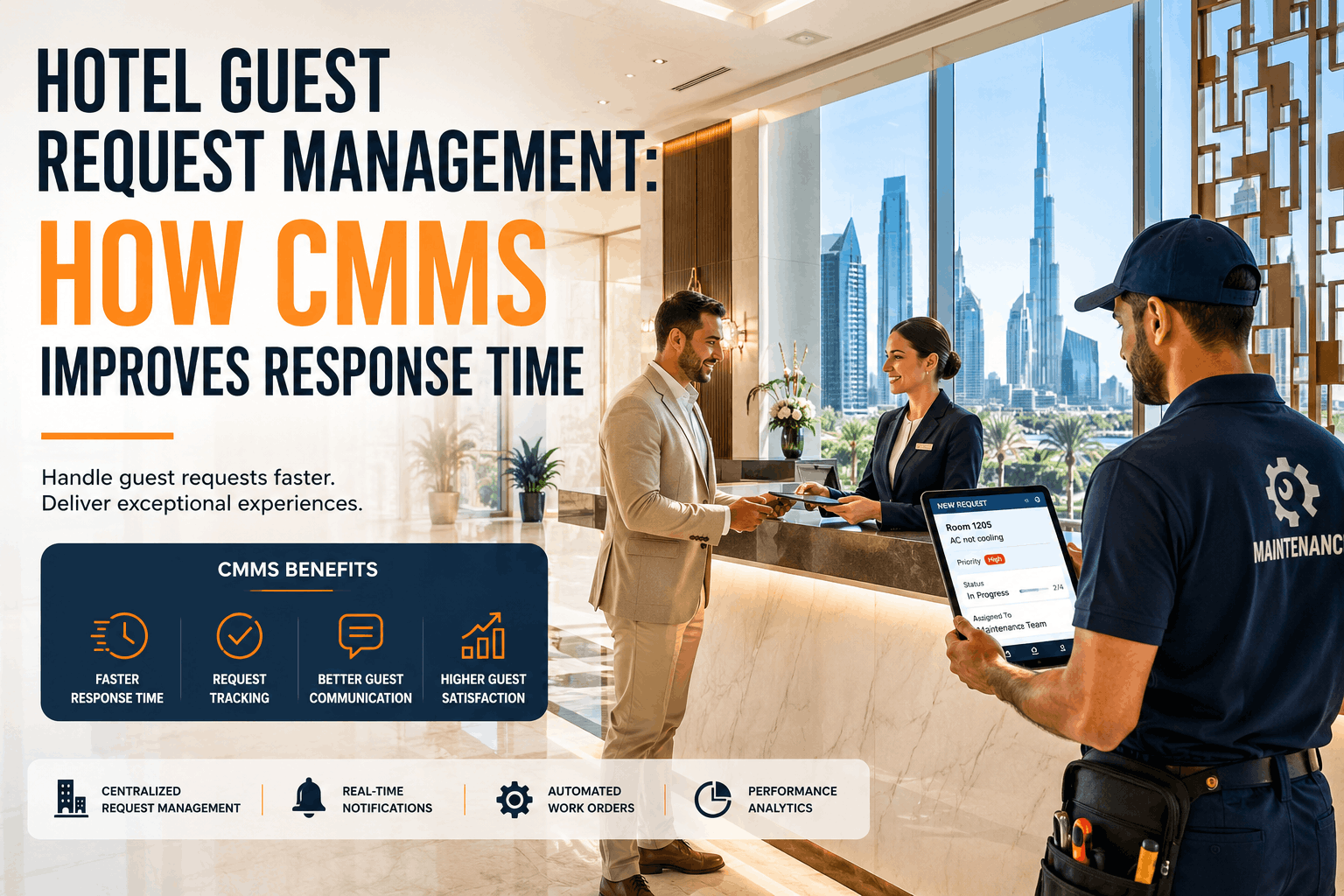
A CMMS like OxMaint auto-routes guest maintenance requests to the nearest qualified technician's mobile device within seconds, eliminating the lag of paper logs and radio calls. It also timestamps every milestone — logged, acknowledged, en route, resolved — so supervisors can see in real time which requests are at risk of breaching the same-shift SLA and intervene before the guest is affected. You can Book a Demo to see the routing and escalation engine live.
What SLA response times should hotels commit to for guest issues?
Best practice is tiered: P1 critical issues (no water, AC failure, flood) at 15-minute response and 2-hour resolution; P2 high-priority issues at 30-minute response and 4-hour resolution; P3 standard issues at 2-hour response and 24-hour resolution; P4 low-priority at 4-hour response and 48-hour resolution. These targets balance guest expectations with realistic labor capacity.
Can OxMaint integrate with our existing hotel PMS and front-desk system?
Yes. OxMaint supports API and webhook integrations with major hotel PMS platforms, so guest maintenance requests can flow automatically into the CMMS as priority-tagged work orders without manual re-entry. This eliminates the dual-log problem where front desk records one timestamp and engineering records another.
How long does it take to implement CMMS hotel SLA tracking?
A typical full-service hotel goes live with OxMaint SLA tracking in 2–4 weeks, including asset import, SLA tier configuration, technician mobile onboarding, and PMS integration. The system is designed for easy migration from spreadsheets or paper — most teams see measurable SLA improvement within the first 30 days of go-live. Start your Start Free Trial to begin the setup today.
Stop Guessing. Start Measuring Every SLA.
Join the hotel engineering teams using OxMaint to hit 95%+ same-shift resolution rates, cut comp spend, and protect their review scores — every single day.
Free 14-day trial · No credit card