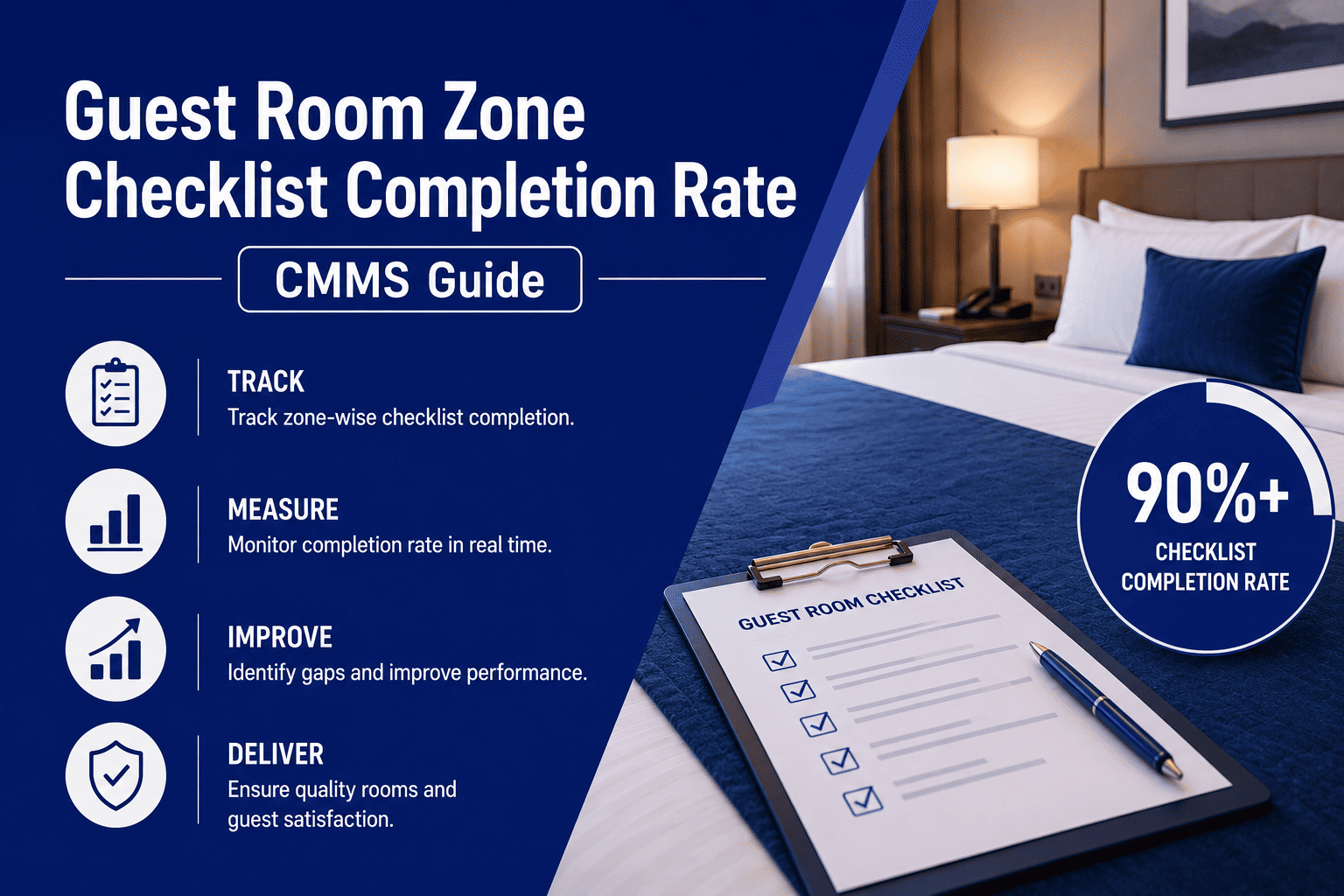
Most hotel maintenance teams still measure performance by ticket count, not inspection coverage — and the cost of that blind spot shows up in guest complaints, repeat call-backs, and negative reviews. Zone checklist completion rate, when tracked through a CMMS, reveals exactly which floors, wings, and technicians are getting full inspections and which are slipping through. A 180-room property running at sub-70 percent completion typically sees 2.3x more repeat HVAC and plumbing failures than one holding above 90 percent. This guide breaks down how to configure zones, enforce completion tracking, and read the analytics in OxMaint — Start Free Trial to follow along with the live dashboard.
Which zones actually got inspected this week — and which didn't?
Completion rate turns a clipboard ritual into a measurable KPI. Track every floor, every wing, every technician — in real time.
What zone checklist completion rate actually measures
Completion rate = (rooms fully inspected ÷ rooms assigned) × 100, tracked per zone, per technician, per shift. Most hotels run 58-72 percent on paper — top performers using CMMS hold 90 percent or above.
A room counts as "fully inspected" only when every checklist item — HVAC, plumbing, electrical, FF&E, life-safety — is marked Pass, Fail, or Flagged for follow-up. Partial inspections count as zero.
Structuring zones for measurable coverage
A 250-key hotel should run 4-6 zones, each containing 30-60 rooms — small enough for one technician to inspect thoroughly in a single shift, large enough to produce statistically meaningful completion data.
Floor 3 East Wing
Standard guest rooms 301-348. Assigned to Technician 1 on AM shift. Checklist: 22 items across HVAC, plumbing, FF&E.
Floors 4-5 West Wing
Standard guest rooms 401-424, 501-524. Assigned to Technician 2 on AM shift. Higher guest turnover — daily inspection priority.
Suites & VIP Floor
Executive suites 601-620. Assigned to Senior Technician on AM shift. 28-item checklist includes premium FF&E and upgraded HVAC units.
Floors 7-8 Standard
Rooms 701-727, 801-827. Assigned to Technician 3 on PM shift. Lower occupancy priority but equal preventive maintenance weight.
Zone D dropped to 78% over four consecutive weeks. When we dug into the CMMS log, the PM-shift technician was skipping plumbing checks on checkout rooms to keep up with guest calls. Completion analytics caught it before a single guest complaint did.
— Director of Engineering, 420-key full-service hotel, OrlandoThe 22-item room checklist that drives real completion
Generic checklists inflate completion numbers without catching failures. The structure below — grouped by trade, each item requiring a photo on Fail — is what moves completion from busywork to preventive value.
| Trade Group | Check Items | Items | Fail Threshold | Photo Req. |
|---|---|---|---|---|
| HVAC | Filter condition, thermostat calibration, vent airflow, condensate drain | 4 | 1 fail = work order | Yes |
| Plumbing | Faucet pressure, drain speed, toilet seal, shower grout, P-trap leak | 5 | 1 fail = work order | Yes |
| Electrical | GFCI test, outlet count, lamp function, switch plates, breaker label | 5 | 1 fail = urgent WO | Yes |
| FF&E | Mattress condition, TV mount, drawer slides, curtain track, safe battery | 5 | 2 fails = WO | On Fail |
| Life Safety | Smoke detector test, sprinkler clearance, exit signs, door closer, CO detector | 3 | 1 fail = critical WO | Yes |
Turnover rooms
Full 22-item checklist on every checkout room before guest arrival. Target: 100% completion, same-day.
Occupied rooms
Condensed 12-item checklist (HVAC, plumbing, life safety only) during guest stay. Target: 90% completion per zone per week.
Deep preventive
Full 22-item plus filter swap, descale, and FF&E audit. Target: 100% of assigned rooms, 28-day cycle.
What a completion-rate dashboard must show
A maintenance director should know within 8 seconds which zone is behind, which technician is carrying the gap, and what items are being skipped most often. Five tiles do that job.
Weighted by room count per zone. Drops below 85% triggers an automated alert to the DOE.
78% — flagged red. Drill-down shows PM shift, plumbing items skipped on 12 rooms.
34% of incomplete rooms have plumbing items untouched — indicates a time-pressure pattern, not a skill gap.
61% personal completion rate vs. team average of 88%. Needs retraining or workload rebalancing.
Calculated from historical failure-to-cost ratios: each missed plumbing check averages $47 in downstream repair cost.
The 4-week review cycle that holds 90%+ completion
Completion rate decays without review. The timeline below is the minimum cadence top-quartile hotels use to keep coverage from slipping — weekly tactical, monthly structural, quarterly strategic.
Technician self-check
Each technician reviews their own completion in the CMMS mobile app at end of shift. Target: any room below 100% gets a next-day revisit logged before clock-out. Catches 60% of gaps within 24 hours.
Supervisor zone review
Chief Engineer reviews zone-level completion every Monday. Any zone below 85% triggers a root-cause log: staffing, time pressure, or checklist bloat. Average resolution: 1.3 weeks to recover above target.
DOE structural review
Director of Engineering reviews the full dashboard: completion trend, most-skipped items, per-technician performance, cost-of-skips. Decisions on retraining, zone reassignment, or checklist revision happen here.
Strategic recalibration
Compare completion data against guest complaint trends, repeat work orders, and P&L maintenance spend. Adjust zone boundaries, checklist items, and technician assignments. Properties doing this see 18-24% fewer guest complaints within two quarters.
Why paper checklists cap you at 67%
Paper completion is self-reported, unaudited, and lagged by 3-5 days before anyone sees the data. CMMS completion is timestamped, geo-tagged, and visible in real time. The gap isn't effort — it's visibility.
| Dimension | Paper Checklist | CMMS Checklist |
|---|---|---|
| Completion visibility | 3-5 day lag, manual tally | Real-time, auto-calculated |
| Typical completion rate | 58-72% | 85-95% |
| Item-level skip detection | Impossible — whole sheet or nothing | Per-item tracking with skip alerts |
| Photo evidence on Fail | Rarely attached, easily lost | Auto-attached to work order |
| Technician accountability | Sheet handed in, unverifiable | Timestamped, geo-tagged per room |
| Trend analysis | Manual spreadsheet, monthly | Dashboard, any date range |
| Cost of skipped checks | Invisible until guest complaint | Quantified weekly in dollars |
Stop guessing which zones got inspected
See live completion rates for every floor, every technician, every checklist item — the day you go live.
Common questions about zone checklist completion rate
What is a good zone checklist completion rate target?
Top-quartile hotels hold 90% or above on daily turnover rooms and 95% on monthly deep-preventive checks. Anything below 85% on a rolling 7-day average should trigger a root-cause review — it almost always indicates a staffing or time-pressure gap, not technician negligence.
How does a CMMS track completion differently from paper?
A CMMS timestamps and geo-tags every checklist item per room, so completion is calculated automatically from actual submitted inspections — not self-reported tallies. You can see which specific items were skipped, not just whether a sheet was handed in. You can explore the live tracking interface when you Start Free Trial.
How many zones should a hotel have?
A 150-250 room property typically runs 4-6 zones of 30-60 rooms each. The test is whether one technician can complete a full inspection cycle in one shift without rushing. If completion drops below 80% consistently, the zone is too large or the checklist is too long — split the zone or trim redundant items.
What happens when a room is marked incomplete?
The CMMS auto-generates a follow-up task assigned to the same technician or the next shift, with a deadline before the room's next guest arrival. If the gap is item-level (e.g., plumbing skipped), only the missing items appear in the follow-up — no redundant re-inspection. Persistent gaps escalate to the supervisor automatically.
How quickly can we see improvement after switching to CMMS tracking?
Most properties see completion jump from the 60s to the mid-80s within 2-3 weeks of going live, simply because visibility changes behavior. Reaching 90%+ sustained usually takes 6-8 weeks as supervisors establish the weekly review cadence and rebalance workloads. Book a walkthrough at calendly.com/oxmaintapp/30min to see the rollout plan.
Get every zone to 90%+ — starting this week
Configure zones, deploy checklists, and watch completion rates climb in real time. Most hotels see measurable improvement within 14 days.
Free 14-day trial · No credit card