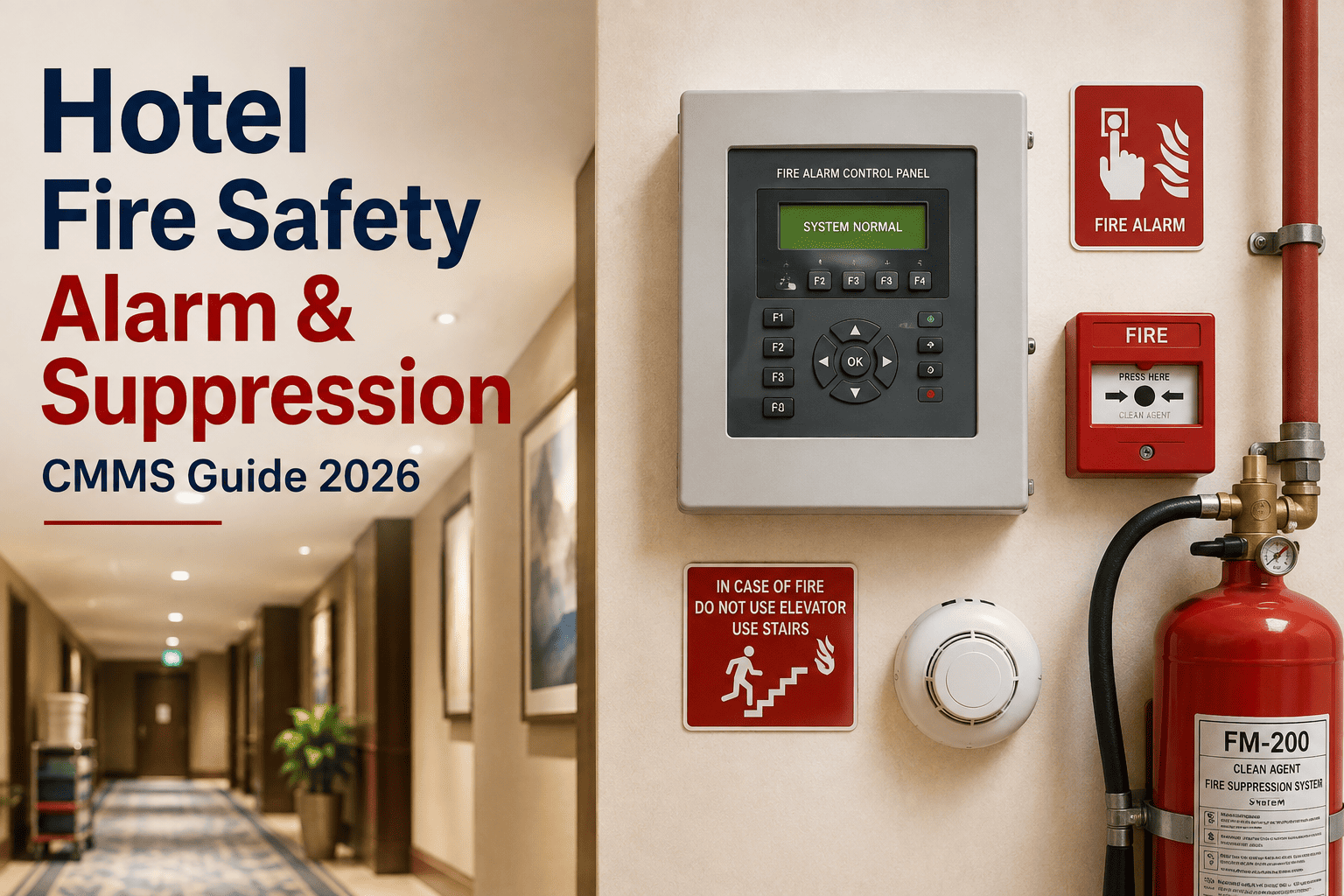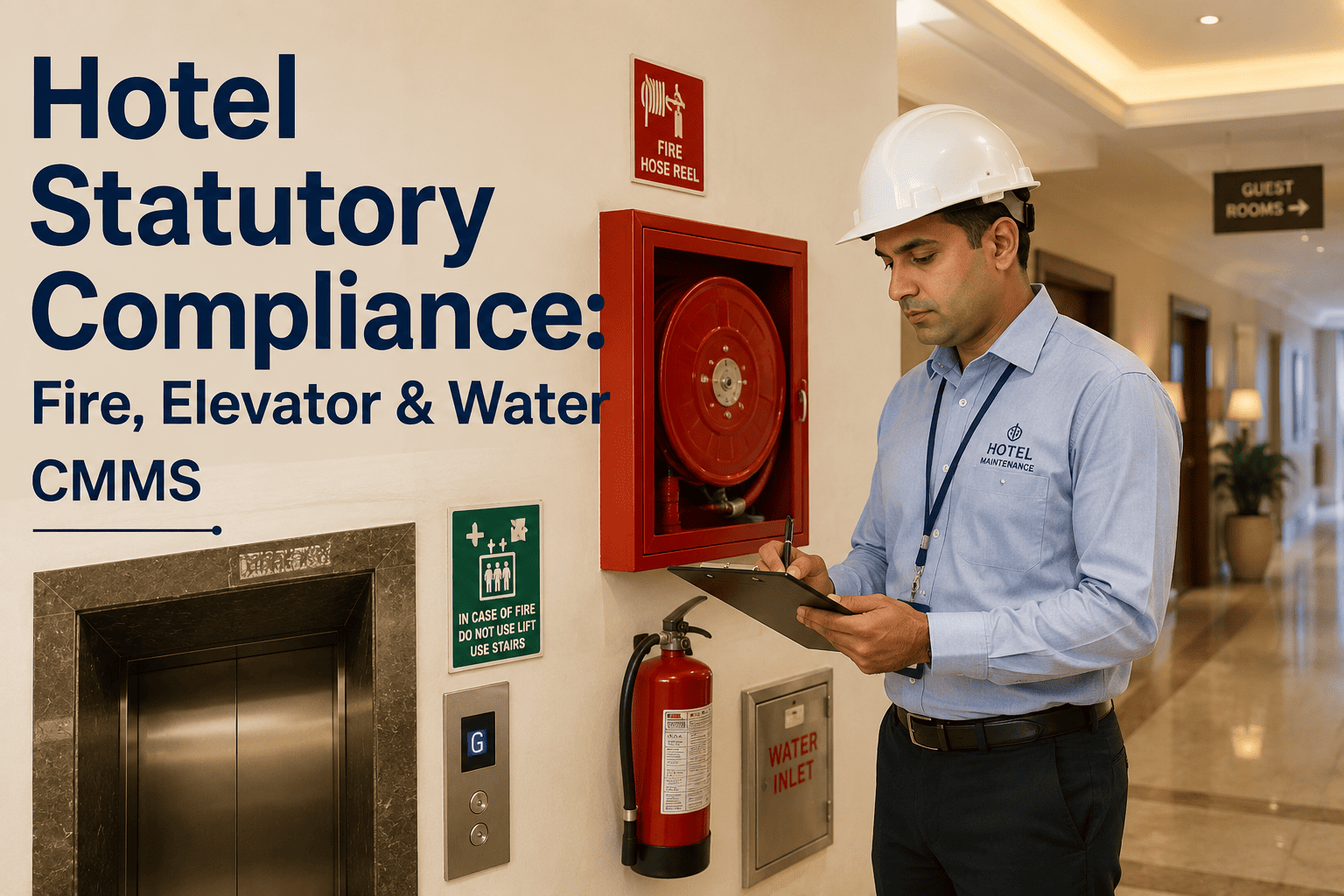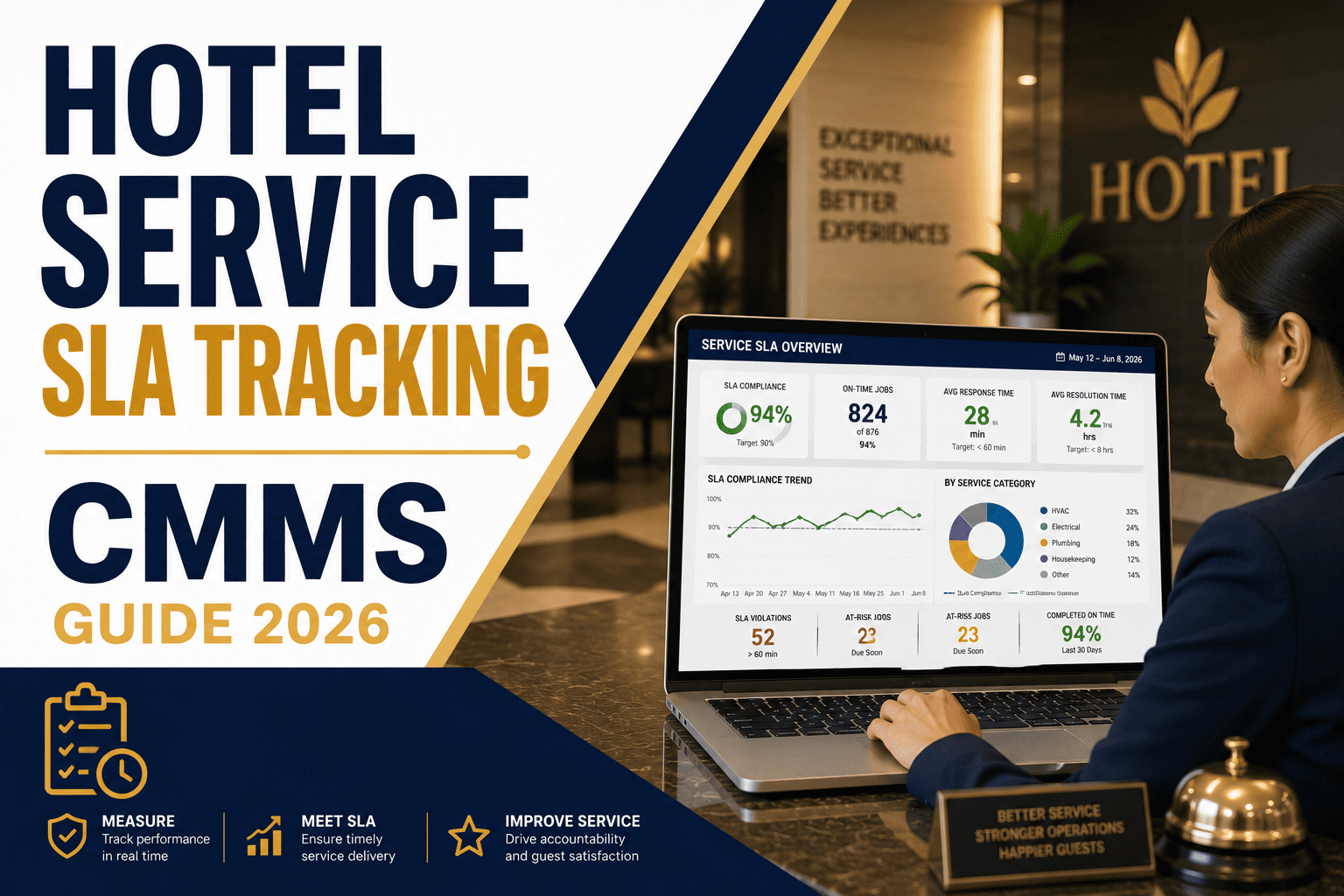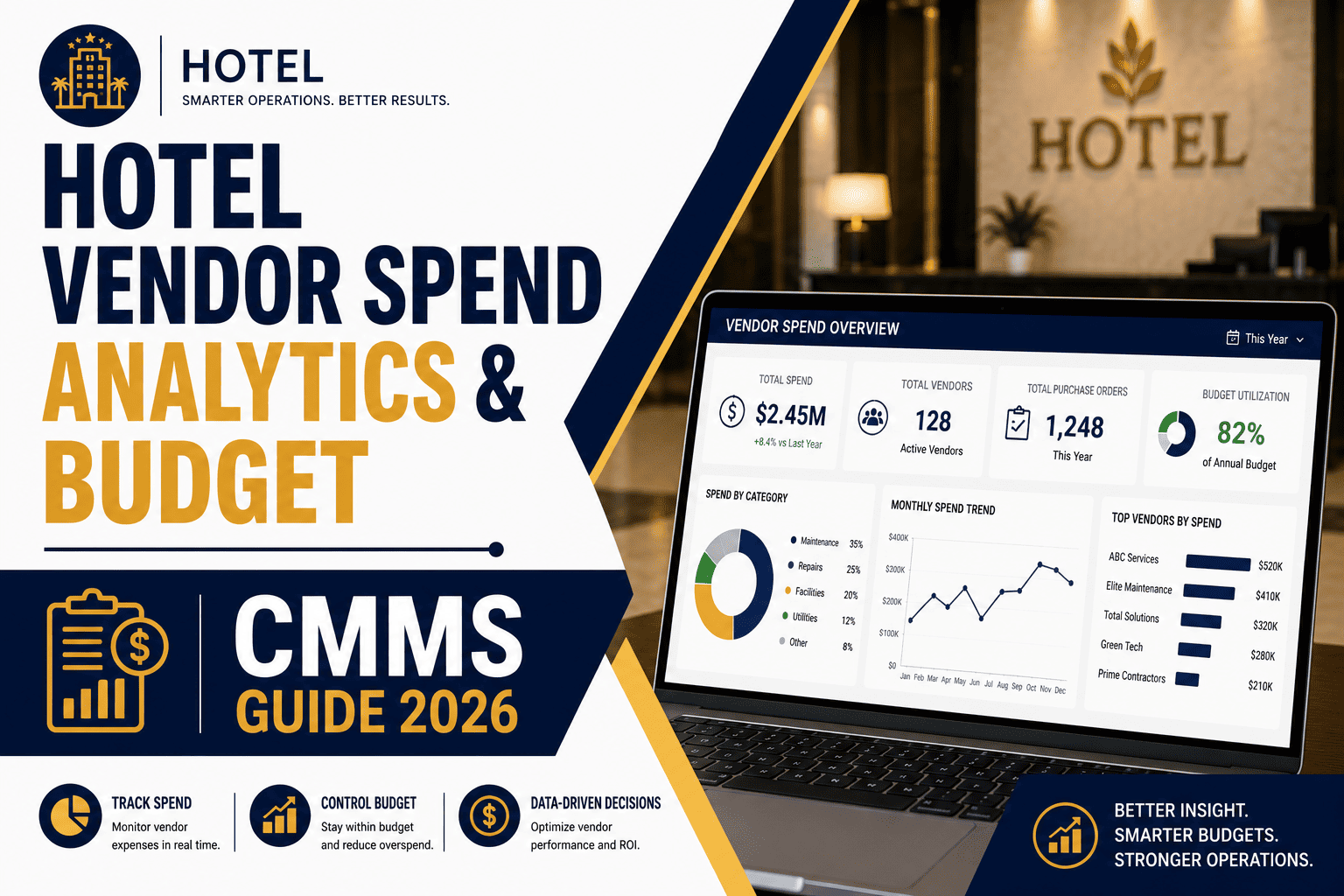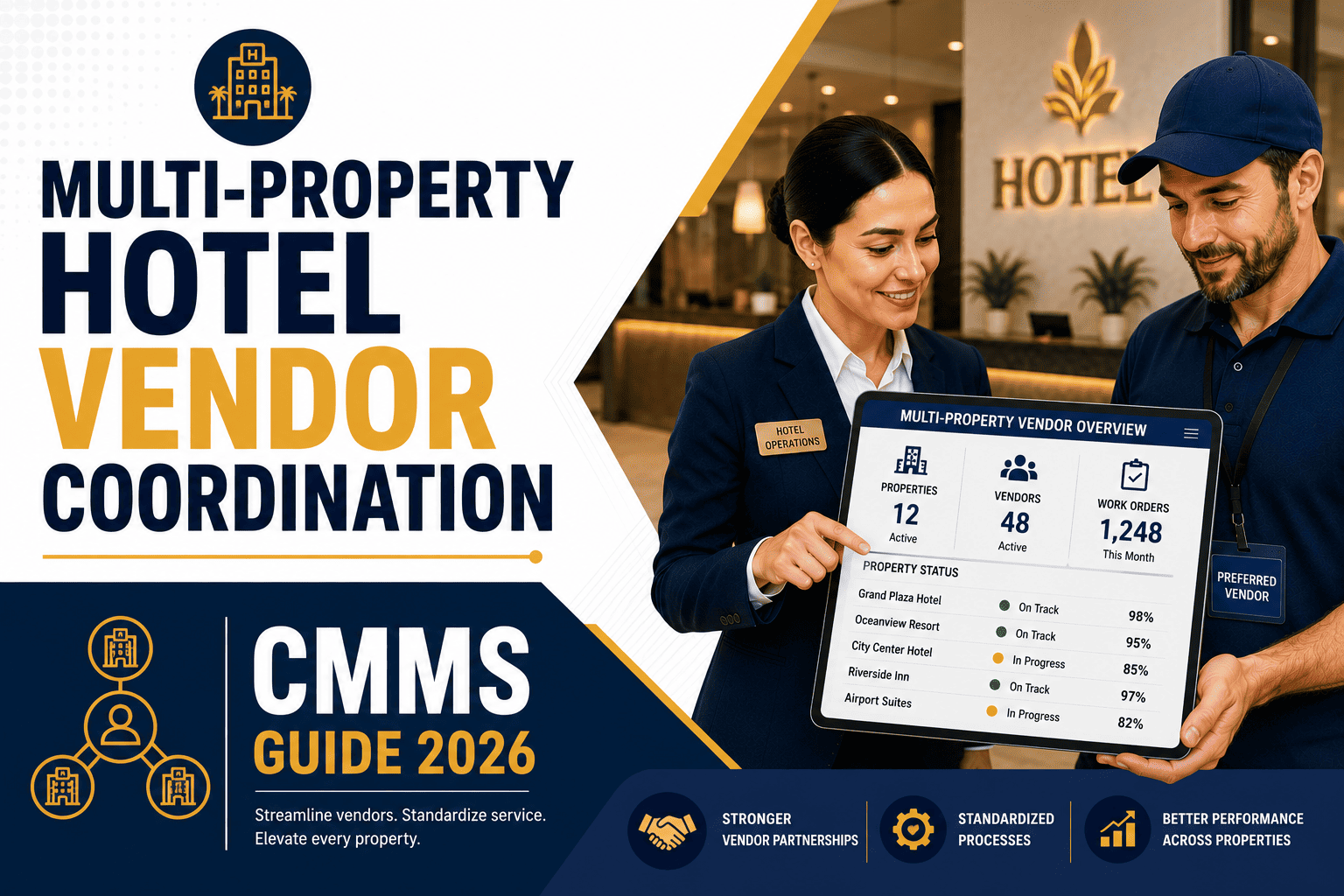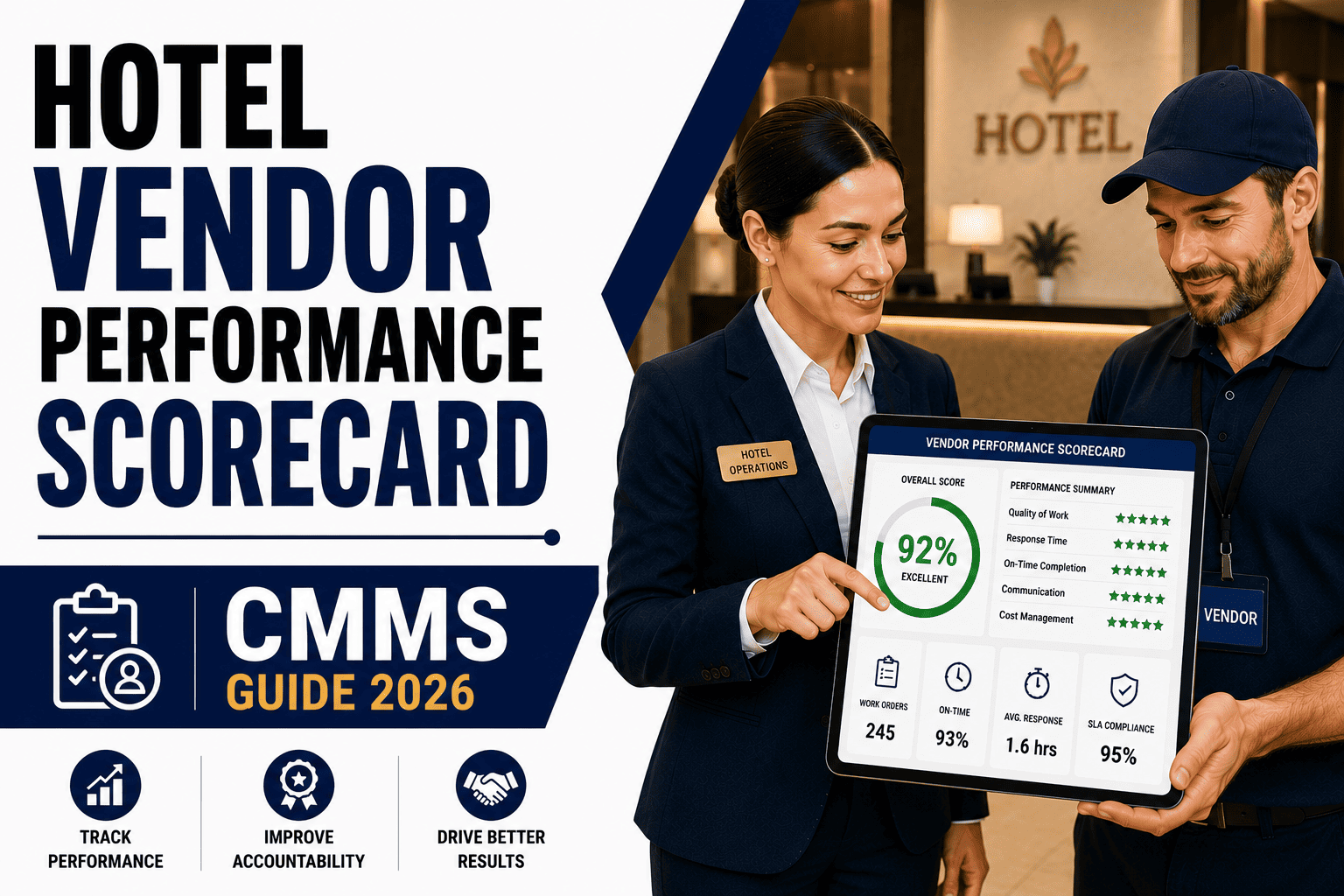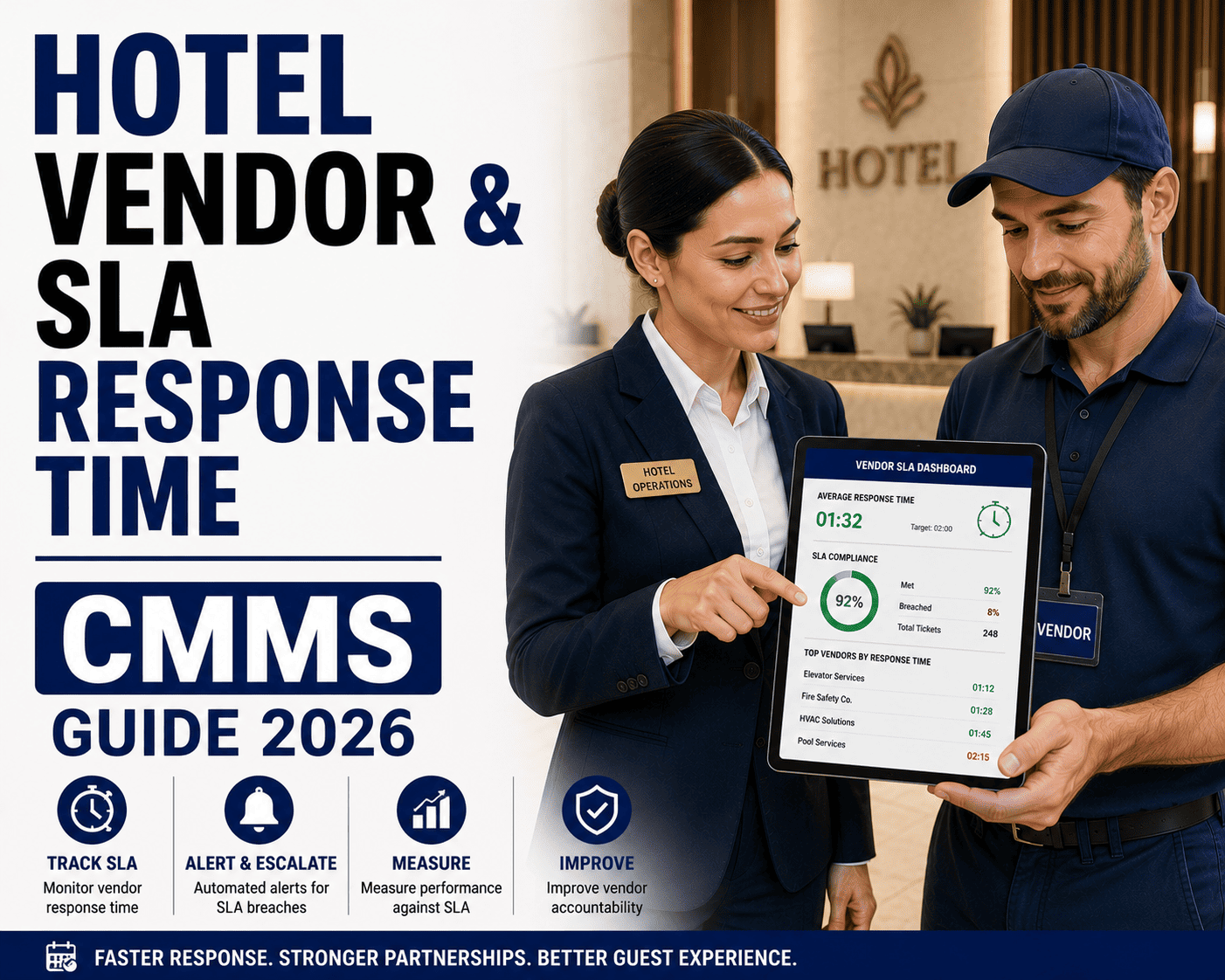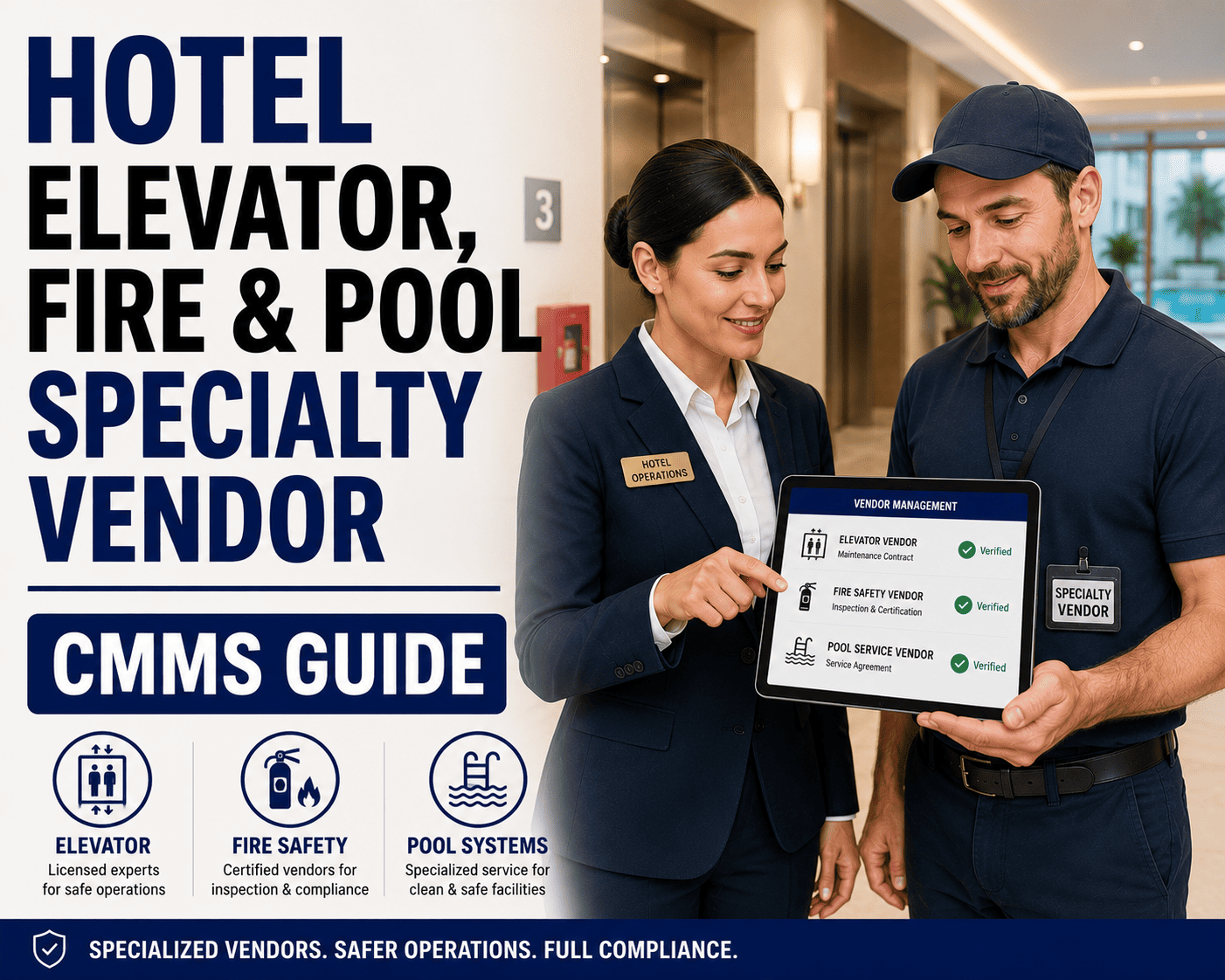
Hotel specialty vendor management for elevators, fire suppression systems, and pools represents the most compliance-sensitive contractor coordination challenge in hospitality — a single missed inspection can trigger OSHA citations, ADA elevator shutdowns, or health-department pool closures. This CMMS hotel specialty vendor guide covers contract structure, inspection scheduling, compliance documentation, and the CMMS setup that keeps specialty vendors audit-ready across elevator, fire, and pool service categories. If your team is still juggling spreadsheets, email threads, and paper certificates, Start Free Trial to see how OxMaint consolidates every vendor workflow into one AI-powered platform.
Specialty Service Guide 2026
Are your elevator, fire & pool vendors audit-ready — or one missed inspection from a shutdown?
Hotels that coordinate specialty service vendors through a CMMS cut compliance gaps by 60% and avoid the $12K–$45K average cost of a single failed fire or elevator inspection. OxMaint centralizes every contract, certificate, and work order so your highest-consequence contractors never fall through the cracks.
CMMS Hotel Specialty Vendor Guide
Why elevator, fire & pool vendors need a dedicated CMMS workflow
Elevator, fire suppression, and pool contractors operate under stricter regulatory frameworks than general maintenance vendors — ASME A17.1 for elevators, NFPA 25 for water-based fire systems, and state health codes for public pools. A hotel running 200+ rooms typically manages 8–14 specialty vendors simultaneously, each with different inspection cadences, certificate expiry dates, and jurisdictional reporting requirements. Without a CMMS purpose-built for specialty vendor coordination, hotels lose visibility into which certificates have expired, which inspections are overdue, and which vendor contracts auto-renewed at inflated rates.
CMMS Hotel Specialty Service Setup
How to structure specialty vendor contracts and inspections in a CMMS
The right CMMS hotel specialty vendor setup turns chaotic contractor management into a predictable, audit-ready system. Each specialty vendor category — elevator, fire, pool — needs its own asset hierarchy, inspection template, and compliance document vault. Here is the step-by-step configuration that high-performing hotel engineering teams use.
Map every elevator as a tracked asset with ASME inspection cadences
Register each elevator unit with its manufacturer, model, capacity, install date, and jurisdictional code. Assign ASME A17.1 Category 1 (annual) and Category 5 (5-year) inspections as recurring work orders auto-routed to your certified elevator vendor 30 days before the due date. Attach the current certificate of operation directly to the asset record so any auditor can pull it in seconds.
Configure NFPA 25 quarterly, annual & 5-year inspection templates
Create separate preventive maintenance templates for sprinkler systems (quarterly), fire pumps (weekly churn test), standpipes (5-year), and kitchen hood suppression (semi-annual). Each template auto-generates a work order with the required checklist, assigned to your licensed fire vendor. The CMMS stores completed test reports, forward-flow results, and impairment tags — building a defensible compliance trail.
Schedule health-code water testing and equipment service with expiry alerts
Public pool regulations vary by state but universally require daily chemical logs, weekly professional testing, and monthly equipment inspections. Configure the CMMS to send automated reminders to your pool service vendor, attach CPO certifications, and flag when pump room equipment — filters, chemical feeders, UV systems — approaches manufacturer-recommended service intervals.
Centralize COIs, licenses, and SLA terms with auto-expiry alerts
Upload every vendor contract, certificate of insurance, technician license, and service-level agreement to the vendor master record. Set expiry alerts 60, 30, and 7 days out so no certificate lapses without warning. When a fire vendor's GL policy expires, the CMMS automatically blocks new work order assignment until proof of renewal is uploaded — protecting your hotel from uninsured-contractor liability.
Specialty Vendor Compliance Checklist
Hotel elevator, fire & pool vendor compliance checklist
Use this checklist to audit your current specialty vendor management program. If you cannot answer "yes" to every line item, your hotel is carrying preventable compliance and liability risk — the exact gap a CMMS hotel specialty service platform closes.
Elevator Vendor Compliance
- ASME A17.1 Category 1 annual inspection completed and certificate posted in machine room
- Elevator vendor maintains QEI (Qualified Elevator Inspector) certification on file
- Category 5 full-load 5-year test scheduled and documented within jurisdictional window
- Fire-service phase recall test performed and logged annually
- Certificate of insurance with minimum $2M GL coverage verified current
Fire Suppression Vendor Compliance
- NFPA 25 quarterly sprinkler inspection reports filed and archived for 5 years
- Fire pump weekly churn test logged with pressure readings
- Kitchen hood suppression semi-annual service documented with nozzle and link replacements
- Standpipe and hose 5-year hydrostatic test completed and certified
- Vendor NICET certification level verified for each assigned technician
Pool Vendor Compliance
- Daily water chemistry logs (pH, chlorine, alkalinity) recorded by hotel staff or vendor
- Weekly professional water testing and bacteriological sampling documented
- Pool operator CPO certification current and posted per state requirement
- Monthly pump room equipment inspection — filters, feeders, controllers — logged
- Drain cover compliance (VGB Act) verified with manufacturer date and model recorded
Specialty Vendor CMMS Comparison
Spreadsheets vs. CMMS for hotel specialty vendor management
Most hotels still track specialty vendor inspections in a combination of Excel spreadsheets, shared calendar reminders, and physical binders in the engineering office. The cost of that approach compounds silently — until a failed audit, a guest injury, or an insurance renewal makes it painfully visible.
| Capability | Spreadsheet / Manual | OxMaint CMMS |
|---|---|---|
| Inspection scheduling & auto-reminders | Manual calendar entry; 30–40% of inspections missed or late | Auto-generated work orders 30/60/90 days out with vendor assignment |
| Certificate & COI expiry tracking | Reactive — discovered during audit or after lapse | Automated 60/30/7-day alerts; work orders blocked if expired |
| Compliance document storage | Binders and shared drives; retrieval takes hours | Every document attached to asset or vendor record; instant retrieval |
| Audit readiness | 2–5 days of preparation per audit cycle | Real-time dashboard; audit-ready in under 30 minutes |
| Vendor performance tracking | Subjective; no response-time or completion-rate data | SLA tracking with on-time %, mean response time, and cost per asset |
| Multi-property visibility | Separate spreadsheets per property; no rollup | Portfolio-wide dashboard with drill-down to any asset or vendor |
A 280-room boutique hotel group in Arizona switched from spreadsheet-based vendor tracking to OxMaint and eliminated 100% of late fire inspections within the first quarter — saving an estimated $38K in potential re-inspection fees and insurance surcharges.
How OxMaint Helps
How OxMaint streamlines hotel specialty vendor management
OxMaint was built for the realities of hotel engineering — where a single missed elevator certification can shut down guest floors and a failed fire inspection can trigger a chain of insurance and licensing consequences. These are the four capabilities that directly solve the specialty vendor coordination problem.
Automated inspection work orders
OxMaint auto-generates preventive maintenance work orders for ASME, NFPA 25, and pool health-code inspections based on the exact cadence your jurisdiction requires — eliminating the 30–40% missed-inspection rate typical of manual scheduling.
Compliance document vault
Upload certificates of insurance, inspection reports, technician licenses, and service contracts directly to vendor and asset records. Expiry alerts fire automatically at 60, 30, and 7 days — so no coverage ever lapses silently.
Vendor SLA & cost tracking
Every specialty vendor work order captures response time, completion time, parts cost, and labor cost — giving you objective data to renegotiate contracts or replace underperforming contractors with defensible metrics.
Multi-property compliance dashboard
Roll up elevator, fire, and pool compliance status across every property in your portfolio. Spot the hotel with an expiring fire pump certificate before it becomes a shutdown — and drill from portfolio view to a single asset in two clicks.
See OxMaint manage your elevator, fire & pool vendors — book a 30-minute demo
Walk through a live specialty vendor setup: inspection scheduling, compliance vault, and multi-property dashboards configured for your hotel's exact asset list and jurisdictional requirements.
Specialty Vendor CMMS FAQ
Frequently asked questions about hotel specialty vendor CMMS
What is a hotel specialty vendor CMMS and why do hotels need one?
A hotel specialty vendor CMMS is a maintenance management system configured to coordinate the inspection scheduling, compliance documentation, and contract management of high-risk contractors — elevator, fire suppression, and pool service providers. Hotels need one because these vendors operate under strict regulatory codes (ASME, NFPA, state health regulations) where a missed inspection can result in fines, shutdowns, or guest safety incidents. A CMMS like OxMaint automates the scheduling and documentation that spreadsheets cannot reliably handle.
How does a CMMS track elevator vendor inspections and ASME compliance?
The CMMS registers each elevator as a tracked asset with its inspection cadence (typically ASME A17.1 Category 1 annually and Category 5 every 5 years), then auto-generates work orders assigned to your certified elevator vendor 30 days before each due date. Completed inspection reports and certificates are stored on the asset record, and expiry alerts ensure no certification lapses. You can see this workflow live by booking a demo at calendly.com/oxmaintapp/30min.
Can a CMMS manage fire suppression vendor NFPA 25 inspection schedules?
Yes. A CMMS like OxMaint supports separate preventive maintenance templates for each NFPA 25 requirement — quarterly sprinkler inspections, weekly fire pump churn tests, semi-annual kitchen hood suppression service, and 5-year standpipe hydrostatic tests. Each template generates a checklist-driven work order routed to your licensed fire vendor, and the completed report is archived for the 5-year retention period auditors require.
How much does a hotel specialty vendor CMMS cost compared to manual tracking?
A CMMS for hotel specialty vendor management typically costs $35–$75 per user per month, while the cost of manual tracking errors — a single failed fire inspection averages $45K in fines and re-inspection fees, and an elevator shutdown can cost $12K+ per day in guest disruption. Most hotels achieve full payback within 2–4 months by preventing just one compliance failure. You can explore pricing and start a free trial at app.oxmaint.ai.
How long does it take to implement a CMMS for hotel specialty vendors?
Most hotel properties are live on OxMaint within 2–3 weeks. The implementation includes loading elevator, fire, and pool assets into the hierarchy, importing existing vendor contracts and certificates, configuring inspection templates to match your jurisdictional codes, and training engineering staff. OxMaint's onboarding team handles data migration from spreadsheets and paper records so your team starts with a fully populated, audit-ready system from day one.
Make your hotel audit-ready for every elevator, fire & pool inspection
Join hotel engineering teams using OxMaint to eliminate missed specialty inspections, automate compliance documentation, and cut vendor coordination time by 70%.
Free 14-day trial · No credit card