A single unblocked guest room defect — a leaking shower trap, a dead HVAC condensate pump, a faulty safe — costs a property roughly $180 to $420 in comped nights, displacement, and front-desk firefighting. When the CMMS does not push an automatic Out-of-Order (OOO) or Out-of-Service (OOS) block into the Property Management System (PMS), the front desk keeps selling broken rooms, and housekeeping keeps cleaning them. This guide breaks down the escalation criteria, PMS integration, front-desk workflow, and the CMMS configuration that closes the loop between a defect report and a blocked, trackable work order. You can Start Free Trial to wire this into your property today.
Every defect that skips the front desk becomes a comp.
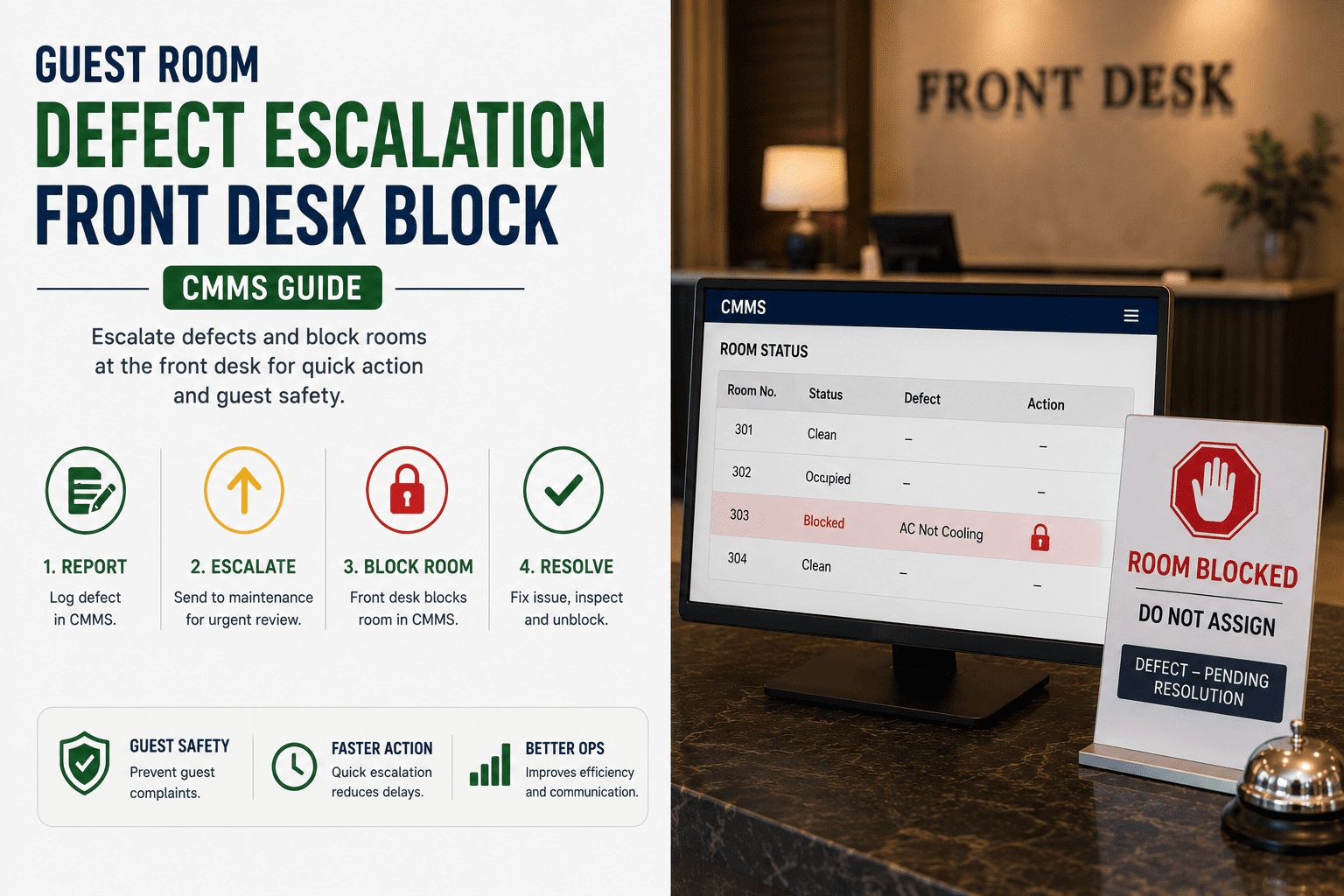
When a defect is severe enough to affect a guest stay, your CMMS should block the room in the PMS automatically — no phone calls, no sticky notes, no missed handoffs. This guide shows the exact escalation rules and integration setup that make blocking happen by default.
One missed block = three nights of lost revenue
Industry data from STR and AHLA puts average daily room revenue at $148 across U.S. properties — but the true cost of selling a defective room is 2.5× to 3× ADR once you factor in comp, guest recovery, online review damage, and churn. The math below is conservative.
The four-tier defect severity model
Every defect logged in the CMMS is auto-classified into one of four severity tiers. Tiers 1 and 2 trigger maintenance routing only; Tiers 3 and 4 push a room block to the PMS within 90 seconds. The thresholds below are the recommended defaults — adjust per property, but keep the block-on-critical-item rule non-negotiable.
| Tier | Severity | Example Defects | PMS Block | SLA Response | Auto-Escalate |
|---|---|---|---|---|---|
| T1 | Cosmetic | Scuffed wall, loose towel hook, chipped tile | No block | 72 hours | No |
| T2 | Minor functional | Dripping faucet, slow drain, noisy fan | No block | 24 hours | If unresolved 48h |
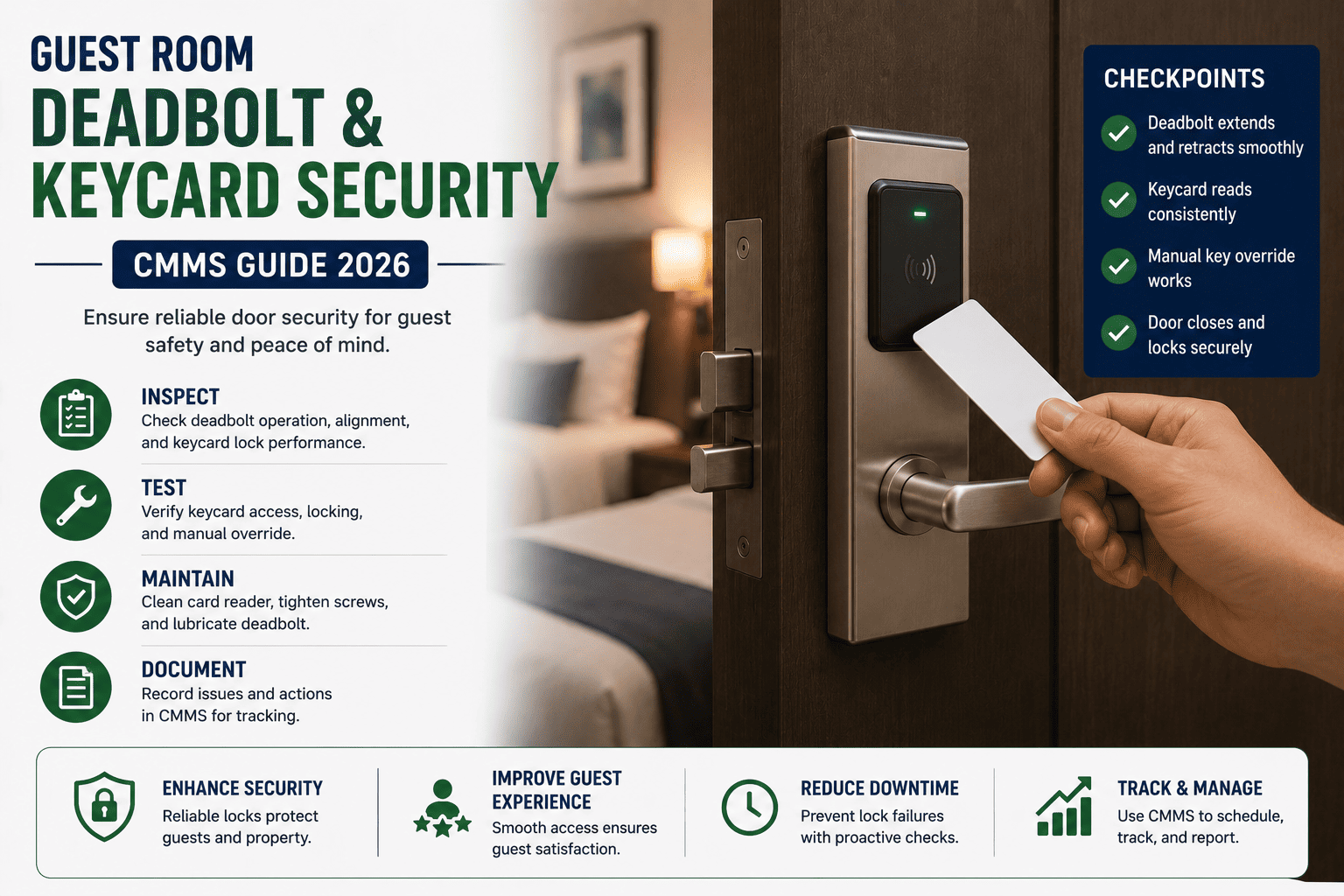
| T3 | Stay-affecting | AC failure, no hot water, safe jammed, broken lock | OOS block (sellable next day if fixed) | 4 hours | Yes — immediate |
| T4 | Critical / safety | Sewage backup, electrical fault, gas leak, flood | OOO block (hard hold) | 30 minutes | Yes + GM + Eng. Mgr |
How the defect-to-block signal flows
The integration rests on a two-way handshake: the CMMS writes the room status (OOO / OOS) into the PMS via API or interface, and the PMS returns the current sellable inventory so the CMMS never blocks a room that doesn't exist. The four steps below run automatically once configured — no human handoff required.
Defect logged
Housekeeping, engineering, or the guest-app channel tags a defect with a category code (HVAC, PLUMB, ELEC, SAFE, LOCK, SANI). The CMMS assigns a severity tier based on the category + keyword scan of the description.
Tier evaluated
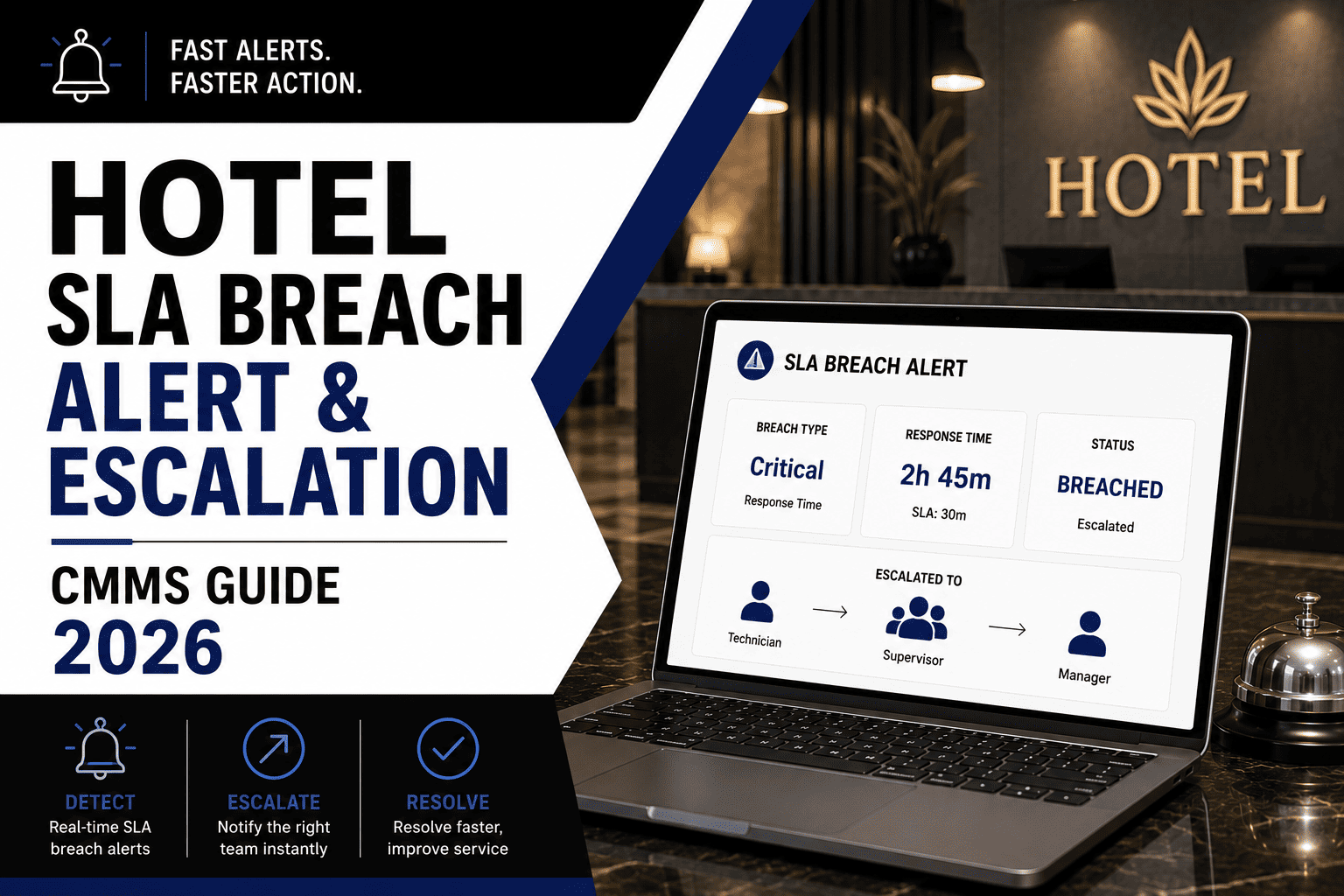
If tier = T3, CMMS opens an OOS work order. If tier = T4, CMMS opens an OOO work order and fires parallel alerts to the Chief Engineer, GM, and Front-Office Manager via push, SMS, and email.
PMS block pushed
CMMS calls the PMS room-status endpoint within 90 seconds. PMS flips the room to OOO/OOS, removes it from sellable inventory, and returns a confirmation token the CMMS stores against the work order.
Release on close
When the tech closes the work order with a "verified-fixed" status, CMMS sends a release signal. PMS returns the room to clean/inspect, and housekeeping is dispatched for a final QC pass before sellability.
The 8-field configuration that makes blocking automatic
Most CMMS platforms can do this — the failure is in configuration, not capability. These eight fields must be set per room-type and per defect-category so the system knows exactly when to block, whom to notify, and when to release.
1 · Severity matrix
Map each defect category to a default tier. Override allowed only by a supervisor-level login. Lock the T3/T4 thresholds — never let a frontline user downgrade a critical item.
2 · PMS endpoint map
Define the room-status API endpoint, auth token, and field names for OOO and OOS. Test the round-trip in a sandbox room before going live. Log every write for audit.
3 · Notification roster
T3 = Chief Engineer + Front-Desk Supervisor. T4 = add GM + Director of Operations. Use role-based routing so staff changes don't break the chain.
4 · SLA timers
T3 = 4-hour resolution target. T4 = 30-minute acknowledgement, 4-hour mitigation. Auto-escalate to next tier if SLA breaches — never let a defect age silently.
5 · Release protocol
Work order must close with a photo + supervisor sign-off before the PMS release fires. No exceptions — a verbal "it's fixed" is how rooms get re-sold with the same defect.
6 · Duplicate guard
If a defect is logged on a room already in OOO/OOS for the same category, merge into the existing work order. This stops three techs from responding to the same AC failure.
7 · Displacement log
Track every guest moved due to a defect — room number, new room, comp value, defect ID. This feeds the monthly cost-of-defects report that justifies the CMMS spend.
8 · Audit trail
Every status change (logged, blocked, acknowledged, fixed, released) is timestamped and user-stamped. Exportable for brand-compliance audits and insurance claims.
What the front desk sees — and does — at each tier
The front desk is the last line of defense. Even with full automation, agents need a clear visual on blocked rooms and a 60-second protocol for guest-facing communication. The checklist below is what a trained agent follows when the PMS flags a blocked room at check-in.
At pre-arrival (daily 7 AM)
- Review the CMMS-blocked room report; confirm none are assigned to arriving guests.
- Verify OOO rooms are not in the sellable inventory snapshot for the day.
- Flag any T3 room expected to clear by 4 PM as "conditional" — reassign guest if SLA is at risk.
At check-in (live)
- If a room blocks mid-check-in, never walk the guest to the desk — pre-block the replacement room first.
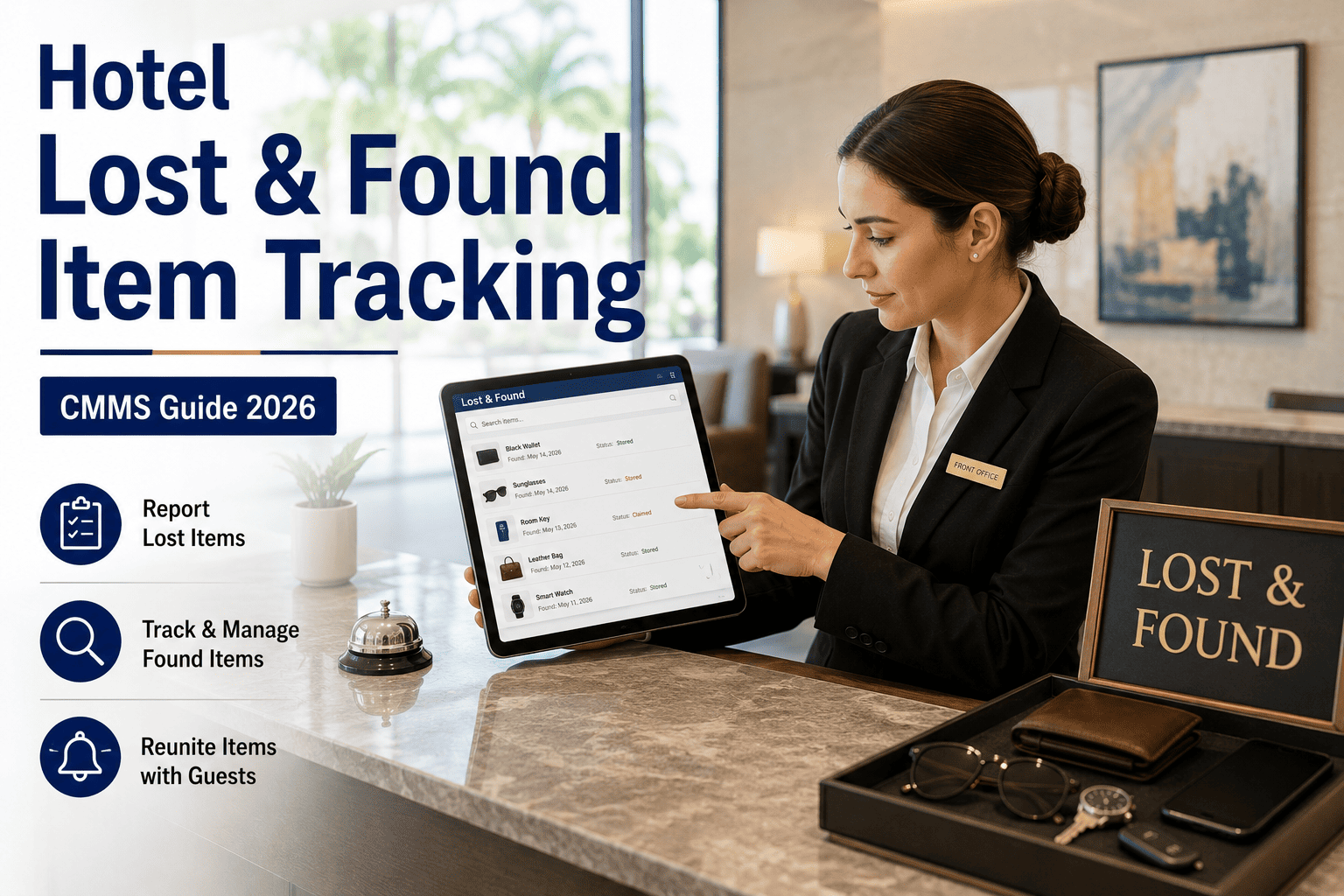
- Log the displacement in the CMMS displacement module with the defect ID for cost tracking.
- Offer upgrade or F&B credit proactively — recovery cost is 40% lower when initiated by staff, not the guest.
At release (engineering close)
- Confirm the CMMS work order shows "verified-fixed" with photo before accepting the PMS release.
- Dispatch housekeeping for a 15-minute QC pass; do not return to sellable until QC clears.
- Log total block duration — if > 24 hours, flag for the weekly engineering review.
What a 180-room property saves in year one
A conservative model based on STR average ADR ($148), a 68% occupancy, and a 3.2 weekly T3/T4 defect rate. Numbers assume the CMMS catches 95% of blockable defects (vs. ~80% manual) and cuts average resolution time by 35%.
| Cost / Savings Line | Manual (baseline) | CMMS with auto-block | Annual Delta |
|---|---|---|---|
| Comped nights from sold-defective rooms | $28,800 | $3,600 | +$25,200 |
| Guest recovery (F&B, upgrades, points) | $11,200 | $4,100 | +$7,100 |
| Engineering labor on duplicate/repeat defects | $18,500 | $9,200 | +$9,300 |
| Review-score impact (RevPAR drag, est.) | $22,000 | $6,500 | +$15,500 |
| CMMS platform cost | $0 | -$6,400 | -$6,400 |
| Net annual impact | $80,500 | $29,800 | +$50,700 |
Stop selling broken rooms — automate the block.
Wire your CMMS to your PMS and turn every T3/T4 defect into an automatic room block, work order, and notification chain. Most properties go live in under 14 days.
Guest room defect escalation, answered
What is the difference between OOO and OOS in a CMMS-PMS integration?
OOO (Out-of-Order) is a hard hold — the room is unsellable for at least one full night and typically requires engineering intervention plus housekeeping QC. OOS (Out-of-Service) is a soft hold — the room can return to sellable inventory the same day once the defect is fixed and verified. A T4 defect (sewage, electrical fault) should always trigger OOO; a T3 defect (AC failure, no hot water) typically triggers OOS with a 4-hour resolution SLA.
How fast should the CMMS push a block to the PMS after a defect is logged?
The industry benchmark is under 90 seconds for T3 and T4 defects. The window matters because central reservations systems and OTAs can pull inventory in near real-time — if the block lags by even 5 minutes, a room may get assigned to an arriving guest or sold online. Configure your CMMS to fire the PMS write call the moment the severity tier is assigned, not after a technician acknowledges the work order. You can validate this latency by Book a Demo and running a live sandbox test.
Which PMS systems support real-time room-status integration with a CMMS?
Most major PMS platforms — Opera Cloud, Mews, Cloudbeds, Stayntouch, Protel — expose a room-status API or interface that supports OOO/OOS writes. Older on-premise systems may require a flat-file or TCP/IP interface with a polling interval of 5 to 15 minutes, which is acceptable for T1/T2 defects but risky for T3/T4. If your PMS lacks real-time capability, prioritize an upgrade or middleware layer before configuring auto-block.
Can a front-desk agent override an automatic room block?
They should not be able to. The release must come from the CMMS work order, tied to a verified-fixed status with photo evidence and a supervisor sign-off. If your workflow allows front-desk agents to manually unblock a room in the PMS, you have a gap — a guest will eventually be walked into a defective room. Lock the release path to engineering and housekeeping QC only.
What metrics should we track to prove the CMMS auto-block is working?
Track four KPIs monthly: (1) block-to-PMS latency — target under 90 seconds; (2) defects sold despite a block — target zero; (3) average OOO/OOS duration — target under 18 hours for T3, under 8 hours for T4; (4) displacement cost per defect — target under $60, down from the $180 baseline. If any KPI drifts, the integration or the severity matrix needs recalibration. Log everything to the audit trail for brand-compliance reviews.
Close the loop between defect and block today.
Configure severity tiers, PMS endpoints, and release protocols in one platform — built for hotels that refuse to sell broken rooms.
Free 14-day trial · No credit card