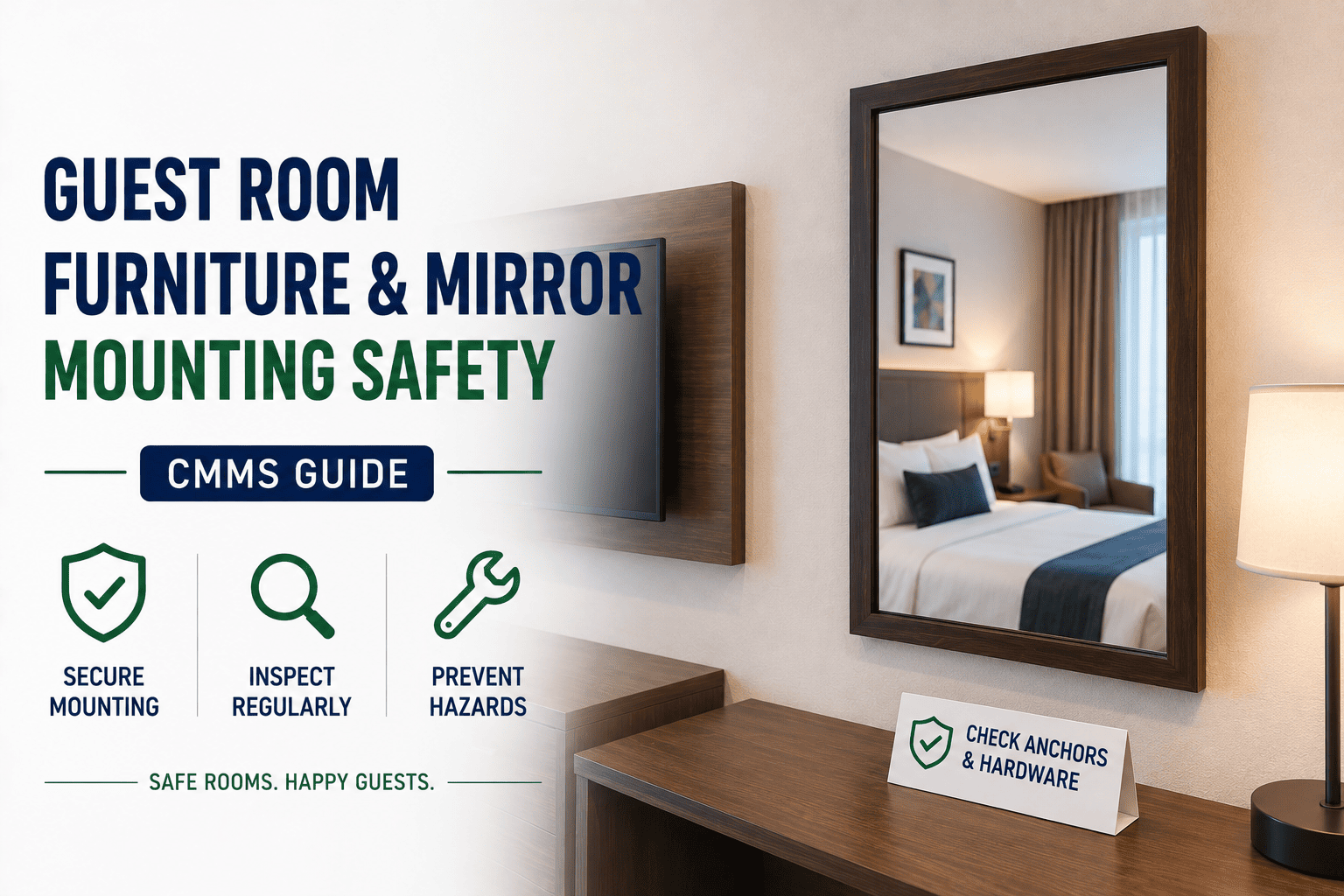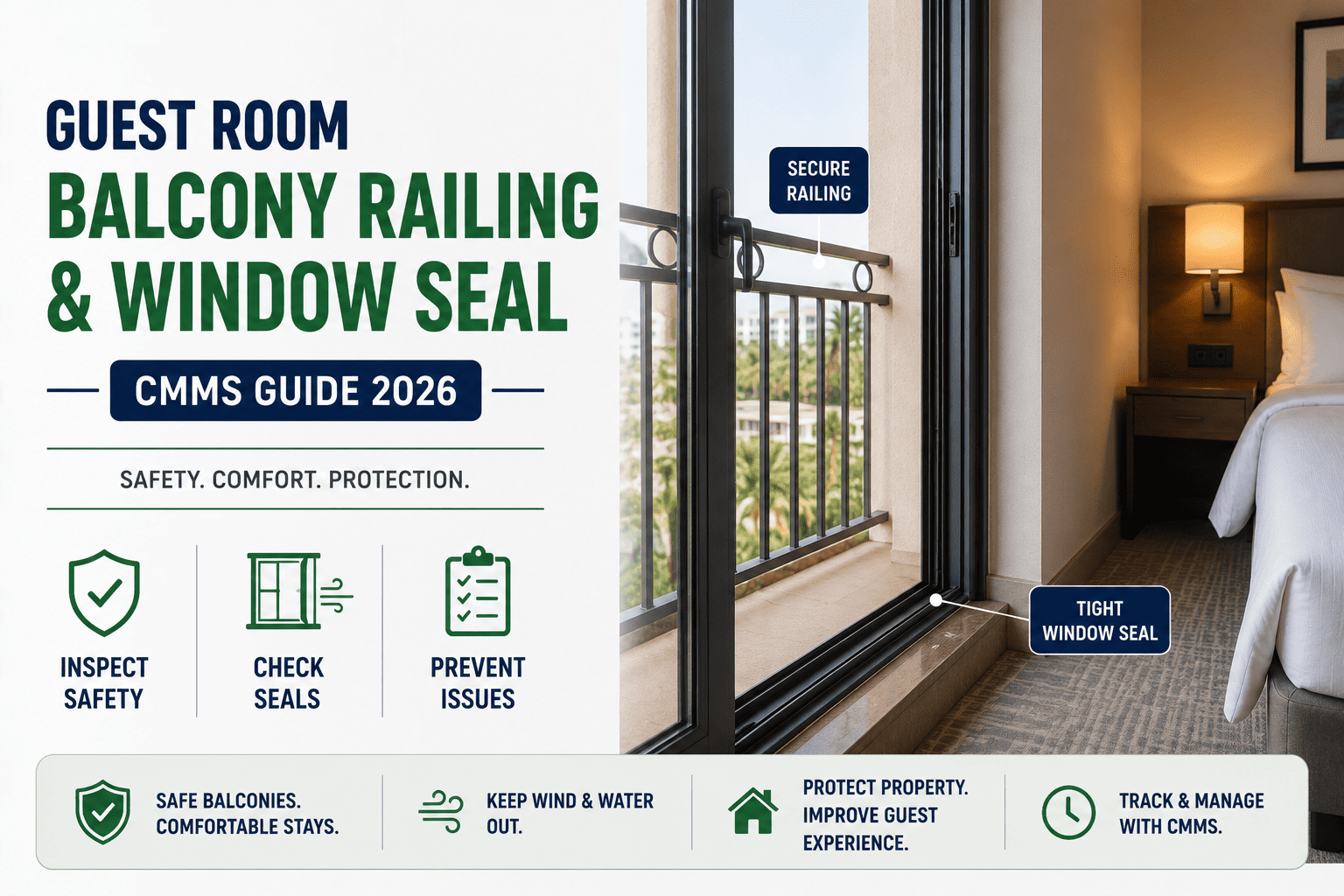
Balcony railings and window seals are the two life-safety and energy items most hotel engineering teams touch only during a property renovation — yet between renovations they quietly absorb wind, salt, UV, and thousands of guest interactions that degrade them month over month. A single failed railing post can cost a property seven figures in liability exposure, while a compromised window weatherstrip silently leaks conditioned air and inflates guest-room HVAC loads by 18–25%. This 2026 guide walks engineering and operations leaders through a CMMS-driven preventive maintenance program for guest room balconies and windows: railing outward-force load testing at the posts, weatherstrip integrity checks, fall-hazard remediation workflows, and the PM cadence that keeps every exterior opening compliant, efficient, and audit-ready. You can put this entire program into production today when you Start Free Trial on oxmaint.
Is a railing or window seal you have not load-tested this year holding back your next audit?
Most hotels inspect railings and seals only at renovation — leaving a 3-to-5-year blind window where corrosion, UV breakdown, and guest wear create fall hazards and energy bleed long before anyone notices. A CMMS-driven balcony and seal program closes that gap with quarterly outward-force tests, weatherstrip integrity logs, and life-safety remediation tracking on every guest room.
Railings and seals decay on different clocks — and neither waits for renovation
A coastal property turning 180 rooms sees railing fastener corrosion begin in year 2 and weatherstrip compression set in as early as 14 months. By year 4, both are typically out of spec — yet still 18 months from the next capital cycle.
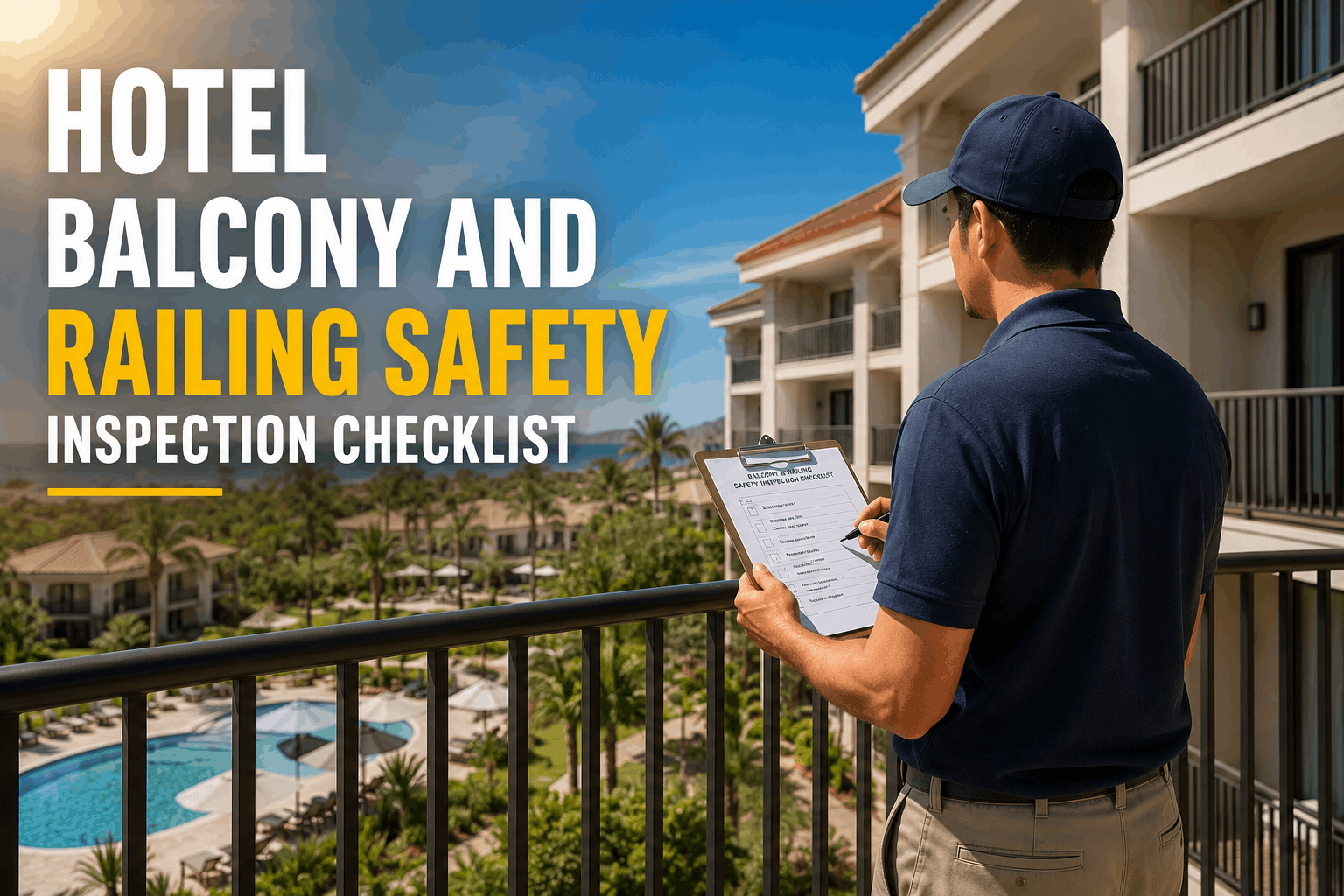
The 2026 guest room balcony railing inspection checklist
Run this 12-point checklist every 90 days on every balcony guest room. Each item logs a pass/fail plus a photo in the CMMS asset record, creating a defensible audit trail.
Post & Anchor Integrity
- Torque-check base-plate bolts to manufacturer spec
- Inspect anchor embedment for spalling or hairline cracks
- Verify no corrosion bloom at the post-to-deck interface
Outward Force Load Test
- Apply 50 lb horizontal load at top rail midpoint; log deflection
- Repeat at each post; flag any deflection exceeding 1.5 in
- Confirm recovery to zero deflection after load release
Infill & Rail Geometry
- Verify no 4-inch sphere passes through any infill gap
- Measure top-rail height ≥ 42 in above finished balcony deck
- Check mid-rail fasteners for backing-out or spinning
Surface & Coating
- Photograph any coating breakdown > 1 in² per rail span
- Probe welds and joints for pitting with a pick tool
- Touch up bare metal within 72 hours of discovery
| Inspection Item | Cadence | Pass Threshold | CMMS Action on Fail |
|---|---|---|---|
| Base-plate bolt torque | Quarterly | ±5% of mfr spec | Auto-generate work order |
| Outward force at top rail | Quarterly | ≤ 1.5 in deflection @ 50 lb | Tag room out-of-service |
| Infill sphere test (4 in) | Quarterly | No passage | Priority-1 remediation |
| Top-rail height | Annual | ≥ 42 in above deck | Capital project request |
| Coating integrity | Quarterly | No break > 1 in² | 72-hour touch-up WO |
| Weld joint pitting | Annual | 0 visible pits | Engineering review |
Weatherstrip integrity check — the energy item hiding in plain sight
A degraded perimeter weatherstrip on a single balcony door leaks enough conditioned air to add $90–$140 per room per year in HVAC cost across a cooling season. At 180 balcony rooms that is $16K–$25K in preventable energy bleed — every year, silently.
Baseline seal audit
Run a dollar-bill drag test on every operable window and balcony door. Log drag resistance on a 1–5 scale and photograph each perimeter. Establish the CMMS asset record with baseline readings, gasket type, and install date.
First integrity recheck
Re-run the drag test on high-cycle rooms (balcony floors, street-facing corners). Any reading that drops 2 points from baseline triggers an auto-generated weatherstrip replacement work order in the CMMS.
Thermal imaging scan
Walk corridors and exteriors with a thermal camera at dawn. Flag any window showing a perimeter temperature delta > 8°F versus the glazing center — that is a seal failure, not just weatherstrip wear, and needs gasket plus sealant remediation.
Annual sealant & gasket replacement
Bulk-replace weatherstrips on every room flagged twice during the year. Re-baseline the CMMS record. Compare aggregate HVAC kWh against the prior year to quantify savings — most properties see a 6–11% guest-floor energy reduction.
A 180-balcony-room coastal property: the cost of waiting vs. acting
Consider a 180-room beachfront hotel running on a reactive model — inspections only at renovation. Below is the math on what that blind window actually costs, and what a CMMS balcony-and-seal program returns in year one.
Fall-hazard remediation: from failed load test to room-safe in 72 hours
When a railing fails the 50 lb outward-force test or an infill gap exceeds the 4-inch sphere rule, the CMMS must trigger a closed-loop remediation workflow — not just a work order. Here is the sequence that keeps guests safe and the property defensible.
Auto-tag the room out-of-service
The failed inspection record instantly flips the room status in the PMS integration, blocks new assignments, and notifies the front desk and GM within 60 seconds. The balcony door is keyed to deadbolt-only until cleared.
Dispatch engineered remediation
A Priority-1 work order routes to the qualified structural vendor with the load-test photo, deflection measurement, and anchor detail pre-attached. No phone calls, no missing context — the vendor arrives with everything needed to assess and repair.
Re-test and clear to service
After repair, the same 50 lb outward-force test is re-run by hotel engineering — not the vendor — and the new deflection reading is logged against the original record. Only a passing result clears the room back to sellable status.
Escalate systemic patterns
If three or more posts on the same balcony stack fail within a quarter, the CMMS auto-generates a capital project request for that elevation — because repeat failures signal a systemic anchor or substrate problem, not isolated wear.
Turn every balcony and window into a logged, compliant asset
Roll out the full railing load-test, weatherstrip, and remediation program across your property in under a week. Your audit trail, energy savings, and liability posture all improve on day one.
Balcony railing & window seal CMMS — your questions answered
The five questions engineering directors and GMs ask most before launching a guest room balcony and window seal PM program.
How often should balcony railings be load-tested in a hotel?
Every 90 days for coastal and high-wind properties, and at minimum semi-annually for inland hotels. The 50 lb outward-force test at the top rail should be applied at each post, with deflection logged in the CMMS. Any reading exceeding 1.5 inches of deflection — or failure to return to zero after load release — triggers immediate room out-of-service status. You can stand up the full quarterly cadence in oxmaint when you Start Free Trial.
What is the dollar-bill drag test for window weatherstrips?
Close a standard dollar bill in the closed window or balcony door at the perimeter gasket and pull it outward. A healthy weatherstrip holds the bill with noticeable resistance; if it slides out with light pressure, the gasket has taken a compression set and needs replacement. Log the resistance on a 1–5 scale in the CMMS asset record so you can track degradation over time rather than waiting for a guest complaint.
Which code or standard governs hotel balcony railing strength?
IBC Section 1015.3 requires guardrails to withstand a minimum 200 lb concentrated horizontal load applied at the top rail, with ASCE 7 providing the live load framework. Most hotel PM programs use a 50 lb field test as an early-warning proxy — it will not prove full code compliance, but it catches the anchor loosening and substrate degradation that precede a real failure well before a code-level load test would be required.
Can a CMMS really reduce guest-room HVAC energy from seal fixes?
Yes. Properties that baseline weatherstrip integrity, replace degraded gaskets within the year, and log thermal-scan results in the CMMS typically see a 6–11% reduction in guest-floor HVAC kWh. The key is the closed loop — the CMMS auto-generates the replacement work order the moment a drag-test reading drops, so the fix happens in days, not at the next renovation cycle. Book a walkthrough at calendly.com/oxmaintapp/30min to see the energy reporting dashboard.
What happens if a railing fails the load test while a guest is in the room?
The CMMS immediately flips the room to out-of-service, deadbolts the balcony door from the PMS integration, and notifies the front desk and GM within 60 seconds. A Priority-1 structural work order routes to the qualified vendor with the test photo and deflection data pre-attached. After repair, hotel engineering re-runs the same 50 lb test and logs the new reading before the room returns to sellable status — the vendor never clears their own work.
Every railing tested. Every seal logged. Every room compliant.
Deploy the full guest room balcony railing and window seal CMMS program across your property this week. Load-test templates, weatherstrip drag-test logs, remediation workflows, and energy-savings dashboards are ready out of the box.
Free 14-day trial · No credit card