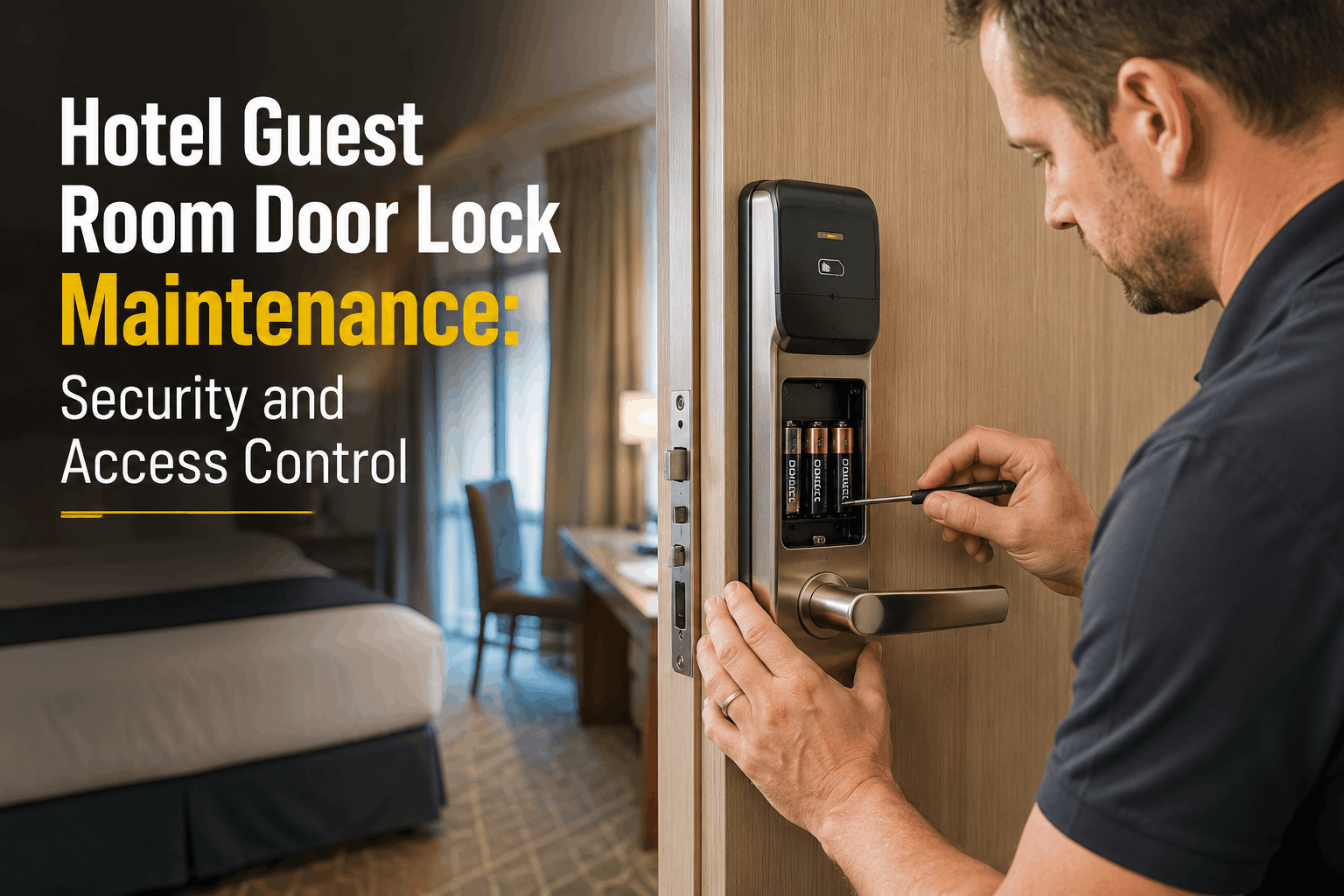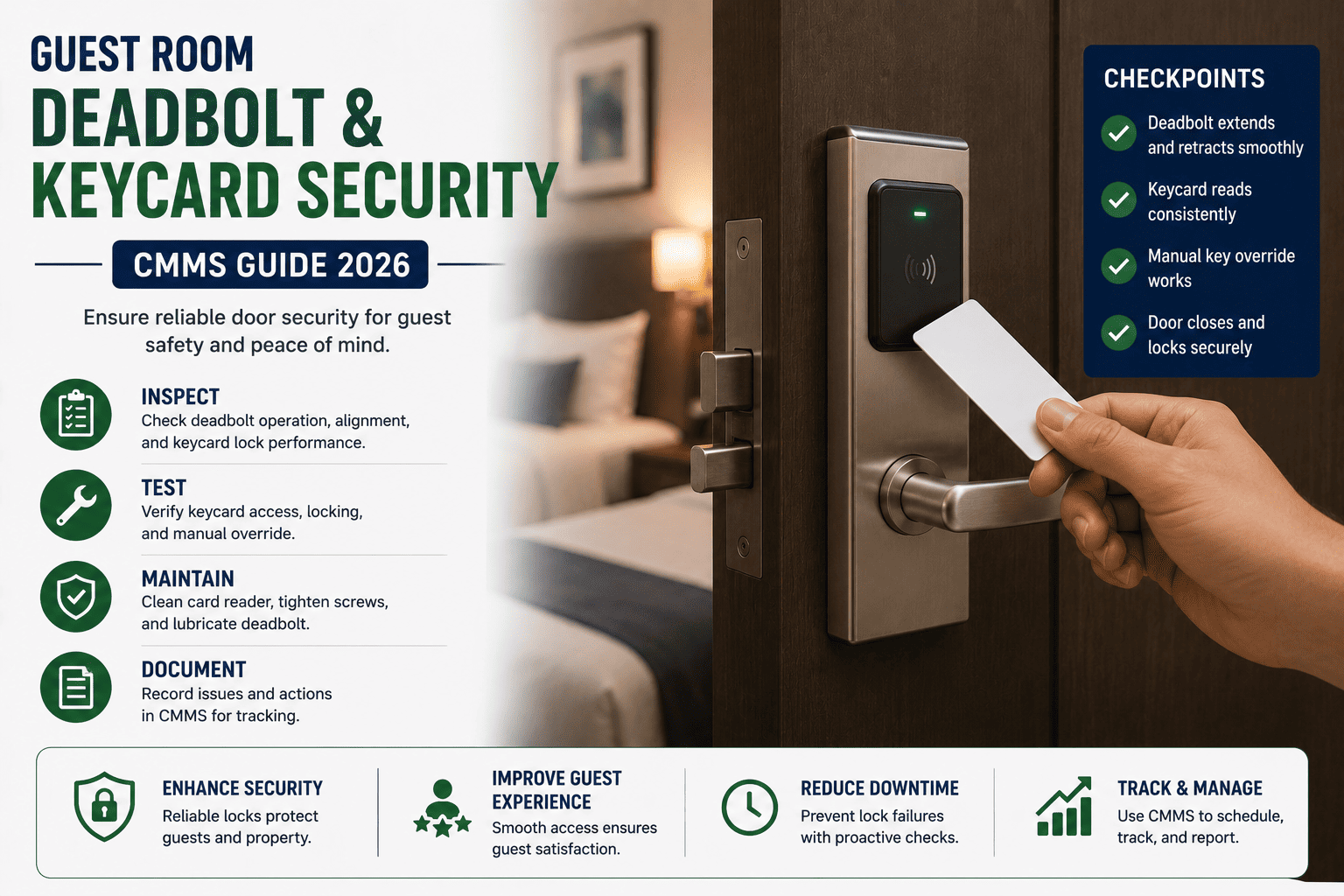
Guest room locks are not a maintenance line item — they are the legal and operational perimeter of your property. A deadbolt that throws misaligned, a keycard reader with a drifting battery, or a self-closer that slams short of the latch is an incident report waiting to be filed, and in 2026 every one of those failures is logged, timestamped, and reviewed during audit. This guide lays out a CMMS-driven security testing program for deadbolts, keycard readers, ancillary latches, and self-closers, covering PM intervals, battery management, reader diagnostics, and the audit evidence trail that keeps a property defensible. If you want to skip ahead to deployment, you can Start Free Trial and import the full lock PM template library today.
One failed keycard reader is a security incident — not a maintenance ticket.
Most guest room lock failures are predictable: a 3.6V battery sagging below 2.8V, a deadbolt throw drifting 2mm off strike alignment, or a reader antenna losing range after 14 months without a diagnostic sweep. A CMMS-built security PM program catches all three before the guest ever touches the door.
The cost of treating lock failures as ad-hoc tickets
A 220-room property running break-fix lock maintenance averages 11.4 unplanned lock calls per week — each one consuming 26 minutes of technician time and, in 1 of every 9 cases, escalating to a guest relocation or comp night.
Average annual cost of lock-related guest incidents (comp nights, relocations, liability holds) at a mid-size hotel without a structured lock PM program.
Typical interval before a keycard reader antenna loses reliable range without a diagnostic sweep — well inside a 24-month preventive cycle but outside most break-fix radars.
Voltage threshold below which most RFID and magstripe keycard readers begin rejecting valid credentials. A CMMS battery-schedule trigger fires at 3.0V — 2 to 3 weeks of margin.
Lock security audit pass rate at properties running quarterly CMMS-scheduled deadbolt, reader, and self-closer PM — versus 61% at break-fix properties.
A single failed keycard lock on an occupied room is a security incident that the property must disclose, document, and remediate within a defined window. There is no maintenance-only path through that failure.
— Hotel Security & Life-Safety Audit Framework, 2026 revisionTiered guest room lock inspection grid
Each PM tier below maps to a CMMS work-order template with photo capture, voltage reading, and technician sign-off fields. The full library is importable in one click.
Every Room — Quarterly
- Deadbolt throws full 25mm travel and engages strike cleanly
- Door self-closer latches door from 30° open without slam
- Auxiliary latch (chain/bar) retracts fully and locks under hand pressure
- Keycard reader accepts a valid test card in under 0.8 seconds
- Battery voltage logged in CMMS — flagged at or below 3.0V
- Strike plate screws torqued to spec, no visible backing-out
High-Traffic & Suite — Monthly
- Reader diagnostic sweep via portable programmer — log antenna range
- Deadbolt throw torque measured — replace cylinder at 6N·m drift
- Self-closer sweep speed adjusted to 6–8 second full-close
- Door alignment checked — gap tolerance 3mm top-to-bottom
- Loss-key audit: all issued cards for that room reviewed in PMS
- Lock event log pulled — last 30 days — archived in CMMS
Annual & Audit-Trigger
- Full battery replacement on all readers (scheduled, not reactive)
- Lock firmware version checked and updated where applicable
- Strike and hinge screws removed, re-threadlocked, re-torqued
- Doorframe squareness verified — shims replaced as needed
- Master-key hierarchy reviewed and re-issued on staff turnover
- Full audit packet: photos, logs, sign-offs — generated from CMMS
The two failure modes that cause 80% of lock incidents
Battery sag and reader-antenna drift are slow, silent, and entirely predictable — yet they account for the overwhelming majority of unplanned guest lock calls because no one is logging the data between failures.
Most readers fail below 2.8V. A 3.0V floor gives a 2–3 week margin for scheduled replacement during turn-down. Logging the voltage reading in the CMMS on every quarterly PM creates a degradation curve that lets you forecast room-level replacements before the guest ever sees a slow read.
A healthy RFID reader accepts a valid card at 5–8cm in under 0.8 seconds. Drift below 4cm or a read latency above 1.2s signals antenna degradation or firmware drift — schedule a reader swap before the card starts requiring a "second tap," which is the guest-visible failure that triggers a call.
Worked scenario — 180-room business hotel
Break-fix model. Average 9.2 unplanned lock calls per week. Battery failures accounted for 54% of those calls, reader drift another 22%. Annual lock-related guest comp cost: roughly $41K. Audit pass rate on unannounced quarterly review: 63%.
CMMS quarterly PM cycle with battery-voltage logging and reader diagnostic sweeps. Unplanned lock calls dropped to 2.1 per week. Comp cost fell to $9.4K annualized. Audit pass rate on the same unannounced review: 94% — with full photo and sign-off evidence attached to every room.
CMMS-driven preventive maintenance calendar
A defensible lock security program is not a checklist — it is a schedule with assigned owners, photo evidence, and an audit-ready trail. Here is what the 12-month cycle looks like inside the CMMS.
Full lock inventory & baseline PM
Every room gets a Tier 1 + Tier 2 sweep. Battery voltages logged, reader ranges measured, deadbolt travel recorded. CMMS auto-generates the asset register with room-level lock IDs.
Exception-only intervention
CMMS flags any room whose baseline readings were borderline (V < 3.1V, range < 5cm). Those get a targeted re-check. Everything else runs on guest-reported exceptions only.
First scheduled quarterly sweep
Full Tier 1 inspection on all rooms. CMMS compares readings to Month 1 baseline — any degradation trend is flagged for early battery or reader replacement rather than waiting for failure.
High-traffic room monthly cycle
Suites, ADA rooms, and high-turnover floors get monthly Tier 2 sweeps. The CMMS routes these automatically based on room-type tags — no manual scheduling required.
Second quarterly sweep + mid-year audit
Repeat Tier 1 plus an internal audit packet pull. The CMMS generates a room-by-room evidence report with photos, voltages, and sign-offs — the same packet a third-party auditor would request.
Full battery replacement & firmware audit
Every reader gets fresh batteries regardless of voltage reading. Firmware versions checked and updated. Master-key hierarchy re-issued. The CMMS closes the year with a complete audit-defensible record.
What a CMMS lock record must contain to survive an audit
An auditor does not care that you inspected a lock — they care that you can prove it. The table below defines the minimum record fields every lock PM work order must capture inside the CMMS.
| Record Field | Required Format | Audit Purpose | CMMS Behavior |
|---|---|---|---|
| Room / Lock ID | Room number + lock serial | Traceability to physical asset | Auto-pulled from asset register |
| Inspection Date | ISO 8601 timestamp | Frequency compliance proof | System-stamped, not editable |
| Battery Voltage | Numeric, 2 decimal places | Predictive replacement evidence | Auto-flag at ≤ 3.0V |
| Reader Range | Centimeters, integer | Antenna health verification | Auto-flag at < 4cm |
| Deadbolt Travel | Millimeters, integer | Mechanical security proof | Auto-flag at < 23mm |
| Photo Evidence | Strike, bolt, reader — 3 min | Visual condition verification | Required to close work order |
| Technician Sign-off | Named user, timestamped | Accountability chain | PIN or biometric capture |
| Exception Notes | Free text + follow-up WO | Remediation traceability | Auto-spawns child work order |
Stop running lock security on break-fix tickets.
Deploy a CMMS-built lock PM program with battery forecasting, reader diagnostics, and audit-ready evidence capture in under a day.
Guest room lock security CMMS — common questions
How often should guest room deadbolts be tested under a CMMS schedule?
Standard guest rooms should receive a Tier 1 deadbolt and lock inspection quarterly — full bolt travel measurement, strike engagement check, and self-closer function test. High-traffic rooms, suites, and ADA rooms should be on a monthly Tier 2 cycle that adds reader diagnostic sweeps and deadbolt torque measurement. Annual PM covers full battery replacement, firmware audit, and master-key hierarchy review regardless of quarterly readings.
What battery voltage triggers a keycard reader replacement in the CMMS?
Set the CMMS flag at 3.0V — most readers begin rejecting valid credentials below 2.8V, so a 3.0V floor gives a 2 to 3 week scheduling margin. Log voltage on every quarterly PM so the system builds a degradation curve per room. When a reader crosses 3.0V the CMMS auto-generates a replacement work order rather than waiting for the guest to report a slow read. To see the full battery-forecast workflow, Start Free Trial and import the lock PM template.
Can a CMMS really make lock maintenance audit-defensible?
Yes — the key is that every PM work order captures a system-stamped timestamp, battery voltage, reader range, deadbolt travel, three photos, and a named technician sign-off. When an auditor requests proof of a specific room's lock inspection on a specific date, the CMMS generates that packet in seconds. Properties running this model report 92%+ audit pass rates versus 61% under break-fix.
What is the single most common lock failure a CMMS prevents?
Battery sag — it accounts for over half of all unplanned lock calls at break-fix properties. The failure is silent, predictable, and entirely preventable with voltage logging. The second most common is reader antenna drift, which causes "second tap" card reads long before a full failure. Both are caught by a quarterly CMMS PM that logs voltage and reader range.
How long does it take to deploy a lock security CMMS program?
A 180-room property can complete the Month 1 baseline sweep and have the full 12-month PM schedule live in 5 to 7 working days, assuming the asset register is imported and technicians are trained on the mobile app. The lock PM template library, battery-forecast triggers, and audit packet generator are pre-built — you can Book a Demo to see a staged deployment walkthrough.
Build a lock security program that holds up under audit.
Pre-built lock PM templates, battery forecasting, reader diagnostics, and one-click audit packets — live in your property inside a week.
Free 14-day trial · No credit card