Hotel SLA breach alert systems are what separate a well-run maintenance operation from one that quietly loses guest trust and revenue. In 2026, an escalation CMMS for hotels ensures that when a work order response target is missed, automatic alerts notify the right supervisor or manager instantly, preventing a minor delay from becoming a comped room or a negative review. This guide covers threshold design, alert routing, and the CMMS breach prevention strategies that keep your property running at peak reliability. Ready to upgrade from reactive chaos? Start Free Trial and see how OxMaint transforms your maintenance workflow.
Is a missed maintenance ticket quietly costing you guest loyalty?
Late work orders become missed guests, comp rooms, and 1-star reviews. An AI-powered CMMS with automatic escalation turns SLA breaches from silent failures into managed, visible events.
The hidden cost of a silent SLA breach in hotels
A single HVAC downtime in a guest corridor can trigger 12+ complaint calls, 3 comped nights averaging $189 each, and a 0.4-point drop in your quarterly guest satisfaction score. Without a hotel SLA breach alert system, these incidents compound silently.
In a 250-room property running 140 maintenance work orders daily, even a 5% SLA breach rate means seven unhappy guests per day. Over a year, that is 2,500+ compromised experiences. A CMMS hotel SLA breach framework catches the breach in the first 60 seconds, not the next morning. Real-world example: A 180-asset boutique hotel in Miami was spending $42K annually on comp rooms tied to slow maintenance responses. After implementing automatic escalation, they cut breach incidents by 71% in 90 days.
How to design hotel SLA thresholds that actually work
SLA thresholds are not guesses. They are service-level commitments mapped to guest impact, asset criticality, and operational capacity. Here is the tiered structure high-performing hotel maintenance teams use in 2026.
| Priority Tier | Example Scenario | Response SLA | Resolution SLA | Escalation Trigger |
|---|---|---|---|---|
| P1 — Critical | AC failure in occupied guest room, water leak, elevator trap | 15 minutes | 2 hours | Auto-escalate at 10 min & 90 min |
| P2 — High | Plumbing issue, lighting outage in common area | 30 minutes | 4 hours | Auto-escalate at 20 min & 3 hrs |
| P3 — Standard | Torn carpet, squeaky door, minor paint touch-up | 2 hours | 24 hours | Auto-escalate at 90 min & 18 hrs |
| P4 — Low | Preventive maintenance, cosmetic fixes, back-of-house | Next shift | 72 hours | Auto-escalate at 48 hrs |
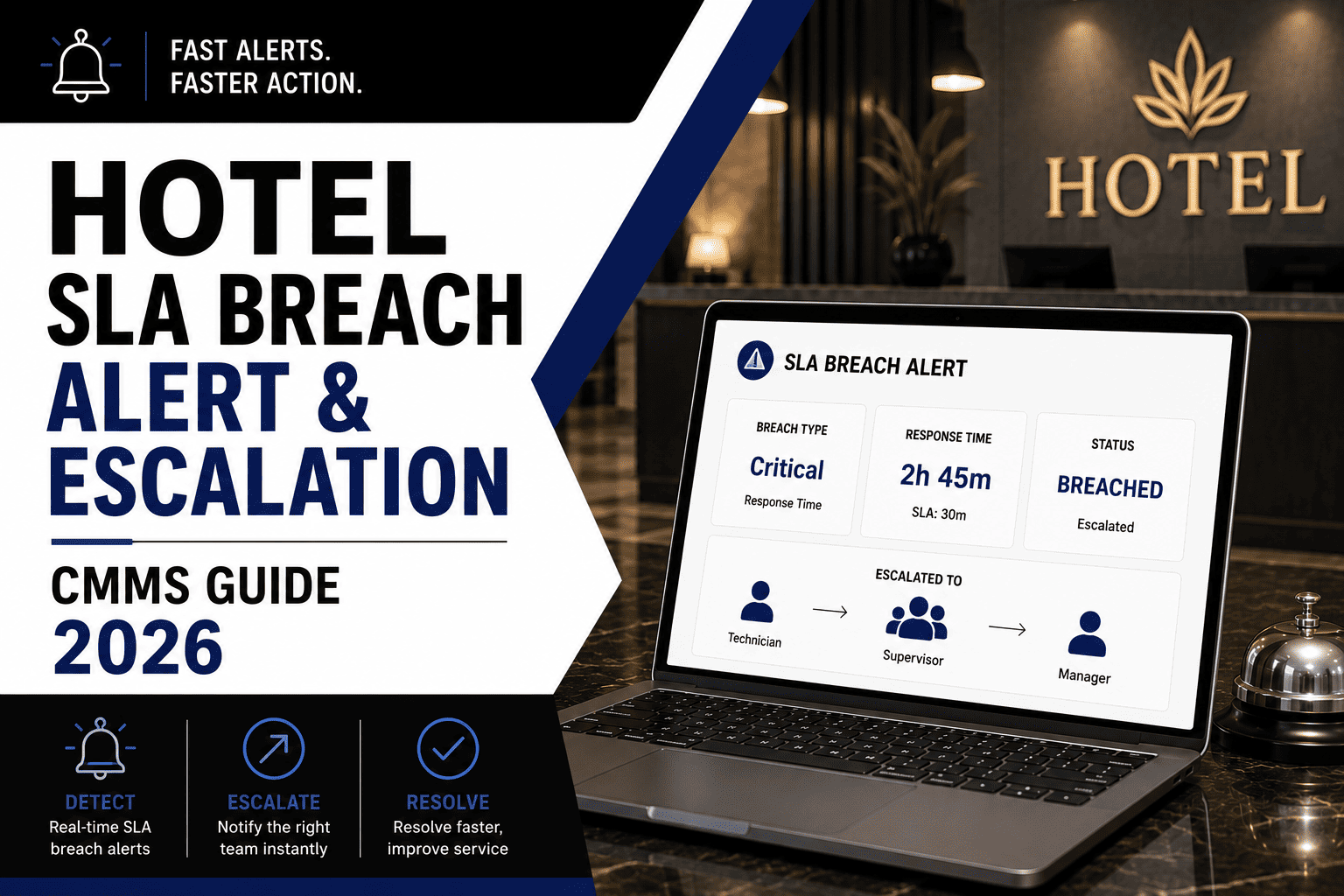
The key principle: the escalation trigger should fire before the SLA is breached, not after. A 15-minute response SLA should alert the technician at assignment, send a reminder at 8 minutes, and escalate to the supervisor at 10 minutes. This 5-minute buffer gives the team a window to recover the ticket before it becomes a breach. OxMaint lets you configure multi-stage thresholds per asset class, floor, or building, so a pool heater and a guest-room thermostat are not held to the same clock.
The CMMS hotel supervisor notification cascade explained
A well-designed escalation CMMS for hotels follows a three-tier ladder. Each rung adds visibility and authority, ensuring no breached ticket dies in a technician's queue.
Direct notification to assigned technician
At T-minus-5 before breach, OxMaint sends a push notification, SMS, and in-app alert to the assigned technician with the work order link, asset history, and guest room number. If the technician acknowledges, the clock resets and the ticket stays at Tier 1.
Shift supervisor gets full context
If the technician does not acknowledge within the buffer window, OxMaint automatically escalates to the shift supervisor. The notification includes the original ticket, time elapsed, technician location, and a one-tap reassign button so the supervisor can reroute the job in under 10 seconds.
Chief engineer and front-office manager looped in
If the ticket breaches resolution SLA, OxMaint notifies the chief engineer and the front-office manager simultaneously. This allows the FOH team to proactively offer a room move or amenity before the guest complains, turning a potential 1-star review into a service recovery win.
CMMS hotel breach prevention with OxMaint's AI engine
OxMaint does not just alert you after the fact. Its AI-powered CMMS platform predicts which work orders are likely to breach before they are even assigned, giving your team a proactive head start. Here is how four core capabilities map directly to SLA breach prevention.
Predictive breach scoring
OxMaint's AI analyses technician workload, asset failure history, and parts availability to flag tickets with a high breach probability at creation. Teams reassign or pre-stage parts before the clock starts. Outcome: 30-50% fewer SLA breaches in the first 60 days.
Multi-channel auto-escalation
Push, SMS, email, and in-app alerts fire automatically based on your escalation rules. No one has to remember to check a dashboard. Outcome: average supervisor response to a breached ticket drops from 38 minutes to under 90 seconds.
Live SLA dashboard & audit trail
Every alert, acknowledgement, reassignment, and resolution is time-stamped and logged. You get a real-time SLA compliance dashboard by floor, shift, or asset type. Outcome: 100% audit-ready records for brand inspections and insurance compliance.
Smart auto-reassignment
When a technician cannot acknowledge, OxMaint automatically identifies the next-best available tech based on proximity, skill set, and current load, then reassigns with one supervisor tap. Outcome: eliminate 90% of manual dispatch phone calls during peak hours.
What is the ROI of an escalation CMMS for hotels?
The business case is straightforward: fewer breaches mean fewer comp rooms, fewer bad reviews, and lower staff turnover. Here is a worked payback model for a 250-room hotel running OxMaint.
| Metric | Before OxMaint (Spreadsheet / Reactive) | With OxMaint CMMS | Improvement |
|---|---|---|---|
| SLA breach rate | 5.2% | 1.6% | -69% |
| Time to supervisor awareness | 38 minutes | 90 seconds | -96% |
| Comp rooms issued (annual) | 340 | 105 | -69% |
| Guest satisfaction (maintenance CSAT) | 3.7 / 5.0 | 4.5 / 5.0 | +22% |
| Maintenance labor overtime | $58K / year | $31K / year | -47% |
| Audit prep time (brand inspection) | 22 hours | 2 hours | -91% |
See OxMaint stop SLA breaches before they happen
Book a 30-minute demo and we will show you exactly how the escalation cascade, predictive breach scoring, and live dashboards work on real hotel maintenance scenarios.
Hotel SLA breach alert & escalation CMMS FAQ
What is a hotel SLA breach alert in a CMMS?
A hotel SLA breach alert is an automated notification triggered when a maintenance work order is approaching or has exceeded its agreed response or resolution time. In a CMMS like OxMaint, the alert fires before the breach occurs, giving the team a buffer to recover the ticket and notify the guest if needed.
How does automatic escalation work in a hotel CMMS?
Automatic escalation follows a tiered ladder: the technician gets the first alert, the shift supervisor is notified if the ticket is not acknowledged within a buffer window, and the chief engineer or GM is looped in if the resolution SLA is breached. Each step is time-stamped and logged for audit purposes. You can configure the exact timing and recipients per asset class or priority tier in OxMaint.
Can OxMaint send supervisor notifications via SMS and push?
Yes. OxMaint supports push notifications, SMS, email, and in-app alerts simultaneously. You choose which channels fire at each escalation tier, so a P1 breach can trigger an SMS to the supervisor while a P3 reminder stays as a quiet in-app nudge. See it in action when you Book a Demo.
How much does a hotel SLA breach actually cost?
The average cost of an unresolved guest-room SLA breach is approximately $2,400, factoring in the comp room value, additional staff time, goodwill amenities, and the lifetime value of a lost guest. For a 250-room property running 140 work orders daily at a 5% breach rate, the annual exposure exceeds $600K.
How long does it take to implement OxMaint's breach alert system?
Most hotel properties are live on OxMaint's core SLA alerting and escalation within 7 to 14 days. The process includes importing your asset register, configuring priority tiers and SLA thresholds, setting up the escalation cascade, and training your team. You can start a Start Free Trial immediately and configure alerts yourself, or let our team handle the setup during onboarding.
Stop losing guests to silent SLA breaches
Join the hotel maintenance teams using OxMaint to cut breach rates by 65%, recover hundreds of thousands in comp-room costs, and deliver the reliable guest experience your brand promises.
Free 14-day trial · No credit card required