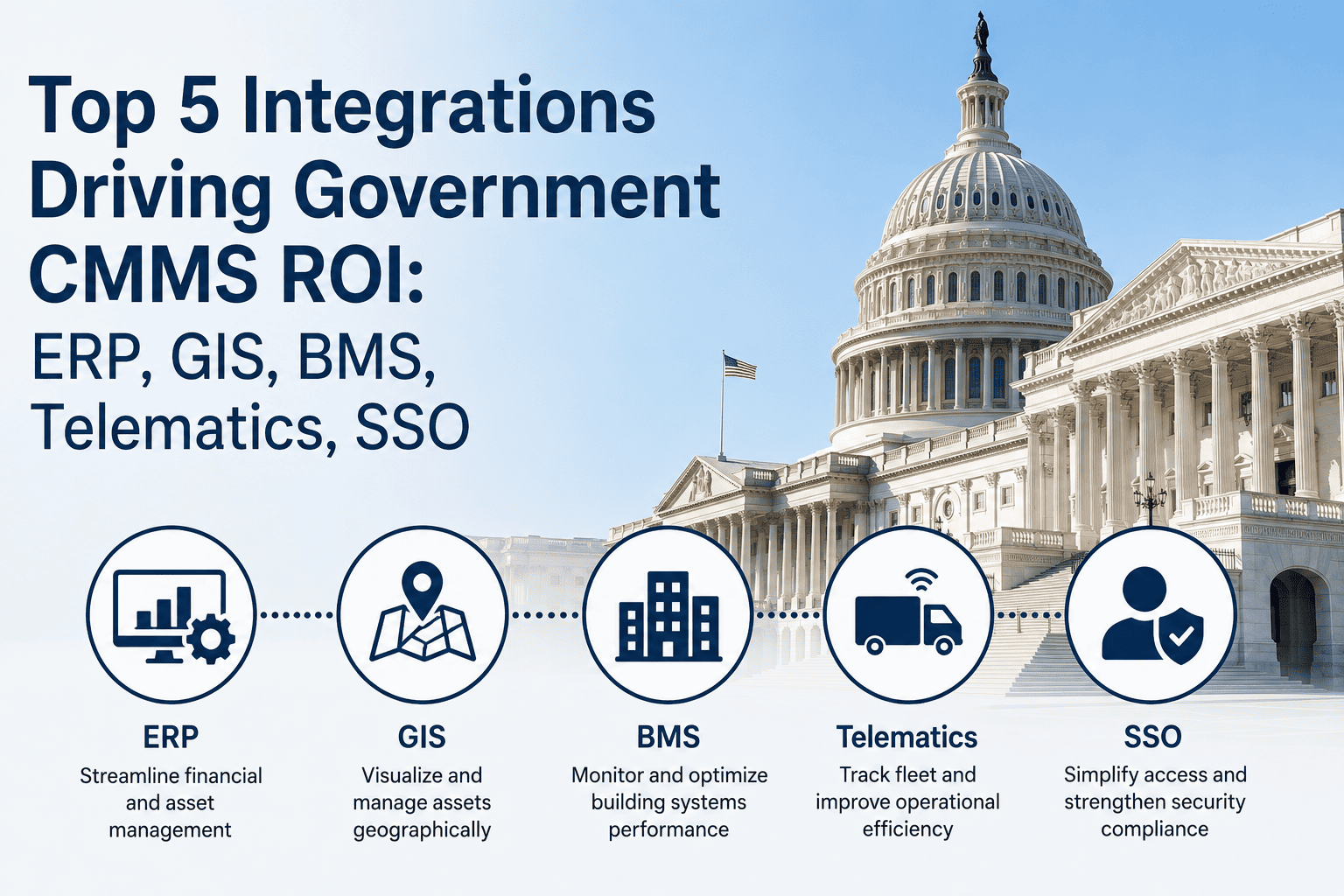
Top 5 Integrations Driving Government CMMS ROI: ERP, GIS, BMS, Telematics, SSO

By James Smith on May 16, 2026

top-5-integrations-driving-government-cmms-roi-erp-gis-bms-telematics-sso

A government CMMS that operates in isolation is a scheduling tool. A government CMMS integrated with ERP, GIS, building management systems, fleet telematics, and single sign-on becomes a financial management and asset lifecycle platform — one that connects maintenance actions to budget lines, geographic assets, building controls, vehicle fleets, and agency identity systems simultaneously. The five integrations below are the ones that consistently deliver the highest measurable ROI for state, federal, and municipal agencies, based on implementation outcomes across public sector CMMS deployments. Explore Oxmaint's integration library or book a 30-minute session to scope the right integrations for your agency's technology environment.

Integration Impact Overview

What Integration Actually Delivers for Government Agencies

3.8x
Average ROI multiplier when CMMS integrates with agency ERP vs standalone deployment
62%
Reduction in duplicate data entry when CMMS and GIS share a common asset record
28%
Fleet maintenance cost reduction achieved through telematics-triggered CMMS work orders
91%
User adoption rate for CMMS platforms with SSO vs 54% for separate credential systems
The Top 5 Integrations

Ranked: The 5 Integrations That Drive the Most Government CMMS ROI

1
ERP Integration — Tyler Technologies, Oracle, Workday, SAP
ROI Multiplier: 3.8x
What It Unlocks

ERP integration connects CMMS work orders directly to purchase orders, vendor invoices, and budget line items. When a CMMS work order for a boiler repair generates an automatic PO in Tyler or Oracle — with the correct cost center, fund code, and vendor number — the agency eliminates manual re-entry, accelerates procurement, and creates an unbroken audit trail from maintenance need to payment.

How to Scope It

Identify which ERP modules you need to connect: procurement (PO generation), financial reporting (cost allocation by asset), and human resources (technician time tracking). A phased integration — starting with PO generation — delivers the fastest ROI and lowest implementation risk.

Key Data Flows
CMMS work order closes → ERP cost entry posted
Parts used in CMMS → ERP inventory adjustment
CMMS budget threshold alert → ERP budget warning
CMMS asset lifecycle data → ERP capital planning
Compatible Systems
Tyler Munis Tyler New World Oracle EBS Workday SAP S/4HANA
2
GIS Integration — Esri ArcGIS, QGIS, Google Maps Platform
ROI Multiplier: 2.6x
What It Unlocks

GIS integration gives every CMMS asset a geographic coordinate — enabling map-based work order dispatch, geographic condition reporting, and spatial analysis of infrastructure deterioration patterns. For DOT, utilities, and large municipal portfolios, GIS-linked CMMS transforms maintenance planning from list-based to spatially intelligent, allowing crews to plan geographically efficient routes and identify clustered deterioration before it becomes systemic.

How to Scope It

Start by syncing the asset register — CMMS asset IDs linked to GIS feature IDs — so both systems refer to the same record. Layer on map-based work order visualization in phase two, and condition-based heat mapping in phase three.

Key Data Flows
GIS asset location → CMMS asset record coordinates
CMMS work order → GIS map pin with status
CMMS condition rating → GIS condition heat map
GIS inspection route → CMMS route-optimized dispatch
Compatible Systems
Esri ArcGIS ArcGIS Online QGIS Google Maps Platform
3
Building Management System (BMS/BAS) Integration
ROI Multiplier: 2.2x
What It Unlocks

BMS integration allows building sensor data — equipment runtime, fault codes, temperature exceedances, and energy consumption anomalies — to automatically trigger CMMS work orders without human intervention. This converts a reactive maintenance model into a condition-based model: the building tells the CMMS when something needs attention, and the CMMS dispatches the right technician with the right parts. Government buildings with BMS integration consistently show 20–35% reduction in unplanned equipment failures.

How to Scope It

Prioritize fault code-to-work-order triggers for HVAC, chiller, and AHU assets first — these are the highest-frequency maintenance drivers. Map fault code descriptions to CMMS task types so auto-generated work orders carry actionable instructions, not raw fault codes.

Key Data Flows
BMS fault code → CMMS corrective work order
BMS runtime hours → CMMS PM trigger update
CMMS repair history → BMS baseline recalibration
BMS energy spike → CMMS investigation task
Compatible Systems
Siemens Desigo Honeywell EBI Johnson Controls Metasys Schneider EcoStruxure
4
Fleet Telematics Integration — Samsara, Verizon Connect, Geotab
ROI Multiplier: 2.0x
What It Unlocks

Telematics integration feeds actual vehicle mileage, engine hours, fault codes, and GPS location directly into CMMS — replacing manual odometer entry and enabling precise, usage-based PM triggers for government fleets. For agencies managing mixed fleets of vehicles, heavy equipment, and special-purpose units, telematics-triggered CMMS eliminates the single most common fleet maintenance failure: PM intervals missed because mileage was never reported.

How to Scope It

Connect telematics to CMMS via API for odometer and engine hours sync first. Layer on fault code translation — converting OBD-II and J1939 codes to maintenance task types — in phase two. Fleet dispatch integration is phase three.

Key Data Flows
Telematics odometer → CMMS PM trigger update
Vehicle fault code → CMMS corrective work order
GPS location → CMMS asset location update
Engine hours → CMMS operating-hour PM trigger
Compatible Systems
Samsara Verizon Connect Geotab Motive Fleet Complete
5
Single Sign-On (SSO) — Microsoft Entra ID, Okta, SAML 2.0
ROI Multiplier: 1.7x (adoption-driven)
What It Unlocks

SSO integration eliminates the separate CMMS login barrier that is, statistically, the number one reason government CMMS implementations fail to achieve adoption. When technicians and supervisors log in with their existing agency credentials, CMMS adoption rates rise from a typical 54% to over 90% — and the data quality improvement from higher adoption generates ROI across every other CMMS function. SSO also satisfies government IT security requirements for privileged access management and multi-factor authentication without requiring separate CMMS-specific MFA configuration.

Key Data Flows
Agency IdP login → CMMS session (no separate credentials)
User role in directory → CMMS permission level auto-assigned
Employee offboarding → CMMS access revoked automatically
Compatible Systems
Microsoft Entra ID Okta SAML 2.0 Google Workspace Ping Identity
Expert Review

Public Sector Technology Leaders on CMMS Integration

"The ERP-CMMS integration was the turning point for our agency. Before integration, our facilities team was logging work in CMMS and our finance team was re-entering the same data in Tyler Munis. We had two records of the same event, and they never agreed perfectly. The moment those systems shared a record, our cost-of-maintenance reporting went from quarterly estimates to real-time actuals."
GN
Gary N., CPFO
Chief Financial Officer, Mid-size Municipal Government
"We implemented SSO for our CMMS in Q1 and by Q3 our active user rate had gone from 58% to 94%. That adoption gain alone justified the integration cost. Every other CMMS metric — PM compliance, work order closure time, asset data completeness — improved as a direct consequence of having more people actually using the system."
TM
Theresa M., CGCIO
Chief Government CIO, State Department of General Services
Frequently Asked Questions

Government CMMS Integrations: Common Questions

For most agencies, ERP integration delivers the highest and most immediately measurable ROI — connecting maintenance costs directly to financial records eliminates the manual reconciliation step that consumes significant finance and facilities staff time. However, for agencies with an active fleet operation, telematics integration frequently delivers faster payback due to the immediate reduction in missed vehicle PMs and emergency repair costs. The right first integration depends on where your agency's largest maintenance cost driver sits: building operations or fleet. Book a session to evaluate your agency's integration priority.
Tyler Munis and Tyler New World both support REST API integration and have established data dictionaries for work order, vendor, and cost center data exchange. A standard CMMS-to-Tyler integration covering PO generation and cost posting can typically be scoped, tested, and deployed in 6 to 12 weeks depending on the agency's IT resource availability and Tyler module configuration. Oxmaint's public sector implementation team has completed Tyler integrations across multiple municipal deployments and can provide reference architecture and estimated implementation timelines during a scoping session. Start a free trial to access Oxmaint's integration documentation library.
No — CMMS GIS integration can be scoped to work with ArcGIS Online (SaaS), which is available to government agencies at significantly lower cost than ArcGIS Enterprise. The core requirement is API access to the GIS feature service for asset record synchronization and map-based work order display. Agencies using QGIS (open source) can also achieve asset coordinate synchronization through standard GeoJSON or WFS API connections. A full ArcGIS Enterprise deployment is only necessary if the agency requires advanced spatial analysis functions — route optimization, watershed analysis, utility network tracing — built directly from CMMS condition data. Book a session to scope your GIS integration options.
SSO via SAML 2.0 or Microsoft Entra ID (formerly Azure AD) actually improves cybersecurity posture for government CMMS deployments by centralizing access management, enforcing agency-wide MFA policies, and ensuring automatic access revocation when employees leave the agency. This directly addresses NIST SP 800-53 controls for identification and authentication (IA) and access control (AC). Separate CMMS credential systems create orphaned accounts — a significant audit risk under FedRAMP and StateRAMP compliance frameworks — that SSO eliminates by tying CMMS access to the central identity directory. Review Oxmaint's SSO configuration documentation in your free trial.
Connect Your CMMS to the Systems Your Agency Already Runs

Oxmaint supports ERP, GIS, BMS, telematics, and SSO integrations with a public sector implementation team that has scoped and deployed these connections across state, federal, and municipal agencies.


Share This Story, Choose Your Platform!