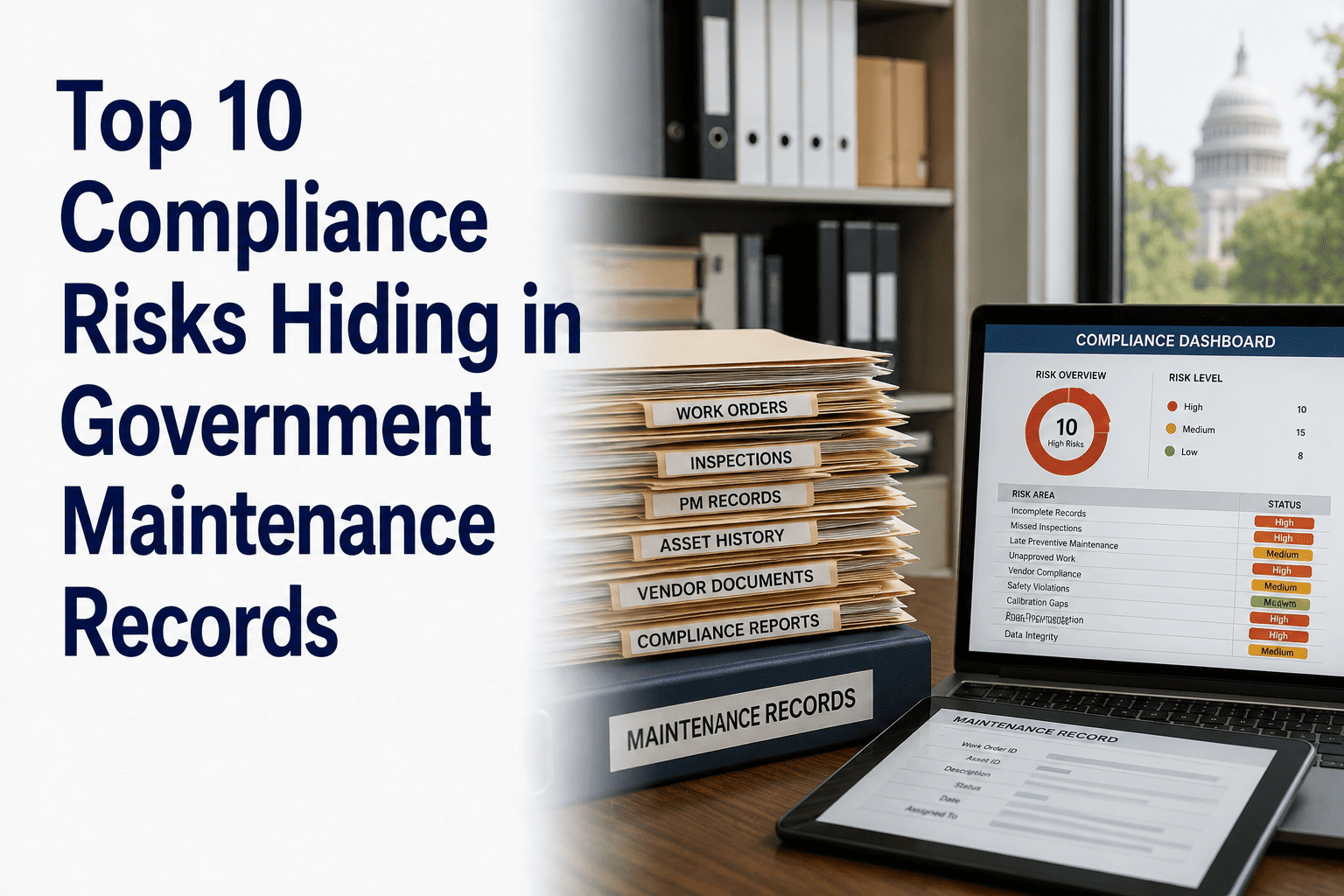
Top 10 Compliance Risks Hiding in Government Maintenance Records

By James Smith on May 16, 2026

top-10-compliance-risks-hiding-government-maintenance-records

Government maintenance records are audited more frequently than most facility managers expect — and the findings that trigger formal findings, corrective action plans, and budget freezes are rarely dramatic failures. They are paperwork gaps, expired certifications, and inspection intervals that slipped by 30 days. A state auditor or federal inspector general does not need to find a broken boiler to issue a compliance finding; an undocumented PM cycle is sufficient. This list identifies the ten compliance risks most commonly discovered in government facility audits — and explains exactly what record gap triggers each one. Start a free trial with Oxmaint CMMS to close these gaps before your next audit, or book a 30-minute session with our public sector compliance specialists.

Audit Risk Overview

Where Government Maintenance Audits Find Their Findings

68%
of government facility audit findings are documentation-related, not physical failures

4.2
Average maintenance-related findings per government facility audit cycle

$34K
Average cost of a single corrective action plan for a maintenance compliance finding
The Top 10 List

Top 10 Compliance Risks in Government Maintenance Records

01
Missing Preventive Maintenance Completion Records
Critical Risk
What auditors look for: Signed, dated PM completion records for every scheduled task on every asset in the facility inventory. A PM work order that was performed but not documented is treated identically to a PM that was never performed.
Audit trigger: Any gap in PM completion records for life safety, HVAC, elevators, fire suppression, or critical infrastructure assets.
CMMS fix: Auto-generated work orders with required technician sign-off fields that cannot be closed without documentation. Oxmaint enforces mandatory completion fields on every PM closure.
02
Expired Equipment Certifications and Inspection Tags
Critical Risk
What auditors look for: Current, unexpired certification tags on elevators, pressure vessels, fire suppression systems, emergency generators, and backflow preventers. Expiration within the audit window — even by one day — constitutes a finding.
Audit trigger: Physical tag inspection combined with cross-reference against the asset register. Discrepancies between tag date and CMMS record are flagged as double findings.
CMMS fix: Certification expiry tracking with 60-day and 30-day advance alerts. Track every certification date in Oxmaint with automatic renewal alerts.
03
Incomplete or Unsigned Inspection Logs
High Risk
What auditors look for: Inspector name, credential, date, findings, and corrective action on every log entry. Logs completed in pencil, unsigned, or missing corrective action notes for identified deficiencies are all finding triggers.
Audit trigger: Routine document review — most government audits begin with a request for 24 months of inspection logs for all regulated systems.
CMMS fix: Digital inspection forms with required signature capture, credentialed technician assignment, and mandatory corrective action fields for any non-pass result.
04
Corrective Work Orders Without Documented Closure
High Risk
What auditors look for: Open corrective work orders for deficiencies identified in prior inspections. An inspection that found a problem is not compliant unless the corrective action work order was completed and documented within the required remediation window.
Audit trigger: Cross-referencing open work orders against prior inspection findings. Any inspection finding without a matching closed corrective work order is a standalone finding.
CMMS fix: Automatic corrective work order generation from inspection findings with linked tracking and escalation for overdue closures. Book a session to configure inspection-to-corrective-action workflows.
05
Asset Register Gaps — Assets Not in the Inventory
High Risk
What auditors look for: A complete, current inventory of all maintainable assets — particularly regulated systems. Assets that exist physically but are absent from the official register are treated as unmanaged and untested, regardless of actual maintenance history.
Audit trigger: Physical walkthrough compared against the submitted asset register. Missing assets trigger an immediate question about what other maintenance obligations are being tracked informally or not at all.
CMMS fix: QR/barcode asset tagging with CMMS-linked records that require physical verification before an asset is considered active in the inventory.
06
PM Intervals That Exceed Regulatory or Manufacturer Requirements
High Risk
What auditors look for: PM schedules that comply with the most restrictive applicable requirement — regulatory code, manufacturer OEM specification, or agency policy. A PM performed at 13 months on a 12-month regulatory cycle is a finding even if the asset passed inspection.
Audit trigger: Comparison of scheduled PM intervals against the applicable code citation. Facilities that use calendar-year scheduling rather than from-last-completion triggers frequently drift beyond compliance intervals.
CMMS fix: Interval triggers set from last completion date, not calendar year, with code citation recorded against each PM task.
07
Contractor Work Without Verified Credentials on File
Moderate Risk
What auditors look for: For every contractor who performed regulated work — elevator inspection, fire suppression testing, electrical PM — a copy of their current license and insurance certificate on file at the time of service. Expired credentials at time of service invalidate the work for compliance purposes.
Audit trigger: Contractor credential verification during document review. This is a consistent audit step in state and federal facility audits that many agencies overlook entirely.
CMMS fix: Vendor management module with credential expiry tracking and mandatory credential upload before work order assignment.
08
Emergency Response and Contingency Plan — Outdated or Untested
Moderate Risk
What auditors look for: Emergency response plans updated within 12 months, with documented tabletop or functional exercise completion. Plans that reference outdated emergency contacts, superseded equipment, or personnel no longer at the agency are finding triggers regardless of plan age.
Audit trigger: Date of last plan revision combined with evidence of exercise or drill completion in the maintenance record.
CMMS fix: Annual PM work orders for emergency plan review and drill documentation, linked to the facility asset record for audit retrieval. Schedule emergency plan reviews as recurring CMMS tasks in Oxmaint.
09
Deferred Maintenance Without Formal Documentation of Deferral Decision
Moderate Risk
What auditors look for: When maintenance is intentionally deferred, there must be a documented decision — with rationale, risk assessment, approving authority, and planned remediation date — in the facility record. Undocumented deferred maintenance is treated as neglected maintenance in government audits.
Audit trigger: Any PM work order that was due but not completed within the required interval without a formal deferral record linked to it.
CMMS fix: Deferral workflow with required fields for justification, approving supervisor, and target completion date — creating an audit-defensible deferral record automatically.
10
No Digital Audit Trail — Records That Cannot Be Produced on Demand
Moderate Risk
What auditors look for: The ability to produce any requested maintenance record within the timeframe specified in the audit request — typically 24 to 72 hours. Paper-based systems that require physical file searches routinely fail to produce complete records in time, converting otherwise compliant maintenance histories into findings.
Audit trigger: Records not produced within the audit response window are treated as if they do not exist. This is the single risk that turns a good maintenance program into a failed audit.
CMMS fix: Cloud-based maintenance records with instant search by asset, date range, task type, and technician — producing a compliance report in under five minutes. Start your Oxmaint trial and run your first compliance report today.
Risk Summary

Risk Level Breakdown at a Glance

Risk Severity Most Common in Primary CMMS Fix
Missing PM completion recordsCriticalAll government facilitiesMandatory completion fields
Expired certificationsCriticalElevators, pressure vessels, fire suppressionExpiry tracking with advance alerts
Incomplete inspection logsHighFederal buildings, courthouses, DOTDigital forms with required signature
Unclosed corrective work ordersHighPublic housing, municipal buildingsAuto-linked corrective WO generation
Asset register gapsHighLarge portfolios, legacy inventoryQR tagging + physical verification
PM interval exceedanceHighRegulated systems, life safetyFrom-completion interval triggers
Unverified contractor credentialsModerateOutsourced maintenance programsVendor credential management module
Outdated emergency plansModerateFederal, tribal, DOT facilitiesAnnual plan review PM task
Undocumented deferralsModerateBudget-constrained agenciesDeferral workflow with approval chain
No digital audit trailModeratePaper-based or legacy systemsCloud CMMS with instant reporting
Expert Review

What Government Auditors and Facility Directors Say

"In twelve years of conducting government facility audits, I have never issued a finding for equipment that was maintained but poorly documented. Every single critical finding I have issued traced back to a record gap — missing signatures, expired tags, or a corrective action that was performed but never closed in the system. Documentation is compliance."
RH
Robert H., CFM, FMP
Former State Facilities Inspector, 12 years government audit experience
"We switched from spreadsheets to CMMS eighteen months before our IG audit. When the audit team arrived and asked for three years of PM records for our 47 HVAC units, our facilities manager pulled the complete report in four minutes. The auditors noted it in writing as a best practice. We had zero maintenance findings for the first time in eight years."
KW
Karen W., PE, CFMO
Chief Facilities Management Officer, Federal Agency (Mid-Atlantic Region)
Frequently Asked Questions

Government Compliance Risks: Common Questions

Most state and federal facility audits request 24 months of maintenance records as a standard scope, with the ability to extend to 36 months if initial review reveals gaps. Inspector General audits at the federal level may request up to five years of records for specific asset categories. Government agencies should maintain complete, searchable digital records for a minimum of five years — not just the most recent audit cycle — and CMMS should retain all records indefinitely with the ability to produce date-range reports on demand. Oxmaint retains complete maintenance histories with no record expiry.
A compliance finding is the auditor's documented conclusion that a specific requirement was not met. A corrective action requirement is the mandatory response the agency must provide — typically within 30 to 90 days — that documents what will be done to remediate the finding and prevent recurrence. Multiple findings can trigger a single corrective action plan, but each finding must be addressed individually with evidence of remediation. CMMS provides the structured documentation for both the finding evidence and the corrective action completion record. Book a session to review your corrective action tracking workflow.
Yes — and this is the single most important concept for government facility managers to understand. In regulated maintenance environments, an undocumented action is legally equivalent to an action that did not occur. An elevator that was inspected on schedule but whose inspection report was lost, unsigned, or filed in a location the auditor could not access within the document request window will generate a finding identical to an elevator that was never inspected. The maintenance practice and the documentation practice must both be correct. Start your free Oxmaint trial to ensure every action is documented at completion.
Deferred maintenance must be formally documented — not simply left as an open or overdue work order. The deferral record should include the original due date, the reason for deferral (budget constraint, staffing, parts availability), a risk assessment or condition assessment for the period of deferral, the name and title of the approving authority, and the planned remediation date. This formal deferral record, retained in CMMS, is the difference between a defensible audit response and an unmitigated finding. Many agencies also use CMMS-generated deferred maintenance reports as capital planning inputs for future budget requests. Book a session to configure deferral workflows in Oxmaint.
Close Every Gap Before the Auditors Find It

Oxmaint CMMS gives government facility teams automated PM scheduling, certification expiry alerts, digital inspection logs, and instant compliance reporting — so every record is complete, current, and retrievable in minutes.
Share This Story, Choose Your Platform!