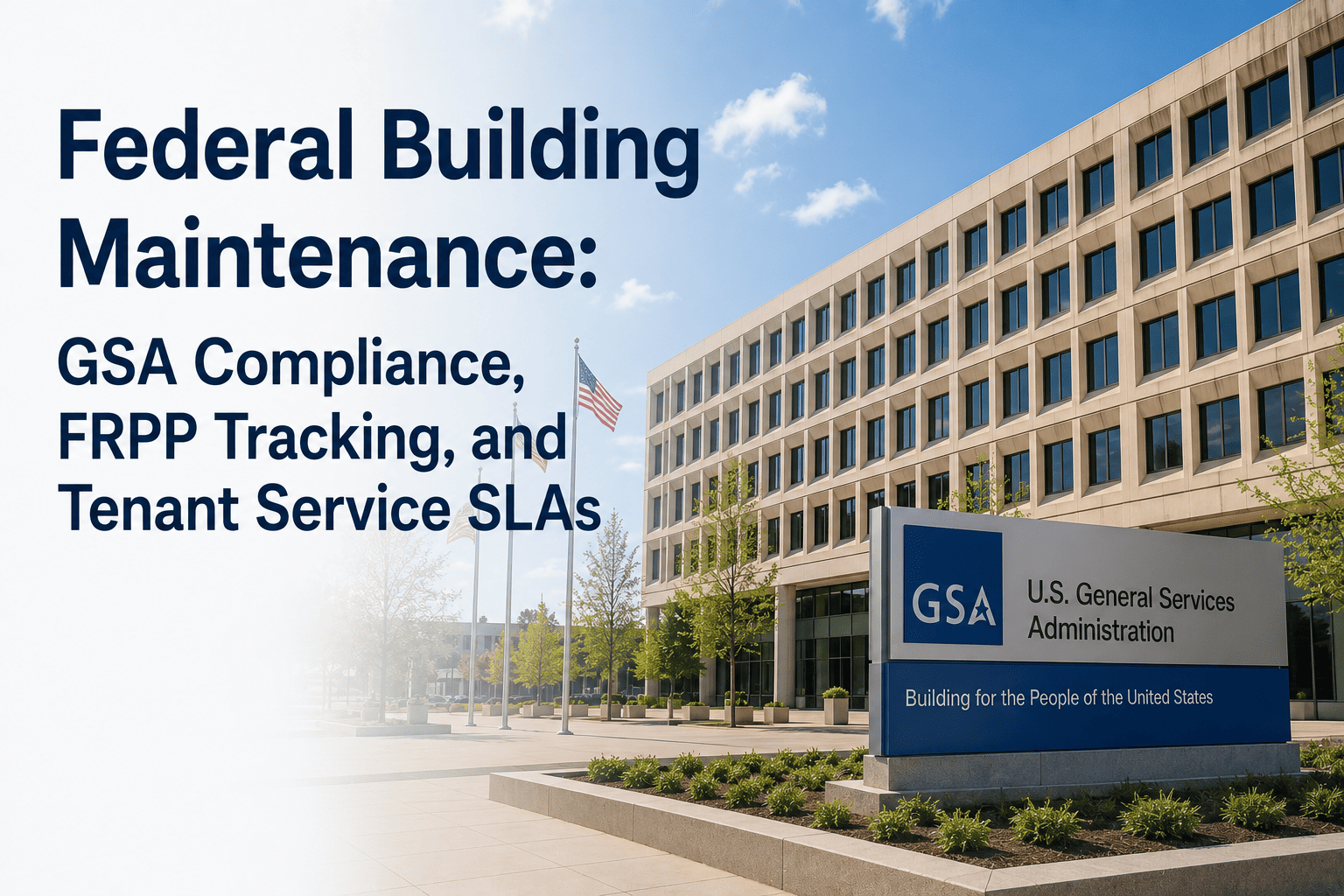
Federal Building Maintenance: GSA Compliance, FRPP Tracking, and Tenant Service SLAs

By James Smith on May 16, 2026

federal-building-maintenance-gsa-compliance-frpp-tenant-sla

Federal building maintenance operates within a regulatory and reporting framework that has no equivalent in the private sector. General Services Administration Public Buildings Service oversight, Federal Real Property Profile asset reporting, tenant agency service level agreements, and federal procurement requirements create a compliance environment where maintenance decisions are simultaneously financial management decisions, audit events, and policy obligations. A CMMS configured for federal use is not simply a work order system — it is the documentation backbone for GSA compliance, FRPP data integrity, and tenant satisfaction measurement. Start a free trial with Oxmaint CMMS to configure your federal building maintenance program, or book a 30-minute session with our federal facilities specialists.

Federal Portfolio Scale

The Federal Building Maintenance Challenge in Numbers

375K+
Buildings in the federal real property portfolio
$98B
Estimated deferred maintenance backlog across federal facilities
FRPP
Annual reporting obligation for all federal real property — data sourced from maintenance records
72 hrs
Typical tenant SLA for non-emergency maintenance response under GSA Occupancy Agreements
Three Core Obligations

GSA Compliance, FRPP Tracking, and Tenant SLAs: What Each Requires

GSA PBS Compliance
General Services Administration Public Buildings Service
Primary RequirementDocumented preventive and corrective maintenance for all federally owned and leased buildings under GSA PBS jurisdiction, aligned to GSA P-100 Facilities Standards.
Inspection ObligationAnnual building condition inspections with documented findings and corrective action plans; life safety systems inspected on code-mandated intervals.
CMMS Data RequiredPM completion records, inspection findings, corrective work order status, contractor credential verification, and cost-by-system reporting.
Audit FrequencyGSA Inspector General reviews; GAO facility oversight inquiries; Congressional facility condition reporting requests.
FRPP Asset Reporting
Federal Real Property Profile — Annual OMB Submission
Primary RequirementAnnual submission to OMB's Federal Real Property Profile of all real property assets — including condition index scores derived from maintenance and inspection records.
Condition IndexThe FRPP Facility Condition Index (FCI) is calculated as deferred maintenance cost divided by current replacement value — requiring accurate, complete maintenance cost records from CMMS.
CMMS Data RequiredAsset inventory with replacement values, deferred maintenance work order costs, completed maintenance costs by system category, and condition assessment results.
Reporting DeadlineAnnual submission; data must reflect the fiscal year end condition of all assets. Incomplete or inconsistent CMMS records directly compromise FCI accuracy.
Tenant Agency Service Level Agreements
GSA Occupancy Agreements and Inter-Agency SLA Performance
Emergency ResponseTypically 2–4 hours for life safety or building access failures under Occupancy Agreement terms
Urgent Maintenance24–48 hours for conditions affecting occupant health, comfort, or security
Routine Maintenance5–10 business days for non-critical building systems and common area maintenance
CMMS Tracking RequiredWork order receipt timestamp, assignment timestamp, and completion timestamp for every tenant request — automated SLA breach alerts
Reporting to TenantsMonthly or quarterly SLA performance reports by building and by tenant agency — drawn directly from CMMS work order data
Consequence of MissTenant agency complaints, GSA management attention, and potential OA amendment or credit adjustment
CMMS Configuration

How CMMS Should Be Configured for Federal Building Requirements

01
Asset Hierarchy Aligned to FRPP Categories
Structure the CMMS asset hierarchy to match FRPP asset type categories — buildings, structures, land parcels — with replacement value and square footage recorded at the asset level. This alignment allows CMMS condition data to flow directly into FCI calculations without manual reconciliation at annual reporting time.
02
Work Order Cost Coding by System Category
Federal FRPP reporting requires maintenance costs separated by building system — structural, mechanical, electrical, plumbing, and special systems. CMMS work orders must capture cost by system category at closure to support accurate FCI calculation and GSA cost reporting without manual allocation spreadsheets.
03
Tenant Work Request Portal with SLA Timestamps
Tenant agencies should submit maintenance requests through a CMMS portal that automatically timestamps receipt, creates a work order, assigns based on priority, and generates SLA countdown tracking. This eliminates the email-and-phone-call request process that makes SLA compliance measurement impossible without CMMS automation.
04
Federal Procurement Integration
CMMS procurement for federal buildings must route through approved acquisition channels — GSA Advantage, SAM.gov vendor lists, and agency contracting officer approval thresholds. CMMS purchase request workflows should enforce micro-purchase thresholds, simplified acquisition procedures, and mandatory SAM.gov exclusion checks before vendor assignment on any work order above the applicable threshold.
Configure Your Federal Building CMMS Program

Oxmaint CMMS is configured for federal building requirements — FRPP-aligned asset hierarchy, SLA-tracked tenant work orders, federal procurement workflows, and GSA-ready compliance reporting.

Expert Review

Federal Facility Managers on GSA Compliance and CMMS

"FRPP reporting used to take our team six weeks at fiscal year end. We were pulling cost data from spreadsheets, reconciling with finance, and manually calculating FCI for 23 buildings. After implementing CMMS with system-category cost coding, FRPP data export took three days. The accuracy was better and the auditors had no questions about our FCI methodology."
JB
James B., CFM, PMP
Federal Facilities Director, Cabinet-Level Agency (Washington, D.C.)
"Tenant SLA compliance is a political issue, not just an operational one. When a tenant agency's regional director calls GSA because their HVAC has been out for four days and the OA says 48 hours, you need documentation — and you need it immediately. CMMS with timestamp tracking turned our SLA dispute conversations into five-minute data reviews instead of week-long investigations."
SL
Sandra L., LEED AP, CFM
Regional Property Manager, GSA Public Buildings Service
Frequently Asked Questions

Federal Building Maintenance and CMMS: Common Questions

The Facility Condition Index (FCI) is calculated as the ratio of deferred maintenance and repair costs to the current replacement value of the asset. An FCI of 0.00–0.05 is considered good condition; 0.05–0.10 is fair; above 0.10 is poor. CMMS data directly affects FCI in two ways: it provides the numerator (accumulated deferred maintenance work order costs) and informs the denominator (replacement value assessments tied to asset records). Inaccurate or incomplete CMMS records cause FCI scores to be systematically understated, leading to insufficient capital planning allocations. Configure FRPP-aligned cost tracking in Oxmaint.
GSA Occupancy Agreements (OAs) define which maintenance responsibilities belong to GSA PBS (building systems, common areas, structural elements) and which belong to the tenant agency (tenant-installed equipment, interior modifications, mission-specific systems). CMMS must be configured to reflect this division — with work order types and asset ownership correctly attributed so that costs are allocated to the correct party and SLA tracking applies only to GSA-owned maintenance obligations. Misattributed work orders are a common source of OA billing disputes. Book a session to configure OA-aligned responsibility tracking in Oxmaint.
Federal Acquisition Regulation (FAR) thresholds that apply to maintenance procurement include the micro-purchase threshold (currently $10,000 for most agencies), the simplified acquisition threshold ($250,000), and the threshold requiring full and open competition for larger maintenance contracts. CMMS purchase request workflows should enforce these thresholds by routing requests above the micro-purchase level to a contracting officer approval queue, flagging SAM.gov exclusion verification requirements, and preventing vendor assignment on non-contract purchases above the simplified acquisition threshold. Configure FAR-compliant procurement workflows in Oxmaint.
FedRAMP authorization is required for cloud software that processes, stores, or transmits federal data under FISMA. Whether your CMMS requires FedRAMP authorization depends on the sensitivity of the data it contains — specifically whether it includes controlled unclassified information (CUI), personally identifiable information (PII), or data subject to agency-specific handling requirements. Many federal facility teams operate CMMS with non-CUI maintenance data under an agency-issued Authority to Operate (ATO) rather than full FedRAMP authorization. Your agency's Information System Security Officer (ISSO) determines the applicable authorization pathway. Book a session to discuss your agency's authorization requirements.
GSA-Ready. FRPP-Aligned. Tenant SLA-Tracked.

Oxmaint CMMS gives federal facility managers the documentation, cost tracking, and reporting infrastructure to satisfy GSA oversight, FRPP annual reporting, and tenant agency SLA obligations — all in one system.
Share This Story, Choose Your Platform!